
Chess Tactics: Complete Beginner’s Guide to Tactical Patterns
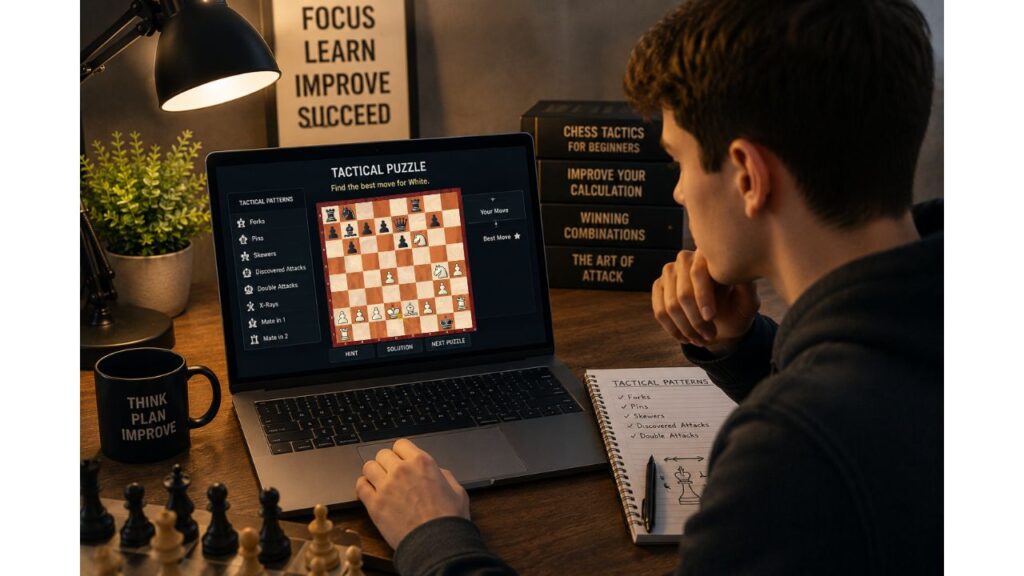
Chess tactics are the concrete moves and combinations that allow you to win material, create decisive threats, or finish a game with checkmate.
For beginners, learning tactics is not about memorising dozens of names. It is about learning to see opportunities, recognise patterns, calculate your opponent’s response, and check that your idea actually works.
A simple fork can win a piece. A pin can restrict an important defender. A discovered attack can create two threats at once. A well-calculated combination can turn an ordinary position into a winning one.
This guide explains the most important chess tactics from the ground up. You will learn what tactics are, why they work, the tactical patterns every beginner should know, how to calculate combinations, common mistakes to avoid, and how to build a practical training routine.
Quick Summary
The most important ideas to remember are:
- Chess tactics are concrete. They depend on the exact position and specific moves.
- Most tactical opportunities involve checks, captures, threats, loose pieces, exposed kings or overloaded defenders.
- Beginners should first learn forks, pins, skewers, double attacks and discovered attacks.
- More advanced tactical ideas include deflection, removing the defender and zwischenzug.
- Tactical vision helps you recognise an opportunity.
- Calculation helps you determine whether the opportunity actually works.
- Always consider your opponent’s strongest response before committing to a combination.
- Tactical puzzles are useful, but analysing your own games is essential for transferring tactical knowledge into practical play.
- The goal is not simply to solve tactics quickly. The goal is to understand why they work and recognise similar ideas in real games.
What Are Chess Tactics?
Chess tactics are short, concrete sequences of moves that achieve an immediate or relatively immediate objective.
That objective might be:
- winning a piece
- winning material
- giving checkmate
- creating a decisive attack
- forcing an opponent’s piece onto a bad square
- removing an important defender
- preventing an opponent’s tactical threat
Tactics are different from long-term strategic planning because they depend heavily on the exact position.
For example, a strategic idea might be to improve a poorly placed knight.
A tactical idea might be:
“If I move my knight here, I attack the queen and rook at the same time.”
The first idea may take many moves to develop.
The second depends on a specific opportunity that exists right now.
Why tactical positions are concrete
A tactical combination can disappear after one small change.
If a defending piece moves, the tactic may stop working.
If the king finds an escape square, a mating combination may disappear.
If an additional defender arrives, a material-winning capture may no longer be possible.
This is why tactics require calculation rather than simply recognising a familiar-looking pattern.
Why Are Chess Tactics Important?
Tactical skill is one of the foundations of practical chess improvement.
Tactics help you avoid blunders
A large number of beginner losses come from overlooking simple threats.
A player may spend time planning an attack while failing to notice that their own queen is attacked.
Tactical training develops the habit of checking what changed after every move.
Tactics help you win material
A tactical opportunity may allow you to win a pawn, minor piece, rook or queen.
Sometimes the material gain is the result of one move.
More often, it comes from a short combination in which the first move creates the conditions for the second.
Tactics improve calculation
Tactical positions force you to calculate:
Your move → Opponent’s response → Your continuation → Result
This is one of the clearest ways to develop practical calculation.
Tactics improve pattern recognition
The first time you encounter a fork, you may need to calculate carefully.
After seeing many fork positions, you begin to recognise the pattern much faster.
That developing ability is called tactical vision.
Tactics make strategic play more effective
Strategy and tactics are not competing skills.
A good strategic position can create tactical opportunities.
For example, developing your pieces and controlling important squares may eventually create a tactical attack against the opponent’s king.
Strategy helps create favourable conditions.
Tactics exploit concrete opportunities within those conditions.
For broader positional understanding, see our Chess Strategy guide.
Strategy vs Tactics in Chess
The easiest way to distinguish the two is to think about the questions they answer.
Strategy asks:
“What should I try to achieve?”
Tactics ask:
“What can I do right now?”
| Strategy | Tactics |
|---|---|
| Long-term planning | Concrete calculation |
| Piece improvement | Forcing moves |
| Pawn structure | Tactical opportunities |
| King safety | Checks and mating threats |
| Central control | Captures and attacks |
| Positional evaluation | Specific variations |
Strong chess requires both.
A player who understands strategy but regularly hangs pieces will struggle to convert good positions.
A player who finds tactics but ignores development, king safety and piece activity may create opportunities for the opponent instead.
The practical goal is to combine strategic understanding with tactical awareness.
The Most Important Chess Tactical Patterns
The following patterns form the foundation of tactical understanding.
You do not need to master all of them immediately. Learn the basic ideas first, then practise recognising them in different positions.
Forks in Chess
A fork occurs when one piece attacks two or more targets at the same time.
Knights are particularly famous for forks because their movement allows them to attack pieces that cannot easily escape together.
A typical knight fork might attack:
- the king and queen
- the king and rook
- two major pieces
- two minor pieces
The opponent may have to respond to one threat while the other remains.
What to look for
When considering a knight move, ask:
“Which pieces will my knight attack from this square?”
Also look for fork opportunities created by:
- checks
- pawn moves
- discovered attacks
- tactical sacrifices
The key principle is simple:
One move creates multiple targets.
Learn more in our Forks in Chess guide.
Pins in Chess
A pin occurs when a piece cannot move safely because moving it would expose a more valuable piece behind it.
An absolute pin involves the king.
For example, if a bishop attacks a knight and the king stands directly behind that knight, the knight cannot legally move if doing so exposes the king to check.
A relative pin involves another valuable piece, such as the queen.
The pinned piece can legally move, but doing so may lose material.
Why pins are useful
A pin can:
- restrict a piece
- make a defender unreliable
- create a tactical target
- support another attack
- prevent a piece from moving to an important square
Do not stop after noticing the pin.
Ask:
“What can I do because this piece is restricted?”
Read our detailed guide to Pins in Chess.
Skewers in Chess
A skewer is similar to a pin, but the more valuable piece is attacked first.
The valuable piece is forced to move, exposing a less valuable piece behind it.
For example:
Rook gives check → king moves → rook captures the queen behind it.
The important distinction is:
- Pin: the less valuable piece is in front.
- Skewer: the more valuable piece is in front.
Whenever two enemy pieces are aligned, check whether a pin or skewer is possible.
Double Attacks
A double attack occurs when one move creates two threats.
A fork is one type of double attack, but the broader idea includes many other possibilities.
A move might:
- attack the queen and rook
- give check while attacking another piece
- create a mating threat while attacking material
- threaten promotion while attacking a piece
The important question is:
“Can one move create two important problems for my opponent?”
This is one of the most useful questions to develop tactical awareness.
Discovered Attacks
A discovered attack occurs when one piece moves away and reveals an attack from another piece behind it.
For example, your rook may be attacking along a file, but one of your own pieces is blocking the line.
When that piece moves, the rook’s attack becomes active.
The moving piece may then create another threat.
This makes discovered attacks especially dangerous because your opponent may have to deal with more than one consequence at the same time.
Whenever your pieces are aligned, ask:
“What attack is hidden behind this piece?”
Discovered Check
A discovered check is a discovered attack against the king.
The moving piece uncovers an attack from another piece, giving check.
Because the opponent must respond to the check, the moving piece may simultaneously create another tactical threat.
Discovered checks are therefore highly forcing and often form part of larger combinations.
Deflection
Deflection means forcing a defending piece away from the square, file, rank or responsibility it is protecting.
Suppose a rook is defending a queen.
If you can force the rook away, the queen may become vulnerable.
The important tactical question is:
“What is defending the target?”
Instead of attacking the final target immediately, you may first attack or distract its defender.
Removing the Defender
Sometimes a tactical target is well protected by one important piece.
If you can capture that defender first, the original target may become vulnerable.
The sequence might be:
Remove defender → target becomes weak → exploit the weakness.
This idea appears frequently in combinations involving:
- checkmate
- winning material
- weak back ranks
- overloaded pieces
- attacks on pinned pieces
Zwischenzug
A Zwischenzug, or in-between move, is a forcing move played before an expected exchange or recapture.
For example, you might expect to recapture an opponent’s piece immediately.
Before doing so, you notice that you can give check.
You play the check first.
After the king responds, you complete the original exchange.
The practical lesson is:
Do not automatically play the obvious recapture. Look for a stronger forcing move first.
Why Do Chess Tactics Work?
Tactical combinations usually work because something concrete in the position can be exploited.
Loose or undefended pieces
A piece that is not adequately protected can become a tactical target.
Before every move, check which pieces are defended and which are vulnerable.
Exposed kings
An exposed king can be vulnerable to:
- checks
- mating attacks
- discovered attacks
- sacrifices
- removal of defenders
The fewer safe squares the king has, the more carefully you should examine forcing moves.
Overloaded defenders
An overloaded piece is responsible for too many defensive tasks.
For example, one rook may be protecting both a back-rank weakness and another valuable piece.
If you can force the rook to abandon one responsibility, the other target may fall.
Alignment
Pieces lined up on the same:
- file
- rank
- diagonal
can create opportunities for pins, skewers and discovered attacks.
Restricted pieces
A piece with very few safe squares may become a tactical target.
Restricted mobility is particularly important when combined with another tactical pattern.
How to Find Tactical Opportunities
You do not need to search the entire board randomly.
Use a consistent tactical scan.
Step 1: Check your opponent’s threat
Before searching for your own combination, ask:
“What changed after my opponent’s last move?”
Then ask:
“What are they threatening?”
This prevents you from launching an attack while ignoring an immediate danger.
Step 2: Look for loose pieces
Check:
- your king
- your queen
- your rooks
- your minor pieces
- your pawns
Then examine the opponent’s pieces.
Step 3: Look for forcing moves
Search for:
- Checks
- Captures
- Threats
Checks deserve particular attention because the opponent must respond to them.
Step 4: Look for tactical patterns
Ask whether the position contains:
- a fork
- a pin
- a skewer
- a double attack
- a discovered attack
- a deflection
- an overloaded defender
Step 5: Calculate before playing
Finding a candidate move is only the beginning.
Now ask:
“What is my opponent’s strongest response?”
Then continue the calculation until you know whether your idea works.
Tactical Calculation: How to Know If a Tactic Works
A common beginner mistake is stopping calculation after finding the attractive move.
Suppose you notice:
“I can win the queen.”
That is not yet a conclusion.
You must check:
- Can the opponent move the queen?
- Can they capture your attacking piece?
- Can they give check?
- Is there a stronger counterattack?
- Is your king exposed?
- Does the tactical sequence actually win material?
Use forcing moves first
When calculating, begin with the most forcing possibilities.
Look at:
- checks
- captures
- direct threats
Then identify the opponent’s strongest reply.
Calculate the position, not your wish
Do not calculate:
“I play this and they probably do that.”
Calculate:
“I play this. What is the strongest response available to them?”
This is one of the biggest differences between guessing and genuine calculation.
Stop when the result is clear
You do not always need to calculate ten moves ahead.
If your sequence wins a piece safely and the position is stable, the tactical question may already be answered.
If the position remains complicated, calculate further.
Tactical Vision and Pattern Recognition
Tactical vision is your ability to recognise tactical possibilities in a position.
It develops through repeated exposure to patterns.
At first, a fork may look like an ordinary knight move.
Later, you may immediately notice:
“That square attacks the queen and rook.”
That recognition saves calculation time.
But tactical vision should not replace calculation.
It should identify which positions deserve calculation.
A useful way to think about the relationship is:
Pattern recognition → Candidate move → Calculation → Verification
This is why tactical puzzles are useful, but also why puzzle practice alone is not enough.
Common Chess Tactics Mistakes Beginners Make
Playing a tactic because it looks good
A move can look tactical and still fail.
Better habit: Always calculate the strongest defensive response.
Ignoring the opponent’s threat
You may find an attractive attack while your opponent has a stronger immediate threat.
Better habit: Ask what changed after their last move.
Assuming every check is strong
A check is forcing, but it is not automatically good.
The king may move to a better square, capture your attacking piece or escape the attack.
Better habit: Calculate the consequences of every check.
Forgetting defenders
Seeing that a piece can be captured is not enough.
You must know what happens after the capture.
Better habit: Count attackers and defenders.
Moving too quickly
Tactics require accuracy.
A few extra seconds of calculation can prevent a major blunder.
Memorising names without understanding patterns
Knowing the definition of a fork does not guarantee that you will recognise one in a game.
The goal is to understand the relationship between:
- the attacking piece
- the targets
- the available squares
- the opponent’s response
Only practising puzzles
Puzzles isolate tactics.
Real games require you to recognise when a tactical opportunity exists.
Better habit: Combine puzzle training with game analysis.
How to Improve Your Chess Tactics
A strong tactical training system has three parts:
Pattern Recognition → Calculation → Game Application
Study tactical patterns
Start with the fundamental patterns:
- Forks
- Pins
- Skewers
- Double attacks
- Discovered attacks
Then add:
- Deflection
- Removing the defender
- Overloaded pieces
- Zwischenzug
- Mating patterns
Do not rush through them.
Learn what creates each pattern and how opponents can defend against it.
Solve tactical puzzles carefully
When solving a puzzle:
- Study the position.
- Identify the tactical features.
- Find candidate forcing moves.
- Calculate the opponent’s response.
- Verify the final position.
- Only then make your move.
Accuracy is more valuable than guessing quickly.
Analyse your own games
Your games reveal which tactical patterns you actually miss.
Look for:
- pieces you left hanging
- missed checks
- missed captures
- missed forks
- missed pins
- missed defensive resources
- combinations that failed because of one overlooked response
This turns your mistakes into personalised training material.
Repeat missed positions
If you missed a tactical opportunity, return to the position later.
Try to solve it again without looking at the answer.
The aim is to transform:
“I missed this.”
into:
“I recognise this pattern now.”
A Simple Chess Tactics Training Routine
A short, consistent routine is usually more useful than solving puzzles without reflection.
20-minute routine
5 minutes — Pattern review
Choose one tactical theme and review several examples.
10 minutes — Tactical puzzles
Solve carefully without guessing.
For difficult positions, calculate before moving.
5 minutes — Error review
For every missed puzzle, identify why you missed it.
Was the problem:
- recognising the pattern?
- calculating the variation?
- seeing the opponent’s defence?
- overlooking a loose piece?
Over time, this gives you a clearer picture of what your tactical training actually needs.
Applying Tactics in Real Games
The purpose of tactical training is not to become good at solving diagrams.
It is to make better decisions during games.
Before an important move, ask:
What changed?
What did your opponent’s last move attack, defend or uncover?
What is loose?
Look for undefended or poorly defended pieces.
What are the forcing moves?
Check:
- checks
- captures
- threats
Are there tactical patterns?
Look for:
- forks
- pins
- skewers
- double attacks
- discovered attacks
- overloaded defenders
What is their best response?
Before playing your move, calculate the strongest defence you can find.
This routine becomes increasingly automatic with practice.
Chess Tactics and Overall Chess Improvement
Tactics are essential, but they are not the entire game.
A complete chess education also requires understanding:
- chess fundamentals
- opening principles
- strategy
- calculation
- positional thinking
- endgames
- game analysis
- deliberate practice
Your tactical skill becomes more useful as your overall chess understanding improves.
For a complete foundation, start with the Beginner Chess Guide.
To understand the wider decision-making process, explore Chess Thinking.
For long-term training and improvement, see Improve at Chess.
Guidance for Parents: How to Support Tactical Improvement
Parents often wonder whether a child should focus on solving as many tactical puzzles as possible.
Quantity is not the only measure of progress.
A child is developing useful tactical skill when they gradually become better at:
- noticing when pieces are attacked
- identifying simple threats
- explaining why a tactic works
- calculating the opponent’s response
- spotting recurring patterns
- learning from missed opportunities
- applying tactical ideas during games
Speed can come later.
For beginners, understanding is more important than racing through puzzles.
A useful question after a missed tactic is not:
“Why didn’t you see it?”
Instead ask:
“What did we need to notice in this position?”
That encourages the child to develop a repeatable thinking process rather than fear mistakes.
The goal is to help the player become increasingly independent in recognising and solving tactical problems.
A Practical Tactical Checklist
Before an important move, run through this short checklist:
Opponent
- What is my opponent threatening?
- What changed after their last move?
Pieces
- Is anything undefended?
- Is my king safe?
- Is their king exposed?
Forcing moves
- Do I have a check?
- Do I have a useful capture?
- Do I have a strong threat?
Patterns
- Is there a fork?
- Is there a pin?
- Is there a skewer?
- Is there a double attack?
- Is there a discovered attack?
- Can I remove or deflect a defender?
Calculation
- What is my best candidate move?
- What is my opponent’s strongest response?
- Does the tactic still work after that response?
Final check
- Did I leave my queen hanging?
- Can my opponent check my king?
- Can they capture my attacking piece?
- Did I overlook a counterattack?
If you build this habit into your games, tactical awareness gradually becomes part of your normal thinking process.
Key Takeaways
Chess tactics are about finding and calculating concrete opportunities.
The essential foundation is:
See the position → Find the tactical pattern → Calculate the response → Verify the result
Remember the core tactical patterns:
- Fork
- Pin
- Skewer
- Double attack
- Discovered attack
- Discovered check
- Deflection
- Removing the defender
- Zwischenzug
Do not measure tactical improvement only by puzzle speed.
The deeper goal is to recognise tactical possibilities in real positions, calculate accurately, avoid blunders and make better decisions under practical game conditions.
The strongest tactical players are not simply looking for tricks.
They are constantly asking:
What changed? What is loose? What is forcing? What is my opponent’s best response?
That is the foundation of practical tactical thinking.
Frequently Asked Questions About Chess Tactics
What are chess tactics?
Chess tactics are concrete moves or combinations that create an immediate or short-term advantage. They can win material, create decisive threats or lead to checkmate.
What are the most important chess tactics for beginners?
Beginners should start with forks, pins, skewers, double attacks and discovered attacks. Once these patterns are familiar, they can progress to deflection, removing the defender, overloaded pieces and zwischenzug.
What is a fork in chess?
A fork occurs when one piece attacks two or more targets simultaneously. Knights are especially well known for forks, but other pieces can also create them.
What is a pin in chess?
A pin occurs when a piece cannot safely move because doing so would expose a more valuable piece or the king behind it.
What is the difference between a pin and a skewer?
In a pin, the less valuable piece is generally in front of the more valuable target. In a skewer, the more valuable piece is attacked first and is forced to move, exposing the less valuable piece behind it.
How can I improve my chess tactics?
Study tactical patterns, solve puzzles carefully, analyse your own games and review the tactical mistakes you make. Focus on understanding why each tactic works rather than simply finding the correct move.
Why do I solve chess puzzles but miss tactics in games?
Puzzle positions tell you that a tactic exists. In a real game, you must first recognise that a tactical opportunity is present. Game analysis and pattern-based training help transfer puzzle knowledge into practical play.
Should I focus on speed when solving chess tactics?
Not at first. Accuracy and understanding are more important for beginners. Once you can recognise and calculate tactical patterns reliably, speed can develop naturally.
What should I look for when searching for tactics?
Start by checking your opponent’s threats and then look for loose pieces, exposed kings, checks, captures, threats, alignments and overloaded defenders.
How far should I calculate a chess tactic?
Calculate far enough to determine whether your idea works. Start with forcing moves and your opponent’s strongest response. Simple tactics may require only a few moves of calculation, while complicated combinations require more.
Are chess tactics more important than chess strategy?
Neither replaces the other. Tactics deal with concrete opportunities, while strategy deals with longer-term plans and positional decisions. Strong players use both together.
How often should I practise chess tactics?
Regular practice is more useful than occasional large sessions. A short, focused training routine combined with game analysis can produce steady improvement.
Continue Your Chess Improvement
Tactical knowledge becomes valuable when you can apply it consistently in your own games.
If you are still building your foundation, continue with the Beginner Chess Guide.
If you want to understand the thinking process behind stronger moves, explore Chess Thinking.
For broader improvement, training and practice guidance, visit Improve at Chess.
You can also continue deeper into the tactical cluster with Forks in Chess and Pins in Chess.
Related Pages
- Beginner Chess Guide
- Chess Strategy
- Chess Thinking
- Improve at Chess
- Learn Chess Online
- Forks in Chess
- Pins in Chess