
Improve at Chess: Complete Beginner Improvement Guide
If you want to improve at chess, simply playing more games is rarely enough.
Improvement becomes much easier when you know what to practise, how to think during games, how to learn from mistakes, and how to build a routine you can actually follow.
For beginners, the goal is not to memorise hundreds of opening moves or spend hours studying difficult positions. The goal is to build strong habits in the right order: understand the fundamentals, recognise simple tactical patterns, think carefully before moving, analyse your games, and practise consistently.
This guide explains how to improve at chess step by step. You will learn which skills matter most, how to structure your practice, what mistakes commonly slow beginners down, and how to build a sustainable chess improvement system.
If you are still learning the fundamentals of the game, begin with the Complete Beginner Chess Guide before using this page as your longer-term improvement roadmap.
Quick Summary
- Play thoughtfully, not randomly. Games give you practical experience, but games alone do not automatically correct weaknesses.
- Build fundamentals first. Piece movement, checkmate patterns, tactics, opening principles and basic endgames create the foundation for future improvement.
- Train tactics regularly. Puzzle practice develops pattern recognition and helps you notice threats and opportunities more quickly.
- Analyse your games. Reviewing mistakes turns playing experience into actual learning.
- Improve your thinking process. Before moving, look for checks, captures and threats, then ask what your opponent is trying to do.
- Use slower games for learning. Fast games can be enjoyable, but beginners need enough thinking time to practise good decisions.
- Follow a repeatable routine. A balanced combination of puzzles, games, analysis and study is more useful than random practice.
- Measure progress by habits as well as results. Fewer blunders, better decisions and stronger understanding are meaningful signs of improvement.
What Does It Mean to Improve at Chess?
Chess improvement means becoming better at making decisions in positions you have not seen before.
A beginner often thinks improvement means winning more games or increasing their rating. Those results can matter, but they are outcomes of a deeper process.
A stronger player gradually becomes better at:
- recognising threats
- spotting tactical opportunities
- choosing useful candidate moves
- calculating short variations
- evaluating positions
- developing pieces efficiently
- protecting the king
- creating and following plans
- converting advantages
- defending difficult positions
- learning from mistakes
This is why chess improvement should not be reduced to one activity.
Playing gives you experience.
Puzzles develop tactical awareness.
Study builds understanding.
Game analysis reveals weaknesses.
Consistent practice turns these skills into habits.
The Difference Between Playing Chess and Studying Chess
Playing and studying serve different purposes.
When you play a game, you must make decisions under practical conditions. You experience pressure, uncertainty and unfamiliar positions.
When you study, you can slow down and focus on one particular skill.
For example, a beginner might understand the idea of a fork while solving a puzzle but fail to notice the same pattern during a real game. Playing helps connect the knowledge to practical decision-making.
The strongest improvement routine therefore combines both.
Study → Practise → Play → Analyse → Adjust → Repeat
That cycle is much more useful than simply playing one game after another.
Why Many Beginners Stop Improving
A common reason beginners struggle is not a lack of effort. It is a lack of direction.
A player may spend several hours each week playing chess but still repeat the same mistakes because there is no process for identifying and correcting those mistakes.
Random Practice
Random practice often looks like this:
- play a few blitz games
- watch an opening video
- solve a few puzzles
- play another game
- memorise an interesting move
- switch to another topic
There is nothing inherently wrong with these activities. The problem is that they may not connect to one another.
A structured approach asks a better question:
What skill am I trying to improve, and what practice will help me develop it?
Playing Without Analysing
If you lose a game and immediately start another one, the experience can disappear without teaching you much.
Analysis helps you identify the moments that mattered.
You might discover that the problem was not the opening at all. Perhaps you missed a simple threat, moved too quickly, failed to compare candidate moves, or entered an endgame you did not understand.
That information gives your next practice session a purpose.
Spending Too Much Time on Openings
Openings are useful, but beginners often give them more attention than they deserve.
Memorising a sequence does not automatically teach you how to handle the position after the memorised moves end.
A stronger foundation is to understand opening principles such as:
- developing pieces
- controlling the centre
- getting the king safe
- avoiding unnecessary repeated moves
- connecting the pieces
- recognising when development should give way to a concrete decision
Study Chess Opening Principles before trying to memorise large opening repertoires.
The Most Important Chess Skills to Develop
Chess improvement is easier when you understand the major skill areas and how they fit together.
1. Tactical Awareness
Tactics are concrete sequences that create an immediate advantage.
Common tactical ideas include:
For beginners, tactical awareness is especially important because many games are decided by one overlooked threat.
A player may have a good strategic idea, but if they leave a piece hanging, the plan becomes irrelevant.
The first goal is therefore not to calculate extremely deeply. It is to notice what is happening on the board.
Practise with Basic Chess Tactics and focus on understanding why the combination works rather than simply finding the answer.
2. Calculation
Calculation means looking ahead before committing to a move.
Beginners often calculate only their own idea:
“If I move here, I attack the queen.”
A stronger thinking process continues:
“How can my opponent respond?”
Then:
“What happens after that?”
Good calculation is not about seeing twenty moves into the future. It is about calculating the relevant moves accurately.
Start with short variations and gradually improve your ability to visualise positions without moving the pieces.
3. Board Awareness
Before thinking about complicated plans, you need to know what is happening on the board.
Ask:
- Which pieces are attacked?
- Which pieces are undefended?
- Is either king exposed?
- What changed after the last move?
- Are there checks available?
- Are there captures available?
- Has a line opened or closed?
This simple awareness prevents many beginner blunders.
4. Positional Understanding
Once basic tactical awareness improves, you can begin understanding why some positions are easier to play than others.
Important positional ideas include:
- piece activity
- king safety
- pawn structure
- space
- open files
- weak squares
- coordination
- improving your worst-placed piece
You do not need to memorise positional rules as absolute laws.
Instead, learn to ask:
What does this position need?
Sometimes the answer is a tactical move.
Sometimes it is improving a piece.
Sometimes it is protecting the king.
Sometimes it is creating a plan around a pawn weakness.
5. Endgame Knowledge
Beginners often postpone endgame study because the opening and middlegame seem more exciting.
That can create a significant weakness.
Basic endgames teach fundamental chess ideas such as:
- king activity
- pawn promotion
- opposition
- piece coordination
- converting material advantages
- defending inferior positions
Endgame study also improves your general understanding of how pieces work together.
You do not need to learn every endgame immediately. Start with the essential positions and build gradually.
A Better Thinking Process for Beginners
One of the most useful improvements a beginner can make is learning to pause before moving.
A simple thinking process can prevent many unnecessary mistakes.
The Beginner Move-Checking System
Before playing a move, work through these questions:
Step 1 — What changed?
Look at your opponent’s last move.
Ask:
- What does the move attack?
- What does it defend?
- Did it create a threat?
- Did it open or close a line?
- Did it change the position of a piece?
Step 2 — Check for forcing moves
Look for:
- Checks
- Captures
- Threats
These moves deserve attention because they can change the position quickly.
Step 3 — Find candidate moves
Do not automatically play the first move that looks attractive.
Consider two or three reasonable possibilities.
Step 4 — Calculate the opponent’s reply
For each candidate, ask:
“What is my opponent’s strongest response?”
This is one of the most important habits a beginner can develop.
Step 5 — Perform a blunder check
Before releasing the move, ask:
- Is my king safe?
- Is any piece hanging?
- What can my opponent capture?
- Did I overlook a check?
- Did I leave a tactical weakness?
Then move.
Why This Process Matters
Many beginner losses happen because players see what they want to do but don’t check what the opponent can do.
The objective is not to think for an extremely long time on every move.
The objective is to develop a reliable habit of verification.
Practical Examples of Better Chess Thinking
Example 1: “I Can Capture That Pawn”
You notice an opponent’s pawn that appears free.
A beginner may immediately capture it.
A stronger player first asks:
- Why is the pawn undefended?
- What happens after I capture it?
- Does another piece attack my capturing piece?
- Does the capture expose my king?
- Is there a stronger move?
The lesson is simple:
Do not evaluate a capture only by what you win. Evaluate what happens next.
Example 2: “My Opponent Attacked My Queen”
A beginner may immediately move the queen.
But first ask whether the queen attack creates a more important opportunity.
Perhaps you can:
- capture an attacking piece
- give check
- create a more serious threat
- move the queen while improving its position
The lesson is:
Respond to the position, not just to the emotion created by the opponent’s move.
Example 3: “I Have a Good-Looking Move”
A move can look active without actually being good.
Before playing it, check:
- What is my opponent’s reply?
- Does the move solve a real problem?
- Does it improve my position?
- Does it create a weakness?
- Is there a stronger candidate?
The lesson is:
A move should be judged by the position that follows it, not by how attractive it looks.
The Best Daily Chess Improvement Routine
A useful routine does not need to be complicated.
For many beginners, a focused 30–60-minute session can provide a better learning structure than several hours of unfocused play.
The exact amount of time matters less than consistency and quality.
A 30-Minute Routine
| Activity | Approximate Time | Main Purpose |
|---|---|---|
| Tactical puzzles | 10 minutes | Pattern recognition |
| Concept study | 5 minutes | Understanding |
| Thoughtful game practice | 10 minutes | Application |
| Game review | 5 minutes | Learning from mistakes |
If you have more time, extend the game and analysis portions rather than simply adding more random activities.
A 60-Minute Routine
| Activity | Approximate Time | Main Purpose |
|---|---|---|
| Tactical training | 15 minutes | Tactical awareness |
| Chess concept study | 10 minutes | Strategic understanding |
| Practical game | 20 minutes | Applying ideas |
| Game analysis | 15 minutes | Identifying weaknesses |
The important principle is balance.
A training session should not become ninety minutes of puzzles if your main weakness is practical decision-making.
Likewise, playing several games without reviewing them may give you plenty of experience but little correction.
How to Practise Tactics Effectively
Puzzle solving is valuable, but the way you solve puzzles matters.
Do not treat puzzles as a race.
Instead:
- Look at the whole position.
- Identify checks, captures and threats.
- Look for tactical patterns.
- Calculate the opponent’s response.
- Try to finish the variation before moving.
- After solving, understand why the tactic worked.
If you get the answer wrong, do not simply reveal the solution and move on.
Ask:
What did I fail to notice?
Perhaps you missed:
- an undefended piece
- a back-rank weakness
- an intermediate move
- a defensive resource
- a mating threat
- the opponent’s forcing reply
That explanation is often more valuable than the correct move itself.
How to Analyse Your Chess Games
Game analysis is where playing becomes learning.
You do not need to analyse every move equally.
Start by finding the important moments.
Step 1 — Review the Game Yourself
Before using an engine or looking at outside analysis, replay the game and ask:
- Where did I feel uncertain?
- Which move changed the position?
- Where did I make a mistake?
- What was I trying to achieve?
- What did I miss?
Your own thinking process is important information.
Step 2 — Identify the First Important Mistake
Do not focus only on the final blunder.
A game may be lost because of a mistake much earlier.
For example:
- a piece became badly placed
- development was neglected
- a tactical warning was ignored
- a pawn weakness was created
- a promising position was played too quickly
Finding the first important mistake gives you a more useful lesson.
Step 3 — Identify the Pattern
Ask what type of mistake it was.
Was it:
- a tactical oversight?
- a calculation error?
- a thinking-process problem?
- an opening misunderstanding?
- a positional mistake?
- poor time management?
- an endgame misunderstanding?
Patterns matter more than isolated mistakes.
If the same type of error appears repeatedly, you have found a training priority.
Step 4 — Create One Action for Your Next Game
Turn the analysis into a practical instruction.
For example:
“Before every move, check my opponent’s forcing moves.”
Or:
“Before capturing a pawn, check whether my piece can be trapped.”
Or:
“After development, look for a plan instead of making another opening move automatically.”
This converts analysis into improvement.
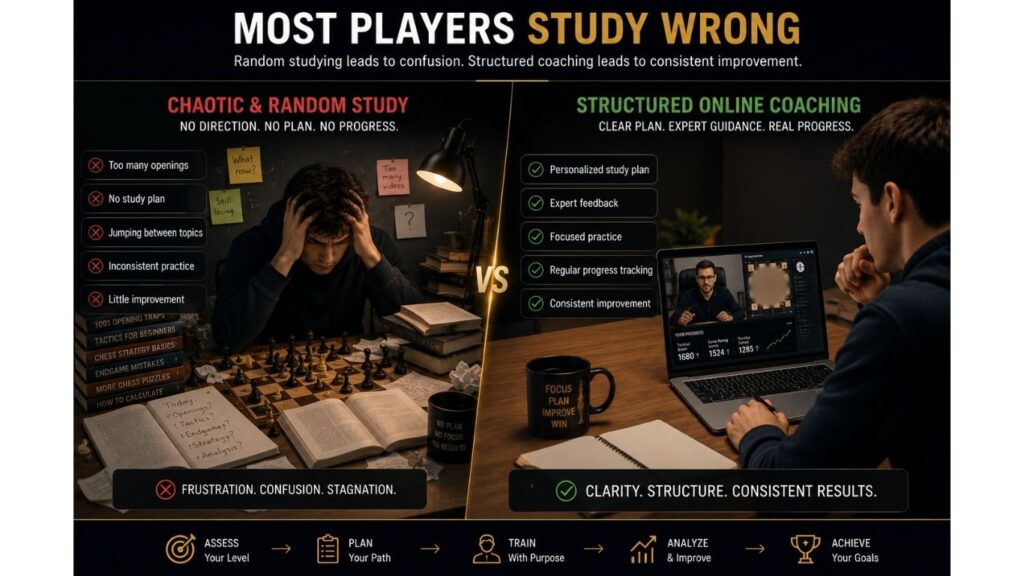
Structured Learning Beats Random Learning
A beginner does not need to study every chess topic simultaneously.
A sensible progression is:
Foundation → Tactics → Thinking Process → Practical Play → Strategy → Endgames → Deeper Calculation
The exact order can vary with the learner, but the principle is consistent:
Understand the fundamentals before adding unnecessary complexity.
Start With the Fundamentals
Make sure you are comfortable with:
- piece movement
- check and checkmate
- castling
- basic tactical patterns
- opening principles
- simple endgames
- basic chess notation if required for study
If these areas are still uncertain, strengthening them will usually produce more benefit than studying advanced opening theory.
Then Build Tactical Awareness
Learn to recognise recurring patterns.
The goal is not to memorise puzzle answers.
The goal is to recognise tactical possibilities in unfamiliar positions.
Then Improve Your Thinking Process
Learn to:
- identify threats
- generate candidate moves
- calculate responses
- compare choices
- verify your move before playing it
This is where knowledge starts becoming practical skill.
Then Add Strategy
Once you can avoid basic tactical errors more consistently, positional concepts become easier to understand.
Study ideas such as:
- improving poorly placed pieces
- identifying weaknesses
- creating useful pawn breaks
- controlling important squares
- understanding open files
- planning around king’s safety
Continue With Endgames
As your games become more competitive, endgame knowledge becomes increasingly useful.
Study essential positions first and practise converting them rather than trying to memorise every possible ending.
Common Mistakes That Slow Chess Improvement
Playing Too Much Blitz
Blitz is enjoyable and can be useful for practical experience, but it gives beginners less time to practise careful calculation.
If every decision is made quickly, you may reinforce the very habits you are trying to correct.
Use slower games when your goal is improvement.
Memorising Without Understanding
Opening memory can create the appearance of knowledge without producing understanding.
When studying an opening, ask:
- Why is this move played?
- What is the plan?
- Where should the pieces go?
- What pawn structure is likely to arise?
- What should I do if my opponent deviates?
Understanding survives when memory fails.
Starting Another Game Immediately
If you never review your games, you lose one of your best sources of feedback.
A single analysed game can reveal more about your current weaknesses than several unreviewed games.
Chasing Rating Every Day
Rating is useful feedback, but it can become distracting if every game feels like a test.
A better question is:
Am I making better decisions than I was making before?
Look for improvements such as:
- fewer one-move blunders
- better tactical awareness
- more consistent development
- stronger calculation
- better time use
- more useful analysis
Rating improvement often follows stronger habits.
Trying to Learn Everything at Once
Chess contains an enormous amount of knowledge.
You do not need all of it immediately.
Choose one or two priorities and work on them consistently.
Depth before breadth is often more useful for beginners.
Structured Practice vs Random Practice
| Structured Practice | Random Practice |
|---|---|
| Has a clear objective | Changes topic frequently |
| Uses games as learning material | Plays mainly for volume |
| Reviews mistakes | Moves on immediately |
| Builds skills progressively | Studies whatever looks interesting |
| Tracks recurring weaknesses | Treats every mistake as isolated |
| Adjusts training based on evidence | Repeats the same routine regardless of results |
The point is not that random activities are always bad.
The problem is that random activities do not automatically form a training system.
A structured routine gives each activity a purpose.
How to Build Your Personal Chess Improvement System
A simple improvement system can be built in five steps.
Step 1 — Identify Your Main Weakness
Look at your recent games.
Ask:
“What type of mistake appears most often?”
Do not choose a weakness because it sounds advanced.
Choose the one that is actually affecting your games.
Step 2 — Choose One Training Priority
Examples:
- tactical awareness
- calculation
- blunder prevention
- opening principles
- game analysis
- endgame fundamentals
Focus creates better feedback.
Step 3 — Choose a Practice Method
Match the weakness to the practice.
| Weakness | Useful Practice |
|---|---|
| Missing tactics | Tactical puzzles |
| Moving too quickly | Deliberate move-checking routine |
| Poor calculation | Short calculation exercises |
| Repeating mistakes | Game analysis |
| Opening confusion | Opening principles and model games |
| Weak endgames | Fundamental endgame positions |
| No clear plan | Positional study and annotated games |
Step 4 — Apply the Skill in Games
Training should eventually appear on the board.
If you are working on blunder prevention, practise the move-checking process during every serious game.
If you are working on tactics, actively look for tactical opportunities in your games.
Step 5 — Review and Adjust
After several games, ask:
- Did the weakness improve?
- Is the same mistake still appearing?
- Did another weakness become more important?
- Should the training priority change?
This creates a continuous learning cycle.
A Simple Chess Improvement Roadmap
Use this roadmap as a general guide rather than a rigid timetable.
Stage 1 — Foundation
Learn:
- rules
- piece movement
- check and checkmate
- basic opening principles
- simple tactical ideas
- fundamental endgames
Goal: Play complete games with a clear understanding of the basic rules and objectives.
Stage 2 — Awareness
Develop:
- threat recognition
- tactical pattern recognition
- piece safety
- basic calculation
Goal: Reduce simple blunders and recognise opportunities more consistently.
Stage 3 — Thinking
Develop:
- candidate moves
- calculation
- opponent awareness
- move verification
Goal: Make decisions deliberately rather than automatically.
Stage 4 — Understanding
Study:
- piece activity
- pawn structure
- king safety
- planning
- positional weaknesses
Goal: Understand why some moves improve a position even when there is no immediate tactic.
Stage 5 — Practical Improvement
Combine:
- regular games
- tactical training
- game analysis
- strategic study
- endgame practice
Goal: Turn knowledge into reliable practical habits.
Stage 6 — Independent Learning
Eventually, you should become increasingly capable of identifying your own weaknesses.
The long-term goal is not to depend on a training plan forever.
It is to learn how to evaluate your own chess and choose useful training.
A Parent’s Guide to Supporting Chess Improvement
Parents often wonder how much practice a child needs.
The most useful principle is to focus on consistency, structure and enjoyment rather than pressure.
A child does not need to spend hours every day studying chess to develop good habits.
Parents can support improvement by helping children:
- maintain a regular practice routine
- play games at an appropriate pace
- review mistakes without turning them into criticism
- celebrate thoughtful decisions, not only wins
- keep learning challenging but manageable
- avoid comparing their progress with other children
The goal is to help the child see mistakes as information.
A lost game can still be a productive game if the child understands what happened and knows what to practise next.
What Parents Should Look For
Progress may appear as:
- fewer careless blunders
- better concentration
- more willingness to analyse games
- improved tactical awareness
- greater confidence in unfamiliar positions
- better understanding of why a move was played
Rating can be useful, but it is not the only measure of development.
A strong learning environment should feel structured, calm and encouraging rather than pressured.
When Structured Guidance Can Help
Self-study can be valuable, but some learners struggle to identify what they should study next.
Structured guidance can help when:
- progress has stalled
- the same mistakes keep appearing
- the player studies many topics without a clear sequence
- the learner is unsure how to analyse games
- practice has become inconsistent
- the player wants a clearer long-term development path
The value of guidance is not simply receiving more chess information.
It is receiving the right information at the right stage, along with feedback that helps connect study to practical play.
If you are considering coaching, an assessment can be useful because it provides a clearer picture of the player’s current level, strengths, recurring mistakes and next learning priorities.
Frequently Asked Questions About Improving at Chess
How long does it take to improve at chess?
There is no single timetable.
Improvement depends on the learner’s starting point, practice quality, consistency, game experience and ability to learn from mistakes.
A beginner who practises deliberately and reviews games can make meaningful progress without studying for many hours each day.
What is the fastest way to improve at chess?
For most beginners, the most useful combination is:
- regular tactical training
- thoughtful games
- game analysis
- fundamental chess study
- a consistent thinking process
There is no reliable shortcut that replaces these foundations.
Is playing chess enough to improve?
Playing is important, but playing alone does not guarantee improvement.
If the same mistakes are repeated without analysis or corrective practice, additional games may simply reinforce existing habits.
How many hours should I practise chess every day?
There is no universal number.
A focused 30–60 minute session can be useful when it contains deliberate practice rather than passive activity.
Consistency is generally more valuable than occasional long sessions.
Should beginners play blitz?
Blitz can be enjoyable, but beginners should not make it the foundation of their improvement routine.
Slower games provide more time to practise calculation, threat recognition and move verification.
Should beginners memorise chess openings?
Beginners should generally understand opening principles before memorising long variations.
Opening knowledge becomes more useful when you understand the plans and structures behind the moves.
How many chess puzzles should I solve each day?
Quality matters more than a fixed number.
A smaller number of puzzles solved carefully can be more useful than rushing through a large number without understanding the patterns.
Why am I not improving even though I play chess regularly?
Look at how you are practising.
Possible reasons include:
- playing without analysing
- playing too much blitz
- inconsistent training
- focusing too heavily on openings
- repeating the same tactical mistakes
- studying topics without a clear sequence
The answer is usually not simply “play more”.
Should I use a chess engine to analyse my games?
An engine can help identify tactical errors and evaluate positions, but beginners should first try to understand their own decisions.
Your thought process is part of the lesson.
Use engine analysis as feedback, not as a replacement for thinking.
What should I learn after the basics?
A useful progression is:
Tactics → Thinking Process → Practical Play → Strategy → Endgames → Deeper Calculation
Your actual training order should adapt to your weaknesses.
Key Takeaways
Improving at chess is a process of building better decisions over time.
The most important lessons are:
- Do not rely on playing alone.
- Build your fundamentals before chasing advanced knowledge.
- Practise tactics regularly.
- Think about your opponent’s ideas before making your move.
- Calculate the important responses rather than guessing.
- Analyse your games and identify recurring mistakes.
- Use slower games to practise deliberate thinking.
- Learn opening principles before memorising long variations.
- Study strategy and endgames as your foundation becomes stronger.
- Keep your training routine simple enough to follow consistently.
- Measure progress through stronger habits, not only rating changes.
- When progress stalls, look for the underlying training problem rather than simply adding more games.
The central principle is simple:
Play to gain experience. Study to build understanding. Analyse to find weaknesses. Practise to change them.
That cycle is the foundation of long-term chess improvement.
Continue Your Chess Learning
Improvement becomes easier when you build one skill on top of another.
Once you are comfortable with the basics, continue into the areas that most directly support practical improvement.
You do not need to study everything at once. Choose the next skill that matches your current weakness, practise it consistently, and then review how it affects your games.
Get Guidance for Your Next Stage
A structured improvement path can be especially useful when you know you want to improve but are unsure what to study next.
An assessment can help identify:
- current playing level
- tactical and calculation strengths
- recurring mistakes
- learning gaps
- suitable training priorities
- practical next steps
The purpose is not simply to assign a level. It is to understand where the player is now and what would make the next stage of learning more productive.
Book an Assessment when you are ready for a clearer improvement path.