
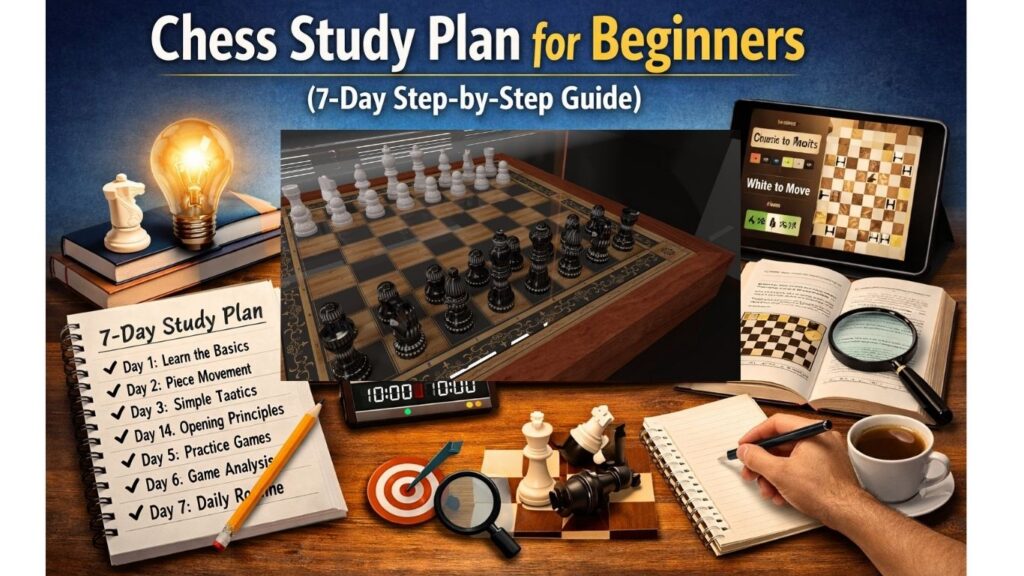
Chess Study Plan for Beginners (7-Day Step-by-Step Guide)
Last Updated: July 2026
Reading Time: 10–12 minutes
Difficulty: Beginner
Estimated Practice Time: 7 Days
Learning chess is much easier when you follow a structured plan instead of trying to learn everything at once. Many beginners spend hours watching random videos, memorizing opening moves, or playing game after game without understanding why they keep making the same mistakes.
A good chess study plan removes that confusion.
This 7-day beginner study plan introduces the most important chess concepts in a logical order. Each day builds on the previous one, helping you develop solid foundations before moving on to more advanced ideas.
Whether you’re learning on your own, helping your child get started, or returning to chess after a long break, this guide will help you build productive study habits from the very beginning.
This chess study plan for beginners is designed to help you focus on the right skills each day so you can improve steadily without feeling overwhelmed.
Quick Summary
| If you want to… | Focus On |
|---|---|
| Learn chess from scratch | Follow one day at a time without skipping ahead. |
| Build strong fundamentals | Understand principles instead of memorizing moves. |
| Improve consistently | Practice a little every day rather than occasionally for long hours. |
| Avoid beginner mistakes | Review your games and learn from your own decisions. |
| Continue improving after this guide | Follow a simple daily routine combining puzzles, games, and analysis. |
Estimated Daily Study Time
- 15–20 minutes: Basic learning
- 30–45 minutes: Recommended for most beginners
- 60 minutes: Ideal if you want faster improvement
Your 7-Day Learning Journey
| Day | What You’ll Learn |
|---|---|
| Day 1 | Chessboard, pieces, and rules |
| Day 2 | How every chess piece moves |
| Day 3 | Basic tactical patterns |
| Day 4 | Opening principles |
| Day 5 | Playing practice games |
| Day 6 | Game analysis |
| Day 7 | Building a long-term study routine |
Each day builds on the previous one, helping you develop confidence before moving to the next stage of your chess journey.
Why Every Chess Study Plan for Beginners Should Start with the Basics
One of the biggest mistakes beginners make is learning without direction.
A typical beginner might watch several YouTube videos, try to memorize a famous opening, play a few online games, and then search for another video after losing. Although this feels productive, it often leads to slow improvement because each activity is disconnected from the others.
A structured study plan solves this problem by giving every practice session a purpose.
Instead of asking, “What should I study today?”, you’ll know exactly what to focus on.
A good study plan helps you:
- Build knowledge step by step
- Avoid information overload
- Develop good study habits
- Practice consistently
- Measure your improvement over time
More importantly, it helps you understand why you’re learning each topic instead of simply memorizing moves.
In my experience, beginners rarely struggle because they aren’t working hard enough. More often, they struggle because they don’t know what to practice next. A simple study plan removes that uncertainty and allows every practice session to build on the previous one.
Who This Chess Study Plan Is For
This guide is ideal if you:
- Have just started learning chess
- Know the rules but don’t know what to study next
- Want a simple daily practice routine
- Are you a parent helping your child learn chess?
- Prefer structured learning instead of random YouTube videos
How This 7-Day Chess Study Plan Works
This guide is designed around a simple learning progression.
| Day | Primary Goal |
|---|---|
| Day 1 | Learn the rules and objective of chess |
| Day 2 | Understand how every piece moves |
| Day 3 | Recognize basic tactical patterns |
| Day 4 | Learn sound opening principles |
| Day 5 | Apply your knowledge in real games |
| Day 6 | Analyze your own games |
| Day 7 | Build a long-term study routine |
Think of this first week as laying the foundation of a house.
You are not trying to become an expert in seven days.
You are creating the habits that will help you improve steadily over the coming weeks and months.
What You’ll Achieve After 7 Days
By following this study plan, you will:
✔ Understand the basic rules of chess
✔ Move every piece confidently
✔ Recognize common tactical ideas
✔ Play the opening with sound principles
✔ Review your own games
✔ Build a sustainable daily practice routine
Before You Begin
Before starting this study plan, remember three important principles.
1. Understanding Is Better Than Memorization
Many beginners believe improvement comes from memorizing opening moves.
In reality, understanding why a move is played is much more valuable than remembering the move itself.
For example, learning to control the center is more useful than memorizing the first ten moves of an opening without understanding their purpose.
Whenever possible, ask yourself:
- Why is this move good?
- What problem does it solve?
- What would happen if I played something else?
Those simple questions develop better chess thinking than memorizing long move sequences.
2. Consistency Beats Long Study Sessions
Studying for 30 minutes every day usually produces better results than studying for four hours once a week.
Regular practice strengthens pattern recognition and helps new ideas become natural.
Small improvements accumulate surprisingly quickly.
3. Mistakes Are Part of Learning
Every beginner loses games.
Every beginner blunders pieces.
Every beginner misses checkmates.
These mistakes are not signs that you are failing—they are opportunities to identify what you need to practice next.
The strongest players improve because they learn from their mistakes instead of becoming discouraged by them.
Day 1: Learn the Basics of Chess
Your first goal is not to win games.
It is simply to understand how chess works.
Before thinking about strategy or tactics, make sure you are comfortable with the basic rules.
Learn These Fundamentals
Spend time understanding:
- The chessboard
- File and rank coordinates
- Piece names
- Starting position
- White moves first
- The objective of the game
You should also understand:
- Check
- Checkmate
- Stalemate
- Draws
If any of these ideas are confusing, take time to understand them before moving on.
A strong foundation makes everything else much easier.
Suggested Practice
Spend around 20–30 minutes on:
- Setting up the board several times
- Naming every piece
- Identifying squares
- Finding checks and checkmates in simple positions
Daily Goal
By the end of Day 1, you should be able to:
✅ Set up the chessboard correctly
✅ Explain the objective of chess
✅ Recognize check and checkmate
Common Beginner Mistakes
- Mixing up board orientation
- Confusing check with checkmate
- Forgetting that the king cannot move into check
- Rushing to play games before understanding the rules
Day 2: Learn How Every Chess Piece Moves
Once you understand the board, the next step is becoming completely comfortable with the movement of every piece.
Many beginner mistakes happen simply because players forget how a piece moves or overlook an important square.
Spend time practicing until movement becomes automatic.
Study Each Piece Individually
Learn:
- Pawn movement and captures
- Knight movement
- Bishop movement
- Rook movement
- Queen movement
- King movement
Pay special attention to the knight.
Its unique movement often causes the most confusion for beginners.
Practical Exercise
Instead of immediately playing games:
- Place one piece on different squares.
- Visualize every legal move.
- Repeat with every piece.
This simple exercise builds board awareness surprisingly quickly.
Daily Goal
By the end of Day 2, you should:
✅ Know how every piece moves
✅ Understand captures
✅ Recognize legal and illegal moves
Common Beginner Mistakes
- Forgetting pawns capture diagonally
- Missing knight attacks
- Leaving pieces undefended
- Confusing bishop and rook movement
Day 3: Practice Simple Chess Tactics
Once you know how the pieces move, it’s time to learn why pieces move.
This is where tactics begin.
Chess tactics are short combinations that win material or deliver checkmate.
Learning tactical patterns early helps beginners avoid many common mistakes.
Start With These Tactical Ideas
Focus on learning:
- Forks
- Pins
- Skewers
- Discovered attacks
- Simple checkmate patterns
Don’t worry about difficult combinations.
Recognizing basic patterns is far more important than solving complicated puzzles.
Daily Practice
Spend about 20 minutes solving easy puzzles.
Choose puzzles that you can solve by understanding the idea rather than guessing.
Quality is more important than quantity.
Why Tactical Training Matters
Regular puzzle practice improves:
- Pattern recognition
- Calculation
- Concentration
- Decision-making
One pattern I repeatedly notice among beginners is that they enjoy playing games far more than solving puzzles. However, players who spend even a few minutes each day practicing tactics usually improve much faster because they begin recognizing opportunities during real games.
Daily Goal
By the end of Day 3, you should:
✅ Recognize common tactical patterns
✅ Solve simple beginner puzzles
✅ Spot basic threats more quickly
You can strengthen these skills further by solving beginner-friendly chess puzzles every day.
Day 4: Learn Basic Opening Principles
Many beginners think they should memorize famous openings immediately.
In reality, understanding opening principles is much more valuable than memorizing long sequences of moves.
Strong openings are built on simple ideas that apply in almost every game.
The Four Most Important Opening Principles
Focus on these principles:
Control the center
Try to influence the central squares with your pawns and pieces.
Develop your minor pieces early
Bring your knights and bishops into active positions before launching attacks.
Castle early
King safety should usually be one of your first priorities.
Avoid moving the same piece repeatedly
Unless necessary, continue developing new pieces instead of moving one piece several times.
Practical Exercise
Play a few short practice games with only one objective:
Follow the opening principles.
Don’t worry about winning.
After every game, ask yourself:
- Did I control the center?
- Did I develop my pieces?
- Did I castle?
- Did I waste moves?
These questions help you build good habits much faster than memorizing opening theory.
Daily Goal
By the end of Day 4, you should:
✅ Understand the purpose of the opening
✅ Follow basic opening principles
✅ Avoid common opening mistakes
If you’d like to understand these ideas in more detail, continue with our complete guide to Chess Opening Principles for Beginners.
By this stage of the chess study plan for beginners, you have learned the essential building blocks needed to start applying your knowledge in real games.
Day 5: Play Practice Games
Now it’s time to put everything you’ve learned into practice.
Many beginners judge their progress only by whether they win or lose. At this stage, that isn’t the right measure of improvement.
Instead, focus on applying the principles you’ve studied during the first four days.
Before Each Game
Take a few seconds to remind yourself:
- Control the center.
- Develop your pieces.
- Keep your king safe.
- Look for simple tactics before every move.
Having these ideas in mind helps you build good habits from the beginning.
During the Game
Your objective is not to play perfectly.
Instead, try to:
- Follow opening principles.
- Avoid hanging pieces.
- Look for checks, captures, and threats before moving.
- Think about your opponent’s ideas as well as your own.
If you lose, don’t be discouraged.
Every game teaches something useful.
After the Game
Before starting another game, ask yourself:
- Where did I make my first mistake?
- Did I miss a tactical opportunity?
- Was my king safe?
- Which move would I change if I played the game again?
Even a two-minute review is more valuable than immediately starting another game.
Daily Goal
By the end of Day 5, you should:
✅ Play 2–3 thoughtful games
✅ Apply basic opening principles
✅ Begin reviewing your decisions
Common Beginner Mistakes
- Playing too quickly
- Ignoring opponent threats
- Starting another game immediately after losing
- Focusing only on the result instead of the quality of decisions
Day 6: Analyze Your Games
Many players believe improvement comes from playing more games.
In reality, much of your improvement comes from understanding why you won or lost.
Game analysis is where mistakes become lessons.
Why Game Analysis Matters
Imagine making the same mistake five games in a row.
Without reviewing your games, you may never notice the pattern.
Analysis helps you identify recurring mistakes so you can correct them.
What Should Beginners Look For?
You don’t need advanced chess software.
Start with simple questions.
Opening
- Did I develop my pieces?
- Did I castle?
- Did I control the center?
Middlegame
- Did I overlook tactics?
- Did I leave pieces undefended?
- Did I rush my decisions?
End of the Game
- What was my biggest mistake?
- What was my best move?
- What will I do differently next time?
These simple questions gradually improve your decision-making.
Daily Goal
By the end of Day 6, you should:
✅ Review every game you play
✅ Identify one lesson from each game
✅ Keep a simple improvement notebook
Coaching Observation
One pattern I repeatedly notice among improving players is that they don’t necessarily play more games—they study their own games more carefully.
A player who reviews five games thoughtfully often improves faster than someone who plays fifty games without reflection.
Day 7: Build Your Long-Term Chess Routine
Congratulations!
You’ve completed your first structured week of chess study.
Now it’s time to turn these daily activities into a sustainable habit.
Remember:
Consistency beats intensity.
A simple routine followed regularly produces better results than occasional long study sessions.
A Recommended Daily Routine
| Activity | Time |
| Solve puzzles | 10–15 minutes |
| Play one or two games | 20–30 minutes |
| Review your games | 10–15 minutes |
| Learn one new concept | 10–15 minutes |
Total:
40–60 minutes per day
If you have less time, reduce the number of games—but don’t skip analysis completely.
Weekly Learning Roadmap
Your chess improvement doesn’t stop after seven days.
Here’s a simple progression to follow.
| Time | Focus |
| Week 1 | Rules, pieces, tactics, opening principles |
| Weeks 2–4 | More puzzles and game analysis |
| Month 2 | Basic strategy and planning |
| Month 3 | Opening understanding and simple endgames |
| Beyond | Consistent practice and tournament preparation |
Think of chess as a long-term learning journey rather than a race.
Practical Tips for Faster Improvement
The following habits help beginners improve much more efficiently.
Study a Little Every Day
Daily practice strengthens memory and pattern recognition.
Solve Puzzles Regularly
Puzzles improve tactical awareness faster than simply playing games.
Review Every Game
Even short reviews reveal important lessons.
Learn Principles Before Memorizing
Understanding ideas gives you the ability to handle unfamiliar positions.
Be Patient
Every strong chess player started as a beginner.
Progress comes from consistent practice.
Random Learning vs Structured Study
| Random Learning | Structured Study Plan |
| Watch random videos | Follow a daily progression |
| Memorize openings | Understand principles |
| Play many games | Practice, play, and review |
| Study without goals | Focus on one objective each day |
| Repeat mistakes | Learn from every game |
A structured study plan helps you build lasting improvement instead of temporary knowledge.
Common Mistakes Beginners Make
Avoiding these mistakes will help you improve much faster.
Playing Too Many Games
More games do not automatically mean more learning.
Ignoring Chess Puzzles
Pattern recognition develops through regular tactical practice.
Memorizing Opening Moves
Understand ideas before learning move sequences.
Never Reviewing Games
Every game contains valuable lessons.
Trying to Learn Everything at Once
Focus on one concept at a time.
Strong foundations make advanced topics much easier later.
Parent Guidance
If you’re helping your child learn chess, remember that improvement takes time.
Instead of asking,
“Did you win?”
Try asking,
- What did you learn today?
- What was your best move?
- What mistake will you avoid next time?
These conversations encourage reflection rather than creating unnecessary pressure.
Children usually improve faster when they enjoy learning and feel comfortable making mistakes.
Encouraging consistency, curiosity, and thoughtful decision-making builds confidence that extends beyond the chessboard.
Key Takeaways
✔ Learn the basics before studying advanced topics.
✔ Practice consistently instead of occasionally.
✔ Solve tactical puzzles every day.
✔ Review your own games.
✔ Understand principles before memorizing openings.
✔ Focus on long-term improvement rather than short-term results.
Frequently Asked Questions
How long does it take to learn chess?
Most beginners understand the basic rules within a few days.
Developing stronger playing skills usually takes weeks or months of consistent practice.
Should beginners learn openings first?
Learn opening principles before memorizing specific openings.
Understanding why good opening moves work is far more valuable than remembering long move sequences.
How much should beginners practice each day?
Around 30–60 minutes of focused practice is enough for most beginners.
Even 20 minutes every day is better than several hours once a week.
Is solving puzzles better than playing games?
Both are important.
Puzzles improve tactical awareness, while games teach practical decision-making.
Combining both produces the best results.
Should I analyze every game?
Yes.
Even a short review helps identify mistakes and reinforces good decisions.
Can children follow this study plan?
Absolutely.
The schedule is simple enough for children, especially when supported by a parent or coach who encourages understanding rather than memorization.
What to Do After This 7-Day Chess Study Plan
Completing your first week is only the beginning.
Continue following a balanced routine:
- Practice tactics every day.
- Play thoughtful games.
- Analyze your decisions.
- Learn one new concept each week.
- Gradually increase your understanding of strategy and endgames.
Small improvements made consistently lead to significant progress over time.
Conclusion
Learning chess doesn’t require studying everything at once.
It requires studying the right things in the right order.
This 7-day chess study plan gives beginners a practical roadmap for building strong foundations, developing productive habits, and improving steadily through consistent practice.
Following this chess study plan for beginners consistently is far more effective than studying randomly or trying to learn advanced concepts too early.
As your understanding grows, continue focusing on thoughtful decision-making, regular analysis, and gradual improvement.
Chess rewards patience, curiosity, and disciplined learning—and every great player began with the same first steps.
Continue Your Learning Journey
Once you’re comfortable with this study plan, these beginner resources are the next logical steps:
- How to Play Chess for Beginners
- Chess Rules Explained
- Chess Opening Principles
- Basic Chess Tactics
- Chess Strategy for Beginners
- Beginner Chess Endgames
- Common Chess Mistakes
- Chess Improvement Guide
Exploring these topics one by one will help you continue building a strong chess foundation.
Continue Learning with Personal Guidance
A structured study plan helps you build strong habits, but every beginner improves at a different pace. Personalized guidance can help you identify exactly what to work on next and avoid spending time on the wrong areas.
During your chess assessment, you’ll discover:
- ✔ Your current strengths and areas for improvement
- ✔ The common mistakes slowing your progress
- ✔ A personalized learning roadmap based on your current level
- ✔ The next skills and concepts you should focus on first
Whether you’re learning on your own or looking for structured online chess coaching, an assessment provides a clear starting point and helps you improve with confidence.
Ready to take the next step?