
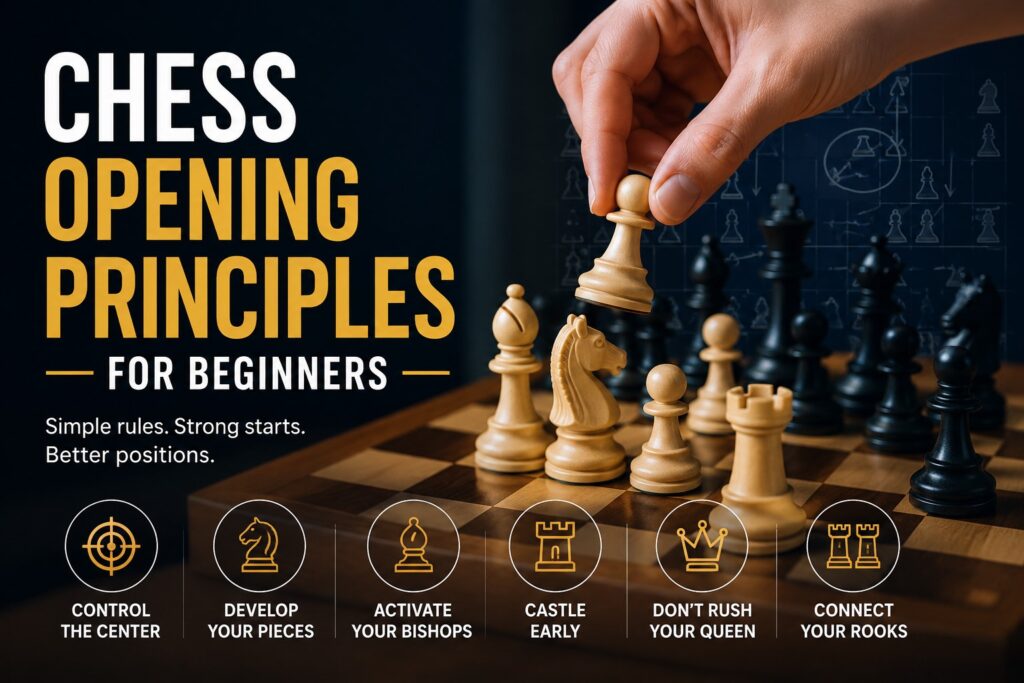
Chess Opening Principles for Beginners
Many beginners struggle with the opening because they are looking for the right move before they understand what the opening is trying to accomplish.
They may memorise a few moves, bring the queen out early, move the same piece several times, or start an attack before the rest of their pieces are ready.
The result is often a position that feels confusing even though the first few moves seemed reasonable.
For beginners, strong opening play is not primarily about memorising long variations. It is about understanding a small number of principles that help your pieces become active, your king become safer and your army work together.
The most useful idea is simple:
Use the opening to develop your pieces efficiently, influence the centre, protect your king and prepare for the middlegame.
This guide explains the most important chess opening principles for beginners, why they work, how to apply them in real games, when the principles can be broken and how to practise them without becoming dependent on opening memorisation.
Opening principles are only one stage of learning. Our Complete Beginner Chess Guide explains what to learn before studying openings and what comes next.
Quick Summary: The 7 Most Important Chess Opening Principles
For most beginner positions, remember these seven ideas:
- Fight for control of the centre.
- Develop your pieces efficiently.
- Avoid moving the same piece repeatedly without a reason.
- Make king safety a priority.
- Be cautious about bringing the queen out too early.
- Use pawn moves with a purpose.
- Complete useful development before launching a major attack.
A simple way to remember the overall purpose is:
Activity → King Safety → Coordination
These principles are guidelines, not laws. A tactical opportunity, threat or unusual position can make a different move correct.
The goal is to understand why the principles work so you can make sensible decisions even when you do not know the opening theory.
What Are Chess Opening Principles?
Chess opening principles are general guidelines that help players make useful decisions during the early part of the game.
At the beginning of a chess game, most of your pieces are still on their starting squares. Your first moves should therefore begin solving several basic problems:
- How will you influence the centre?
- Which pieces should become active?
- How will you make your king safer?
- How will your pieces work together?
- How can you avoid wasting moves?
- What kind of position are you preparing for?
This is why opening principles are particularly valuable for beginners.
Instead of asking:
“What opening move am I supposed to memorise?”
you can ask:
“What does my position need right now?”
That question remains useful even after your opponent plays a move you have never seen before.
The Three Phases of a Chess Game
It helps beginners to understand where the opening fits into the whole game.
Chess is commonly described in three broad phases:
The Opening
The opening is the early phase of the game, when players generally develop their pieces, influence important squares and work toward king safety.
A rough practical reference is the first 10–15 moves, but there is no fixed move number at which the opening ends.
The Middlegame
The middlegame begins as the developed pieces start working together to create plans, attacks, exchanges, tactical opportunities and strategic ideas.
The position matters more than the number of moves played.
The Endgame
The endgame is the later phase, after significant exchanges have reduced the number of pieces and the character of the game has changed.
King activity, pawn structure, passed pawns, and precise calculation become increasingly important.
These phases overlap.
A game does not suddenly become a middlegame after one particular move.
For beginners, the important lesson is that the opening has a purpose: prepare your army for the rest of the game.
What Is the Main Objective of the Opening?
A useful beginner-friendly way to think about the opening is:
Bring your pieces into the game efficiently so they can reach their potential.
At the beginning, your knights, bishops, rooks and queen are restricted by their starting positions and by your own pawns.
Development changes that.
A well-developed army gives you more possibilities because more pieces can:
- Control important squares
- Defend each other
- Attack weaknesses
- Respond to threats
- Support pawn breaks
- Prepare tactical ideas
But there is an important qualification.
The goal is not to move every piece as quickly as possible without considering the position.
Each move should have a purpose.
A useful opening move may:
- Develop a piece
- Influence the centre
- Prepare castling
- Improve king safety
- Prevent an opponent’s plan
- Create a useful threat
- Solve a tactical problem
So rather than thinking:
“I need to get all my pieces out immediately.”
think:
“I want my pieces developed efficiently and coordinated for the position I am entering.”
1. Control the Centre
One of the most important chess opening principles for beginners is to fight for the centre.
The four central squares are:
- e4
- d4
- e5
- d5
These four squares are often called the main centre.
Moves such as 1.e4 and 1.d4 immediately influence central space and also open lines for development.
Why does the centre matter?
Pieces placed toward the centre can generally influence more useful squares.
A knight near the centre, for example, has more potential destinations than a knight stuck on the edge of the board.
Central control can help you:
- Develop pieces actively
- Gain useful space
- Restrict opposing pieces
- Prepare attacks
- Support pawn breaks
- Improve coordination
The principle is therefore deeper than:
“Put a pawn on e4 or d4.”
The real idea is:
Use your pieces and pawns to influence important central squares.
The Main Centre and the Wider Centre
Beginners often hear about the four central squares, but central influence is broader than those four squares.
The main centre consists of:
e4, d4, e5 and d5.
The surrounding squares also contribute to what can be thought of as the wider centre.
This matters because a piece does not have to occupy one of the four central squares to influence central play.
A knight on c3, for example, can influence important central squares.
A bishop developed toward an active diagonal can also exert pressure on the centre from a distance.
The practical lesson is:
Think about central influence, not just central occupation.
What if you cannot play e4 or d4?
This is an important point for beginners.
Sometimes the move you expected to play is not available or does not fit the position.
That does not mean the opening principle has failed.
Suppose you cannot play your preferred e-pawn move.
You may have another useful central option, such as c4, depending on the position.
The principle is therefore not:
“Always play e4 or d4.”
It is:
“Look for a useful way to influence the centre.”
This distinction helps beginners understand principles instead of turning them into rigid rules.
A useful question
Before moving a central pawn, ask:
“Which important squares will this move influence, and what lines will it open?”
That question is more valuable than memorising a single first move.
2. Develop Your Pieces Efficiently
Once you have begun influencing the centre, the next major priority is development.
Development means moving your pieces from their starting squares to useful positions.
The minor pieces are usually developed first:
- Knights
- Bishops
Then the king is made safer, usually through castling when appropriate, and the remaining pieces become increasingly active.
A simple beginner framework is:
Centre → Knights → Bishops → King Safety → Remaining Pieces
This is a useful sequence, not a rigid move order.
The position always comes first.
Develop the Knights Toward Useful Squares
Knights are short-range pieces, so bringing them toward central or active squares early is often useful.
Common beginner development squares include:
- Nf3
- Nc3
- Nf6
- Nc6
These are examples, not automatic destinations.
The right square depends on:
- The pawn structure
- Central tension
- Tactical possibilities
- Opponent’s threats
- Your intended plan
A useful question is:
“Where can this knight influence the most important parts of the position?”
Develop the Bishops Actively
Bishops become more useful when their diagonals are open.
Depending on the position, common developing squares can include:
- Bc4
- Bb5
- Bg5
- Bd3
Again, these are not squares you should play automatically.
The goal is to place the bishop where it can contribute to the position.
An active bishop may:
- Pressure a weakness
- Support central control
- Target the king
- Defend an important piece
- Coordinate with another piece
This is why pawn structure matters.
Your own pawns can either open useful diagonals or block your bishops.
Should Knights Always Come Before Bishops?
No.
“Develop your knights before your bishops” can be a helpful beginner guideline, but it is not an absolute rule.
Sometimes a bishop has an obvious useful square and should be developed immediately.
The stronger principle is:
Develop your pieces efficiently toward useful squares.
The source material you provided presents knights before bishops as a development sequence, but it also works best when taught as a practical guideline rather than a rule that must be followed regardless of the position.
3. Avoid Moving the Same Piece Repeatedly
One of the most common beginner mistakes is moving the same piece again and again while other pieces remain undeveloped.
For example, a player might move a knight to an active square, move it again to attack something, retreat it, and then move it again.
Sometimes repeated moves are necessary.
But when there is no concrete reason, they can waste valuable time.
Why does this matter?
While you spend moves on one piece, your opponent may be:
- Developing another piece
- Preparing to castle
- Controlling the centre
- Creating a threat
- Improving coordination
This creates a development difference.
A simple question can help:
“Can I improve an undeveloped piece instead?”
When is moving the same piece twice correct?
There are many legitimate exceptions.
You may need to move a piece again because:
- It is attacked
- You can win material
- There is a tactical opportunity
- You need to answer a threat
- The piece is badly placed
- The opening requires a specific manoeuvre
The principle is therefore:
Avoid unnecessary repeated moves, not all repeated moves.
4. Make King Safety a Priority
Your king is the most important piece on the board.
That makes King Safety one of the central goals of opening play.
For many beginner positions, castling is the simplest way to improve king safety.
Castling can:
- Move the king away from the centre
- Connect the rooks
- Help activate a rook
- Improve coordination
Why can a king in the centre be dangerous?
The centre is where many pieces become active.
If central files and diagonals open while your king remains there, your opponent may have tactical opportunities.
That does not mean every king must castle immediately.
Sometimes the centre is closed.
Sometimes castling is unsafe.
Sometimes a tactical situation requires another move first.
The principle is:
Make your king safe rather than following a castling rule mechanically.
Castle Early When It Is Safe and Useful
For many beginners, kingside castling is the most common practical choice.
But avoid thinking:
“I must castle on move seven.”
Instead ask:
- Is castling legal?
- Is the destination safe?
- Is my king currently exposed?
- Will castling improve my coordination?
- Is there a concrete reason to delay it?
This teaches the purpose behind castling rather than turning it into another memorised rule.
5. Be Careful With the Queen
The queen is powerful, so beginners are naturally attracted to using it early.
But the queen is also valuable and can become an easy target.
If you bring the queen out before developing your minor pieces, your opponent may gain time by attacking it with developing moves.
For example:
- e4 e5
- Qh5
White immediately creates pressure, but Black may be able to develop while gaining useful tempi against the queen.
The problem is not simply that the queen moved.
The problem is that one piece is being moved repeatedly while the rest of the army is still waiting to enter the game.
A better question
Before bringing the queen out, ask:
“Does the queen need to move now for a concrete reason?”
If not, development may be more useful.
Are early queen moves always wrong?
No.
An early queen move can be correct if it:
- Wins material
- Creates a serious threat
- Solves a tactical problem
- Supports a concrete opening idea
The principle is:
Do not bring the queen out early without a reason.
6. Use Pawn Moves With a Purpose
Beginners sometimes think of pawn moves as harmless.
They are not.
Pawns cannot move backwards, so every pawn move creates a lasting change in the position.
A pawn move can:
- Control central squares
- Open a diagonal
- Support a piece
- Create space
- Prepare castling
- Restrict an enemy piece
- Create a weakness
- Block one of your own pieces
Before making an opening pawn move, ask:
“What does this pawn move improve?”
You do not need to calculate everything.
But it is useful to know whether the move supports:
- Centre control
- Development
- King safety
- Piece activity
- A clear plan
Avoid Too Many Pawn Moves
A common beginner pattern is:
“I can move this pawn, so I will.”
The player may make several pawn moves while the knights and bishops remain on their starting squares.
The result can be slow development and unnecessary weaknesses.
A useful default is:
Use pawn moves to support your position, not simply because the pawn can move.
7. Complete Useful Development Before Launching a Major Attack
Beginners often see an attacking opportunity and immediately move the queen or another piece toward the opponent’s king.
The problem is that an attack usually needs enough pieces to support it.
Before launching a major attack, ask:
- Are my minor pieces developed?
- Is my king safe?
- Are my pieces coordinated?
- Can my opponent create a more serious threat?
- Do I have enough pieces supporting the attack?
- What happens if the opponent defends?
This does not mean:
“Never attack before every piece is developed.”
Concrete tactics can change everything.
The better principle is:
Do not attack simply because you see an attacking move. First ask whether your pieces are ready to support it.
A Simple Development Sequence for Beginners
If you are completely new to opening play, this sequence can help:
Step 1 → Influence the centre
Use a useful central pawn move or piece development to contest important squares.
Step 2 → Develop the knights
Bring them toward useful central or active squares.
Step 3 → Develop the bishops
Open useful diagonals and place the bishops actively.
Step 4 → Make the king safe
Castle when appropriate and safe.
Step 5 → Activate the remaining pieces
Bring the queen and rooks into useful positions when the position calls for them.
Step 6 → Start thinking about the middlegame
Ask what the position now needs.
This is a framework, not a forced opening sequence.
A tactical opportunity or opponent threat can always change the order.
The Three Big Opening Goals
If seven principles feel difficult to remember, reduce them to three goals.
1. Activity
Get your pieces onto useful squares.
2. King Safety
Do not leave your king unnecessarily exposed.
3. Coordination
Make your pieces work together.
Centre control and development improve activity.
Castling improves king safety.
Developing and connecting the pieces improves coordination.
So a simple beginner reminder is:
Get active. Get safe. Get coordinated.
Opening Principles Are Guidelines, Not Laws
This may be the most important lesson in the entire article.
Beginners sometimes turn principles into absolute rules:
“Never move a piece twice.”
“Never bring the queen out early.”
“Always castle immediately.”
“Always play e4.”
That is not how chess works.
The principle gives you a default
If there is no concrete reason to do something else, development may be the sensible choice.
But the position can give you a reason to change course.
For example:
Principle: Avoid moving the same piece twice.
Exception: The repeated move wins material or responds to a serious threat.
Principle: Avoid early queen moves.
Exception: The queen move creates a concrete tactical opportunity.
Principle: Castle early.
Exception: Castling would move your king into danger.
Principle: Fight for the centre.
Exception: A tactical threat requires immediate attention.
The stronger player is not the person who follows the rules most rigidly.
It is the person who understands why the principles exist and when the position justifies something different.
What to Do When You Do Not Know the Opening
This is where opening principles become especially useful.
Imagine your opponent plays a move you have never seen.
You do not know the opening name.
You do not remember the theory.
That is completely manageable if you have a decision-making framework.
Ask:
1. What changed?
Look at the last move and identify what it attacked, defended or opened.
2. What is my opponent threatening?
Do not start with your own plan until you understand theirs.
3. What is happening in the centre?
Are central pawns being exchanged?
Is one side gaining space?
Are important squares becoming available?
4. Which of my pieces is undeveloped?
Look for a useful development move.
5. Is my king safe?
Consider whether castling or another king-safety move is necessary.
6. Am I wasting time?
Check whether you are about to move the same piece again without a concrete reason.
7. What should I improve next?
Once immediate threats are handled, identify the most useful improvement.
This is far more reliable than trying to guess the opening name.
How to Think About the Centre in an Actual Game
Suppose you cannot play the central pawn move you originally wanted.
Do not conclude:
“I have failed to follow the opening principles.”
Instead, look for the next best way to influence the position.
For example, depending on the position, c4 may help challenge central squares when e4 is not the appropriate choice.
The important question is not:
“Which opening move does the rulebook tell me to play?”
It is:
“How can I influence important squares and develop my pieces efficiently from this position?”
That is the difference between understanding an opening principle and memorising an opening rule.
How Opening Principles Connect to Tactics
Opening principles do not replace calculation.
A player can develop all their pieces correctly and still lose material to a simple tactical mistake.
Before making your move, therefore, develop the habit of checking:
Checks → Captures → Threats
Look for your opponent’s possible:
- Checks
- Captures
- Direct threats
Then consider your own.
This is particularly important when following opening principles.
For example, developing a knight is usually sensible.
But if your opponent has created a direct tactical threat, answering that threat may be more important than making another developing move.
The principle provides the default.
Calculation tells you what the position actually requires.
How to Know When the Opening Is Going Well
Beginners often ask:
“How many moves should the opening last?”
That is less useful than asking:
“Have I completed the main jobs of the opening?”
Your opening is often going well when:
- Your minor pieces are developed
- Your king is reasonably safe
- Your pieces coordinate
- Your rooks can become active
- You have reasonable central influence
- You have not wasted many moves
- You understand what you want to improve next
At that point, your thinking should begin to change.
Instead of asking:
“What opening move comes next?”
ask:
“What does this position need?”
That may mean improving your worst piece, creating a pawn break, controlling an open file, defending a weakness or preparing an attack.
This is the transition from opening thinking to middlegame thinking.
What Happens After the Opening?
Opening principles are not meant to be followed forever.
Once your pieces are developed and your king is safe, the position starts demanding different questions.
You may need to think about:
- Tactical opportunities
- Pawn breaks
- Weak squares
- Open files
- Piece exchanges
- Attacking plans
- Defensive plans
- Improving your worst-placed piece
This is why opening study should connect naturally to [chess strategy] and [chess tactics], rather than being treated as a completely separate subject.
The opening prepares the army.
The middlegame determines how that army is used.
Common Opening Mistakes Beginners Make
Ignoring the centre
Problem: Pieces and pawns develop without influencing important central squares.
Better approach: Look for ways to contest central space and central influence.
Moving too many pawns
Problem: Development becomes slow.
Better approach: Make pawn moves that support the centre, development, king safety or a clear plan.
Bringing the queen out too early
Problem: The queen may become a target for developing pieces.
Better approach: Develop your minor pieces first unless there is a concrete reason to move the queen.
Moving the same piece repeatedly
Problem: You spend several moves while other pieces remain inactive.
Better approach: Ask whether another undeveloped piece can improve your position.
Delaying king safety
Problem: Your king remains exposed while the centre opens.
Better approach: Consider castling when it is legal, safe and useful.
Attacking before development
Problem: Your attack may involve too few pieces.
Better approach: Develop and coordinate your army before launching a major attack unless there is a concrete tactical opportunity.
Memorising without understanding
Problem: You become lost when your opponent deviates from the moves you studied.
Better approach: Learn the purpose behind the moves.
Treating principles as absolute rules
Problem: You may reject a strong move simply because it appears to break a general guideline.
Better approach: Use principles as defaults and let concrete calculation decide when an exception is justified.
Beginner-Friendly Opening Examples
Beginners often ask which opening they should learn first.
The important point is not to choose an opening simply because someone calls it “easy”.
Choose openings that help you practise sound principles.
Italian Game
The Italian Game can help beginners study:
- Centre control
- Development
- Bishop activity
- King safety
- Piece coordination
Four Knights Game
This can provide straightforward examples of:
- Knight development
- Central control
- Piece coordination
- Castling
Queen’s Gambit
The Queen’s Gambit can introduce ideas involving:
- Central tension
- Pawn structures
- Development
- Strategic planning
London System
The London System can provide a familiar development structure for some beginners, but it should still be understood through the position rather than played as a fixed sequence.
The lesson is more important than the opening name:
Study openings to understand ideas, not simply to memorise moves.
How to Practise Chess Opening Principles
You do not need to memorise hundreds of variations to improve your opening play.
Play slower games
Give yourself enough time to think about:
- Development
- Centre control
- King safety
- Opponent threats
Review your first 10–15 moves
After the game, ask:
- Did I develop efficiently?
- Did I influence the centre?
- Did I move the same piece too many times?
- Did I delay king safety?
- Did I bring my queen out unnecessarily?
- Did I make too many pawn moves?
- Did I understand what I was trying to accomplish?
Find one recurring mistake
If you repeatedly delay castling, focus on king safety.
If you repeatedly move the queen too early, focus on development.
If you repeatedly ignore central control, study central pawn structures.
One corrected habit can be more valuable than memorising another opening variation.
Explain your moves
After making an opening move, ask:
“Why did I play this?”
Try to answer in plain language.
For example:
“I developed my knight because it controls central squares and prepares me to castle.”
That is much more useful than:
“Because this is the book move.”
A Simple Opening Checklist
When you are unsure what to play, use this checklist.
Centre
- What is happening in the centre?
- Can I influence an important central square?
- Can I make a useful central pawn move?
Development
- Which pieces are undeveloped?
- Which one has the most useful square?
King Safety
- Is my king exposed?
- Can I castle safely?
Efficiency
- Am I moving the same piece again without a concrete reason?
- Am I making an unnecessary pawn move?
Queen
- Does the queen really need to move now?
Opponent
- What is my opponent threatening?
- What changed after their last move?
Plan
- What will I improve next?
You do not need to turn this into a mechanical checklist before every move.
With practice, these questions gradually become part of your natural chess thinking.
Opening Principles vs Opening Theory
| Opening Principles | Opening Theory |
|---|---|
| General guidelines | Specific researched variations |
| Useful in unfamiliar positions | Most useful in known positions |
| Focuses on ideas | Focuses on concrete moves |
| Helps beginners make decisions | Becomes increasingly useful with experience |
| Does not require extensive memorisation | Can involve substantial memorisation |
| Explains why moves make sense | Shows established move sequences |
Both have a place in chess improvement.
But the learning order matters.
For beginners, a strong foundation is:
Rules → Principles → Ideas → Practice → Typical Positions → Opening Knowledge → Deeper Theory
If you memorise variations before understanding the principles, you may know what to do only when your opponent follows your preparation.
If you understand the principles first, you can still make sensible decisions when the game becomes unfamiliar.
What Parents Should Know About Teaching Opening Principles
Parents do not need to know opening theory to support a child learning chess.
A child is making useful progress when they gradually begin to understand questions such as:
- Why should I develop this piece?
- Why is the centre important?
- Why is my king unsafe?
- Why is moving the queen again a problem?
- What is my opponent threatening?
- What should I improve next?
A child who can explain these ideas is developing more than opening knowledge.
They are developing independent decision-making.
Parents can support this by asking:
“Why did you choose that move?”
rather than immediately asking:
“Did you play the right opening?”
The first question encourages thinking.
The second can encourage memorisation.
One pattern I’ve repeatedly noticed in beginner learning is that students often become much more confident when they understand the purpose behind an opening move. They no longer feel that every unfamiliar position means they have forgotten something.
That is exactly what opening principles should provide: a framework for thinking when memorisation runs out.
How Opening Principles Lead Into Better Chess
Opening principles are not valuable because they help you survive the first ten moves.
They are valuable because they establish habits that continue throughout the game.
For example:
Developing pieces teaches you to value activity.
Controlling the centre teaches you to think about space and influence.
King safety teaches you to recognise risk.
Avoiding unnecessary repeated moves teaches you to value time.
Checking your opponent’s threats teaches you to think from both sides of the board.
Building coordination teaches you to make your pieces work together.
These are not opening-only skills.
They are foundations for stronger chess thinking.
Key Takeaways
- The opening is the early phase in which players develop their armies, influence important squares and work toward king safety.
- The opening does not end at one fixed move number.
- The main centre consists of e4, d4, e5 and d5.
- Central influence extends beyond those four squares.
- If your preferred central pawn move is unavailable, look for another useful way to contest central space.
- Develop pieces efficiently rather than following a rigid move order.
- Knights and bishops should generally become active before major pieces.
- Avoid moving the same piece repeatedly without a concrete reason.
- Make king safety a priority and castle when appropriate.
- Avoid bringing the queen out early simply because it can move far.
- Use pawn moves with a purpose.
- Develop and coordinate your army before launching a major attack when there is no concrete tactical reason to do otherwise.
- Opening principles are guidelines, not laws.
- Calculation and awareness of your opponent’s threats always matter.
- Learn the ideas behind openings before spending significant time memorising variations.
The most useful beginner reminder is:
Get active. Get safe. Get coordinated.
Frequently Asked Questions
What are the chess opening principles for beginners?
The main principles are to control the centre, develop pieces efficiently, avoid unnecessary repeated moves, make the king safe, be cautious with early queen moves, use pawn moves purposefully and coordinate your pieces before launching major attacks.
What is the most important opening principle in chess?
There is no single principle that works independently of the position. For beginners, the broad goals of activity, king safety and coordination provide a useful framework.
What are the four central squares in chess?
The four main central squares are e4, d4, e5 and d5.
They are especially important because pieces and pawns that influence these squares can often affect many important parts of the board.
What is the wider centre in chess?
The wider centre refers to the squares surrounding the four main central squares. Central influence is broader than simply occupying e4, d4, e5 or d5.
A piece can influence the centre from nearby squares without physically occupying one of the four central squares.
Should beginners always play e4 or d4?
No.
Moves such as e4 and d4 are common ways to influence the centre, but they are not mandatory.
If one central move is unavailable or does not fit the position, another move such as c4 may provide a useful way to contest central space.
Should beginners develop knights before bishops?
This can be a useful guideline, but it is not an absolute rule.
The better principle is to develop your pieces efficiently toward useful squares.
When should beginners castle?
Beginners should generally make king safety an early priority.
Castle when it is legal, safe and useful rather than trying to follow a fixed move number.
Why should beginners avoid bringing the queen out early?
An early queen can become a target for developing pieces.
If the queen has to move repeatedly, you may lose time while your opponent develops.
Early queen moves can still be correct when there is a concrete tactical or positional reason.
Should I move the same piece twice in the opening?
Avoid unnecessary repeated moves when other pieces remain undeveloped.
However, moving the same piece twice can be correct if you are responding to a threat, winning material or following a concrete plan.
Do beginners need to memorise chess openings?
Not extensively.
Beginners should first understand opening principles and typical ideas. Opening theory becomes more useful as their understanding and playing strength develop.
What should I do if my opponent plays an opening move I do not know?
Stay calm and return to the principles.
Check what your opponent is threatening, look at the centre, develop a useful piece, consider king safety, and avoid unnecessary moves.
You do not need to know the opening name to play a sensible position.
When does the opening end?
There is no fixed move number.
The opening is generally giving way to the middlegame as development becomes largely complete, the king is reasonably safe, and the position begins to demand specific strategic and tactical decisions.
How can I practise opening principles?
Play slower games, review your first 10–15 moves, identify recurring mistakes and explain the purpose behind your moves.
Focus on correcting one opening habit at a time rather than trying to memorise many variations at once.
Continue Learning Chess
Opening principles are only one part of a complete chess education.
Once you understand how to develop your pieces, influence the centre, and protect your king, the next step is to learn how those pieces work together in tactical and strategic positions.
A useful learning progression is:
Chess Fundamentals → Opening Principles → Tactics → Calculation → Middlegame → Endgame → Game Analysis
If you are still building your foundation, continue with the Complete Beginner Chess Guide.
If you want structured support as you learn these concepts, explore Online Chess Classes for Beginners.
You can also explore Online Chess Courses if you prefer a structured course-based learning format.
Build Strong Opening Understanding
The best opening knowledge is not a list of moves you can repeat from memory.
It is the ability to look at a position and understand:
What should I develop?
What is happening in the centre?
Is my king safe?
Am I wasting time?
What is my opponent threatening?
How can my pieces work together?
When those questions become part of your normal thinking, unfamiliar openings become much easier to handle.
For beginners, that is the real purpose of opening principles: to give you a reliable way to think when you do not know what move comes next.
Related Pages
- Complete Beginner Chess Guide
- Chess Fundamentals
- Chess Openings
- Chess Tactics
- Chess Strategy
- Online Chess Classes
- Online Chess Classes for Kids
- Online Chess Courses
- Online Group Chess Classes
- Online 1-on-1 Chess Classes