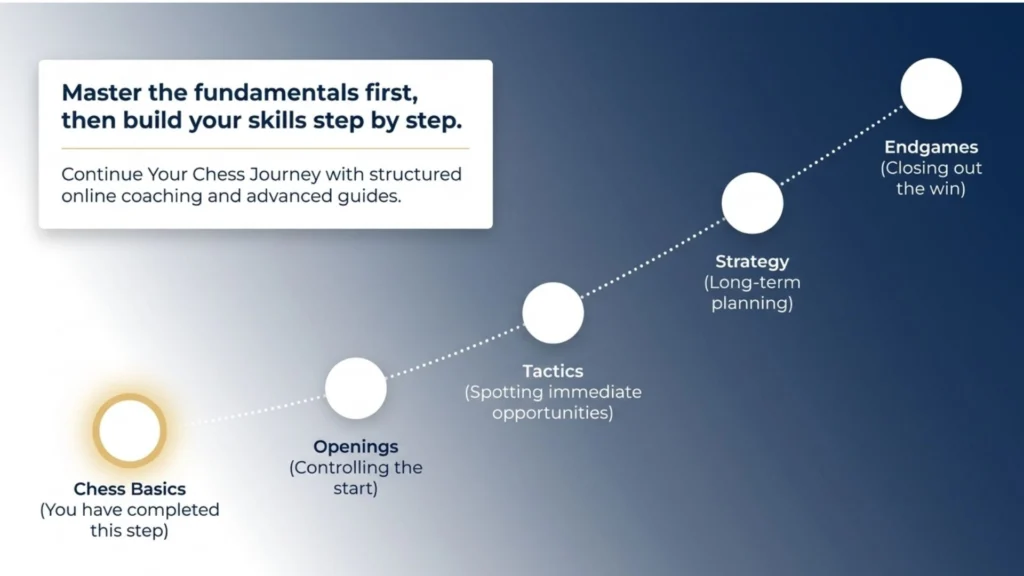
Chess Basics for Beginners: Learn the Fundamentals of Chess
Learning chess may seem complicated at first, but every strong player starts with the same fundamentals.
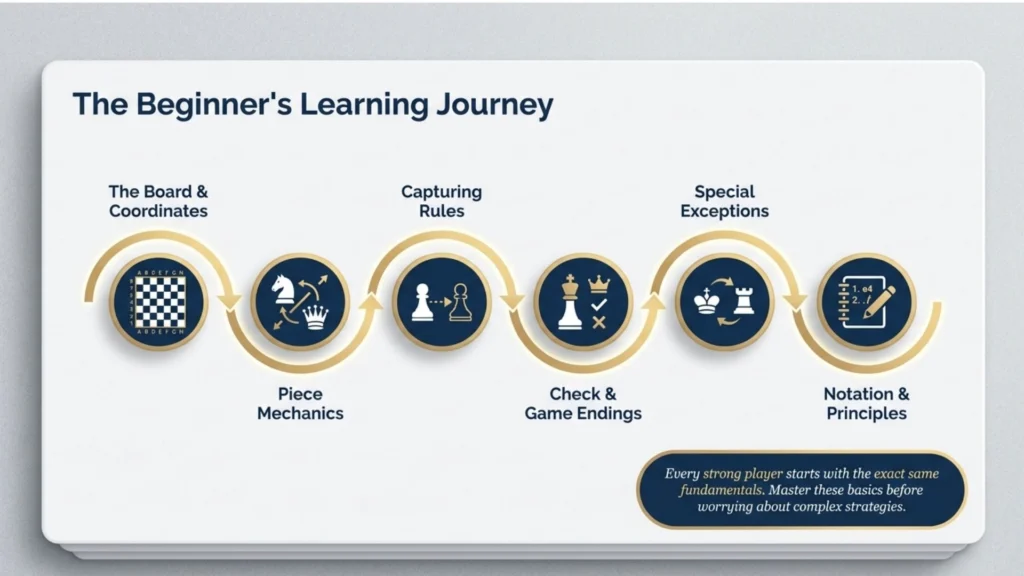
Before learning openings, tactics, or advanced strategies, you need to understand how the board works, how each piece moves, and the basic rules that govern every game.
This beginner-friendly guide explains the essential chess basics step by step. By the end of this page, you’ll know how to set up a chessboard, move every piece correctly, understand check and checkmate, and play your first complete game with confidence.
If you’re completely new to chess, start with our Complete Beginner Chess Guide, which explains what to learn first and how each stage fits together before diving into the fundamentals.
Quick Summary
In this guide, you’ll learn the following:
- ✔ How the chessboard is set up
- ✔ Chessboard coordinates
- ✔ How every chess piece moves
- ✔ How chess pieces capture
- ✔ What check means
- ✔ How checkmate wins the game
- ✔ What stalemate is
- ✔ Castling, en passant, and pawn promotion
- ✔ Basic chess notation
- ✔ Simple beginner principles
- ✔ Common mistakes to avoid
Table of Contents
What Are Chess Basics?
Chess basics are the fundamental rules and concepts every beginner should learn before studying openings, tactics, or strategy.
These basics help you understand how the game works and allow you to play legal games with confidence.
They include:
- Understanding the chessboard
- Learning how each piece moves
- Knowing how pieces capture
- Recognising check and checkmate
- Learning the special rules
- Reading simple chess notation
Once these fundamentals become familiar, learning more advanced topics becomes much easier.
Understanding the Chess Board
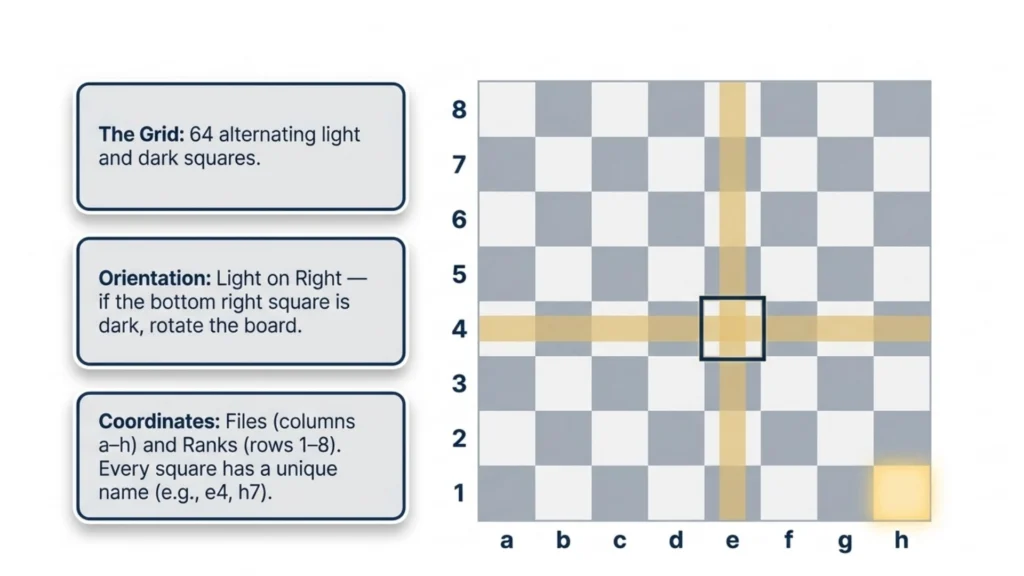
Every chess game is played on the same board consisting of 64 squares arranged in an 8 × 8 grid.
The squares alternate between light and dark colours.
One easy way to check that the board is set up correctly is to remember this rule:
The bottom-right corner should always be a light-coloured square.
If the bottom-right square is dark, simply rotate the board.
Files and Ranks
The chessboard is divided into the following:
- Files – the eight vertical columns labelled a to h.
- Ranks – the eight horizontal rows numbered 1 to 8.
| Board Part | Description |
|---|---|
| Files | Vertical columns (a–h) |
| Ranks | Horizontal rows (1–8) |
Chessboard Coordinates
Every square on the board has a unique coordinate made from one letter and one number.
Examples include:
- e4
- d5
- c3
- h7
- a1
These coordinates are used worldwide to record and study chess games.
You’ll see them in books, videos, puzzles, tournament games, and online lessons.
Why Coordinates Matter
Learning coordinates may seem difficult at first, but they quickly become second nature.
Knowing them helps you:
- Follow chess lessons
- Read chess books
- Solve puzzles
- Analyse your games
- Communicate moves clearly
Beginner Tip
Spend a few minutes each day naming random squares on the board. Within a week, you’ll recognise coordinates much more quickly.
Now that you understand how the chessboard is organised, the next step is learning how every chess piece moves.
Chess Piece Movement
Every chess piece has its own way of moving. Understanding how each piece moves is one of the most important chess basics because every move you make depends on these movement rules.
At the beginning, don’t worry about advanced strategies. Simply become comfortable with how each piece moves and captures. Once these movements become natural, learning tactics and strategy becomes much easier.
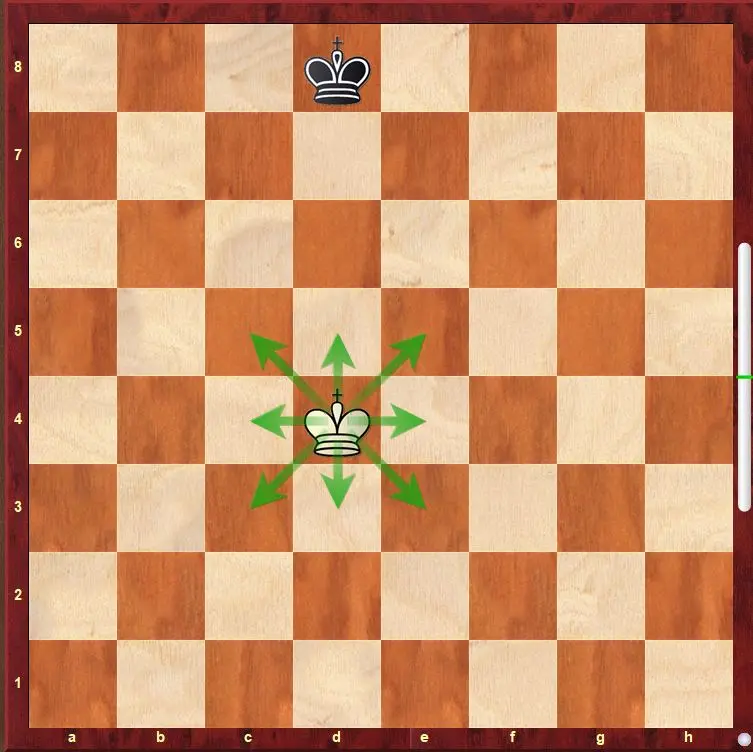
The King
The king is the most important piece in chess. Although it is not the strongest attacking piece, protecting your king is your highest priority because the game ends if your king is checkmated.
How the King Moves
- One square forward
- One square backwards
- One square sideways
- One square diagonally
In simple terms, the king moves one square in any direction.
Beginner Tip
Keep your king safe by castling early. A king left in the centre of the board often becomes the target of attacks.
The Queen
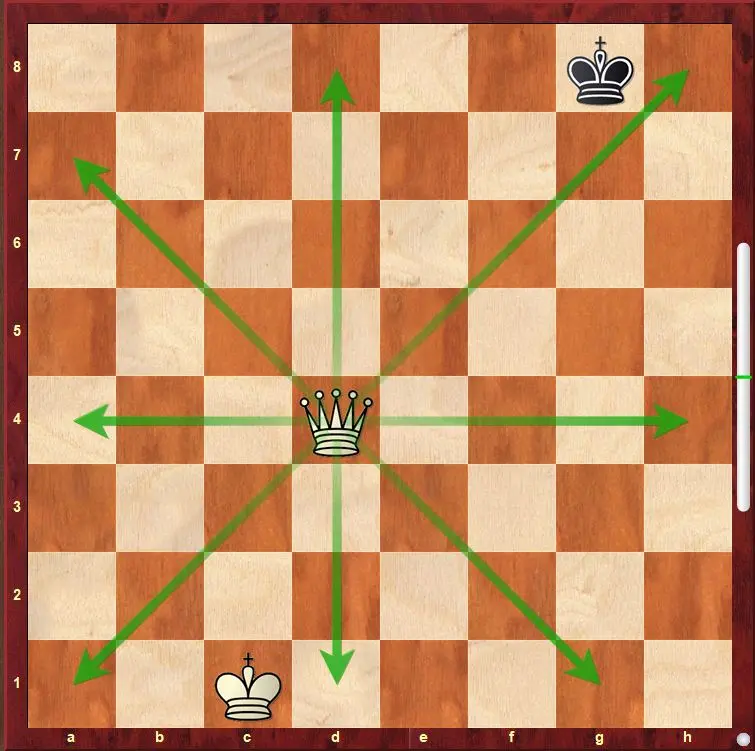
The queen is the most powerful piece on the board because she combines the movement of both the rook and the bishop.
How the Queen Moves
- Horizontally
- Vertically
- Diagonally
- Any number of squares
The queen cannot jump over pieces. If another piece blocks her path, she must stop.
Common Beginner Mistake
Many beginners move the queen too early. Although the queen is powerful, bringing her out too soon often allows your opponent to attack her while developing their own pieces.
The Rook
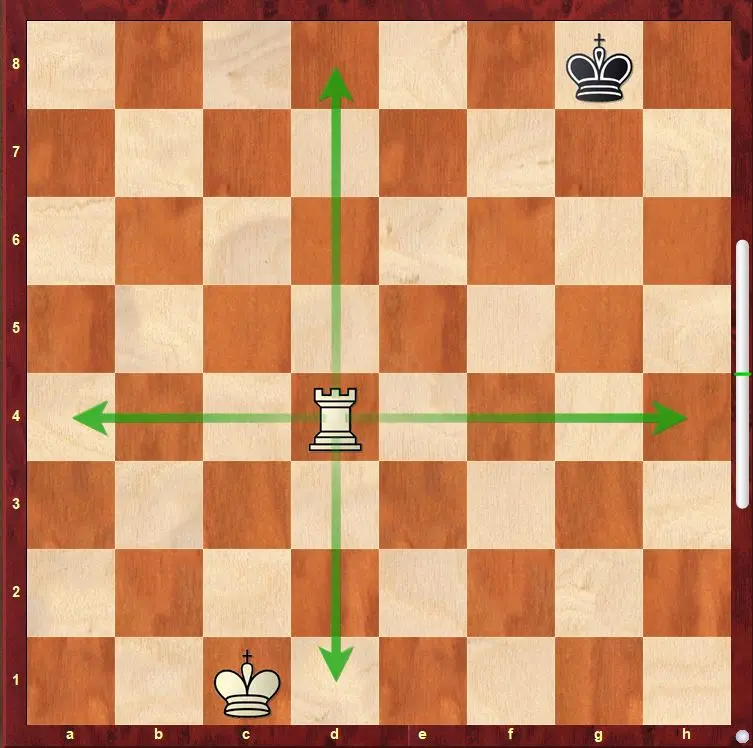
Each player starts with two rooks.
Rooks become especially powerful during the middlegame and endgame when files begin to open.
How the Rook Moves
- Horizontally
- Vertically
- Any number of squares
Like the queen, rooks cannot jump over pieces.
The Bishop
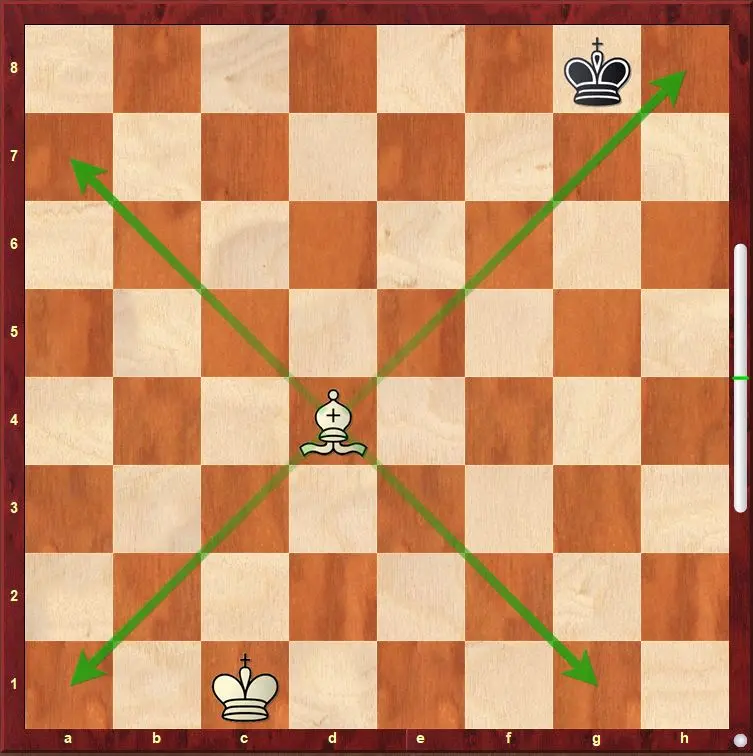
Each player starts with two bishops.
One bishop always moves on light squares.
The other always moves on dark squares.
How the Bishop Moves
- Diagonally
- Any number of squares
Because bishops stay on one colour throughout the game, both bishops work together to control different diagonals.
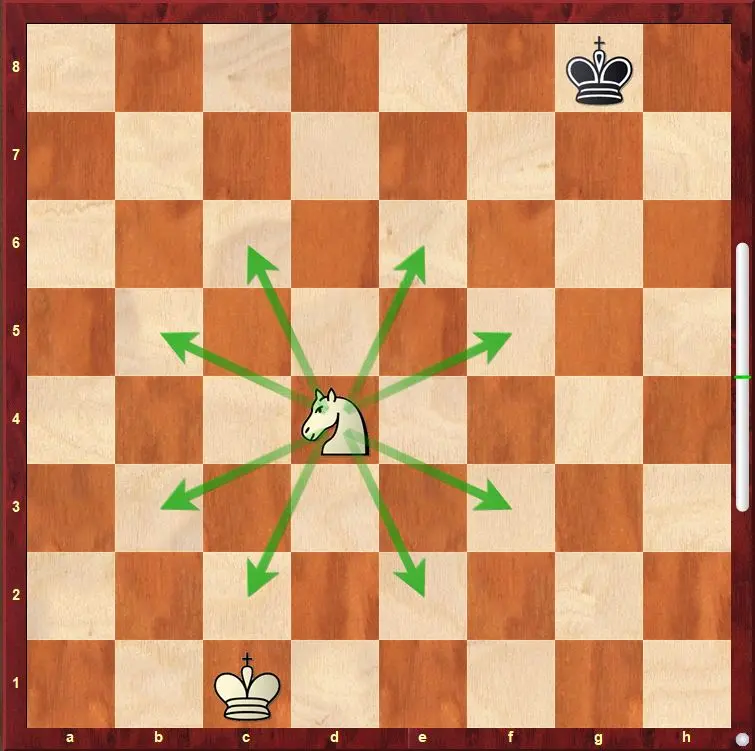
The Knight
The knight has the most unusual movement of all the chess pieces.
Unlike every other piece except the king, it can jump over pieces.
How the Knight Moves
The knight moves in an L-shape.
- Two squares in one direction
- Then one square sideways
or
- One square in one direction
- Then two squares sideways
Beginner Tip
Knights become stronger near the centre of the board because they can attack more squares.
The Pawn
Pawns may appear to be the weakest pieces, but they play an important role throughout the game.
Every player begins with eight pawns.
How Pawns Move
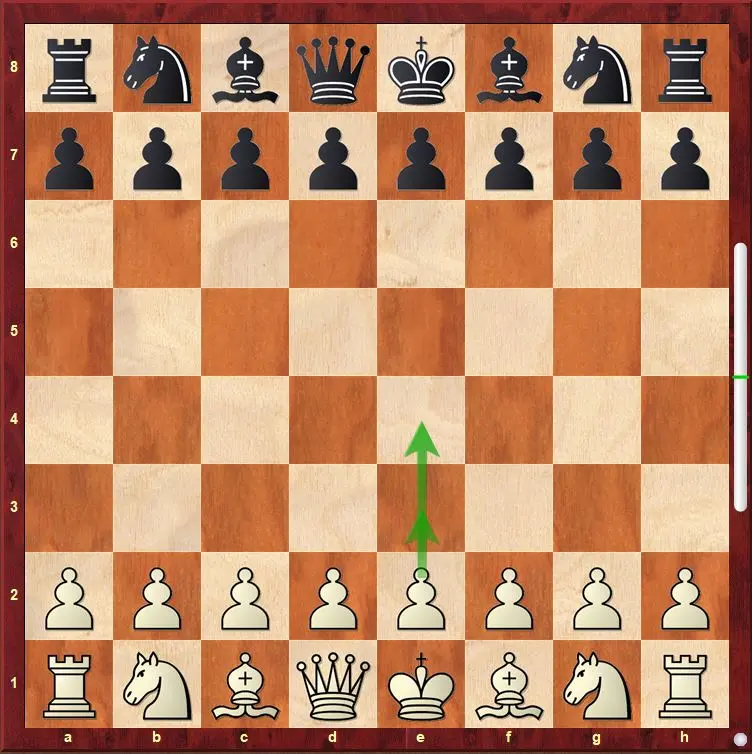
- Normally one square forward.
- On their first move, they may move one or two squares.
- Pawns never move backwards.
How Pawns Capture
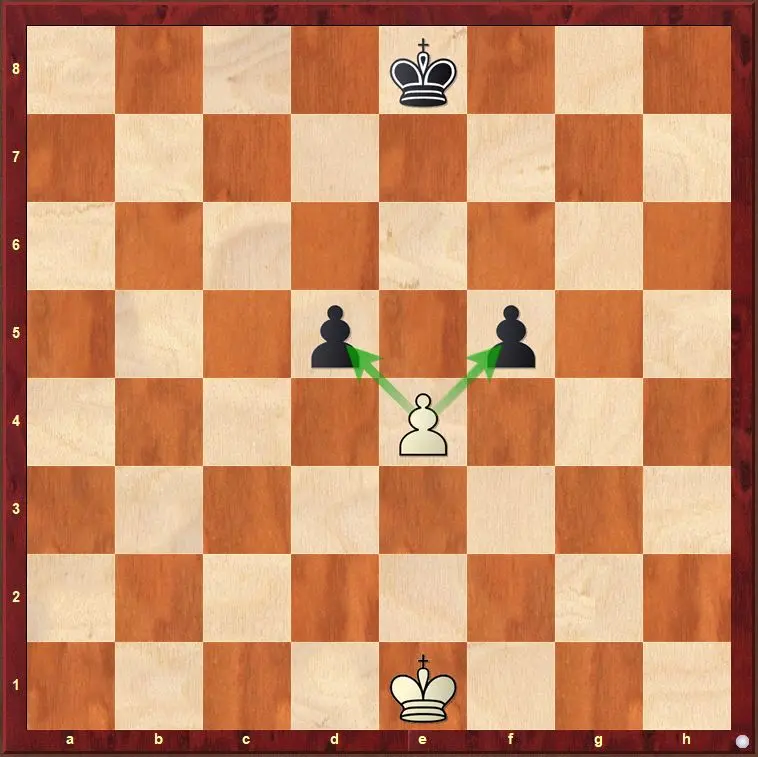
Pawns capture differently from how they move.
- Move straight forward.
- Capture one square diagonally forward.
This is one of the first rules every beginner should remember.
Chess Piece Movement Summary
| Piece | Movement |
|---|---|
| King | One square in any direction |
| Queen | Any direction for any distance |
| Rook | Horizontal and vertical |
| Bishop | Diagonal |
| Knight | L-shaped jump |
| Pawn | Forward one square, captures diagonally |
How Chess Pieces Capture
Capturing means removing one of your opponent’s pieces from the board.
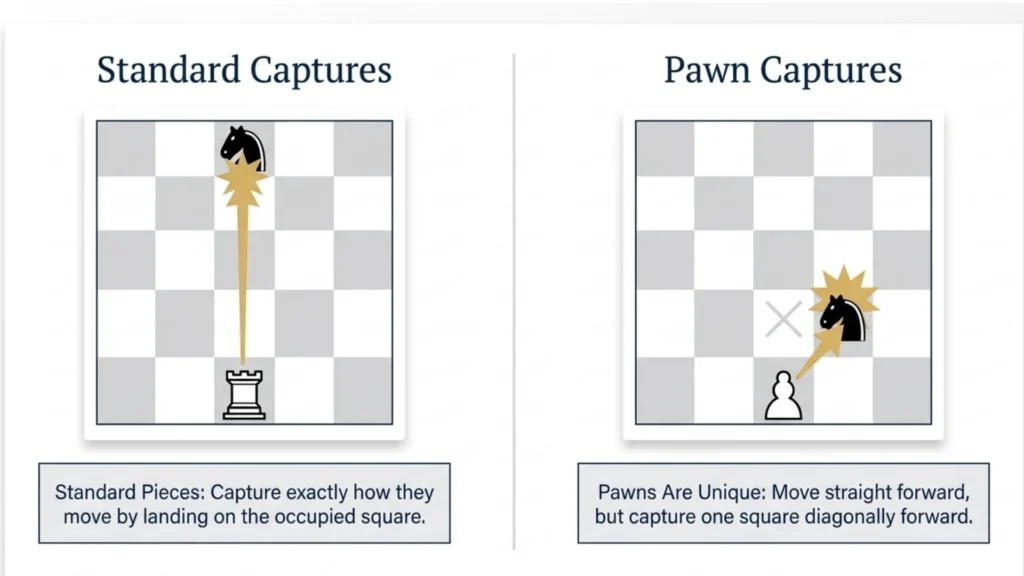
Most chess pieces capture by moving onto the square occupied by an opponent’s piece. The captured piece is then removed from the game.
For example:
- A rook captures along ranks and files.
- A bishop captures along diagonals.
- A queen captures in any direction.
- A knight captures by landing on its destination square.
Pawn Captures Are Different
Pawns are unique because they move forward but capture diagonally.
For example:
- A pawn on e4 may capture a piece on d5 or f5.
- It cannot capture a piece directly in front of it.
This simple rule causes many beginner mistakes.
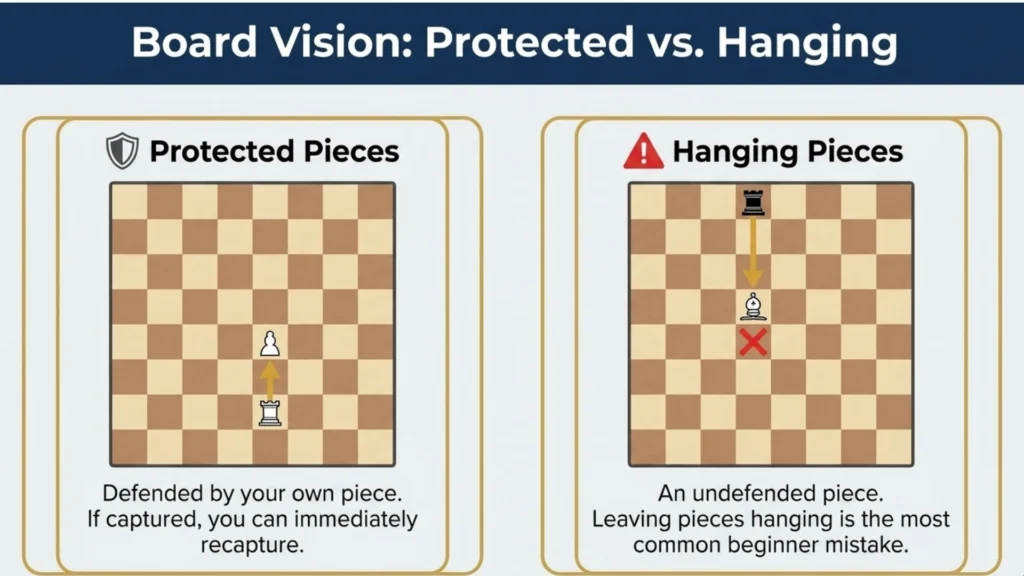
Protected Pieces
A protected piece is defended by another piece.
If your opponent captures it, you can immediately recapture it.
Before making a move, ask yourself:
- Is this piece protected?
- If my opponent captures it, can I recapture?
Developing this habit helps reduce unnecessary mistakes.
Hanging Pieces
A hanging piece is a piece that is not protected by any of your other pieces.
Leaving pieces hanging is one of the most common beginner mistakes.
Before ending every move, quickly scan the board and check whether any valuable piece has been left undefended.
Quick Habit for Beginners
- Look for checks.
- Look for captures.
- Check whether any of your pieces are hanging.
- Then make your move.
Following this simple routine will prevent many avoidable mistakes.
Now that you understand how every piece moves and captures, you’re ready to learn the rules that decide the outcome of every chess game: check, checkmate, stalemate, and the special rules of chess.
What Is Check?
A king is in check when it is directly attacked by one or more of the opponent’s pieces.
Unlike other pieces, the king can never remain under attack. If your king is in check, you must respond immediately before making any other move.
Remember: Being in check does not mean the game is over. It simply means your king is under attack and you must make a legal move to escape the threat.
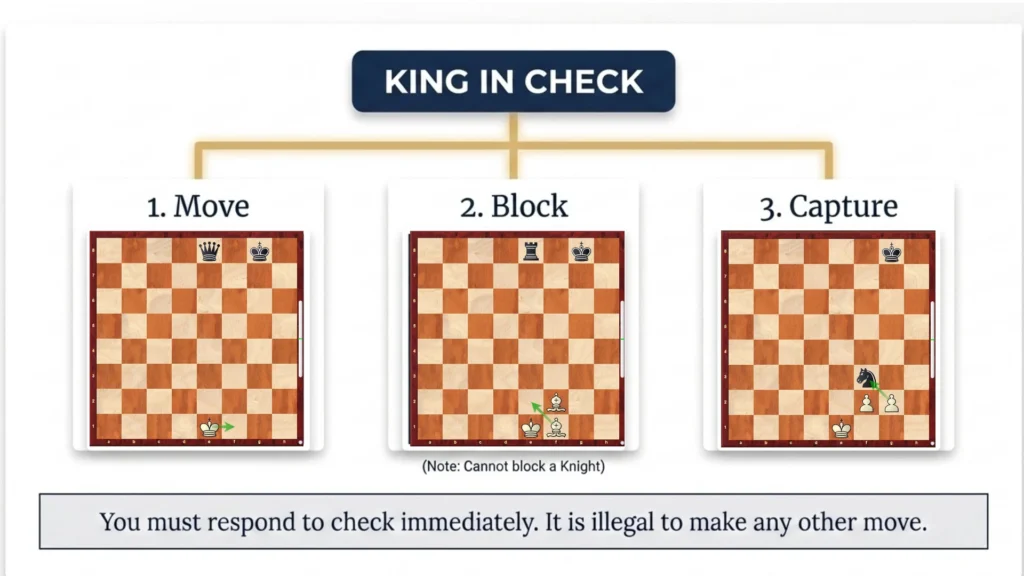
Three Ways to Escape a Check
Whenever your king is in check, there are only three legal responses.
1. Move the King
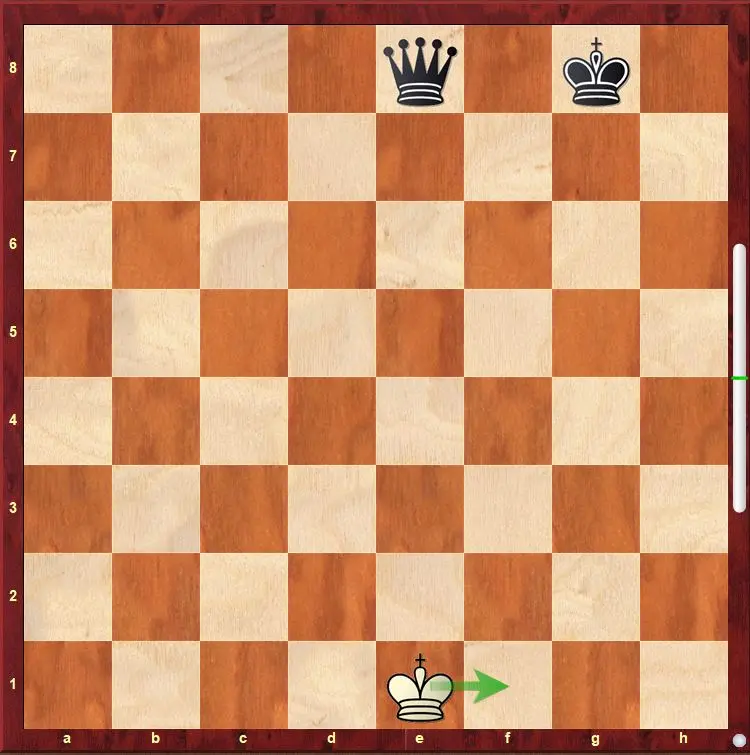
Move your king to a safe square where it is no longer under attack.
2. Block the Attack
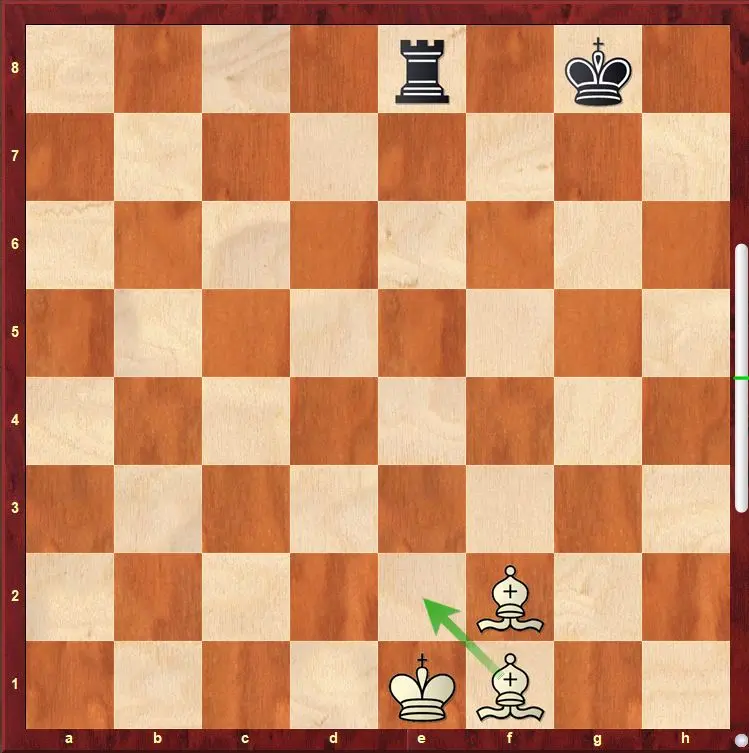
If the attack comes from a rook, bishop, or queen, you may place one of your own pieces between the attacking piece and your king.
This blocks the attack.
Note: You cannot block a knight because knights jump over pieces.
3. Capture the Attacking Piece
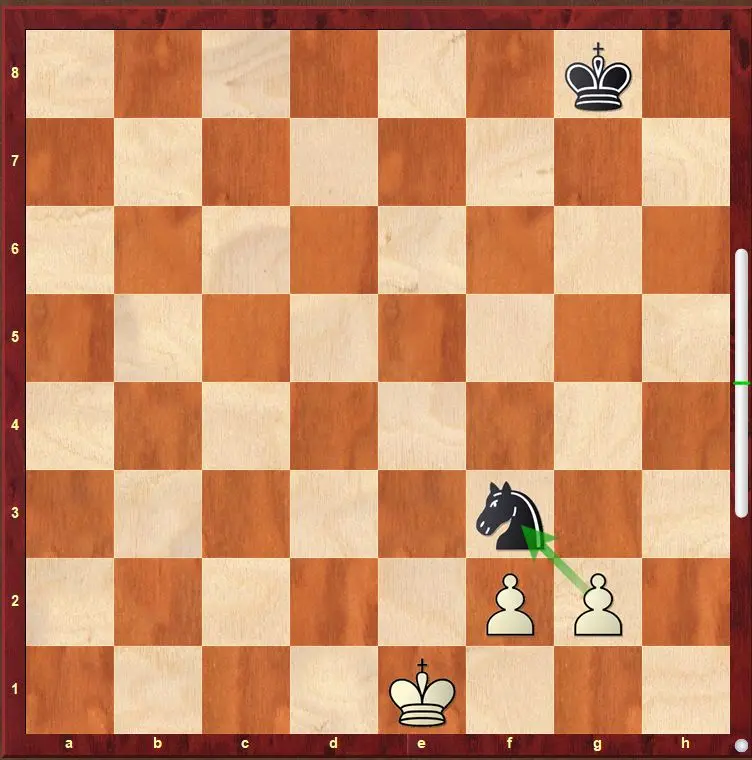
If one of your pieces can safely capture the attacking piece, you may remove the threat by capturing it.
After the capture, your king must no longer be in check.
What Is Checkmate?
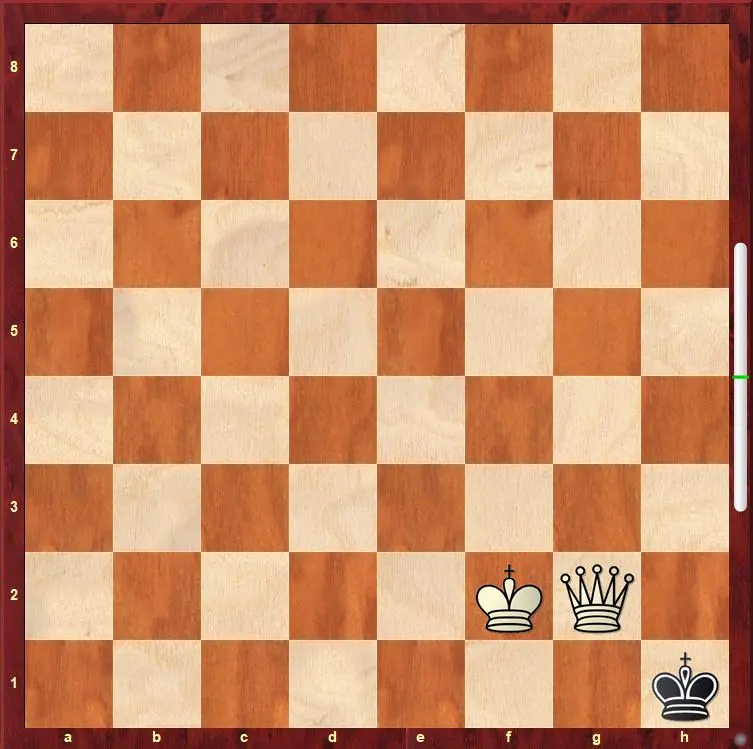
Checkmate is the objective of chess.
A player wins the game by placing the opponent’s king in check with no legal way to escape.
A position is checkmate when:
- The king is in check.
- The king cannot move to a safe square.
- No piece can block the attack.
- No piece can capture the attacking piece.
Once checkmate occurs, the game ends immediately.
Important: In chess, the king is never actually captured. The game finishes as soon as checkmate is unavoidable.
Simple Beginner Checkmates
Some checkmate patterns appear frequently in beginner games.
- King and Queen Checkmate
- King and Rook Checkmate
- Back Rank Checkmate
- Two-Rook Checkmate
Learning these patterns helps you recognise winning opportunities more quickly.
What Is Stalemate?
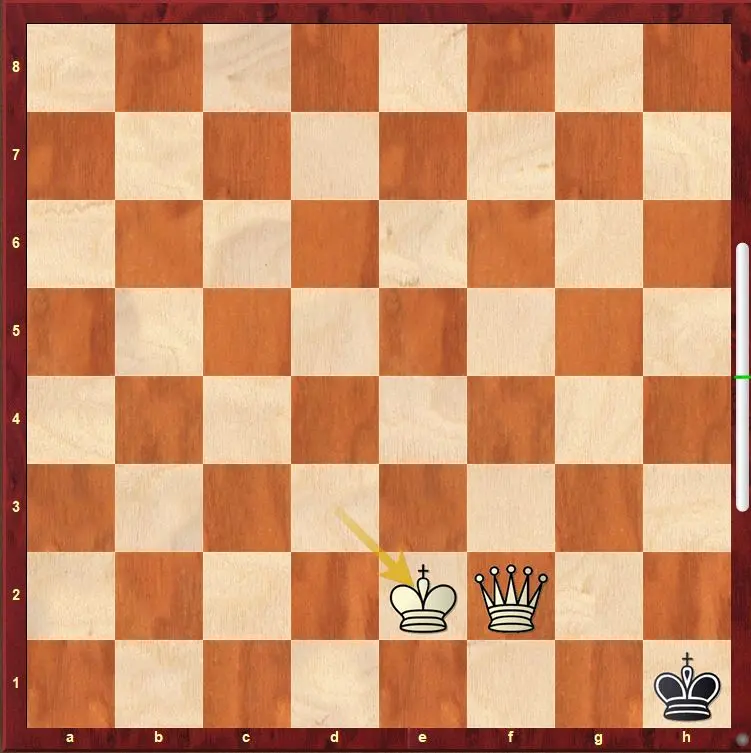
Stalemate is one of the most common drawing situations in chess.
A stalemate occurs when:
- The player whose turn it is is not in check.
- That player has no legal moves.
Instead of winning, the game ends in a draw.
Checkmate vs Stalemate
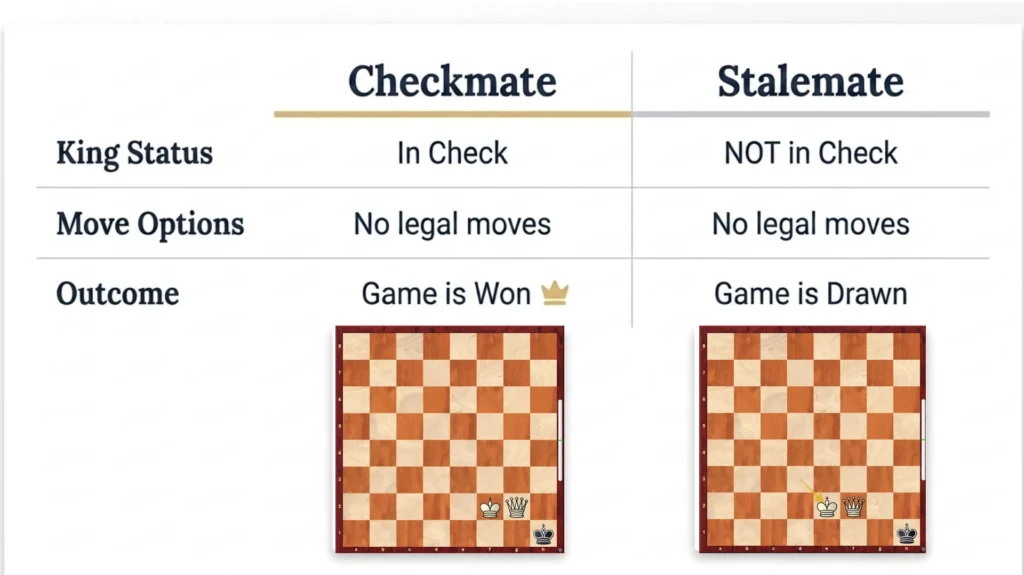
| Checkmate | Stalemate |
|---|---|
| The king is in check | The king is not in check |
| No legal escape | No legal moves |
| The game is won | The game is drawn |
Special Chess Rules
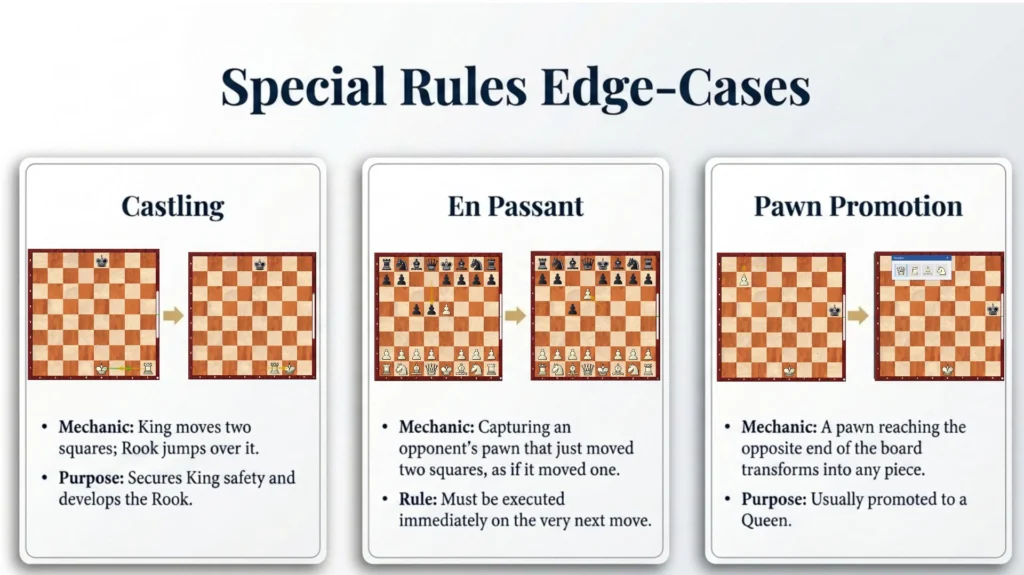
Besides the normal movement of the pieces, chess has three special rules that every beginner should know.
- Castling
- En Passant
- Pawn Promotion
Castling
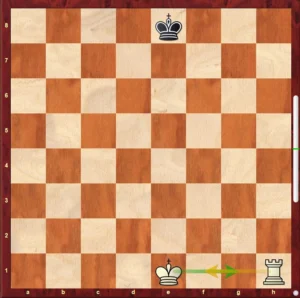
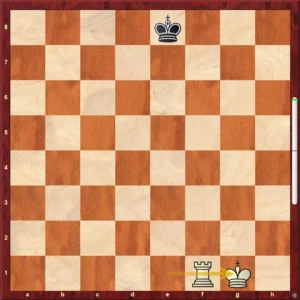
Castling is the only move in chess where two pieces move at the same time.
It involves the king and one rook.
The king moves two squares towards the rook, and the rook jumps over the king to the square beside it.
Castling improves king safety and develops the rook.
Conditions for Castling
You may castle only if:
- The king has never moved.
- The rook has never moved.
- No pieces stand between them.
- The king is not currently in check.
- The king does not move through a square under attack.
- The king does not finish on a square under attack.
Beginner Tip
In most games, castling early helps keep your king safe and brings your rook into the game.
En Passant
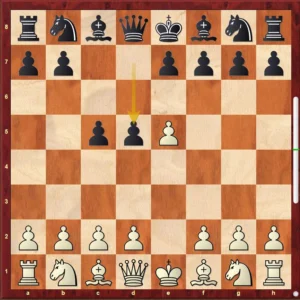
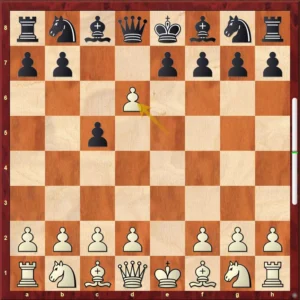
En passant is a special pawn capture that can happen only under specific circumstances.
If an opponent’s pawn moves forward two squares from its starting position and lands beside your pawn, your pawn may capture it as though it had moved only one square.
This special capture must be played immediately on the very next move.
If you play another move first, the opportunity disappears.
Pawn Promotion
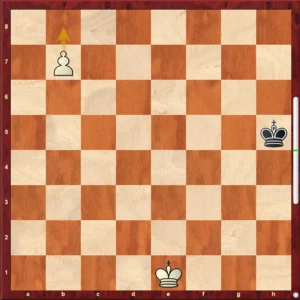
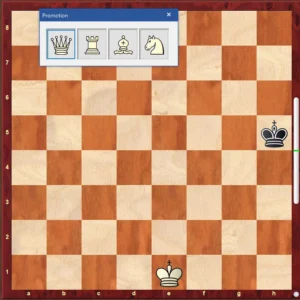
When a pawn reaches the last rank of the board, it must be promoted.
The pawn may become:
- Queen
- Rook
- Bishop
- Knight
Most players choose a queen because it is the strongest piece.
Did You Know?
A player can have two queens—or even more—through pawn promotion.
Chess Notation
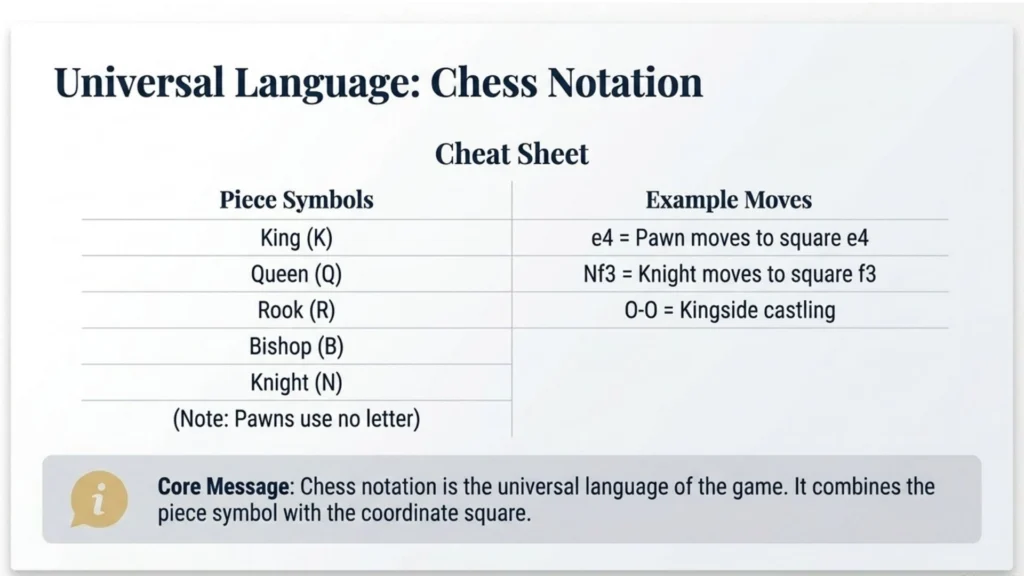
Chess notation is the standard language used to record moves.
Instead of writing full sentences, each move is written using letters and numbers.
Examples include:
- e4
- Nf3
- Bb5
- Qd2
- O-O
Piece Symbols
| Piece | Notation |
|---|---|
| King | K |
| Queen | Q |
| Rook | R |
| Bishop | B |
| Knight | N |
| Pawn | No letter |
Example Chess Moves
| Notation | Meaning |
|---|---|
| e4 | Pawn moves to e4 |
| Nf3 | Knight moves to f3 |
| Bb5 | Bishop moves to b5 |
| Qd2 | Queen moves to d2 |
| O-O | Kingside castling |
| O-O-O | Queenside castling |
Quick Review
You now understand:
- ✔ What check means
- ✔ How checkmate wins the game
- ✔ Why stalemate is a draw
- ✔ The three special chess rules
- ✔ How basic chess notation works
In the final section, you’ll learn the basic chess principles every beginner should follow, the most common mistakes to avoid, and answers to frequently asked questions.
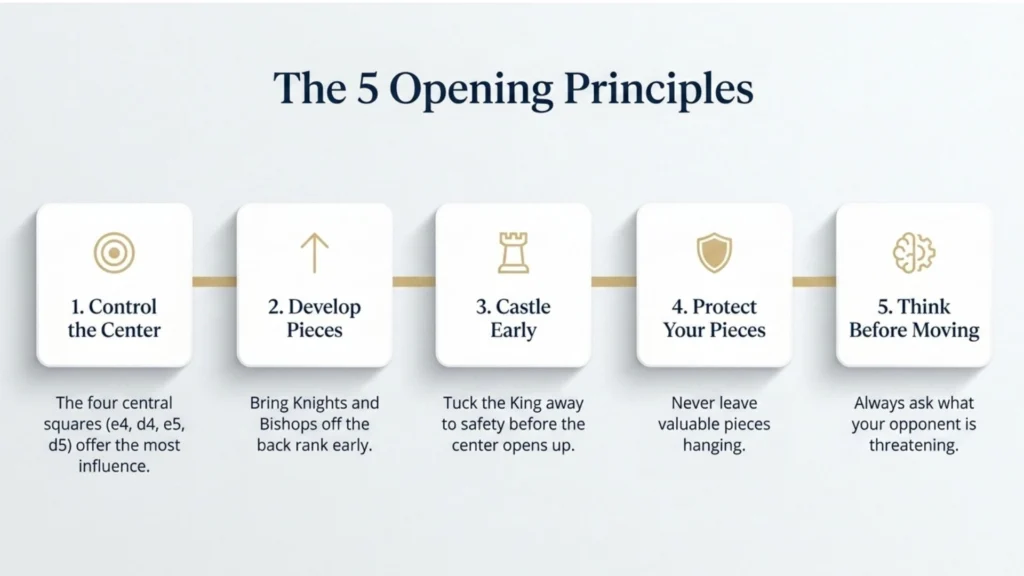
Basic Chess Principles Every Beginner Should Know
Once you understand the rules of chess, the next step is learning a few simple principles that guide good decision-making.
Unlike opening variations, these principles apply to almost every game and help beginners avoid many common mistakes.
1. Control the Centre
The four central squares—e4, d4, e5, and d5—are the most important squares on the chessboard.
Pieces placed near the centre usually have more space to move and influence more of the board.
Whenever possible:
- Move your central pawns early.
- Develop your pieces toward the centre.
Why it matters:
Controlling the centre gives your pieces greater mobility and makes it easier to launch attacks or defend your position.
2. Develop Your Pieces
Development means bringing your pieces off their starting squares into active positions.
In the opening, try to develop:
- Both knights
- Both bishops
before moving the same piece repeatedly.
Avoid spending too many moves pushing pawns unless they help your development.
3. Castle Early
Your king is safest after castling.
Castling also brings one of your rooks into the game, helping your pieces work together.
In most beginner games, castling early is a good habit.
4. Protect Your Pieces
Before making every move, quickly check whether your pieces are defended.
Many games are lost simply because players leave valuable pieces unprotected.
Ask yourself:
- Is this piece defended?
- Can my opponent capture it?
- If they do, can I recapture?
5. Think Before You Move
One of the simplest ways to improve is to slow down.
Before every move, ask yourself the following middlegame principles:
- Can I capture a piece?
- Can my opponent capture one of mine?
- Can I give a check?
- Can my opponent give a check?
- Why did my opponent play the last or previous move?
This short thinking routine helps prevent many beginner blunders.
Common Beginner Chess Mistakes
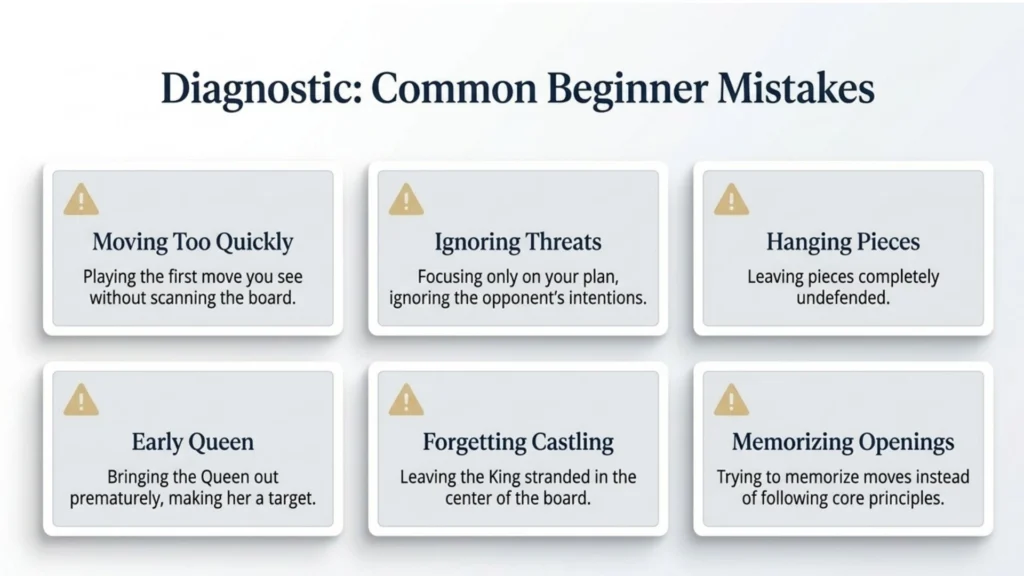
Every beginner makes mistakes while learning chess.
Recognising these mistakes early helps you improve more quickly.
Moving Too Quickly
Many beginners play the first move they notice without checking for threats.
Take a few extra seconds before every move.
Often, those few seconds are enough to spot a better move or avoid losing a piece.
Ignoring the Opponent’s Threats
New players often focus only on their own plans.
Instead, ask:
What is my opponent threatening?
Thinking from both sides of the board is an important chess habit.
Leaving Pieces Hanging
An undefended piece is called a hanging piece.
Before ending your turn, quickly scan the board to make sure every valuable piece is protected.
Moving the Queen Too Early
Although the queen is powerful, bringing her out early often allows your opponent to gain time by attacking her while developing their own pieces.
Develop your knights and bishops first.
Forgetting to Castle
Leaving your king in the centre for too long often leads to unnecessary attacks.
Whenever possible, castle early to improve your king’s safety.
Trying to Memorise Openings
Many beginners believe they must memorise dozens of opening moves.
Instead, focus on understanding:
- Centre control
- Piece development
- King safety
- Simple tactics
These ideas are much more useful than memorising long move sequences.
Quick Checklist Before Every Move
Use this simple checklist during every game.
- ✅ Is my king safe?
- ✅ Did my opponent create a threat?
- ✅ Can I capture a piece?
- ✅ Are any of my pieces hanging?
- ✅ Is there a better move?
Following this routine consistently will help you make fewer mistakes and build stronger chess habits.
Frequently Asked Questions
How long does it take to learn chess basics?
Most beginners can learn the basic rules within a few days. Becoming comfortable applying those rules in real games usually takes several weeks of regular practice.
What should I learn first in chess?
Start with the chessboard, piece movement, capturing, check, checkmate, and the special rules. These are the foundation of every game.
Should beginners memorise openings?
No. It is far more important to understand opening principles such as controlling the centre, developing pieces, and protecting the king.
What is the most common beginner mistake?
Moving too quickly without checking the opponent’s threats or leaving pieces undefended.
Is chess difficult to learn?
The rules of chess are straightforward, but mastering the game takes time and practice. Every experienced player started by learning the same basic rules.
Can children learn chess easily?
Yes. Children often learn the basic rules quickly when lessons are taught step by step with regular practice and encouragement.
What is the goal of a chess game?
The goal is to checkmate your opponent’s king while protecting your own king from being checkmated.
Can I learn chess without a coach?
Yes. Many beginners start by learning the rules independently. A coach can help correct mistakes, explain ideas more clearly, and provide structured guidance as you progress.
Key Takeaways
- Understand how every piece moves before learning advanced concepts.
- Always protect your king.
- Control the centre whenever possible.
- Develop your pieces before launching attacks.
- Castle early to improve the king’s safety.
- Think before every move.
- Review your mistakes and keep practising consistently.
What to Learn Next
Now that you’ve learned the basic rules of chess, you’re ready to explore the next stage of your chess journey.
Continue with these beginner-friendly guides:
- Learn Chess
- Chess Rules Explained
- Chess Openings for Beginners
- Chess Tactics for Beginners
- Chess Strategy for Beginners
- Chess Endgames
- How to Improve at Chess
Ready to Take the Next Step?
Learning the basics is the first step. Consistent practice and structured guidance help you build confidence, improve your decision-making, and enjoy the game even more.