
Online Chess Coaching
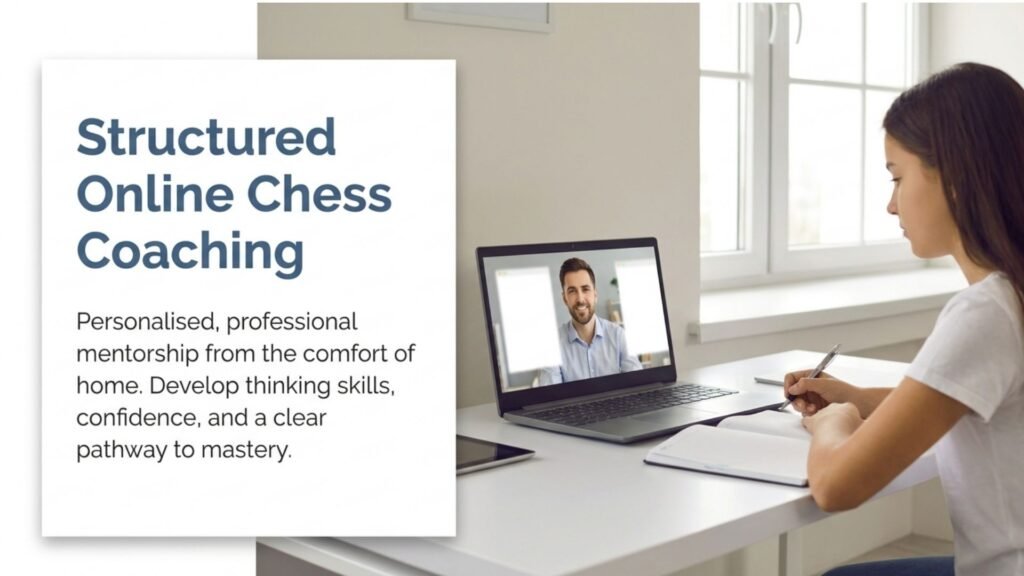
Online chess coaching has transformed the way students learn chess, making high-quality instruction accessible from anywhere in the world. Whether you are a complete beginner, a parent looking for structured coaching for your child, or an improving player aiming to take your game to the next level, online coaching combines flexibility with personalised guidance.
Unlike self-study, where learners often struggle to decide what to study next, online chess coaching provides a structured learning journey. A structured learning pathway begins with understanding the right fundamentals before moving to advanced concepts. Every lesson builds on previous knowledge, helping students understand concepts, develop good thinking habits, and apply what they learn in real games.
At Online Chess Coaching, we believe that chess is about much more than winning games or increasing ratings. It is about developing critical thinking, problem-solving skills, patience, confidence, and disciplined learning habits that benefit students both on and off the chessboard. Many parents choose chess because of the lifelong skills it develops beyond the game itself.
Rather than following a one-size-fits-all approach, coaching is adapted to each student’s current level, goals, learning pace, and interests. The result is a learning experience that is engaging, purposeful, and focused on long-term improvement.
Quick Summary
Online chess coaching provides live, interactive lessons delivered via video conferencing and digital platforms.
It is suitable for:
- Complete beginners learning chess correctly from the start
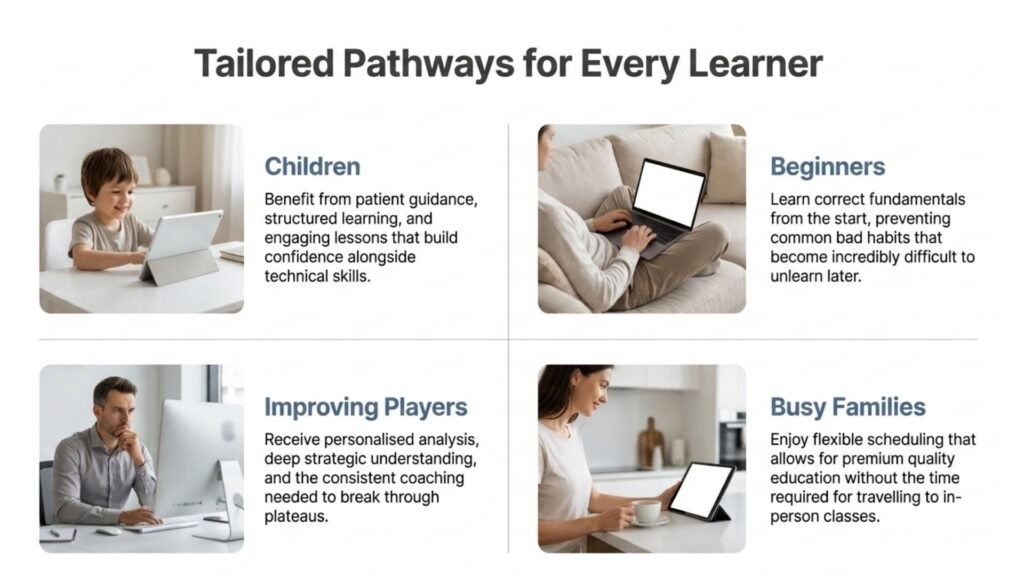
- Children who benefit from structured guidance and regular encouragement
- Improving players seeking personalised feedback
- Adults returning to chess or looking to develop their understanding
- Families who prefer the convenience of learning from home
A structured coaching programme focuses on understanding ideas, improving decision-making, and building long-term chess skills rather than simply memorising opening moves.
If you’re completely new to chess, start with our Complete Beginner Chess Guide. It explains what to learn first and how each stage builds towards becoming a stronger player before you begin structured coaching.
Why Choose Our Online Chess Coaching?
Choosing the right chess coach is one of the most important decisions in a student’s learning journey. While there are many online resources available, meaningful improvement often comes from personalised guidance, consistent feedback, and a structured learning plan.
Our coaching is designed to help students learn with confidence through:
- Personalised learning plans based on current ability and goals
- Live interactive lessons rather than passive video content
- Individual feedback during every coaching session
- Structured progression from fundamentals to advanced concepts
- Regular practice recommendations between lessons
- Ongoing progress reviews to refine learning plans
- Flexible online scheduling that fits around school and family life
- A teaching approach that prioritises understanding over memorisation
Instead of simply teaching chess moves, we help students learn how to think during a game. Strong decision-making develops from understanding positions rather than memorising moves. This creates stronger decision-making skills and builds confidence that continues to grow over time.
Why Online Chess Coaching Matters
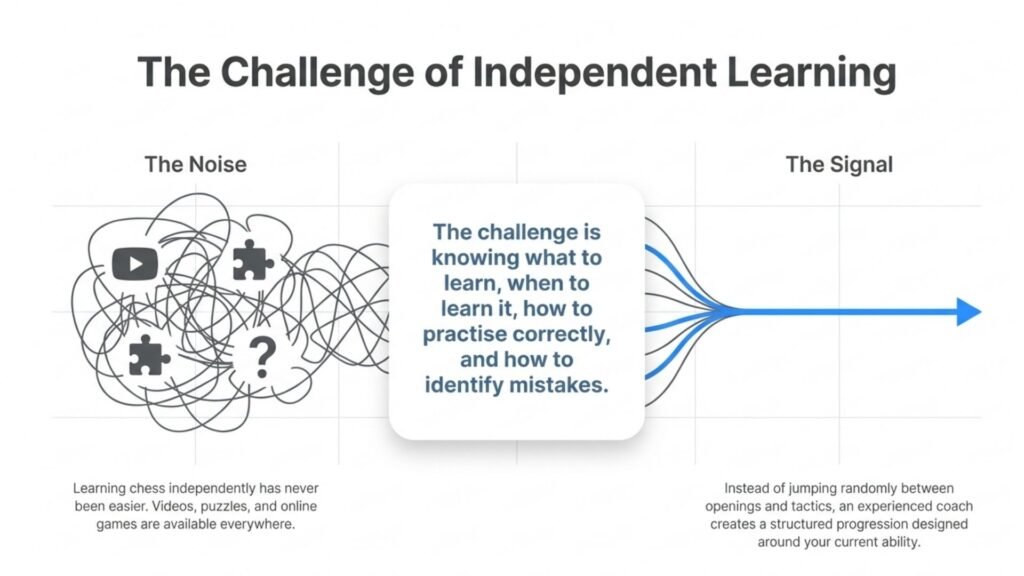
Learning chess independently has never been easier. Thousands of videos, puzzles, articles, books, and online games are available within seconds. Many learners begin with free resources before discovering the need for structured guidance.
The real challenge, however, is not finding information—it’s knowing how to use it effectively.
Many students struggle with questions such as:
- What should I learn first?
- Which openings should I study?
- How much tactical practice is enough?
- Why do I keep making the same mistakes?
- How do I know if I’m improving?
Without a structured learning plan, it is easy to spend hours studying without making meaningful progress. Many players struggle because they don’t know what to study next.
An experienced coach removes this uncertainty by creating a clear pathway based on the student’s current level and learning objectives.
Instead of jumping randomly between topics, students develop their understanding of chess in a logical sequence that builds a strong foundation before introducing more advanced ideas.
This structured approach often leads to more consistent improvement and a more enjoyable learning experience.
What Is Online Chess Coaching?
Online chess coaching is live instruction delivered through video conferencing together with digital chess platforms that allow coaches and students to analyse positions, solve exercises, review games, and play training positions together.
Because lessons are interactive, students receive immediate feedback and can ask questions throughout the session.
A typical coaching programme may include:
- Position analysis
- Tactical training
- Strategic concepts
- Opening understanding
- Endgame fundamentals
- Guided exercises
- Interactive discussions
- Practical game review
- Homework for independent practice
Rather than simply showing the best moves, coaching focuses on helping students understand why those moves work. Developing understanding instead of memorisation is one of the foundations of long-term improvement.
Benefits of Online Chess Coaching
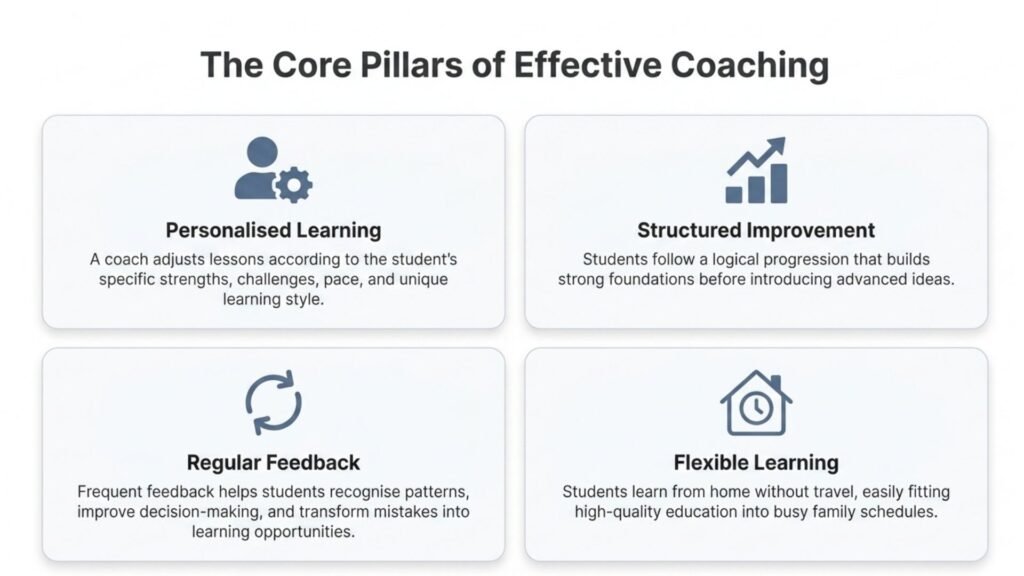
Personalised Learning
Every student learns differently.
Some students need more tactical training, while others benefit from improving positional understanding or endgame technique.
Personalised coaching allows lessons to be adapted to each student’s strengths, challenges, and pace of learning.
Structured Improvement
Improvement rarely happens by accident.
Students progress more consistently when they follow a logical learning sequence that develops strong foundations before introducing increasingly complex ideas.
Immediate Feedback
One of the biggest advantages of working with a coach is receiving feedback during the learning process.
Instead of repeating the same mistakes for months, students learn how to recognise and correct them much earlier.
Accountability
Regular lessons encourage students to maintain consistent study habits.
Knowing that games and homework will be reviewed often motivates students to practise more effectively between sessions.
Flexible Learning
Learning from home removes travel time and allows coaching to fit more easily into busy school and family schedules.
Students can access high-quality coaching regardless of where they live. Students can receive expert instruction regardless of where they live.
How Our Online Chess Coaching Works
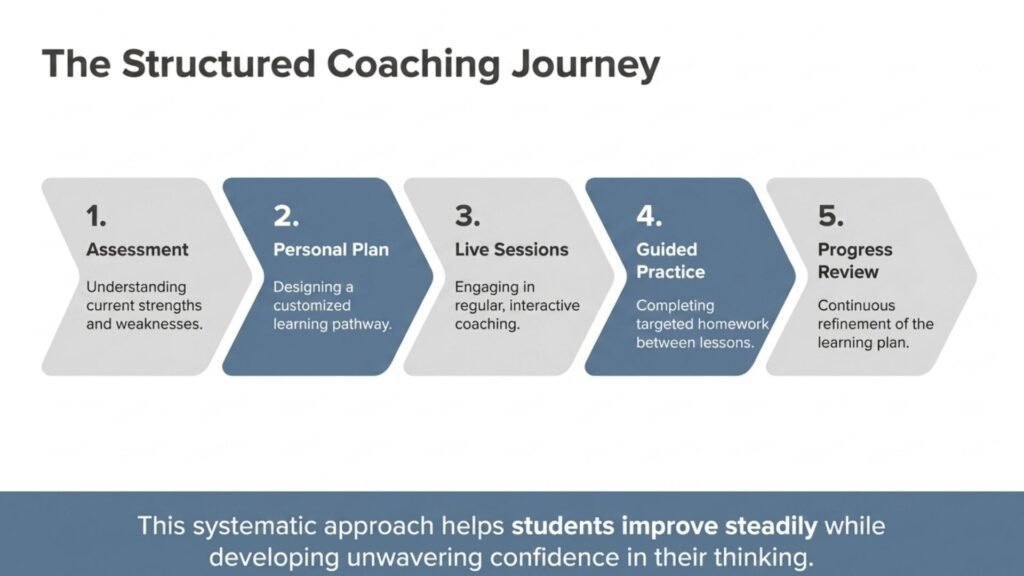
Every student’s journey is different, but a structured coaching programme generally follows a clear process.
Step 1 – Initial Assessment
Before regular coaching begins, we assess the student’s current playing strength, understanding of key concepts, learning goals, and areas that need improvement.
Step 2 – Personal Learning Plan
Based on the assessment, a structured learning plan is created.
This helps ensure lessons remain focused, progressive, and appropriate for the student’s level.
Step 3 – Regular Live Coaching
Students attend live online coaching sessions where new concepts are introduced, previous lessons are reinforced, and games are analysed together. These sessions can be delivered individually or in carefully structured small groups.
Step 4 – Guided Practice
Learning continues between lessons through carefully selected exercises, practice games, and independent study tasks.
Step 5 – Progress Reviews
As students improve, their learning plan is refined to introduce new challenges while strengthening existing skills.
This cycle of learning, practice, feedback, and review supports long-term development. Students who follow a structured pathway typically make more consistent progress over time.
Online 1-to-1 and Small Group Chess Classes
We understand that every student learns differently. Some benefit most from individual attention, while others enjoy learning alongside a small group of students with similar abilities.
To support different learning preferences, we currently offer online 1-to-1 chess coaching and small-group chess classes.
Online 1-to-1 Chess Coaching
One-to-one coaching provides a fully personalised learning experience in which every lesson is tailored to the individual student.
This format is particularly suitable for:
- Beginners who need strong foundations
- Students preparing for tournaments
- Players working towards specific rating goals
- Adults returning to chess
- Learners who prefer individual attention
During each session, the coach can focus entirely on the student’s games, strengths, areas for improvement, and long-term development.
Online Small Group Chess Classes
Small-group classes bring together students of similar playing strength, allowing them to learn in an interactive and supportive environment.
These classes combine structured instruction with opportunities for discussion, practical exercises, and collaborative learning.
Small-group coaching is ideal for students who enjoy learning with others while still benefiting from regular guidance and individual feedback.
Which Option Is Right for You?
The choice depends on the student’s learning style, experience, and goals.
| 1-to-1 Coaching | Small Group Classes |
| Fully personalised lessons | Learn alongside a small group |
| Individual learning plan | Shared structured curriculum |
| Flexible scheduling | Fixed class schedules |
| Maximum individual attention | Interactive peer learning |
| Ideal for specific goals | Ideal for collaborative learning |
If you’re unsure which option is the best fit, an initial assessment allows us to understand the student’s current level, learning objectives, and preferences before recommending the most suitable coaching format.
What Happens During a Typical Lesson?
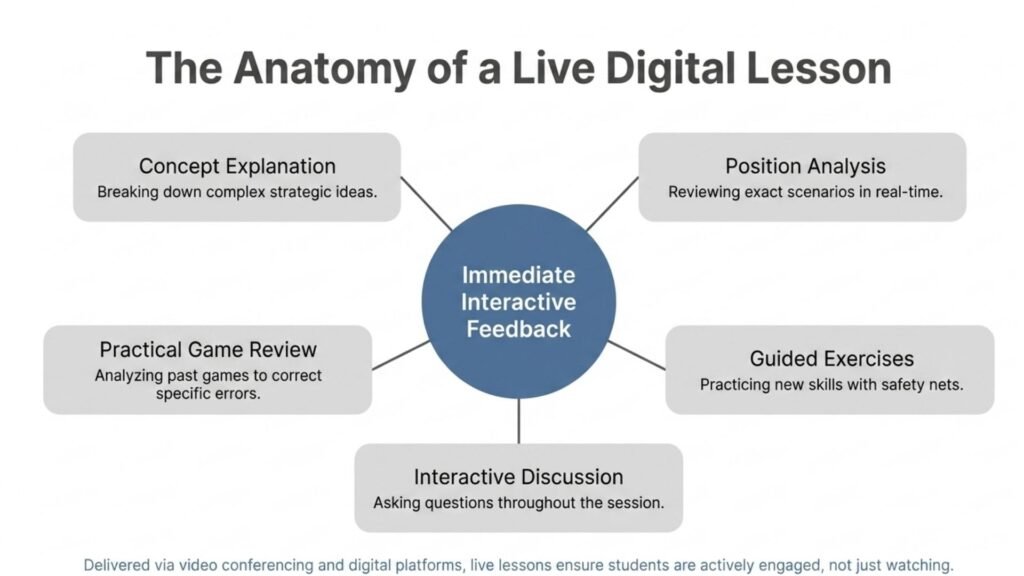
Parents often ask what actually happens during an online coaching session. Understanding what happens during a lesson helps families feel confident before starting coaching
While every lesson is adapted to the student’s needs, a typical session may include:
- Reviewing homework or recent games.
- Discussing mistakes and key learning points.
- Introducing a new concept or theme.
- Solving practical positions together.
- Playing training exercises to apply new ideas.
- Answering questions and clarifying concepts.
- Setting practice tasks for the next lesson.
This balance of explanation, discussion, and practical application helps students remain engaged while developing genuine understanding. Long-term improvement comes from understanding ideas rather than memorising moves.
Online Chess Coaching for Children
Children often benefit most from learning in a structured environment where lessons are engaging, age-appropriate, and designed to build confidence alongside chess skills.
A good coaching programme introduces new ideas gradually while encouraging curiosity, independent thinking, and a positive attitude towards learning. Many parents discover that chess supports learning far beyond the chessboard.
Rather than overwhelming young learners with theory, lessons should balance explanation with practical activities, puzzles, and games that make learning enjoyable.
For many parents, chess is not only about the game itself. They also appreciate the wider benefits that a structured learning activity can offer, including:
- Improved concentration
- Better problem-solving skills
- Greater patience
- Logical thinking
- Confidence in decision-making
- Resilience after mistakes
- Positive study habits
When children enjoy learning, they are far more likely to remain motivated and continue improving over the long term.
Online Chess Coaching for Beginners
Starting chess with the right guidance makes a significant difference.
Many beginners rely on random videos, online games, or advice from different sources. While these resources can be helpful, they often introduce ideas without explaining how they connect. Independent learning works best when supported by a clear roadmap.
As a result, beginners may:
- Learn openings before understanding basic principles.
- Memorise moves without knowing why they are played.
- Develop habits that become difficult to correct later.
- Feel unsure about what to study next.
Structured online coaching helps beginners build a strong foundation by learning the essentials in the right order.
Typical beginner topics include:
- Chess rules and notation
- Piece activity
- Basic tactical patterns
- Opening principles
- King safety
- Planning simple attacks
- Basic endgames
- Analysing completed games
Learning these fundamentals thoroughly gives students confidence as they progress to more advanced concepts.
Online Chess Coaching for Adults
Many adults return to chess after years away from the game, while others discover it for the first time later in life.
Adult learners often have different goals from younger students. Some simply want to enjoy chess as a hobby, while others wish to improve their online ratings, prepare for tournaments, or better understand the game they already love.
To support these different objectives, we currently offer:
- Personalised 1-to-1 online chess coaching
- Small-group coaching for suitable learners
Both formats provide opportunities for discussion, analysis, and personalised feedback while allowing adults to learn at a comfortable pace.
Lessons are planned around individual goals, making them suitable for players who value structured learning but need flexibility around work, family, or other commitments.
Online Chess Coaching vs Self-Learning
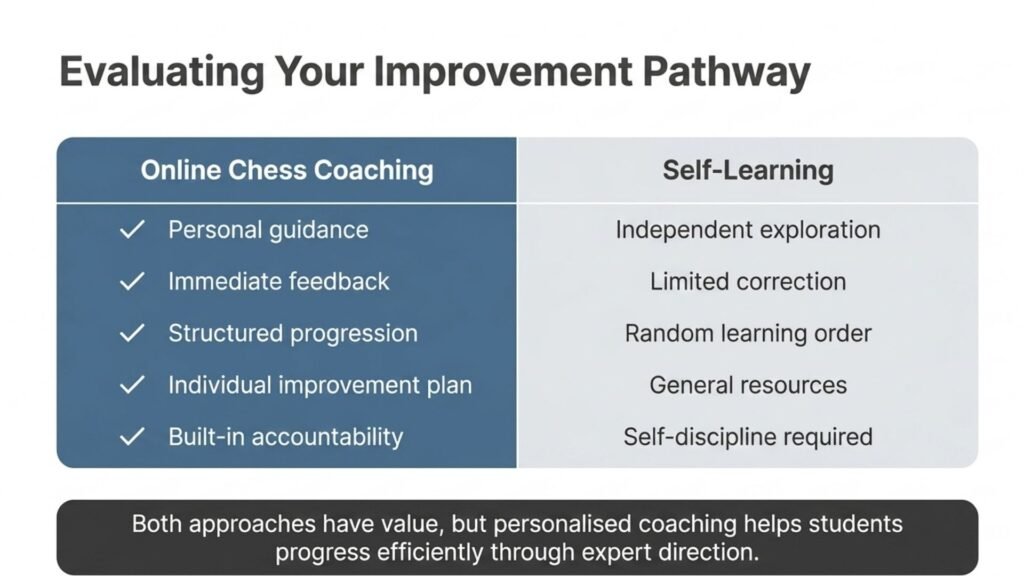
Self-learning has become more accessible than ever, with thousands of books, videos, puzzles, and online courses available.
These resources can be valuable, especially for motivated learners. However, they cannot always replace the benefits of personalised coaching.
| Online Chess Coaching | Self-Learning |
| Personalised guidance | Independent exploration |
| Immediate feedback | Limited correction |
| Structured learning plan | Random learning order |
| Individual improvement goals | General learning resources |
| Regular accountability | Self-discipline required |
| Lessons adapted to progress | Same material for everyone |
Both approaches have value.
Many students combine self-study with coaching, using independent practice to reinforce concepts introduced during live lessons.
Online Chess Coaching vs Offline Coaching
One of the most common questions parents ask is whether online coaching is as effective as traditional face-to-face lessons.
The answer often depends more on the quality of teaching than the location.
Modern online coaching allows coaches and students to share boards, analyse games together, solve exercises interactively, and communicate in real time.
| Online Coaching | Offline Coaching |
| Learn from home | Travel required |
| Flexible scheduling | Fixed locations and timings |
| Digital game analysis | Physical demonstration |
| Easy sharing of lesson material | Printed or handwritten notes |
| Access to coaches regardless of location | Limited by geography |
For many families, online coaching offers greater convenience while maintaining a highly interactive learning experience.
Common Questions Parents Ask
Parents understandably want to know whether coaching is the right investment for their child.
Some of the most common questions include:
- Is online coaching as effective as classroom learning?
- How do I know if my child is improving?
- How often should lessons be scheduled?
- What happens between lessons?
- Will my child enjoy learning online?
- Does my child need previous chess experience?
- What equipment is required?
- Can coaching prepare students for tournaments?
These questions are important because successful coaching depends on much more than lesson frequency. It relies on clear communication, thoughtful planning, regular practice, and a learning environment where students feel supported.
Coaching Perspective
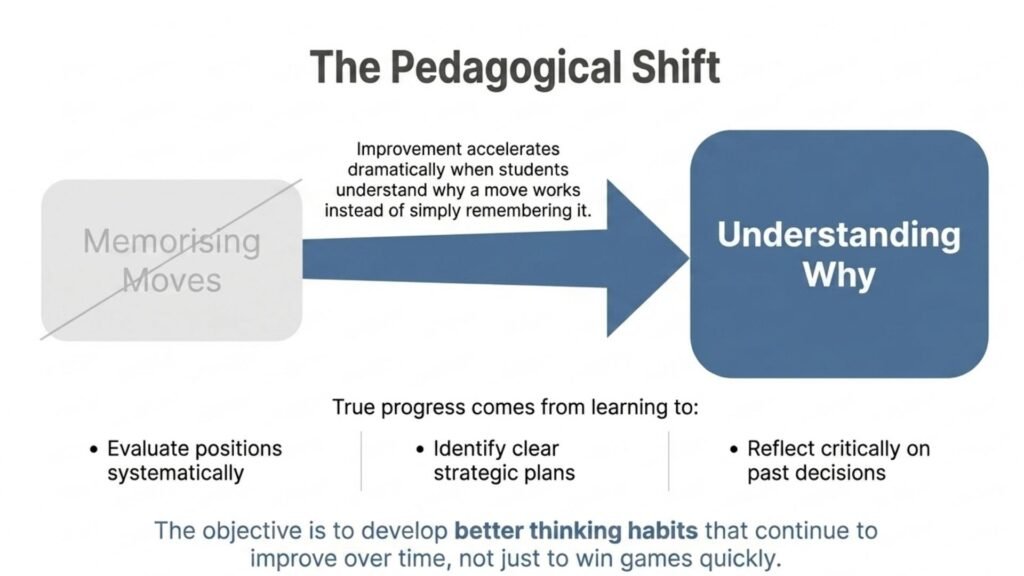
One pattern experienced coaches frequently notice is that students improve more consistently when they understand why a move is played rather than simply remembering it.
Memorisation can help in familiar positions, but chess constantly presents new situations that require independent thinking.
Students who learn how to evaluate positions, recognise plans, compare candidate moves, and reflect on their decisions often become stronger players than those who rely primarily on memorised variations.
Another observation is that confidence grows naturally when students experience steady progress. Small improvements, recognised and reinforced over time, usually lead to greater motivation than chasing quick results.
The goal of coaching is therefore not only to improve chess strength but also to help students become thoughtful, independent learners.
Parent Guidance
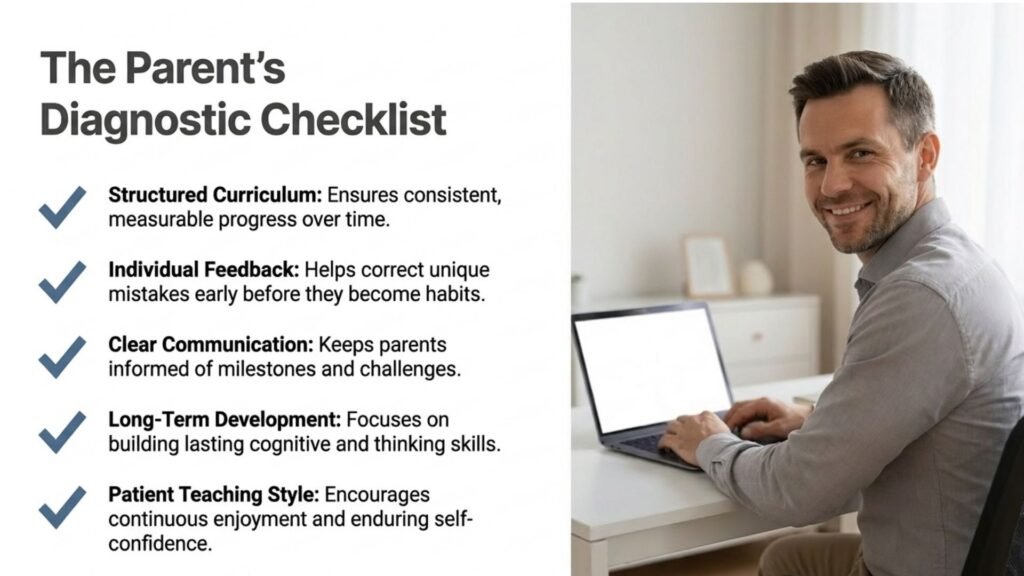
Choosing the right online chess coach involves more than comparing prices or lesson durations.
Parents should look for a coaching programme that provides both structure and individual attention.
| What to Consider | Why It Matters |
| Structured curriculum | Supports steady long-term progress |
| Personalised feedback | Corrects mistakes before they become habits |
| Clear communication | Keeps parents informed about development |
| Individual learning plans | Matches lessons to the student’s needs |
| Patient teaching style | Builds confidence and enjoyment |
| Long-term development | Focuses on understanding rather than quick fixes |
A quality coaching programme should encourage curiosity, confidence, and consistent improvement—not simply higher ratings.
Over time, these habits often become just as valuable as the chess knowledge itself.
Frequently Asked Questions
Is online chess coaching suitable for complete beginners?
Yes. Beginners often benefit the most from structured coaching because they learn correct fundamentals from the beginning. Developing good habits early makes future learning easier and helps avoid common mistakes that can become difficult to correct later.
How often should coaching sessions take place?
For most students, two lessons per week combined with regular practice provides a balanced learning routine.
The ideal frequency depends on factors such as the student’s age, experience, goals, tournament schedule, and the amount of time available for independent practice.
What technology is required for online chess coaching?
Most students only need:
- A stable internet connection
- A desktop computer, laptop, or tablet
- A webcam and microphone
- Video conferencing software
- Access to an online chess platform
No specialised equipment is required to begin learning.
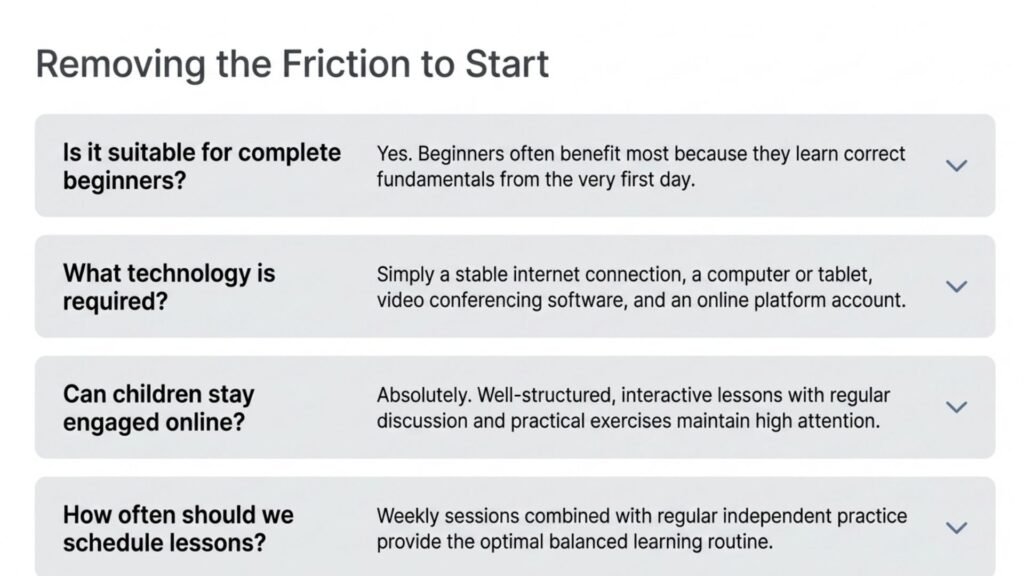
Can children stay engaged during online lessons?
Yes, when lessons are interactive and appropriately structured.
Good online coaching combines discussion, practical exercises, puzzles, game analysis, and regular interaction to keep students actively involved throughout the lesson rather than simply watching demonstrations.
Are lessons personalised for each student?
Yes.
Every student learns at a different pace and has different strengths, challenges, and goals. Coaching is adapted accordingly so that lessons remain relevant, engaging, and appropriately challenging.
Do students receive homework?
Practice between lessons is an important part of learning.
Students may receive exercises, puzzles, game analysis tasks, or other activities that reinforce concepts introduced during coaching sessions.
How is progress measured?
Progress is not measured solely by chess ratings.
Coaches also look at improvements in areas such as:
- Decision-making
- Tactical awareness
- Strategic understanding
- Calculation
- Endgame knowledge
- Confidence during games
- Consistency in applying learned concepts
Ratings often improve naturally as these underlying skills develop.
Is online coaching as effective as face-to-face coaching?
For many students, yes.
Modern online coaching allows coaches and students to analyse positions together, review games, solve exercises, and communicate in real time.
The quality of teaching, lesson structure, and student engagement generally have a greater influence on learning than whether lessons take place online or in person.
Can coaching help prepare students for tournaments?
Yes.
Tournament preparation may include opening preparation, game analysis, time management, psychological readiness, and reviewing previous tournament games to identify areas for improvement.
Can adults learn chess online?
Absolutely.
Many adults learn chess to enjoy a new hobby, improve their online ratings, prepare for competitions, or simply deepen their understanding of the game.
Our adult coaching is available through personalised 1-to-1 coaching and selected small-group classes, allowing learners to choose the format that best suits their goals.
How long does it take to improve at chess?
There is no fixed timeline.
Improvement depends on factors such as previous experience, lesson frequency, practice habits, and learning goals.
Students who attend lessons regularly and practise consistently between sessions usually make steadier progress than those who rely on occasional study alone.
What happens before regular coaching begins?
Every student’s journey starts with an assessment.
The assessment helps identify the student’s current playing strength, understanding of chess fundamentals, learning goals, and the coaching format that is most suitable.
It also provides an opportunity for students and parents to ask questions and understand what to expect from the coaching programme.
Take the Next Step
Choosing the right online chess coaching is about finding a learning environment that supports steady improvement, builds confidence, and encourages independent thinking.
Whether you are looking for personalised coaching for your child, structured guidance as a beginner, or flexible coaching as an adult, the first step is understanding your current level and learning goals.
A coaching assessment helps us evaluate the student’s strengths, identify areas for improvement, and recommend the most suitable learning pathway—whether that’s 1-to-1 coaching or small-group chess classes.
Rather than making assumptions, the assessment ensures that every student begins with a plan tailored to their individual needs, helping them learn with confidence from the very first lesson.
Book an Assessment to discuss your goals and discover the coaching approach that’s right for you.
Related Pages
Continue exploring our online chess learning resources:
- Online Chess Classes
- Online Chess Classes for Kids
- Online Chess Courses
- Chess for Kids
- Learn Chess
- Chess Coaching
- Beginner Chess Guide
- Benefits of Chess
- Book Assessment