
Tournament Chess: Complete Beginner Guide
Tournament chess can feel very different from playing casually at home or online.
The chess itself is still the same game, but the environment adds several new skills: playing with a clock, recording moves, following pairings, managing time, staying focused after mistakes and handling the emotional ups and downs of competition.
For a beginner, these practical skills can matter just as much as knowing chess openings or tactics.
This guide explains tournament chess from the ground up. You will learn how tournaments work, what to expect before and during a game, how to think under time pressure, how pairings and notation work, how to respond to wins and losses, and how to use tournament games as part of a long-term improvement process.
If you are still learning the fundamentals of chess, start with the Complete Beginner Chess Guide before focusing heavily on competitive play.
Quick Summary
- Tournament chess is organised competitive chess played through scheduled rounds, pairings, rules and time controls.
- Beginners need to prepare for the experience of playing, not only for the chess position.
- A chess clock changes how you manage your thinking time.
- Tournament pairings normally depend on the event format, previous results and, in many tournaments, ratings.
- Chess notation allows you to record and later review your games.
- Good tournament thinking means checking threats, considering candidate moves and verifying your decision before moving.
- Losing a game is not the same as failing to improve; the quality of your review matters more than the result alone.
- Parents can help most by creating calm routines and focusing on learning rather than pressure or ratings.
What Is Tournament Chess?
Tournament chess is organised competitive chess played according to the rules of a particular event.
Unlike a casual game, a tournament normally has a defined schedule, an opponent pairing system, a time control and procedures for recording and reporting results.
Depending on the event, players may compete in several rounds over a single day, a weekend or a longer period.
The purpose of tournament chess is not simply to determine who wins. For developing players, tournaments provide a practical environment in which chess knowledge has to become decision-making.
A player may know what a fork is in a lesson. The more difficult skill is recognising the opportunity during a real game while the clock is running, the opponent is thinking and the position is unfamiliar.
That is why tournament experience can become an important part of chess improvement.
Tournament Chess in Simple Terms
Think of tournament chess as:
Chess knowledge + practical decision-making + time management + competitive discipline
A beginner who develops all four gradually will usually find tournaments much easier to handle.
Why Tournament Chess Matters
Tournament play exposes gaps that are sometimes difficult to notice during casual games.
A player might perform well when there is no time pressure but struggle when the clock is running. Another might know many opening moves but lose concentration after making one mistake.
These are useful discoveries.
Tournament Chess Develops More Than Chess Knowledge
Regular competitive play can help develop:
- Decision-making under pressure
- Concentration
- Time awareness
- Emotional control
- Patience
- Resilience
- Practical calculation
- Ability to evaluate unfamiliar positions
- Respect for opponents and tournament officials
The important point is that these skills should develop progressively.
A beginner does not need to become completely comfortable with tournament pressure before entering a tournament. Tournament experience itself is part of the learning process.
A Useful Change in Mindset
Instead of asking:
“Did I win?”
also ask:
“What did this game teach me?”
That second question is often more useful for long-term improvement.
Online Chess vs Over-the-Board Tournament Chess
Both online and over-the-board tournaments can provide competitive experience, but the practical demands are different.
| Online Tournament Chess | Over-the-Board Tournament Chess |
|---|---|
| Played on a digital board | Played on a physical board |
| Clock is usually integrated into the interface | Player operates a physical chess clock |
| Moves are automatically recorded | Player may need to record moves |
| Convenient for frequent practice | Provides a fuller tournament environment |
| Easy access to many games | Requires preparation and travel |
| Less emphasis on physical tournament procedures | Requires etiquette, pairing, scoresheet and board awareness |
Neither format replaces the other.
Online play can be useful for developing speed, pattern recognition and competitive habits. Over-the-board tournaments add practical skills such as handling a physical clock, recording moves and concentrating in a tournament environment.
For a child preparing for their first serious event, it is helpful to practise these practical skills before tournament day rather than expecting everything to feel natural immediately.
How Chess Tournaments Work
A tournament is usually divided into rounds.
Before each round, players receive an opponent. They then play their game under the event’s specified time control and rules.
After the game, the result is recorded and the tournament organiser uses the results to determine later pairings.
Different tournaments use different formats.
Swiss System
The Swiss system is common in chess tournaments.
Players normally do not play every other participant. Instead, pairings are created round by round, generally taking previous scores into account.
This means that a player who wins a round may face another player who has also performed well.
A beginner therefore does not need to understand every detail of the pairing algorithm. The practical lesson is simpler:
Play each round independently and follow the official pairing information provided by the organiser.
Round Robin
In a round-robin event, players are scheduled to play against each other according to the tournament structure.
This format works particularly well for smaller groups because everyone can play the other participants.
Knockout Tournament
A knockout event is structured around elimination.
Depending on the rules, losing may mean leaving the main competition, while winning allows the player to continue.
Arena-Style Events
Online events may use arena-style formats in which players are continuously matched during a defined period.
The exact rules vary by platform and event.
What Beginners Should Focus On
Do not spend too much energy trying to understand tournament mathematics before your first event.
Know:
- Where to find your pairing.
- Which board you are playing on.
- Which colour you have.
- What time the round begins.
- What the time control is.
- What to do when the game finishes.
The tournament organiser’s instructions always take priority.
Chess Clocks and Time Controls
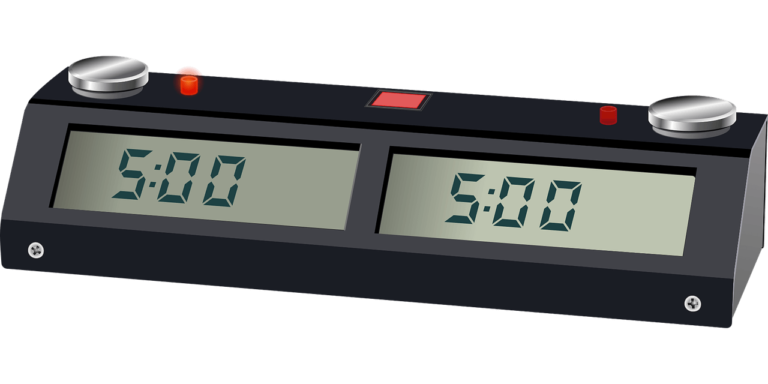
The chess clock is one of the biggest differences between casual and tournament chess.
A chess clock gives each player a specific amount of thinking time. When you make your move, you press the clock so your opponent’s time begins.
The exact clock procedure depends on the tournament rules and equipment.
Common Time-Control Categories
You may hear terms such as:
- Bullet: Extremely fast chess, usually measured in minutes or less.
- Blitz: Fast chess with limited thinking time.
- Rapid: Faster than classical chess but generally allows more thinking time than blitz.
- Classical: Longer time controls designed to allow deeper calculation and strategic thinking.
The exact time limits can vary between events and governing organisations.
Why Time Management Matters
A common beginner mistake is treating every position as though it deserves the same amount of thought.
It does not.
Some moves are obvious. Others require careful calculation.
A useful principle is:
Spend more time when the position demands a decision, not simply because the position looks complicated.
A Simple Time-Management Framework
1. Recognise
What has changed in the position?
2. Check
Does your opponent have a threat, tactic or forcing move?
3. Calculate
Which serious candidate moves deserve attention?
4. Decide
Choose the move that best fits the position.
5. Move and continue
Do not keep analysing a decision after you have already reached a sound conclusion.
The Opposite Mistake: Moving Too Quickly
Time management does not mean playing quickly.
If you move instantly and overlook a simple tactic, saving three minutes has no value.
A better goal is:
Think enough to make a reliable decision, then move.
How to Prepare for a Chess Tournament
Tournament preparation begins before you arrive at the board.
The best preparation is usually simple and repeatable.
Trying to learn huge amounts of chess the night before a tournament often creates anxiety rather than confidence.
The Day Before
Focus on:
- Normal sleep
- Light chess review
- Preparing tournament materials
- Checking the event schedule
- Eating normally
- Staying hydrated
- Avoiding unnecessary late-night study
If you are a beginner, review familiar patterns rather than trying to memorise a completely new opening.
Tournament-Day Preparation
Arrive with enough time to:
- Complete registration if required.
- Find the playing area.
- Understand where pairings will be displayed.
- Locate your board.
- Settle down before the round begins.
- Check that you have everything you need.
A rushed arrival can create unnecessary pressure before the game has even started.
Beginner Tournament Checklist
- Tournament registration details
- Chess board or equipment if required by the event
- Pen or pencil if needed for notation
- Water
- Light snack
- Tournament schedule
- Comfortable clothing
- Enough travel time
- Calm mindset
What Should You Do Before Your First Move?
When you sit down at the board, resist the temptation to think about winning immediately.
Your first responsibility is to settle into the position.
Check:
- Your colour
- Your opponent
- The board orientation
- The clock
- Your scoresheet if one is being used
- The tournament instructions
Then begin the game normally.
A tournament is not a special version of chess in which every move must be brilliant.
You still need to follow good chess principles:
Develop → Protect → Observe → Calculate → Decide
A Practical Tournament Thinking Process
Strong practical play comes from a repeatable thinking process.
You do not need to calculate every possible move. You need to identify the important possibilities and verify your decision.
Step 1: What Did My Opponent’s Move Change?
Before immediately planning your own move, look at the new position.
Ask:
- Did a piece become attacked?
- Did a file or diagonal open?
- Did the king become less safe?
- Is there a tactical threat?
- Did my opponent create a new weakness?
This prevents you from playing the move you planned before your opponent changed the position.
Step 2: Check Forcing Moves
Look for:
- Checks
- Captures
- Threats
- Tactical opportunities
You do not automatically have to play a forcing move. The purpose is to notice important possibilities before making a quiet move.
Step 3: Generate Candidate Moves
Do not analyse ten moves equally.
Choose a small number of serious candidates.
For example:
- A tactical move
- A developing move
- A defensive move
- A move that improves your worst-placed piece
Then compare them.
Step 4: Calculate
Ask:
“If I play this move, what is my opponent’s strongest reply?”
This question is especially valuable for beginners.
Do not calculate only the line you hope will happen.
Step 5: Verify Before Moving
Before touching the piece, make one final check:
What can my opponent do immediately after this move?
This simple habit can prevent many one-move blunders.
A Tournament Thinking Framework
THREAT → CANDIDATES → CALCULATE → VERIFY → MOVE
Threat
What changed? What does my opponent want?
↓
Candidates
What are my serious choices?
↓
Calculate
What happens after each important choice?
↓
Verify
What is my opponent’s strongest reply?
↓
Move
Make the decision confidently and continue.
The objective is not to think forever.
The objective is to make your thinking consistent.
Practical Tournament Examples
Example 1: You See a Possible Capture
You notice that you can capture an opponent’s pawn.
Do not automatically take it.
Ask:
- Why is the pawn available?
- Is the capturing piece safe?
- What happens after the capture?
- Does my opponent have a stronger response?
The lesson is simple:
An available capture is an invitation to calculate, not an instruction to capture.
Example 2: You Make a Mistake
Suppose you overlook a tactic and lose a piece.
The next decision is psychological as well as chess-related.
You might think:
“I have already lost. I need to attack immediately.”
That reaction can create another mistake.
Instead:
- Accept the new position.
- Identify what compensation exists.
- Look for your opponent’s weaknesses.
- Continue making the best decisions available.
A game is not finished merely because something went wrong.
Example 3: You Have Plenty of Time
Having a large amount of time does not mean you should analyse every legal move.
Ask whether the position actually requires deep calculation.
If the best move is clear, make it.
Save your time for positions where the evaluation is genuinely uncertain.
Common Beginner Tournament Mistakes
1. Moving Too Quickly
Fast moves often come from nervousness rather than confidence.
Better approach: pause briefly and complete your verification process.
2. Spending Too Much Time on the Opening
Beginners sometimes spend a large portion of their clock trying to remember exact opening moves.
Better approach: understand the purpose of your opening moves and start thinking independently when the position becomes unfamiliar.
3. Ignoring the Opponent’s Threat
Players may continue with their own plan without asking what the opponent has just changed.
Better approach: begin every move by observing the new position.
4. Panicking After a Mistake
One mistake can lead to another if emotions take over.
Better approach: treat the position after the mistake as the new starting point.
5. Watching Other Games
During a tournament, your own game deserves your attention.
Looking around can reduce concentration and may create unnecessary comparison.
6. Obsessing Over Ratings
Ratings are useful measurements, but they are not a complete description of a player’s development.
A player can improve significantly before the rating catches up.
7. Trying to Win Every Position
Not every position needs an attack.
Sometimes the best practical decision is to improve a piece, defend a weakness or simplify.
8. Failing to Review Games
A tournament without game review can become a collection of results rather than a learning experience.
The games contain the most useful evidence about what you should practise next.
Tournament Etiquette
Good tournament behaviour is part of becoming a strong competitive player.
Players should generally:
- Respect opponents.
- Follow the event’s instructions.
- Remain quiet during games.
- Avoid distracting other players.
- Handle chess equipment carefully.
- Record moves correctly when required.
- Follow clock procedures.
- Speak to arbiters respectfully.
- Accept results calmly.
If you are unsure about a rule, ask the tournament arbiter rather than arguing with your opponent.
The Result Is Not a Character Judgment
Winning does not make a player a better person.
Losing does not make a player a worse one.
Competitive chess should teach players to make decisions, respond to setbacks and continue learning.
That is particularly important for children.
How Chess Tournament Pairings Work
Pairings depend on the tournament format.
In many Swiss-system tournaments, the pairing process considers factors such as players’ current scores and tournament constraints.
You may therefore face different types of opponents from round to round.
What a Beginner Should Check
Before each round, confirm:
- Your name
- Your opponent
- Your colour
- Your board number
- The round number
Do not assume your next opponent will be the same type of player as the previous one.
A tournament is a sequence of new positions and new decisions.
Chess Notation for Tournament Players
In many over-the-board tournaments, players record their moves using algebraic chess notation.
Examples include:
- e4 — pawn moves to e4
- Nf3 — knight moves to f3
- Bb5 — bishop moves to b5
- O-O — kingside castling
- Qxd5 — queen captures on d5
- + — check
- # — checkmate
You do not need to memorise every notation rule in one sitting.
Start by becoming comfortable recording simple moves accurately.
Why Notation Matters
Notation gives you a record of the game.
That record can later be used to:
- Review mistakes
- Identify critical positions
- Compare decisions
- Study tactics
- Understand time-management problems
- Discuss the game with a coach
For a developing player, the scoresheet can become one of the most useful learning records from a tournament.
How to Handle Wins and Losses
A tournament may contain games that feel very different from one another.
You might win a game you expected to lose.
You might lose a game you thought you would win.
You might play brilliantly for one round and make simple mistakes in the next.
That is normal.
After a Win
Do not assume everything was perfect.
Ask:
- Where did I feel uncertain?
- Did I miss any tactics?
- Did I use my time well?
- Which decisions were difficult?
After a Loss
Do not immediately label the game a failure.
Ask:
- Where did the game change?
- What was the first important mistake?
- Did I understand the position?
- Did I have a better option?
- What should I practise next?
The goal is to turn the result into information.
Post-Game Analysis: How to Learn From a Tournament Game
Post-game analysis should not begin with an engine score.
First, try to understand the game yourself.
Step 1: Reconstruct the Game
Use your scoresheet or saved game record.
Step 2: Identify Critical Moments
Look for positions where:
- You were unsure what to do.
- The evaluation changed significantly.
- You spent a lot of time.
- You moved quickly despite uncertainty.
- A tactical opportunity appeared.
- You made a serious mistake.
Step 3: Ask What You Were Thinking
This is one of the most valuable questions.
Do not only ask:
“What was the best move?”
Also ask:
“Why did I choose my move?”
If the reason was based on an incorrect assumption, you have discovered a thinking problem rather than merely a move mistake.
Step 4: Compare Alternatives
Find the move you played and compare it with one or two realistic alternatives.
Step 5: Use Technology as a Verification Tool
Chess engines can help identify tactical or positional errors, but they should support understanding rather than replace it.
The important question is not simply:
“What move does the engine prefer?”
It is:
“Why was that move stronger?”
How to Improve After a Tournament
Tournament improvement works best when games are converted into training priorities.
A useful cycle is:
Play → Review → Identify Pattern → Practise → Play Again
For example, imagine that several games reveal missed tactical threats.
The answer may not be “play more tournaments.”
The better response may be to spend a period practising tactical awareness and verification.
If several games show poor time management, your training should include timed positions and decision-making exercises.
If you repeatedly reach unfamiliar strategic positions without a plan, you may need more work on chess strategy.
The tournament tells you what needs attention.
How Strong Tournament Players Think
Strong tournament players are not necessarily thinking about more things at once.
They are often better at identifying which things matter.
They monitor:
- Opponent threats
- King safety
- Tactical possibilities
- Piece activity
- Pawn structure
- Candidate moves
- Position evaluation
- Time remaining
- Their own emotional state
They also understand when deep calculation is necessary and when a simpler decision is sufficient.
Strong Thinking Is a Process
A useful progression is:
Notice → Question → Calculate → Compare → Verify → Decide
The strength of this process comes from consistency.
You do not need to think like a master on your first tournament day.
You need to build habits that become more reliable over time.
A Simple Tournament Improvement Roadmap
Stage 1: Become Comfortable
Learn:
- Tournament procedures
- Clock handling
- Basic notation
- Pairing systems
- Etiquette
Stage 2: Build Reliable Thinking
Practise:
- Checking threats
- Candidate moves
- Tactical verification
- Basic time management
Stage 3: Review Your Games
After each tournament, identify recurring mistakes.
Stage 4: Train the Weakest Area
Turn your most common mistake into a specific training topic.
Stage 5: Return to Competition
Play again and look for evidence of improvement.
Stage 6: Build Independence
Over time, the player should need less external prompting to:
- Manage time
- Check threats
- Review games
- Identify weaknesses
- Plan training
That is a more meaningful measure of progress than tournament results alone.
Parent Guide for Tournament Chess
For parents, tournament chess can sometimes be harder emotionally than expected.
You may watch your child lose a game after hours of preparation and immediately want to understand what went wrong.
The most helpful response is usually calmer.
Parents do not need to become chess experts to support a child effectively.
Before the Tournament
Help create:
- Adequate rest
- A predictable routine
- Enough travel time
- Appropriate food and water
- Calm expectations
Avoid turning the tournament into a test of your child’s worth.
During the Tournament
Allow the player to focus.
Avoid:
- Giving unsolicited chess advice between moves
- Comparing them constantly with other children
- Treating every result as significant
- Creating pressure around rating changes
The player needs to experience the game as their own learning environment.
After a Loss
Instead of:
“How did you lose that?”
Try:
“What did you learn from the game?”
Or:
“Which part of the game felt difficult?”
This changes the conversation from judgment to reflection.
What Parents Should Look For
Progress can appear as:
- Better concentration
- More confidence at the board
- Better time awareness
- More thoughtful decisions
- Greater comfort with losing
- Better game analysis
- More independent preparation
These signs can matter even when the rating has not changed much.
Parents primarily need confidence that the learning environment is structured, calm, and genuinely helping the child develop. The wider ecosystem is designed around trust, structure, communication, and long-term growth rather than pressure-driven competition.
How to Prepare a Child for a First Tournament
A first tournament does not need an ambitious performance target.
A better set of goals might be:
- Arrive calmly.
- Understand the tournament procedure.
- Play every game with concentration.
- Use the clock responsibly.
- Record moves correctly when required.
- Remain respectful.
- Learn something from each game.
If the child achieves these goals, the tournament has already been educationally valuable.
What Success Can Look Like
For a beginner, success might mean:
“I knew what to do when I arrived.”
Then:
“I stayed focused even after making a mistake.”
Later:
“I understood why I lost.”
Eventually:
“I know what I need to practice before my next tournament.”
That is a healthy progression from participation toward independent improvement.
Tournament Preparation: A Repeatable System
Use this simple preparation cycle before every event.
PREPARE → PLAY → REVIEW → TRAIN
Prepare
Know the schedule, equipment, time control and tournament procedures.
↓
Play
Use your thinking process rather than reacting emotionally.
↓
Review
Identify critical moments and recurring mistakes.
↓
Train
Practise the specific weakness revealed by your games.
Then repeat the cycle.
This is more sustainable than trying to prepare for every tournament by memorising more openings.
Tournament Chess and Long-Term Improvement
Tournament chess should sit inside a broader learning system.
A player needs more than competitive experience.
They also need appropriate work on:
- Chess fundamentals
- Tactics
- Strategy
- Openings
- Endgames
- Calculation
- Thinking processes
- Game analysis
- Practice habits
The tournament provides the real-world test.
Training provides the preparation.
Analysis connects the two.
A useful model is:
Learn → Practise → Play → Review → Adjust → Repeat
This is how competitive chess becomes a learning process rather than simply a series of results.
Key Takeaways
- Tournament chess combines chess skill with practical competitive habits.
- Beginners should prepare for the tournament environment, not just study more opening moves.
- Learn how the clock, pairing system, and notation work before your first serious event.
- Use a consistent thinking process: Threat → Candidates → Calculate → Verify → Move.
- Do not let one mistake determine the rest of your game.
- Time management means thinking enough, not thinking endlessly.
- Treat wins as opportunities to learn as well as losses.
- Review games to identify recurring patterns.
- Turn those patterns into specific training priorities.
- Parents can support improvement by creating calm routines and focusing on learning rather than pressure.
- The best tournament preparation is part of a continuing cycle of learning, practice, competition, and review.
Frequently Asked Questions
What is tournament chess?
Tournament chess is organized competitive chess played according to an event’s rules, schedule, pairing system, and time control. Depending on the tournament, players may compete in several rounds against different opponents.
How should a beginner prepare for a chess tournament?
Focus on sleep, basic chess preparation, tournament procedures, time management, notation, and a calm thinking process. Avoid trying to memorise large amounts of new opening theory immediately before the event.
What should I bring to a chess tournament?
Check the organizer’s instructions first. Depending on the event, you may need registration information, writing materials, water, snacks, and other personal essentials. Some tournaments provide the board, pieces, and clock.
How do chess tournament pairings work?
Pairings depend on the tournament format. In many Swiss-system events, players are paired round by round based partly on their current scores and other tournament constraints.
What happens if I lose my first tournament game?
Usually, you continue to the next round according to the tournament’s rules. More importantly, treat the game as information. Review what happened and identify what you can improve before the next round.
Do beginners need to know chess notation?
For many over-the-board tournaments, players are expected to record their moves. Beginners should therefore become comfortable with basic algebraic notation before playing in events where notation is required.
How much time should I spend thinking about a move?
There is no universal number of seconds. Spend more time when the position contains important tactical or strategic decisions, and avoid using large amounts of time when the correct move is clear.
Should children play chess tournaments?
Tournament participation can be a valuable part of a child’s chess development when the experience is age-appropriate, and the emphasis remains on learning, confidence, and healthy competition rather than excessive pressure.
How can parents help after a tournament?
Ask about the experience rather than focusing only on the result. Encourage the child to identify what they learned, which positions were difficult, and what they might practice next.
How often should a beginner play tournaments?
There is no single ideal frequency. Tournament participation should fit the player’s age, experience, training routine, interest, and ability to recover from competitive events. Quality of learning matters more than simply increasing the number of tournaments.
What to Learn Next
Tournament chess becomes much easier when it is connected to the rest of your chess education.
Build Your Chess Foundation
Start with the Complete Beginner Chess Guide if you are still developing your basic chess knowledge.
Develop Tactical Awareness
Learn how common tactical patterns work so you can recognise opportunities and threats more reliably during tournament games.
Study Chess Strategy
Strategy helps you make decisions when there is no immediate tactic and you need to create a plan.
Improve Your Chess
Use your tournament games as evidence for what you should study next rather than choosing topics randomly.
Train More Systematically
A structured Chess Training Plan can help turn tournament experience into a repeatable improvement process.
Ready to Turn Tournament Experience Into Improvement?
Tournament chess becomes more valuable when each game contributes to the player’s next stage of development.
If you want to understand a player’s current strengths, weaknesses and most useful training priorities, a structured assessment can provide a clearer starting point than simply playing more games.
For questions about the right coaching path, you can also talk on WhatsApp.
The goal is not simply to play more tournaments.
It is to learn how to think better, prepare better, and become more independent with every tournament.