
Online Chess Classes for Kids | Structured Learning & Coaching
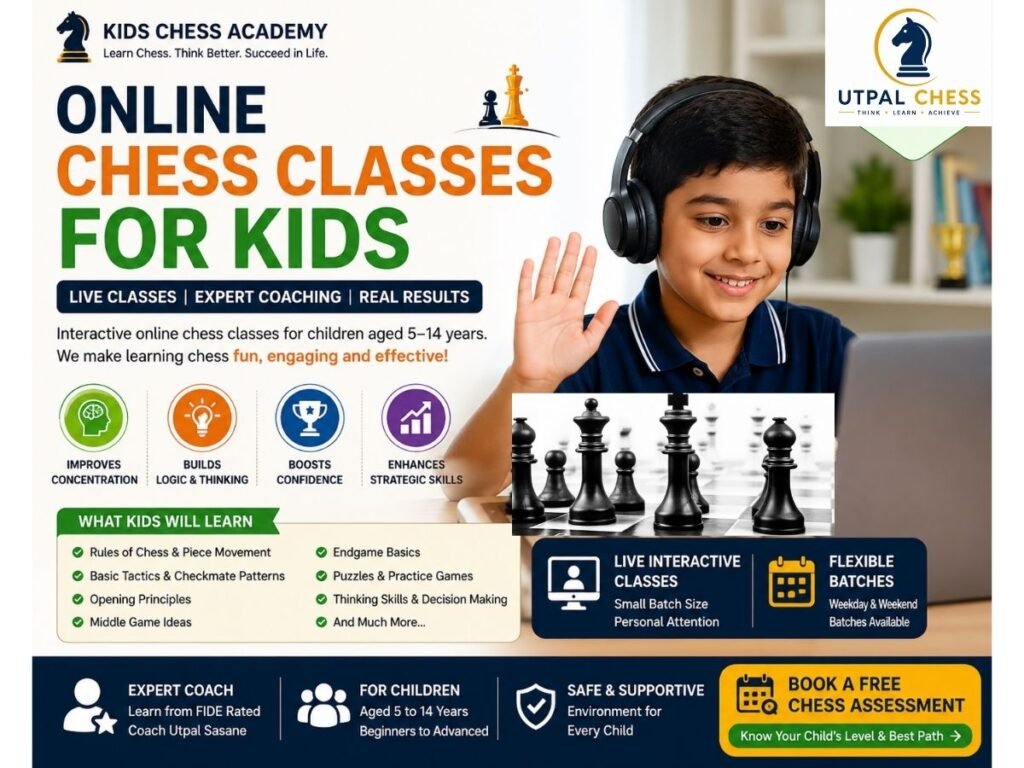
Many online chess classes teach moves.
At Utpal Chess, we focus on helping children understand the game, develop strong thinking habits, improve decision-making and become increasingly independent players.
Our online chess classes for kids are built around structured coaching, assessment-based guidance, guided practice and regular feedback.
Every child comes to chess with a different level of understanding and experience. We therefore begin by understanding where the child is and then build the learning journey around what they need next.
Whether your child is learning chess for the first time, already plays regularly or is preparing for tournaments, the aim is the same:
Understand the game → Think clearly → Make better decisions → Learn from mistakes → Improve independently
If your child is completely new to chess, start with our Complete Beginner Chess Guide for an introduction to the fundamentals.
Quick Summary
- Live online chess classes for kids
- Assessment-based learning and guidance
- Structured improvement pathway
- Focus on thinking before memorisation
- Guided practice, game analysis and feedback
- Group and private coaching options
- Parent guidance and progress clarity
- Suitable for beginners, developing players and tournament players
- Focus on long-term development rather than short-term results
Our Approach to Chess Coaching
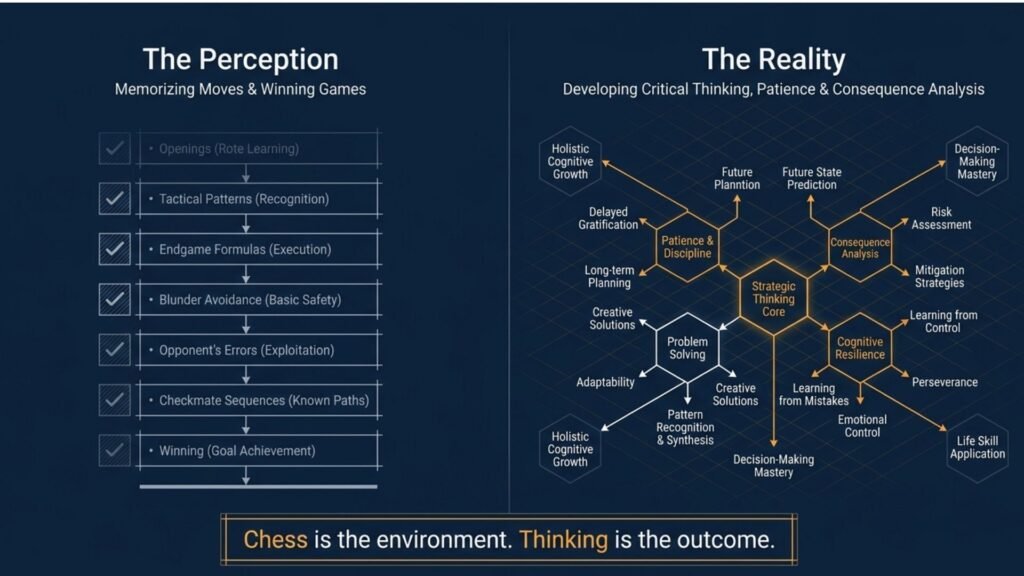
Every child learns chess differently.
Some children need stronger foundations. Others understand the rules but need help with tactical awareness, decision-making, concentration, or applying what they already know during games.
Our coaching begins by understanding the child and then building the learning journey around their current needs.
Assessment Before Instruction
We first look at the child’s current chess level, thinking habits, tactical awareness, decision-making and recurring mistakes.
The purpose is not simply to test how many chess concepts a child remembers. It is to understand how the child thinks, learns and approaches the game.
This helps us identify the most useful areas for development and recommend an appropriate learning pathway.
Structured Learning
Learning follows a clear progression:
Understand → Practise → Apply → Review → Improve
As the child develops, the learning priorities can evolve.
This gives children a clear path instead of leaving them to move randomly between openings, tactics, videos and games.
Understanding Before Memorisation
Chess knowledge is important, but children also need to understand why a move works and how to respond when a position changes.
We encourage children to consider:
- What is happening in the position?
- What is the opponent threatening?
- What options do I have?
- What could happen after my move?
- Why is one choice better than another?
Developing Thinking Through Chess
Chess provides children with repeated opportunities to think, evaluate choices and learn from consequences.
Through regular practice, children can develop habits such as:
- Critical thinking — examining a position before deciding what to do
- Decision-making — comparing choices and considering their consequences
- Concentration — staying focused on the position and the opponent’s ideas
- Patience — taking enough time to understand a position rather than rushing
- Problem-solving — looking for solutions when the position does not have an obvious answer
- Learning habits — reflecting on mistakes, applying feedback and carrying lessons into future games
These skills are developed through the process of learning and playing chess. We do not treat them as separate lessons; they naturally become part of the way children learn to approach the game.
The aim is to help children become more thoughtful and independent in their chess decisions over time.
Learning Through Practice and Feedback
Children develop chess understanding by applying ideas.
They work through positions, exercises and games, receive guidance during the learning process, and review important decisions afterwards.
Feedback helps them understand not only what happened, but why it happened and how they can approach a similar situation next time.
Developing Confidence and Independent Thinking
The aim is not to make children dependent on the coach for every decision.
As they improve, we want them to become increasingly comfortable with:
Seeing → Thinking → Deciding → Acting → Reviewing
The process matters more than any single result.
Over time, children can develop greater confidence in making decisions, greater discipline in their thinking, and greater independence in analysing their own games.
Chess is the learning environment. Thinking is part of the outcome.
What Are Online Chess Classes?
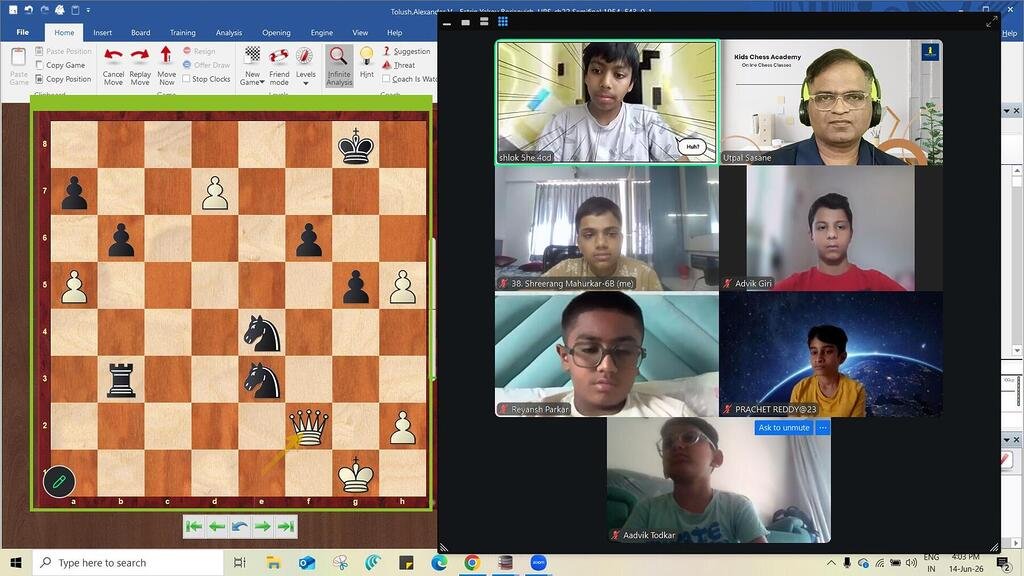
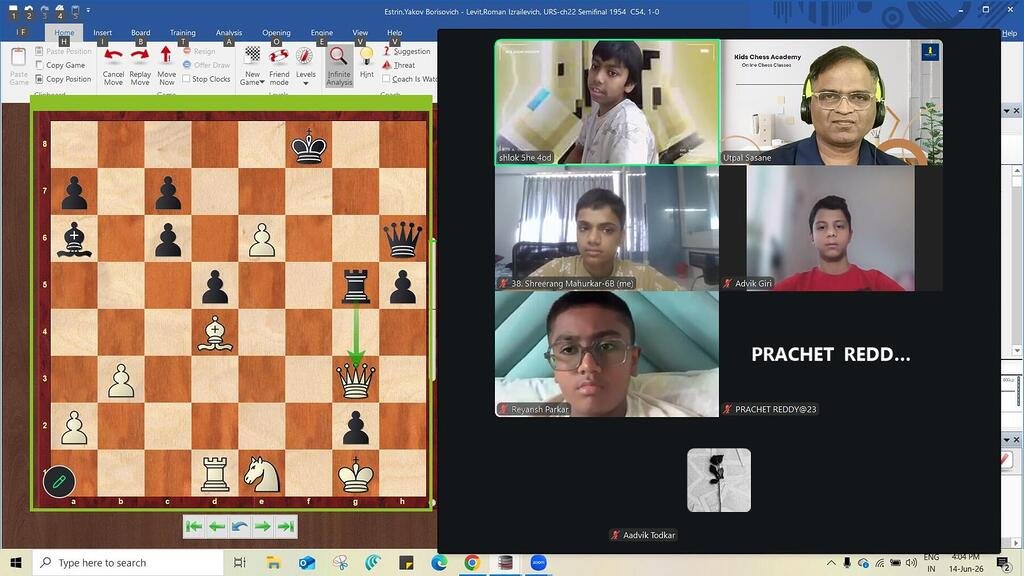
Online chess classes are live, coach-led lessons that allow children to learn chess from home while participating in instruction, questions, practical exercises, chess positions, games and analysis.
Structured coaching connects these lessons with a wider learning process:
- A clear learning pathway
- Guided practice
- Regular feedback
- Game analysis
- Progress review
- Next-step guidance
The goal is not simply to learn more chess moves.
It is to help children understand positions, make thoughtful decisions and apply what they learn during real games.
Are Online Chess Classes Effective?
Online chess classes can be highly effective when the learning experience is interactive, structured and appropriate to the child’s level.
The important question is not simply whether chess is taught online.
It is whether the child is actively involved in learning.
A useful online lesson gives children opportunities to:
- Answer questions
- Solve positions
- Explain their thinking
- Make decisions
- Analyse games
- Receive feedback
- Apply concepts
Online learning also allows children to learn from home without being restricted to coaching options in their immediate locality.
At the same time, online learning is not automatically effective simply because it is convenient.
The quality of instruction, interaction, practice and feedback matters.
Online Chess Classes for Beginners
Children don’t need previous chess experience to start learning.
A beginner needs a strong foundation before moving into more advanced concepts.
Early learning may include:
- Understanding the rules
- Board awareness
- Piece movement and activity
- Check and checkmate
- Basic tactical ideas
- Threat recognition
- Safe decision-making
- Simple planning concepts
Many beginners believe they need to memorise openings before they can improve.
In reality, learning how to recognise threats, make sensible decisions and understand why moves work provides a stronger foundation.
For the detailed beginner learning pathway, see our dedicated Online Chess Classes for Beginners page.
How to Choose the Right Online Chess Classes for Your Child
Choosing a chess programme is ultimately about finding a learning environment that fits your child.
Parents can consider the following.
1. Is There a Structured Learning Path?
Children benefit when lessons connect to one another.
A structured programme should make it reasonably clear:
Where is my child now?
What are they working on?
What comes next?
A clear progression helps prevent learning from becoming a collection of unrelated tactics, openings, videos and games.
2. Is the Child Assessed?
Children of the same age can have very different chess abilities and learning needs.
Assessment can help identify:
- Current skill level
- Strengths
- Thinking habits
- Tactical awareness
- Recurring mistakes
- Decision-making patterns
- Improvement priorities
3. Does the Child Receive Feedback?
Children already have access to enormous amounts of chess information.
The harder part is understanding how to apply that information.
Useful feedback helps a child understand:
- What happened
- Why it happened
- What alternatives were available
- How to approach a similar position next time
4. Is the Teaching Appropriate for Children?
Strong chess knowledge and strong children’s coaching are not automatically the same thing.
Children need explanations they can understand, challenges appropriate to their level and an environment where mistakes are treated as part of learning.
5. Is Progress Reviewed?
Progress may appear in many ways before a rating changes significantly.
Parents may notice:
- Better concentration
- Fewer careless mistakes
- Better threat recognition
- More thoughtful decisions
- Improved game analysis
- Greater confidence
- Increasing independence
6. Is the Learning Environment Right for the Child?
Children should be challenged enough to learn without feeling that every lesson is a test.
A calm, structured and supportive environment helps children remain engaged and comfortable with thinking through difficult positions.
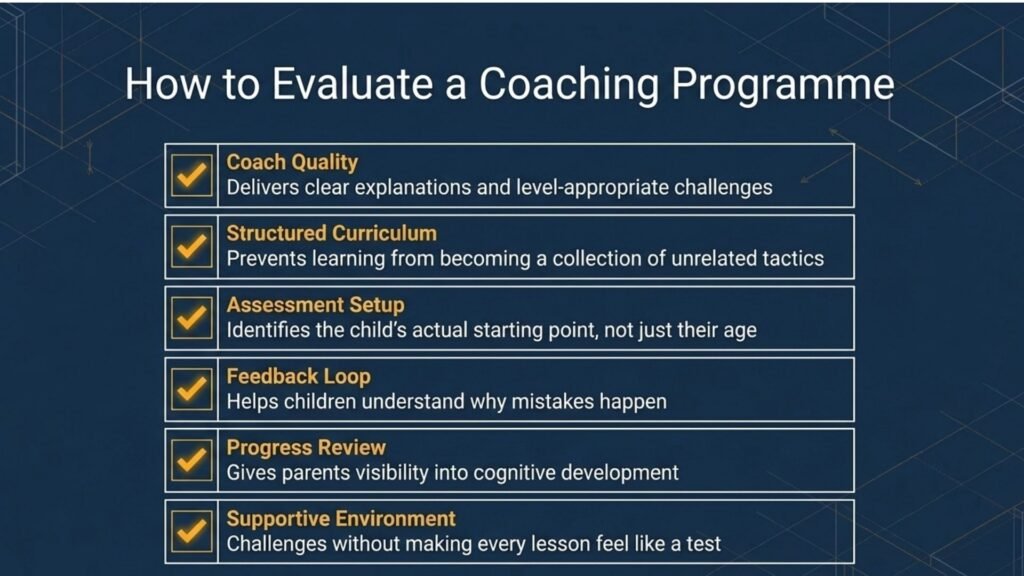
What Should Parents Look for in Online Chess Classes?
Parents do not need advanced chess knowledge to evaluate a coaching programme.
A useful checklist is:
| Factor | Why It Matters |
|---|---|
| Coach quality | Children need clear explanations and appropriate guidance |
| Structured curriculum | Creates a logical learning progression |
| Assessment | Helps identify the child’s actual starting point |
| Feedback | Helps children understand and correct mistakes |
| Progress review | Gives parents visibility into development |
| Thinking skills | Helps children apply knowledge during games |
| Learning environment | Supports confidence and sustained engagement |
The aim is not to find the programme with the longest list of features.
It is to find a learning environment that fits the child.
Who Are Our Online Chess Classes Designed For?
Our programmes can support children at different stages of development.
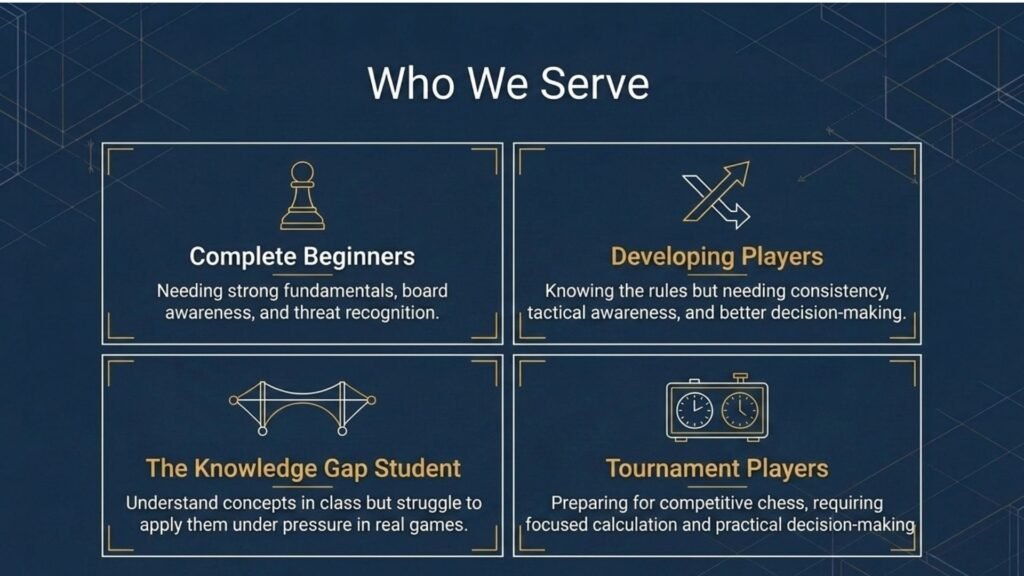
Complete Beginners
Children who are learning chess for the first time can begin with the fundamentals and gradually build their understanding.
Developing Players
Children who know the rules and play regularly can work on tactical awareness, decision-making, consistency and game analysis.
Tournament Players
Children preparing for competitive chess may need more focused work on calculation, practical decision-making and applying their skills under pressure.
Children Who Struggle to Apply What They Know
Some children understand chess concepts during lessons but continue making similar mistakes in games.
Coaching can help bridge the gap between knowing and applying.
Families Seeking Long-Term Development
Some parents are looking beyond short-term results and want a structured learning journey that develops alongside their child.
Why Students Struggle to Improve
Many students learn new concepts but continue making the same mistakes.
The problem is not always a lack of information.
Often, the difficulty is applying knowledge consistently during a real game.
A student may know:
- Opening principles
- Tactical patterns
- Endgame ideas
- The importance of watching threats
Yet still make poor decisions under pressure.
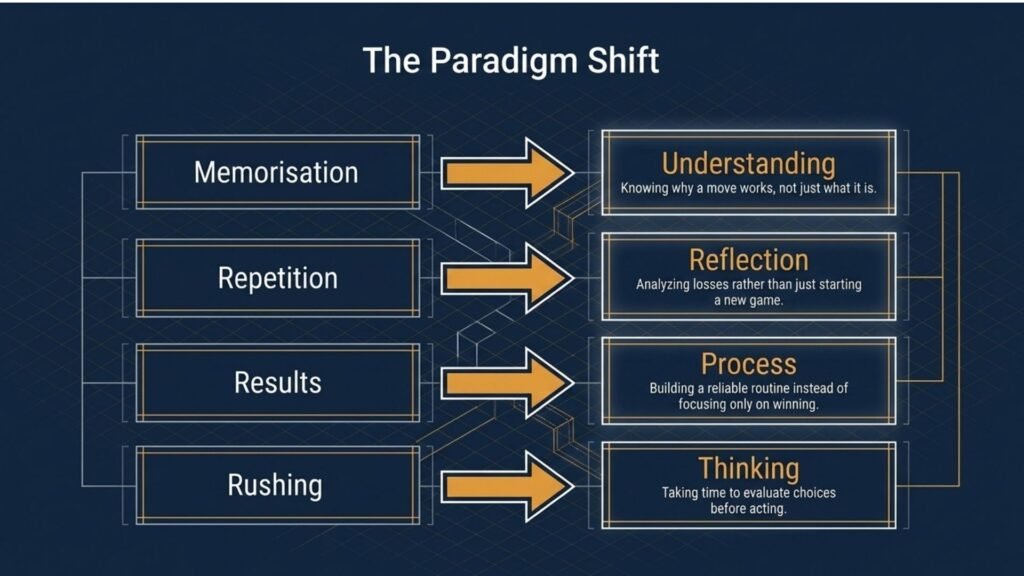
Improvement happens when knowledge becomes a repeatable thinking process.
That is why our coaching focuses on:
Thinking before moving → Understanding before memorisation → Reflection before repetition → Process before results
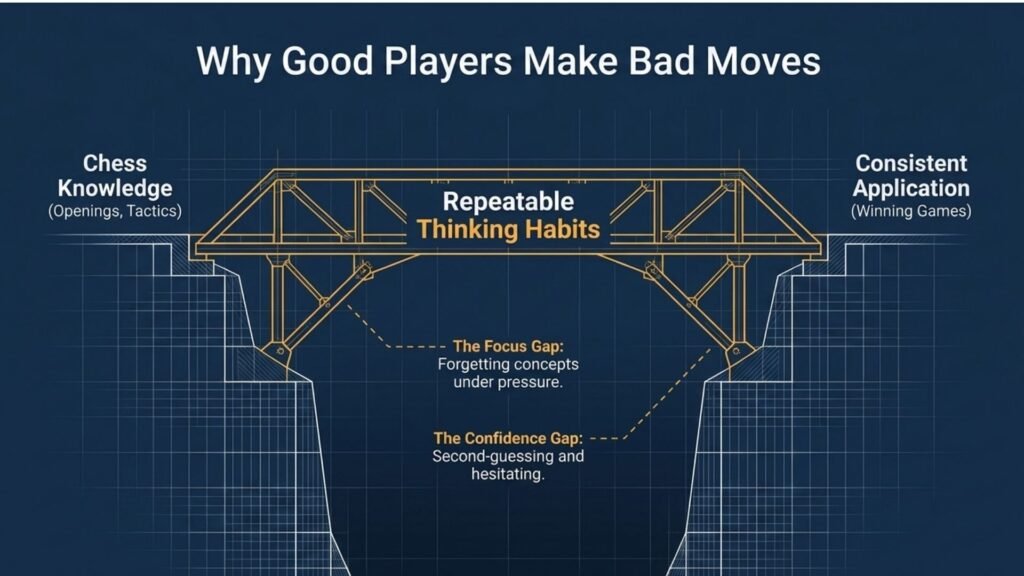
The Focus Gap
One challenge we commonly observe is the gap between understanding a concept during a lesson and applying it during a game.
A student may know:
- Develop pieces
- Watch for threats
- Control important squares
Yet forget these ideas completely during a real game.
The issue is not necessarily knowledge.
It is execution.
Structured practice and guided reflection help children turn concepts into repeatable habits.
The Confidence Gap
Some children know more than they realise.
They may see a good move but hesitate, identify an opportunity but second-guess themselves, or spend too much time looking for the perfect answer.
This can lead to:
- Time pressure
- Hesitation
- Missed opportunities
- Unnecessary mistakes
Through structured coaching and guided reflection, children can gradually become more comfortable trusting a thoughtful decision-making process.
The goal is not to make children play without mistakes.
It is to help them become increasingly comfortable thinking, deciding and learning from the outcome.
How Our Online Chess Classes Work
Step 1: Assessment
We first understand the child’s:
- Current skill level
- Thinking habits
- Tactical awareness
- Concentration
- Decision-making patterns
- Learning needs
Step 2: Learning Roadmap
The assessment helps identify the most important areas for development.
Step 3: Guided Coaching
Students receive targeted instruction through explanations, questions, practical positions and exercises.
Step 4: Practice and Application
Children apply concepts through games, exercises and guided practice.
Step 5: Reflection and Improvement
Games and decisions are reviewed so children can understand what happened and identify useful lessons.
Step 6: Continued Development
As the child improves, the learning priorities can change.
This creates a learning journey rather than a collection of disconnected lessons.
The Student Improvement Journey
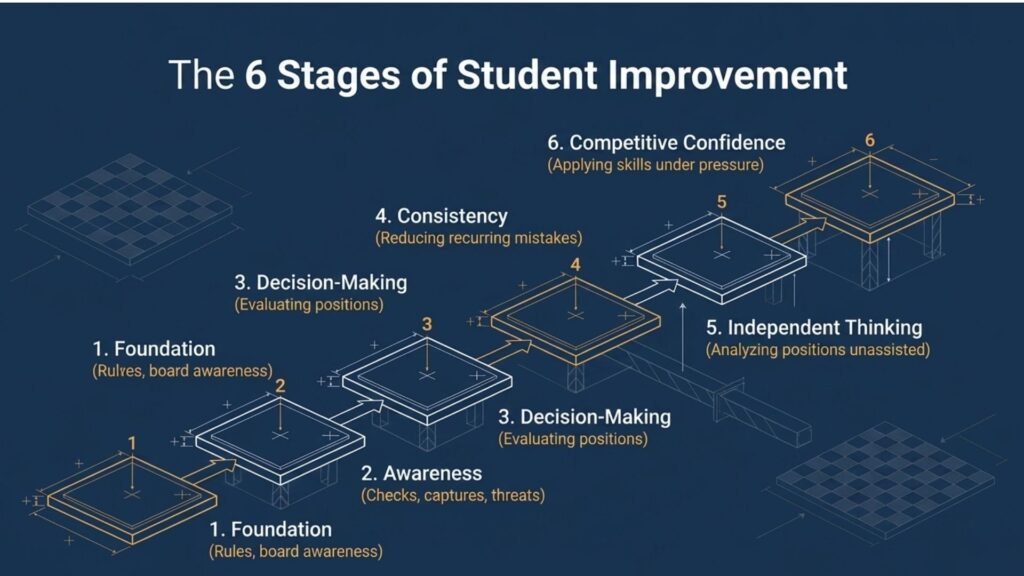
A child’s development can broadly move through several stages.
Foundation
Rules, board awareness and fundamental chess understanding.
Awareness
Checks, captures, threats and tactical opportunities.
Decision-Making
Evaluating positions and considering candidate moves.
Consistency
Reducing recurring mistakes and applying principles more reliably.
Independent Thinking
Analysing positions and making decisions with less assistance.
Competitive Confidence
Applying skills more consistently in serious games and tournaments when appropriate.
Children do not necessarily move through these stages at the same speed.
The purpose of the journey is to provide direction, not to force every child into an identical timetable.
The Five Rules System
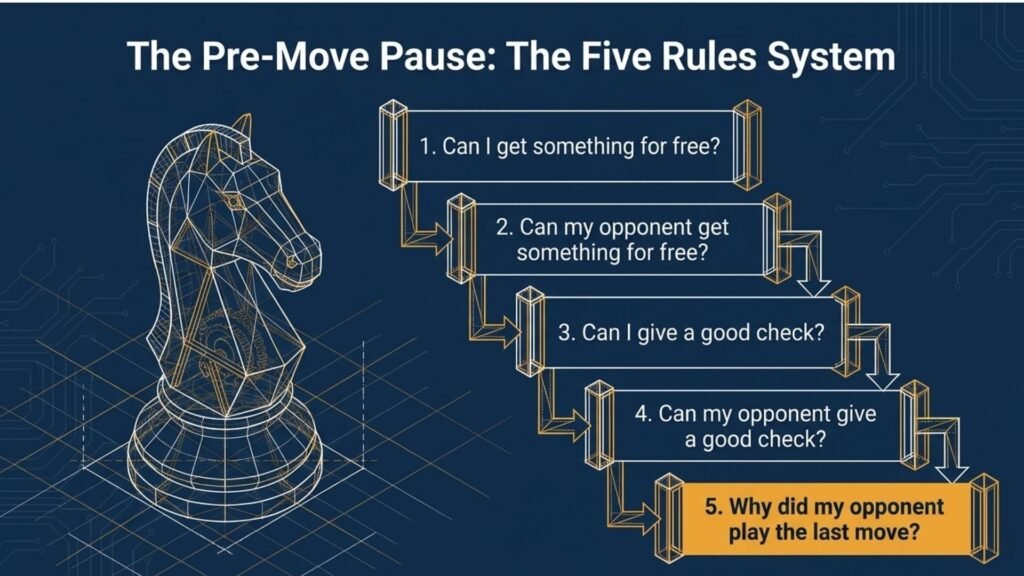
Before making an important move, children learn to pause and ask:
- Can I get something free?
- Can my opponent get something free?
- Can I give a good check?
- Can my opponent give a good check?
- Why did my opponent play the last move?
These five questions give children a practical thinking routine they can use during real games.
They encourage children to look for immediate opportunities and dangers before committing to a move, while the final question helps them understand the opponent’s intention rather than treating the position as if it appeared without a reason.
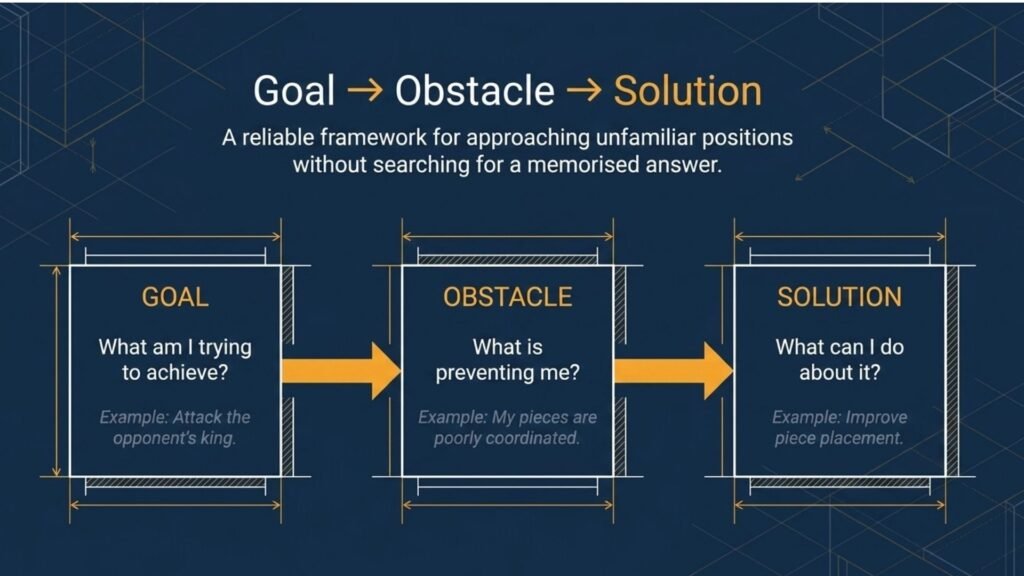
Goal → Obstacle → Solution
Another useful way to approach a chess position is:
Goal
What am I trying to achieve?
Obstacle
What is preventing me?
Solution
What can I do about it?
For example, a child may want to attack the opponent’s king but discover that their own pieces are not developed.
The obstacle may therefore be poor piece coordination.
Instead of forcing an attack, the child can first improve the position of the pieces.
This framework gives children a simple way to approach unfamiliar positions without immediately searching for a memorised answer.
Thinking Before Memorisation
Memorisation has a place in chess.
Opening knowledge, tactical patterns and important positions can all become useful as a child progresses.
But memorisation cannot replace understanding.
A child may remember several opening moves and still become confused when an opponent chooses an unfamiliar continuation.
Understanding gives the child something to fall back on.
Children therefore learn to:
- Notice threats
- Consider forcing moves
- Compare candidate moves
- Think about consequences
- Understand the purpose behind moves
- Adapt when the position changes
The objective is not to eliminate memorisation.
It is to make sure memorisation does not become a substitute for thinking.
Why Structured Learning Matters
Children have access to more chess information than ever before. They can play games, watch videos, solve puzzles and study openings.
But information alone does not provide a learning path.
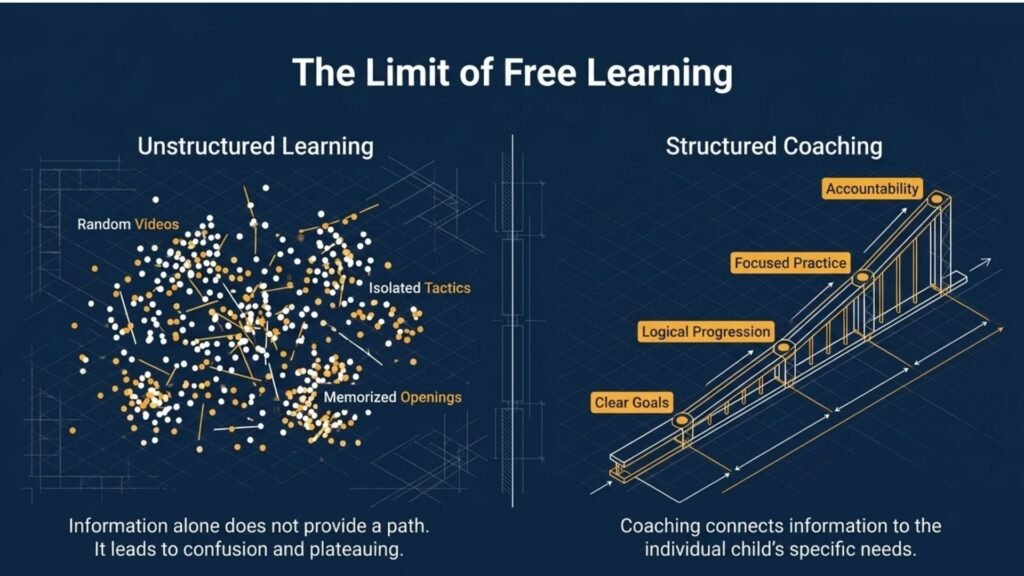
Structured coaching gives children a clearer process for improvement:
Clear Goals → Logical Progression → Focused Practice → Feedback → Review → Accountability
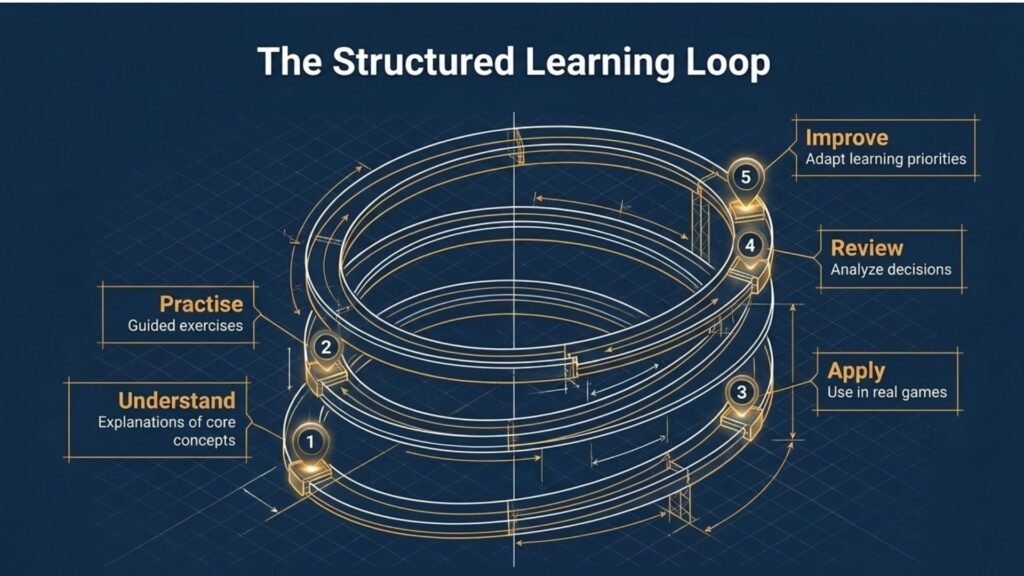
Clear Improvement Goals
Children need to know what they are working towards.
Instead of trying to improve everything at once, coaching can identify the skills that deserve attention at the child’s current stage.
Logical Progression
Learning should build from one stage to the next.
A child first develops an understanding of a concept, then practises it, applies it in games and gradually learns to use it independently.
Focused Practice
Practice becomes more useful when it is connected to the child’s individual needs.
If a child repeatedly misses tactical opportunities, that may deserve more attention than studying another opening.
Regular Assessment and Feedback
Progress is reviewed through lessons, exercises and games.
Feedback helps identify what is improving, what still needs attention and what the child should work on next.
Accountability
A structured learning process also creates accountability.
Children have clear areas to work on, opportunities to apply what they learn and regular feedback on their progress.
This helps turn good intentions into consistent practice.
A Long-Term Roadmap
The purpose of structured learning is not to rush children through a fixed syllabus.
It is to give them a roadmap that can evolve as they improve:
Understand → Practise → Apply → Review → Improve
The goal is to make improvement more deliberate, focused and sustainable.

Online Group Classes vs Online Private Chess Coaching
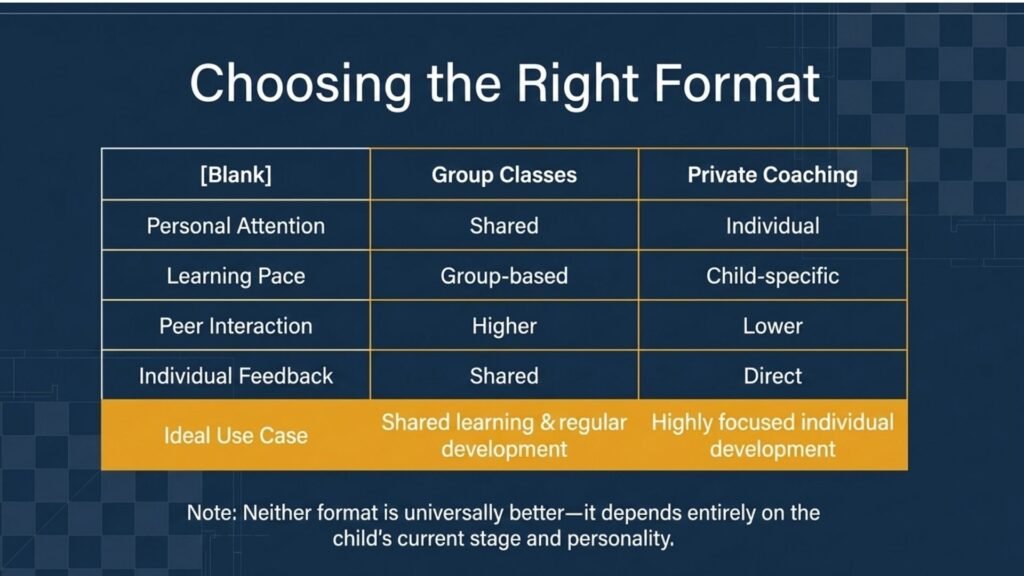
Both online groups and online private coaching can be useful.
The right format depends on the child’s learning needs, goals and personality.
| Feature | Online Group Classes | Online Private Coaching |
|---|---|---|
| Personal attention | Shared | Individual |
| Learning pace | Group-based | Child-specific |
| Peer interaction | Higher | Lower |
| Personalisation | Moderate | High |
| Individual feedback | Shared | Direct |
| Suitable for | Shared learning and regular development | Focused individual development |
Neither format is automatically better.
The important question is which learning environment is appropriate for the child at their current stage.
What Does Improvement Really Look Like?
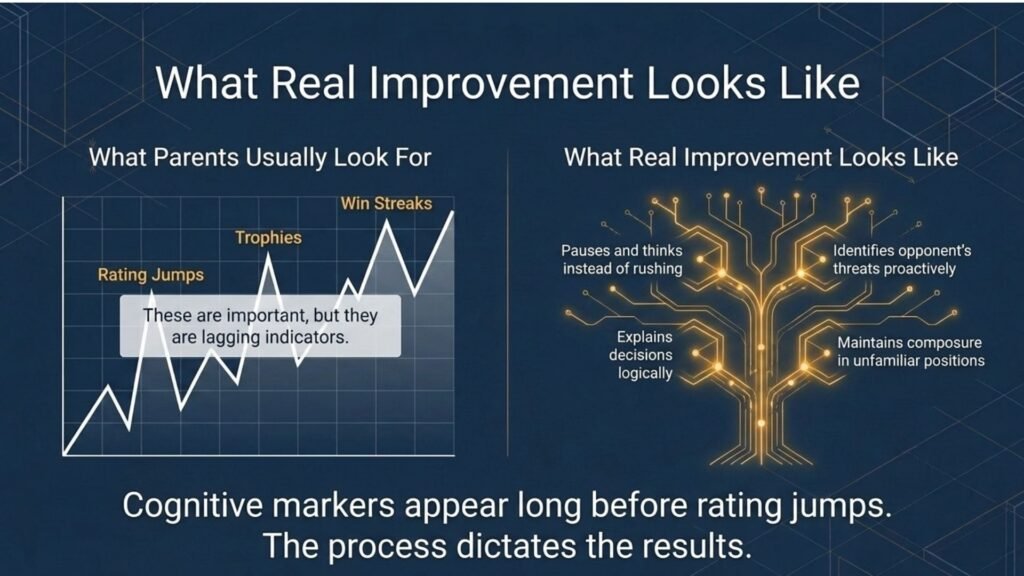
Parents often expect improvement to appear through ratings, tournament results or winning more games.
Those outcomes can be important, particularly for children who are pursuing competitive chess. But they are only one part of a child’s development.
Students make stronger long-term progress when they learn to focus on the process of improvement rather than short-term results.
A game does not become successful only because it was won, and a game is not unsuccessful simply because it was lost.
A loss can reveal an important lesson. A difficult position can develop better decision-making. A mistake can show a child what to notice next time.
At Utpal Chess, we look for progress in the way a child thinks, decides, reflects and applies what they have learned.
Signs That a Student Is Improving
Parents may notice that their child:
- Thinks before moving rather than rushing
- Checks the opponent’s threats
- Makes fewer careless mistakes
- Explains decisions more clearly
- Analyses losses more calmly
- Recognises patterns more quickly
- Becomes more confident with unfamiliar positions
- Needs less help to make decisions
- Applies lessons from previous games to new positions
These changes can appear before significant improvements in rating or tournament results.
Over time, the goal is to help children develop a reliable thinking process that they can carry into every game.
The Process Matters
A useful way to think about progress is:
Thinking before moving → Understanding before memorisation → Reflection before repetition → Process before results
The result of one game is temporary.
The thinking habit developed from that game can continue to help the child in the next.
Online Chess Classes for Kids in India
Children in India can learn chess online from home without being restricted to coaching options in their immediate locality.
For parents considering online chess classes from India, useful questions include:
- Is the child assessed?
- Is there a structured learning path?
- Are lessons interactive?
- Does the child receive feedback?
- Can parents understand the learning priorities?
- Is there a clear progression as the child improves?
Location may affect convenience and scheduling, but the quality and structure of the learning experience should remain the central consideration.
How Much Do Online Chess Classes for Kids Cost?
Fees vary depending on the structure of the coaching programme and the level of individual attention involved.
When considering online chess class fees, parents should understand what the programme includes.
Relevant factors can include:
- Group or private coaching
- Lesson frequency
- Individual attention
- Assessment
- Game analysis
- Feedback
- Progress review
- Parent communication
A lower fee does not automatically mean better value, and a higher fee does not automatically mean better coaching.
A more useful question is:
What learning experience will my child receive for the investment?
This helps parents compare programmes based on educational value rather than price alone.
Are Free Online Chess Resources Enough?
Free chess resources can be an excellent way for children to explore chess.
They can help with:
- Learning the chess rules
- Watching demonstrations
- Solving puzzles
- Playing games
- Exploring chess ideas
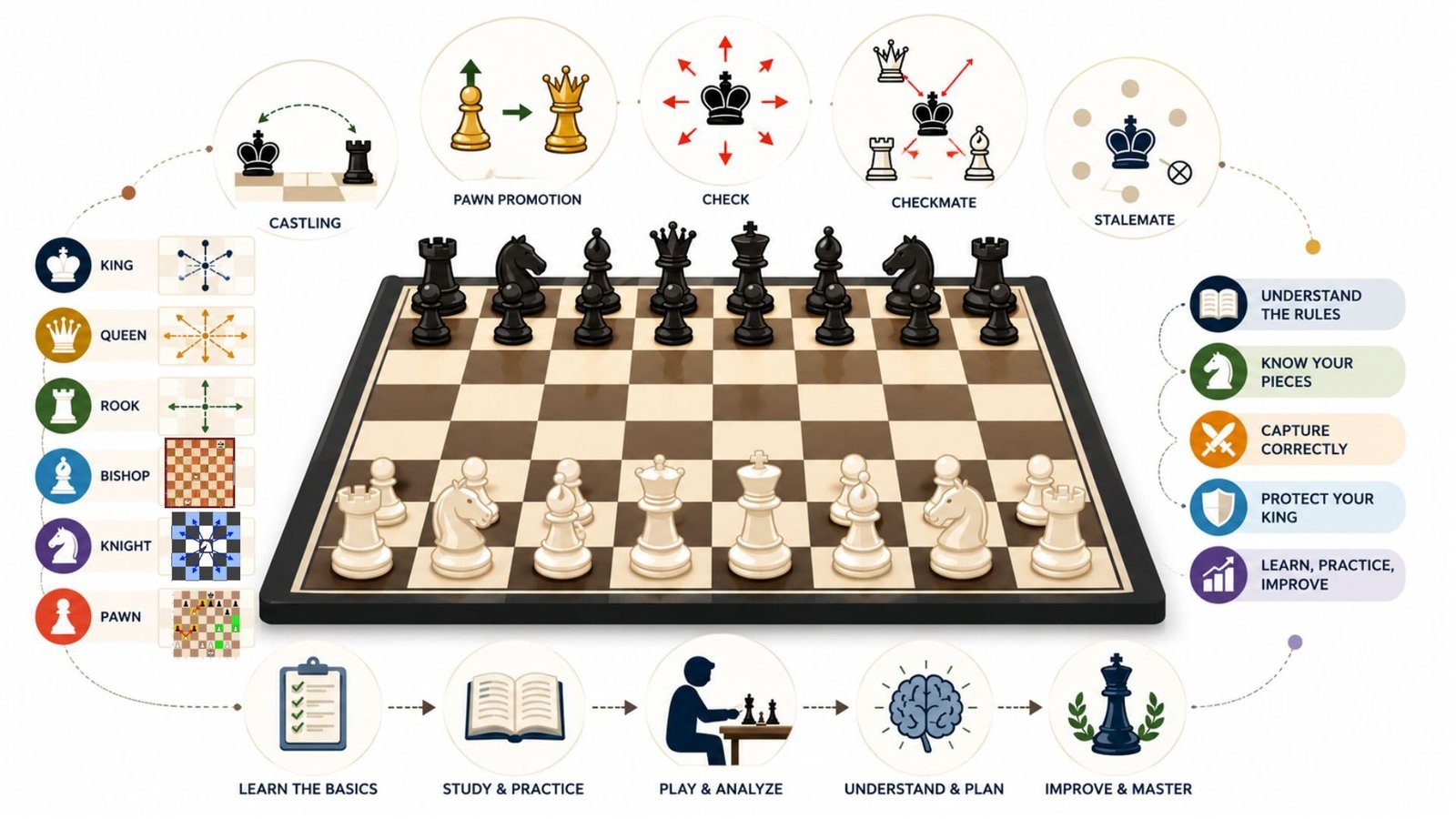
Their main limitation is personalisation.
A free resource generally cannot identify why one particular child keeps making the same mistake or determine which skill that child should work on next.
Structured coaching becomes more valuable when a child needs:
- Individual feedback
- A learning roadmap
- Game analysis
- Correction of recurring mistakes
- Practice guidance
- Accountability
Free resources and coaching can complement each other.
Free resources provide information. Coaching provides guidance around what the individual child should do with that information.
What Age Should a Child Start Learning Chess?
There is no single age that is right for every child.
Readiness is often more useful than age alone.
A child may be ready when they can:
- Follow simple instructions
- Stay engaged during a lesson
- Recognise basic patterns
- Participate in problem-solving
- Show curiosity about chess
For a deeper discussion, see our guide on the Best Age to Learn Chess.
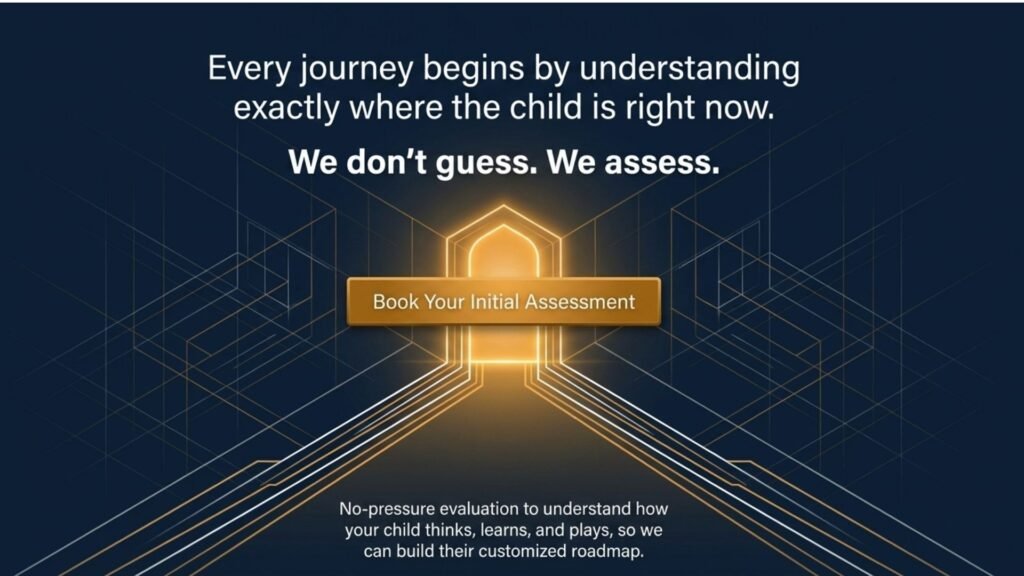
Why Parents Start With an Assessment
Every child starts from a different point.
Some children know the rules but struggle to apply them during games. Others may have good tactical awareness but need help with decision-making, concentration or consistency.
An assessment helps us understand that starting point before recommending the next learning step.
Assessment Is Not an Exam
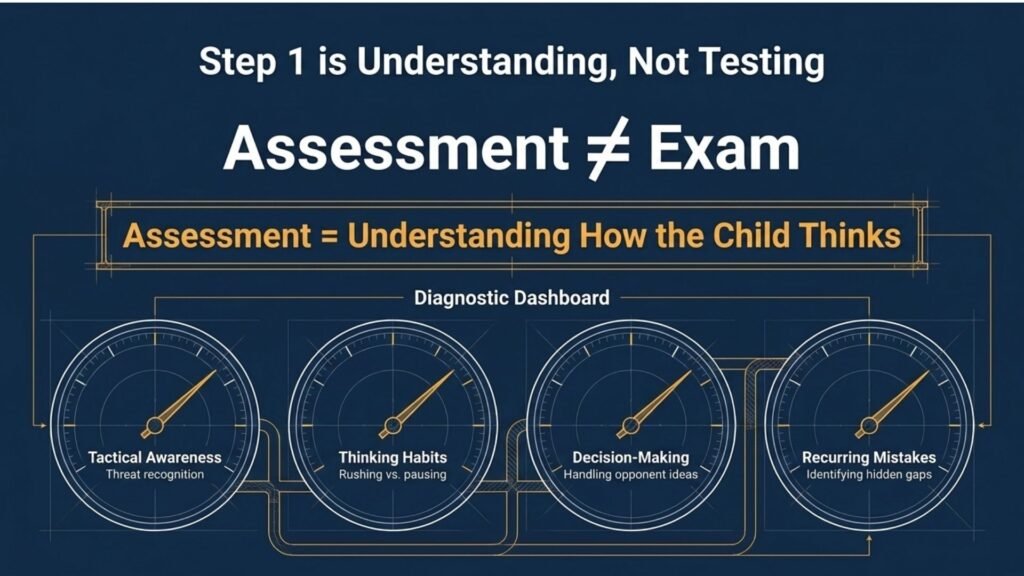
The purpose of the assessment is not simply to test how many chess concepts a child remembers.
It is to understand:
- How the child approaches a position
- How the child thinks before making a move
- How the child responds to the opponent’s ideas
- How the child makes decisions
- Where recurring mistakes appear
- Which areas are ready for further development
In simple terms:
Assessment ≠ Exam
Assessment = Understanding How the Child Thinks, Learns and Plays
What We Look At
Depending on the child’s stage, an assessment can consider:
- Current chess understanding
- Tactical awareness
- Board awareness
- Thinking habits
- Decision-making
- Concentration
- Common mistakes
- Learning gaps
The assessment is therefore not about giving a child a score and moving on.
It gives us a clearer picture of where the child is now and what the child should work on next.
What the Assessment Helps Clarify
The assessment can help identify:
- Current strengths
- Areas requiring attention
- Improvement priorities
- An appropriate coaching pathway
- The next stage of development
This gives parents a clearer starting point and helps make the learning journey more purposeful.
Frequently Asked Questions
Are online chess classes effective for kids?
They can be highly effective when lessons are interactive, structured and supported by practice and feedback. The quality of teaching and the child’s engagement matter more than the format alone.
Can a complete beginner start online chess classes?
Yes. Children can begin without previous chess experience. For the detailed beginner learning pathway, see our Online Chess Classes for Beginners page.
What age should a child start learning chess?
There is no universal starting age. Readiness, attention, curiosity and the ability to participate in structured learning are important considerations.
How often should children attend chess classes?
Consistency is generally more important than simply increasing the number of lessons. The appropriate frequency depends on the child’s level, goals, practice habits and learning capacity.
How long does it take for a child to improve at chess?
There is no fixed timetable. Progress depends on starting level, consistency, practice and how well the child applies what they learn.
How are online chess classes conducted?
Live lessons can include explanations, questions, interactive positions, exercises, games, analysis and feedback. Children should actively participate rather than simply watch.
Should my child join group classes or private coaching?
Both formats can be effective. Group coaching provides shared learning and peer interaction, while private coaching provides greater individual attention. The appropriate choice depends on the child’s needs and goals.
How much do online chess classes for kids cost?
Fees depend on factors such as coaching format, frequency, individual attention and what the programme includes. Parents should compare the overall learning experience, not price alone.
Are free online chess resources enough for children?
They can help with exploration and practice. Structured coaching becomes more valuable when a child needs individual feedback, assessment and a clear learning path.
Key Takeaways
- Online chess classes should provide more than information.
- Assessment helps identify what an individual child needs next.
- Structured learning connects instruction, practice, application and feedback.
- Children benefit from understanding how to think, not simply memorising moves.
- Parents should look for appropriate teaching, clear progression, meaningful feedback and realistic expectations.
- Group and private coaching can both be appropriate.
- Free resources can support learning but cannot provide the same level of personalised guidance.
- Improvement includes understanding, decision-making, confidence and independence as well as competitive results.
Start With a Chess Assessment
Every child starts from a different point.
Some need stronger foundations. Others need help with tactical awareness, decision-making, concentration or applying what they know during games.
A chess assessment helps us understand that starting point before recommending the next learning step.
Ready to Discover Your Child’s Next Step?
Or, if you’d like guidance before scheduling an assessment: