A structured approach to choosing an online chess course.
Choosing an online chess course is not simply about finding the programme with the most lessons, the longest video library or the biggest list of topics.
A useful course gives a learner a clear path: what to learn first, what to practise next, how ideas connect and when it is time to move to a more difficult level.
That matters at every stage of chess development. A beginner may need a clear introduction to the fundamentals. An improving player may need stronger tactical awareness and calculation. An intermediate player may need deeper strategic understanding, while an advanced player may benefit from focused work on preparation, complex positions and detailed game analysis.
With so many chess courses online, the real challenge is not finding more content. It is finding a learning system that matches the learner’s current level, goals and way of learning.
This guide explains how online chess courses work, what a well-structured course should teach at different levels, how courses compare with live classes and personalised coaching, and how to choose the right learning path.
Quick Summary
A good online chess course provides a structured learning pathway, not simply a collection of videos.
The right course depends on the learner’s current level, goals, learning habits and need for feedback.
Beginner courses should establish strong foundations before introducing greater complexity.
Improving and advanced players need increasingly sophisticated work on calculation, strategy, analysis and decision-making.
Effective chess learning combines explanation, practice, playing, analysis and review.
Free chess courses can be useful, but price alone does not determine educational quality.
Online chess courses, live chess classes and personalised coaching serve different learning needs.
Parents should evaluate curriculum, teaching quality, practice, feedback and the learning environment.
When the right learning path is unclear, an assessment can help identify the learner’s current level and next priority.
What Is an Online Chess Course?
An online chess course is a structured learning programme delivered through the internet.
It may contain lessons, demonstrations, exercises, puzzles, games, assignments, quizzes, analysis or other forms of practice.
The format can vary, but the important feature is organisation around a learning goal.
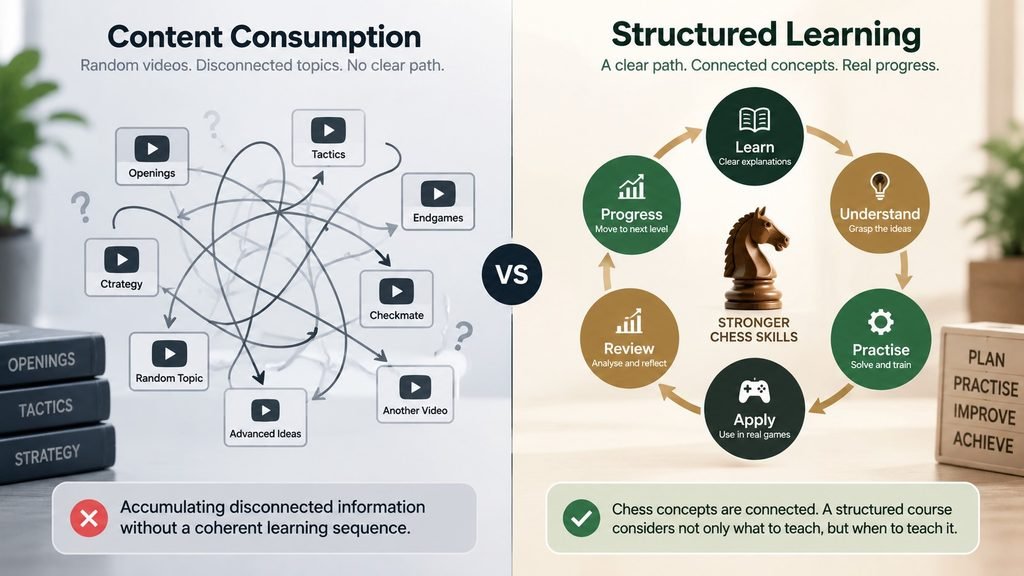
There is a major difference between having access to chess content and following a structured chess course.
A learner can watch one video about openings, another about checkmate and then move to an advanced attacking lesson because the topic looks interesting. Each lesson may contain useful information, but there is no guarantee that those ideas form a coherent learning sequence.
A structured course attempts to solve that problem.
That difference matters because chess concepts are connected.
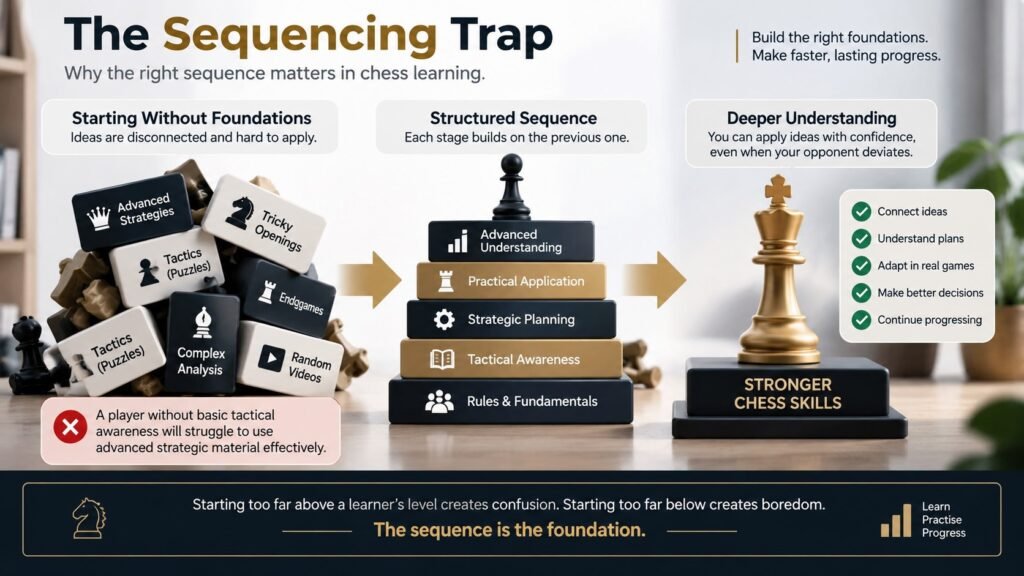
A player who has not developed basic tactical awareness may struggle to use advanced strategic material effectively. Similarly, a player who already has strong tactical knowledge may gain little from repeatedly studying introductory material.
A good course therefore considers not only what to teach, but when to teach it.
What Makes a Good Online Chess Course?
A strong course should do more than explain chess concepts. It should help the learner understand, practise and eventually apply those ideas independently.
A useful learning cycle is:
Level → Concept → Explanation → Example → Practice → Feedback → Review → Progression
Start at the Right Level
The learner should start at an appropriate level.
A complete beginner needs a very different programme from an intermediate player. An advanced learner may need focused work on calculation, positional understanding, preparation and game analysis rather than another introduction to the rules.
Starting too far above the learner’s level can create confusion.
Starting too far below it can create boredom.
The course should make its intended starting level reasonably clear.
A structured chess learning sequence showing how foundational skills support deeper understanding and practical application.
Teach Concepts, Not Just Moves
Chess education becomes much more useful when the learner understands why a move works.
For example, instead of simply memorising an opening sequence, the learner should understand ideas such as development, central control, king safety and piece activity.
That allows the learner to make sensible decisions when the opponent moves differently from what was expected.
Use Examples
Abstract concepts become easier to understand when they are demonstrated in actual positions.
For example, when learning piece development, a learner can compare a position with active pieces with one where several pieces remain undeveloped.
The aim is to help the learner recognise the idea during a real game.
Provide Active Practice
Chess is a practical skill.
Learners need opportunities to:
Solve positions
Find candidate moves
Identify threats
Play games
Analyse positions
Explain decisions
Correct mistakes
Practice reveals whether the learner can actually apply the ideas introduced in the course.
Provide Feedback and Review
Practice becomes more valuable when mistakes can be understood.
A wrong answer can reveal a recurring thinking problem.
For example, a learner may repeatedly find attractive attacking moves while overlooking the opponent’s immediate threat.
More content may not solve that problem.
Understanding why the mistake occurs may be more useful.
Important ideas should also return later in different positions. Repeated exposure with variation helps concepts become part of the learner’s thinking process.
Create a Clear Progression
A course should make the next stage reasonably clear.
The learner should understand:
What am I learning now?
What should I practise?
What should I learn next?
How will I know I am ready to progress?
That turns a collection of lessons into a genuine learning system.
What Should an Online Chess Course Teach?
The curriculum should depend on the learner’s level, but a well-structured programme usually develops several connected areas.
Chess Fundamentals
Beginners need to understand:
The chessboard
Piece movement
Capturing
Check
Checkmate
Castling
Promotion
Basic rules
Piece values
Basic game objectives
These concepts may look simple, but they form the foundation for everything that follows.
A learner who is still unsure whether a move is legal cannot reliably focus on deeper strategy.
Tactical Awareness
Once the fundamentals are understood, learners can begin recognising tactical opportunities.
Important themes may include:
Checks
Captures
Threats
Forks
Pins
Skewers
Double attacks
Discovered attacks
Basic mating patterns
The goal is not simply to memorise tactical names.
It is to develop the habit of asking:
What is happening in this position, and what can change after my move?
Calculation and Decision-Making
Calculation means looking ahead before committing to a move.
A useful thinking process is:
What is my opponent threatening?
What are my forcing moves?
What happens if I make my intended move?
What is the opponent’s strongest reply?
What position remains?
As players improve, calculation becomes more sophisticated.
The objective is not to calculate every possible move. It is to identify the important candidate moves and examine the consequences accurately.
Opening Principles
Beginners generally benefit more from understanding opening principles than from memorising long variations.
Useful principles include:
Develop pieces
Fight for useful squares
Avoid unnecessary repeated moves
Consider king safety
Connect the pieces
Avoid bringing the queen out too early without a reason
For stronger players, opening study can become more specialised and include preparation, typical structures, move-order ideas and understanding specific positions.
The underlying principle remains the same:
Understand the position rather than relying entirely on memorisation.
Middlegame Thinking
As players improve, they need to ask broader questions:
What is my opponent threatening?
Which pieces are well placed?
Which pieces need improvement?
What weaknesses exist?
Where should I play?
What is my plan?
Which exchanges are favourable?
This is where chess develops from tactical reaction into purposeful decision-making.
Endgame Fundamentals
Endgames teach precision.
Depending on level, a course may introduce:
King and pawn endings
Opposition
Basic checkmates
Rook endgames
Passed pawns
King activity
Converting an advantage
At higher levels, learners may study more complex theoretical positions and practical endgame techniques.
The important lesson remains the same: a favourable position still has to be converted correctly.
Game Analysis
One of the most valuable forms of chess learning is examining the learner’s own games.
Instead of asking only:
“Where did I lose?”
a stronger process is:
What was I thinking at the critical moment? What did I miss? What should I have considered?
This helps learners understand the cause of mistakes rather than simply memorising an engine’s preferred move.
Online Chess Courses for Different Skill Levels
A good course should meet the learner where they are.
The learning needs of a complete beginner are very different from those of an intermediate or advanced player.
Beginner Chess Courses
A chess course for beginners should establish a strong foundation.
Typical areas include:
Board awareness
Rules and piece movement
Check and checkmate
Basic piece values
Simple tactics
Opening principles
Basic endgames
Developing a simple thinking process
An online chess course for beginners should avoid introducing too much complexity too quickly.
The objective is not to teach everything.
It is to help the learner build enough understanding to play confidently and continue learning.
Courses for Improving Players
An improving player has usually moved beyond the basic rules and wants to understand why mistakes happen and how to make better decisions.
A course at this stage may focus more heavily on:
Tactical patterns
Calculation
Candidate moves
Opening understanding
Piece activity
Planning
Game analysis
Practical decision-making
The emphasis gradually shifts from learning what chess concepts are to using them reliably during games.
Intermediate Chess Courses
Intermediate players often benefit from more complex decision-making.
A suitable course may explore:
Strategic planning
Pawn structures
Prophylactic thinking
Positional weaknesses
Exchanges
Calculation
Deeper game analysis
Opening structures
Endgame technique
At this stage, simply adding more chess content is rarely enough.
The learner needs to become better at deciding which information matters in a particular position.
Advanced Chess Training
Advanced learners require a different level of challenge.
Depending on the player’s goals, an advanced course may involve:
Deeper calculation
Complex strategic positions
Opening preparation
Middlegame structures
Endgame technique
Critical game analysis
Tournament preparation
Decision-making under practical pressure
At advanced levels, personalised feedback can become particularly valuable because the weaknesses are often more specific and less obvious.
The right course therefore depends heavily on the player’s individual needs.
What Can You Learn From an Online Chess Course?
A good course should produce more than familiarity with chess terminology.
The learner should gradually develop practical abilities.
Building Chess Fundamentals
The learner becomes more comfortable with the board, pieces, rules and basic objectives.
Developing Tactical Awareness
The learner becomes better at recognising opportunities, threats and tactical patterns.
Improving Decision-Making
The learner develops a more reliable process for comparing candidate moves and considering the opponent’s response.
Understanding Strategy
The learner begins to recognise plans, weaknesses, piece activity, exchanges and longer-term positional features.
Analysing Games
The learner becomes better at identifying critical moments and understanding why mistakes occurred.
Becoming More Independent
Over time, the learner should become increasingly capable of identifying what needs work and choosing appropriate practice.
That is an important long-term goal of chess education.
The purpose of a course is not to make the learner permanently dependent on lessons. It should help the learner become increasingly capable of thinking and learning independently.
A Chess Learning Roadmap
A useful online chess course should help learners understand where they are going.
A simplified roadmap is:
Foundation
↓
Tactical Awareness
↓
Calculation & Decision-Making
↓
Strategic Understanding
↓
Game Analysis
↓
Independent Improvement
These stages overlap rather than functioning as rigid levels.
A beginner does not finish tactics before learning anything strategic. Similarly, an advanced player still relies on fundamental tactical awareness.
The complexity increases as the learner becomes more capable of applying earlier ideas.
Foundation
Become comfortable with the board, rules, pieces and basic objectives.
Tactical Awareness
Recognise checks, captures, threats and tactical opportunities.
Calculation and Decision-Making
Develop a process for comparing candidate moves and anticipating responses.
Strategic Understanding
Think about plans, piece activity, weaknesses, exchanges and long-term features of positions.
Game Analysis
Identify why important mistakes happened and what could have been done differently.
Independent Improvement
Learn to identify weaknesses, choose useful practice and evaluate your own games.
Types of Online Chess Courses
Different course formats suit different learners.
Self-Paced Courses
The learner studies according to their own schedule.
Advantages:
Flexible timing
Lessons can be revisited
Suitable for independent learners
Convenient around school or work
Limitations:
Requires self-discipline
Learners may not know when to move forward
Mistakes can go unnoticed
Difficult concepts may remain unresolved
Self-paced learning can work well when the learner is motivated and comfortable studying independently.
Recorded Chess Courses
Recorded lessons allow learners to revisit explanations and study at their own pace.
They can be particularly useful for:
Revision
Repeated practice
Independent study
Reviewing difficult concepts
However, recorded content does not automatically provide personalised diagnosis or feedback.
Live Guided Courses
Live guided programmes introduce scheduled interaction with an instructor or mentor.
They can provide:
Real-time explanation
Immediate questions and answers
Greater accountability
Opportunities to adjust explanations when a learner is confused
The trade-off is generally less scheduling flexibility.
Structured Coaching Programmes
A structured coaching programme combines curriculum with individual guidance.
The learning path can be adjusted according to the learner’s mistakes, goals, progress and specific development needs.
This becomes increasingly useful when a learner has recurring problems that are difficult to diagnose independently.
Free Chess Courses vs Paid Courses
A free chess course can be a useful starting point.
A free online chess course may help a learner explore chess, learn fundamental concepts or decide whether self-paced study suits them.
However, free does not automatically mean better value, and paid does not automatically mean better quality.
When comparing courses, evaluate:
Curriculum structure
Level suitability
Teaching quality
Practice opportunities
Feedback
Progression
Support
Depth of explanation
Long-term usefulness
A free programme may contain excellent educational material but offer limited feedback.
A paid programme may provide additional structure or support, but its price alone does not guarantee educational quality.
The better question is:
What does this learner need, and does this course provide it?
How to Choose the Best Online Chess Course
People often search for the best online chess course, best online chess courses, best chess online course or best chess courses online.
There is no single course that is automatically best for every learner.
The better approach is to define what “best” means for the individual.
Match the Course to the Learner’s Level
A beginner should not be placed immediately into advanced opening theory.
An advanced player should not spend most of the programme revisiting concepts they already understand.
Look for a clear indication of:
Starting level
Expected prior knowledge
Learning objectives
Progression
Evaluate the Curriculum
A good curriculum should answer:
What do I learn first?
What comes next?
Why is this taught now?
How does one concept connect to another?
A long list of lessons is not necessarily a curriculum.
Look for Practical Application
The learner should have opportunities to apply concepts through:
Puzzles
Positions
Games
Analysis
Decision-making exercises
Chess improvement requires active thinking, not simply passive viewing.
Understand the Feedback System
Find out what happens when the learner struggles.
Can mistakes be reviewed?
Can questions be answered?
Is there a way to identify recurring weaknesses?
This becomes particularly important for children and learners who are progressing beyond the basics.
Consider the Learning Environment
For younger learners, the environment matters as much as the curriculum.
Parents should look for a programme that is:
Calm
Structured
Encouraging
Age-appropriate
Clear about expectations
Think About Long-Term Fit
A beginner course may be appropriate now but unsuitable later.
Likewise, an advanced course may be inappropriate if the learner still needs to strengthen fundamental skills.
A good learning path should make the next stage of development clearer rather than leaving the learner to search randomly for new material.
Online Chess Courses vs Online Chess Classes
Courses and classes overlap, but they serve somewhat different learning needs.
Course-Based Learning
Live Online Chess Classes
Curriculum and learning pathways are central
Teaching and interaction are central
Often organised into modules or stages
Usually organised around scheduled lessons
May be self-paced or guided
Usually involves live instruction
Material can often be revisited independently
Questions can be answered during the session
Suits structured independent study
Suits learners who benefit from live explanation
Feedback depends on the course format
Real-time feedback is naturally available
Neither format is automatically better.
The more useful question is:
What type of learning support does this student need?
Online Chess Courses vs Personalised Chess Coaching
A course provides structured knowledge and a defined learning pathway.
Personalised coaching adapts the learning process around the individual.
Course-Based Learning
Personalised Coaching
Follows a defined curriculum
Curriculum can adapt to the learner
Strong emphasis on structured content
Strong emphasis on individual diagnosis
Useful for independent learners
Useful for learners needing close guidance
Feedback varies by programme
Feedback can focus on individual mistakes
Usually offers greater flexibility
Usually offers more individual attention
Strong for systematic learning
Strong for targeted improvement
A course may be enough when a learner has clear goals, follows a routine and can identify many of their own mistakes.
Personalised coaching can become more useful when the learner repeatedly encounters the same problems but cannot identify why they occur.
For example, a student may know several tactical patterns but still overlook simple threats during games.
Adding more tactical content may not solve the underlying problem.
Understanding the learner’s thinking process may be more useful.
Common Mistakes When Learning Through Online Chess Courses
Watching Instead of Practising
Why it happens: Watching lessons feels productive.
Why it matters: Chess requires decision-making, not just recognition.
Better approach: Apply each important concept through positions, puzzles or games.
Choosing by Lesson Count
Why it happens: A larger number appears to offer more value.
Why it matters: More content does not necessarily mean better sequencing.
Better approach: Evaluate the curriculum and learning progression.
Starting at the Wrong Level
Why it happens: Learners may overestimate or underestimate their ability.
Why it matters: Material that is too difficult creates confusion, while material that is too easy creates repetition.
Better approach: Establish the learner’s current level first.
Jumping Between Unrelated Courses
Why it happens: There is always another interesting chess topic to study.
Why it matters: The learner accumulates disconnected information.
Better approach: Follow one coherent learning path long enough to practise and review the concepts.
Memorising Openings Without Understanding Them
Why it happens: Opening moves are easy to collect.
Why it matters: A memorised sequence may stop being useful as soon as the opponent deviates.
Better approach: Understand opening principles and the ideas behind the position.
Ignoring Your Own Games
Why it happens: Learners often prefer new lessons and puzzles.
Why it matters: Your own games reveal the mistakes you actually make.
Better approach: Review critical moments and examine what you were thinking before the mistake.
Expecting the Course to Do Everything
A course can provide structure and knowledge, but improvement still requires participation.
The quality of the course matters, but the learner’s approach matters too.
Suppose a learner studies a lesson about checks, captures and threats.
The lesson may explain the concept clearly.
But the real learning begins when the student faces a position and has to decide:
What should I look at first?
That is where knowledge becomes a thinking habit.
A practical study session might look like this:
Learn
Study one concept.
Practise
Solve several positions related to it.
Play
Look for opportunities to apply the idea in actual games.
Analyse
Review important decisions after the game.
Correct
Identify the recurring mistake.
Revisit
Return to the concept later and test whether the mistake has improved.
This is more useful than continuously consuming new material without checking whether earlier lessons have become part of the learner’s decision-making.
How Parents Can Evaluate a Chess Course
Parents do not need to understand every chess term to judge whether a programme is thoughtfully designed.
The more useful questions are about the child’s learning experience.
Is There a Clear Learning Path?
You should be able to understand what the child is learning now and what comes next.
Does It Match the Child’s Level?
A beginner needs a different starting point from an experienced tournament player.
The same principle applies when a child progresses from beginner to intermediate or advanced study.
Is the Child Actively Learning?
Look for practice, questions, games and application rather than passive viewing alone.
How Are Mistakes Handled?
A healthy learning environment treats mistakes as information.
The goal is not to prevent every mistake.
The goal is to help the child understand and learn from them.
Is Progress Explained Realistically?
Chess development is not perfectly linear.
A child may understand more before their rating reflects that understanding. Confidence can fluctuate, and some concepts require repeated exposure before they become natural.
Parents should look for steady development of skills and learning habits rather than promises of instant results.
Is the Environment Calm and Structured?
A thoughtful programme should provide enough challenge to encourage growth without turning every game into a test of worth.
Parents do not need to become chess coaches.
Supporting consistent practice, reasonable expectations and a positive attitude towards mistakes is often more useful.
When an Assessment Can Help
Sometimes the challenge is not finding a chess course.
It is knowing which learning path is appropriate.
An assessment can help establish a useful starting point.
Depending on the learner and assessment process, areas may include:
Chess fundamentals
Tactical awareness
Calculation habits
Decision-making
Opening understanding
Strategic thinking
Endgame knowledge
Game-analysis habits
Recurring mistakes
The purpose is not simply to label a learner as a beginner, intermediate or advanced player.
A useful assessment should help answer:
What does this learner understand now, where are the important gaps, and what should they work on next?
That makes assessment an educational starting point rather than simply an enrolment step.
Key Takeaways
A good online chess course provides a structured learning pathway.
The right course should match the learner’s current level.
Beginner, improving, intermediate and advanced players have different learning needs.
Effective learning combines explanation, practice, playing and analysis.
A free course can be useful, but price alone does not determine educational quality.
The best course depends on the learner rather than a universal ranking.
Courses, live classes and personalised coaching provide different forms of support.
Parents should evaluate curriculum, practice, feedback, progression and learning environment.
The long-term goal should be increasingly independent thinking and improvement.
When the right learning path is unclear, an assessment can provide useful direction.
Frequently Asked Questions
What is the best online chess course?
There is no single online chess course that is best for every learner.
The right choice depends on the learner’s current level, goals, preferred learning format, available time and need for feedback.
A strong course should provide a clear curriculum, appropriate progression, meaningful practice and a sensible way to review learning.
What is the best online chess course for beginners?
A good course for beginners should start with the fundamentals rather than assume prior chess knowledge.
It should introduce rules, board awareness, piece activity, basic tactics, calculation and practical decision-making progressively.
Are there online chess courses for intermediate and advanced players?
Yes. More experienced players generally need a different type of learning from beginners.
Intermediate and advanced courses may place greater emphasis on calculation, strategic decision-making, opening preparation, positional understanding, endgame technique and detailed game analysis.
The appropriate level depends on the learner’s actual playing strength and learning needs.
Are online chess courses suitable for children?
Yes, provided the course format and level are appropriate.
Children may need more guidance, interaction and encouragement than independent adult learners.
Parents should therefore evaluate both the curriculum and the learning environment.
Can I learn chess completely through an online course?
An online course can provide a strong foundation and structured learning path.
However, chess is a practical skill. Playing games, solving positions, analysing mistakes and applying ideas are essential parts of development.
Is a free online chess course worth using?
It can be.
A free online chess course may be useful for learning fundamentals or exploring whether self-paced study suits you.
Evaluate its structure, teaching quality, practice opportunities and progression rather than focusing only on price.
Are online chess courses better than online chess classes?
Neither is automatically better.
Courses generally emphasise curriculum and independent progression, while live classes provide greater opportunity for interaction and real-time explanation.
The right choice depends on the learner’s needs.
Should a beginner choose a chess course for beginners?
Usually, yes, if the learner has little or no prior chess experience.
A beginner-focused course should introduce concepts progressively rather than assume knowledge of tactics, strategy or opening theory.
How much practice should a chess learner do?
There is no single amount that works for everyone.
Consistency is generally more useful than occasional long study sessions.
The right routine depends on age, level, goals, attention span and the type of practice.
Should a child take a course or personalised coaching?
A structured course can work well when the learner is comfortable following a curriculum and practising independently.
Personalised coaching may be more useful when the child needs individual feedback, has recurring mistakes or requires a learning path adapted to their development.
How do I choose the right chess course?
Start with the learner’s current level and goal.
Then evaluate:
Curriculum
Teaching quality
Practice
Feedback
Progression
Support
Long-term suitability
The right course should make the learner’s next step clearer.
What should parents look for in an online chess course?
Look for a clear curriculum, appropriate level, active practice, thoughtful teaching, realistic expectations and a supportive learning environment.
The quality of the learning system matters more than impressive-sounding promises.
Choose the Right Learning Path
An online chess course can be an excellent way to create structure around independent study.
The key is choosing a programme that matches the learner’s current ability and provides an appropriate progression from understanding to practice and application.
For a beginner, that may mean building strong fundamentals.
For an improving player, it may mean developing tactical awareness, calculation and decision-making.
For an intermediate or advanced player, it may mean deeper strategic understanding, opening preparation, endgame technique or detailed game analysis.
If you already know the learner’s level and are comfortable following a structured programme, an online chess course may provide the framework you need.
If you are unsure where the learner should begin, what they should work on next, or whether a course, class or personalised coaching would be the better fit, an assessment can provide more useful direction.
The goal is simple:
Understand the learner → Identify the right learning path → Practise consistently → Review progress → Adjust when needed
Book an Assessment
An assessment can help identify the learner’s current level, important learning gaps and a sensible next step before committing to a particular learning path.