
Book an Online Chess Assessment
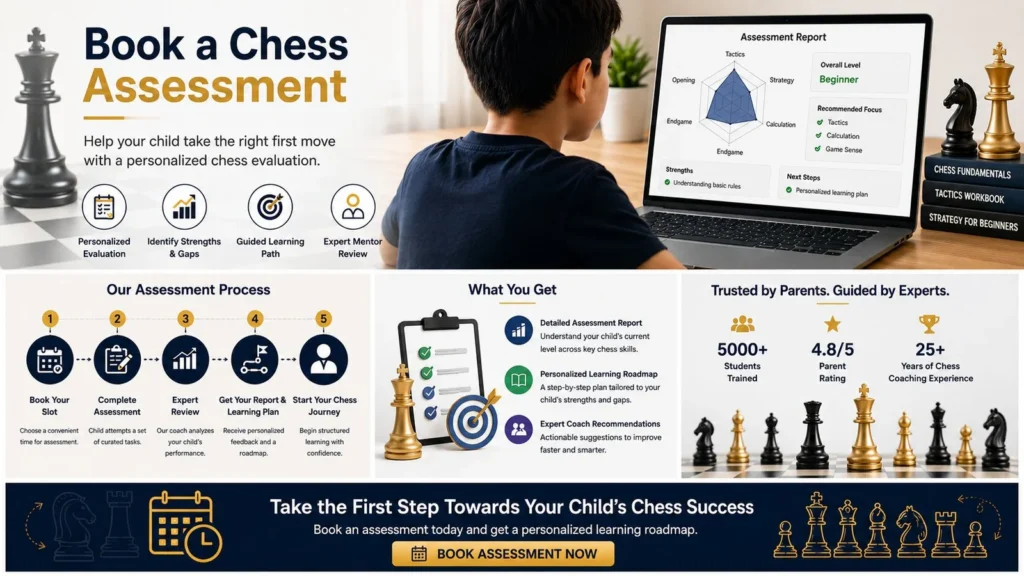
Understand your child’s current chess level, learning approach, strengths, and the most suitable pathway for long-term chess improvement.
Every child learns chess differently. An assessment gives parents a clearer understanding of where their child is today, what they are already doing well, where improvement is needed, and what kind of structured learning may be appropriate next.
- Beginner-friendly guidance
- Structured coaching evaluation
- Parent-focused recommendations
- Personalised improvement direction
Quick Summary
A chess assessment helps us understand:
- Your child’s current playing level
- Chess understanding and thinking habits
- Tactical awareness and decision-making
- Learning approach
- Strengths and improvement areas
- Suitable learning priorities
- Possible next steps for structured coaching
The purpose is not simply to assign a level. It is to understand the student well enough to recommend a thoughtful learning direction.
Online Chess Assessment for Children
Why We Begin With an Assessment
Every child learns chess differently.
Two students with similar playing levels can have very different strengths, weaknesses, thinking habits, and learning needs. One may calculate well but struggle with positional understanding. Another may know the basic rules but need more support with tactical awareness and decision-making.
That is why we prefer to understand the student before recommending a coaching pathway.
One pattern I have repeatedly noticed over the years is that children often improve more confidently when coaching begins with a clear understanding of their current level rather than a one-size-fits-all training approach.
An assessment gives us that starting point.
It helps us recommend the right learning direction thoughtfully instead of placing students into a generic programme.
What We Look At During the Assessment
1. Current Chess Level
We begin by understanding the student’s current experience, including their chess background, previous coaching exposure, tournament participation where relevant, and regular practice habits.
For beginners, the focus is on establishing a comfortable starting point.
For improving players, we look more closely at their existing understanding and development needs.
2. Thinking and Decision-Making
Chess improvement depends not only on knowing moves but also on how a student thinks before making them.
During the assessment, we may observe:
- How the student approaches a position
- Whether they identify threats
- How they consider the opponent’s ideas
- How they calculate possibilities
- Whether they verify their decisions
- How confidently they explain their thinking
These observations help us understand the student’s practical thinking habits.
3. Tactical Awareness
Tactical awareness is an important part of chess development.
The assessment may look at how comfortably the student recognises opportunities such as:
- Checks
- Captures
- Threats
- Tactical patterns
- Vulnerable pieces
- Basic mating ideas
The purpose is not to test the student under unnecessary pressure. It is to understand what they recognise naturally and where further guided practice may help.
4. Learning Approach
Chess coaching is also about understanding how a student learns.
We observe factors such as:
- Communication
- Focus
- Responsiveness
- Problem-solving approach
- Comfort with unfamiliar positions
- Ability to explain ideas
This helps us think about not only what the student should learn, but also how that learning can be structured effectively.
What Happens During the Assessment?
The assessment follows a simple, structured process.
Step 1 — Understand the Student’s Experience
We first establish the student’s chess background.
This can include:
- Current playing level or rating
- Previous coaching
- Tournament experience
- Practice habits
- Learning goals
- Areas where the student or parent feels they need help
Step 2 — Practical Chess Interaction
The student works through guided chess situations appropriate to their level.
This allows us to observe practical thinking, tactical awareness, calculation, and decision-making rather than relying only on a rating or questionnaire.
Step 3 — Identify Strengths and Learning Gaps
We look at what the student already understands and where development would be most useful.
The goal is to identify priorities rather than overwhelm the student with a long list of weaknesses.
Step 4 — Parent Guidance and Recommendations
Parents receive a clearer picture of the student’s current level, strengths, improvement areas, and suitable learning direction.
Where structured coaching is appropriate, the assessment can help establish a more personalised starting point.
Who Is the Assessment For?
Complete Beginners
Children who are just starting chess and need a structured, comfortable introduction to learning.
Students Already Learning Chess
Children who understand the basics but need greater structure, clearer priorities, or a more systematic approach to improvement.
Tournament Beginners
Students beginning tournament chess who would benefit from developing practical thinking, decision-making, and confidence.
Students Struggling to Improve
Children whose progress has slowed despite regular practice or previous coaching.
An assessment can help identify whether the issue is understanding, practice structure, thinking habits, or another learning gap.
A Calm and Structured Learning Environment
Parents are not simply looking for chess lessons.
They are looking for:
- A structured environment
- Patient mentorship
- Professional guidance
- Clear communication
- Meaningful improvement
- Long-term development
The assessment is designed to help parents understand how their child currently approaches chess and whether the proposed coaching pathway is likely to be a suitable fit.
There is no need to rush the decision.
First, understand the student. Then decide what should come next.
What You Will Understand After the Assessment
The assessment is designed to give you greater clarity about:
- Current chess level — where your child is starting from
- Key strengths — abilities that can be developed further
- Improvement areas — the most useful priorities for learning
- Thinking habits — how your child approaches chess decisions
- Learning pathway — what should be worked on next
- Practice direction — where focused practice may help
- Coaching suitability — whether structured coaching is appropriate
- Next steps — a clearer direction for continued development
The goal is not to promise a particular rating outcome.
The goal is to provide a realistic understanding of the student and a sensible direction for improvement.
A Simple Chess Improvement Pathway
Assessment
↓
Understand Current Level
↓
Identify Strengths & Gaps
↓
Set Learning Priorities
↓
Structured Practice & Coaching
↓
Review Progress
↓
Develop Greater Independence
Every student will progress at a different pace.
What matters is having the right starting point and a clear direction.
Why Personalised Direction Matters
A student does not necessarily need to learn everything at once.
If a child is struggling with basic tactical awareness, adding more opening theory may not solve the underlying problem.
If a student understands tactics well but struggles to make decisions in quiet positions, their learning priorities may need to be different.
Good coaching begins by identifying the most important gap first.
That allows learning to become more focused, manageable, and purposeful.
What Parents Should Expect
A useful assessment should leave you with more clarity, not more confusion.
You should understand:
- Where your child is currently
- What they are doing well
- What they need to work on
- What kind of learning structure may help
- What the sensible next step is
Parents do not need to become chess experts to make a good decision.
They need enough clear information to understand their child’s learning journey.
Explore Our Beginner Chess Learning Pathway
If your child is new to chess, you can also explore our beginner learning pathway to understand how foundational chess skills can be developed step by step.
[Explore the Beginner Chess Learning Pathway →]
Book an Assessment Session
If you would like to understand your child’s current chess level and the most suitable direction for improvement, you can book an online assessment session.
The assessment is designed to provide:
- Beginner-friendly guidance
- Parent-focused recommendations
- Structured coaching evaluation
- Personalised improvement direction
Assessment Form
Frequently Asked Questions
What age groups is the assessment suitable for?
The assessment can be adapted to the student’s age, experience, and current chess level. The purpose is to understand the child’s learning needs rather than compare them with other students.
Does my child need tournament experience?
No.
Tournament experience is not required. Complete beginners and children who have never played in tournaments can also benefit from an assessment.
What happens if my child is a complete beginner?
The assessment can establish the child’s starting point and help identify an appropriate foundation for learning.
There is no expectation that a beginner should already know advanced chess concepts.
How long does the assessment session take?
The exact session format can vary depending on the student’s age, experience, and assessment requirements.
The priority is to gather enough useful information without turning the process into an unnecessarily stressful test.
Will parents receive guidance after the assessment?
Yes. The purpose of the assessment is to provide parents with greater clarity about the student’s current level, strengths, improvement areas, and suitable next steps.
Does booking an assessment mean we have to enrol in coaching?
No.
The assessment is intended to help you understand the student’s needs and make a more informed decision about the appropriate learning pathway.
Is the assessment only about chess rating?
No.
Rating can provide useful context, but it does not tell the complete story. Thinking habits, tactical awareness, understanding, decision-making, and learning approach can all be important.
Find the Right Chess Learning Path for Your Child
The right starting point is not always the same for every student.
An assessment helps turn a general question — “What should my child learn next?” — into a clearer understanding of the student’s current level, strengths, learning needs, and possible pathway forward.
If you would like personalised guidance, start with an assessment conversation.
Personalised guidance for beginners, improving students, and tournament learners.