
Chess Thinking: How to Think Better in Every Chess Game
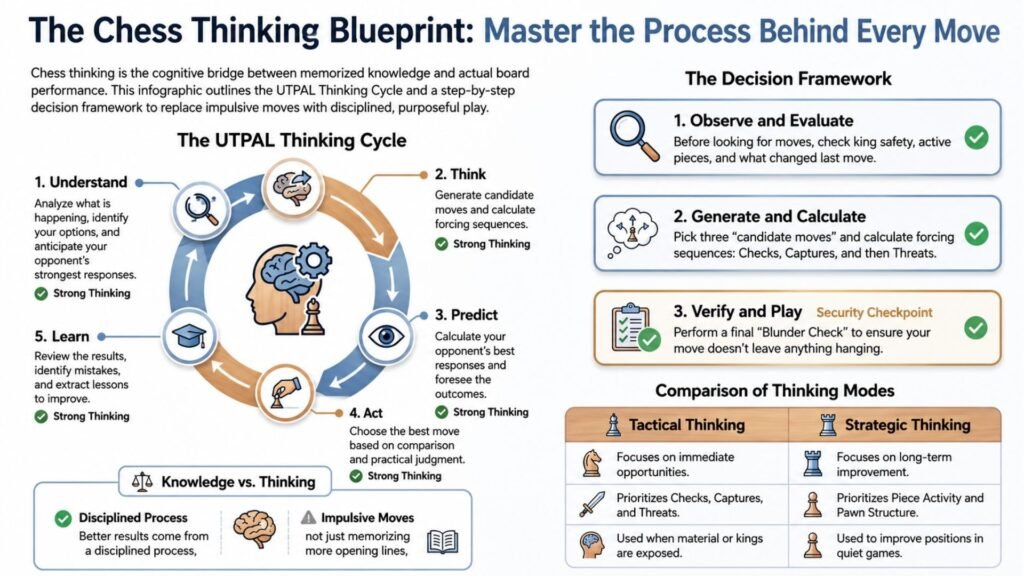
Most chess players spend years learning openings, solving tactics, and watching videos. Yet they continue making the same mistakes.
The problem is often not a lack of chess knowledge.
The problem is the quality of thinking that happens before each move.
Strong players do not simply know more. They notice more, evaluate more carefully, predict more accurately, and make decisions with greater purpose. Every move follows a structured thought process rather than a guess or impulse.
This is why two players with similar knowledge can produce very different results. One consistently finds strong moves, while the other overlooks simple opportunities.
Chess thinking is the bridge between knowledge and performance.
If you can improve how you think, every area of your chess improves—openings become easier to understand, tactics become easier to spot, strategic plans become clearer, and endgames become more manageable.
This guide explains the complete process of chess thinking, from observing a position to making confident decisions and learning from every game.
Whether you are a beginner learning the fundamentals or an improving player trying to reduce mistakes, understanding how to think during a game is one of the most valuable skills you can develop.
Thinking well over the board starts with understanding the fundamentals. Our Complete Beginner Chess Guide explains the complete learning journey.
Related Guides
- Chess Strategy
- Chess Tactics
- Chess Calculation
- Chess Planning
- Chess Visualization
Quick Summary
| Topic | What You’ll Learn |
|---|---|
| Chess Thinking | How strong players approach every move |
| Decision Making | A structured process instead of guessing |
| Calculation | How to evaluate candidate moves |
| Planning | Turning ideas into practical plans |
| Pattern Recognition | Finding tactical and strategic opportunities |
| Reflection | Learning from every game |
What Is Chess Thinking?
Chess thinking is the process of understanding a position, generating ideas, evaluating alternatives, predicting consequences, making a decision, and learning from the result.
It is not a single skill.
Instead, it combines several smaller skills that work together:
- Observation
- Pattern recognition
- Evaluation
- Calculation
- Planning
- Decision making
- Self-reflection
When these skills become habits, players make fewer unnecessary mistakes and become much more consistent.
Many beginners believe strong players instantly “see” the best move.
In reality, experienced players usually follow a disciplined thinking process that has become automatic through years of practice.
Chess Knowledge vs Chess Thinking
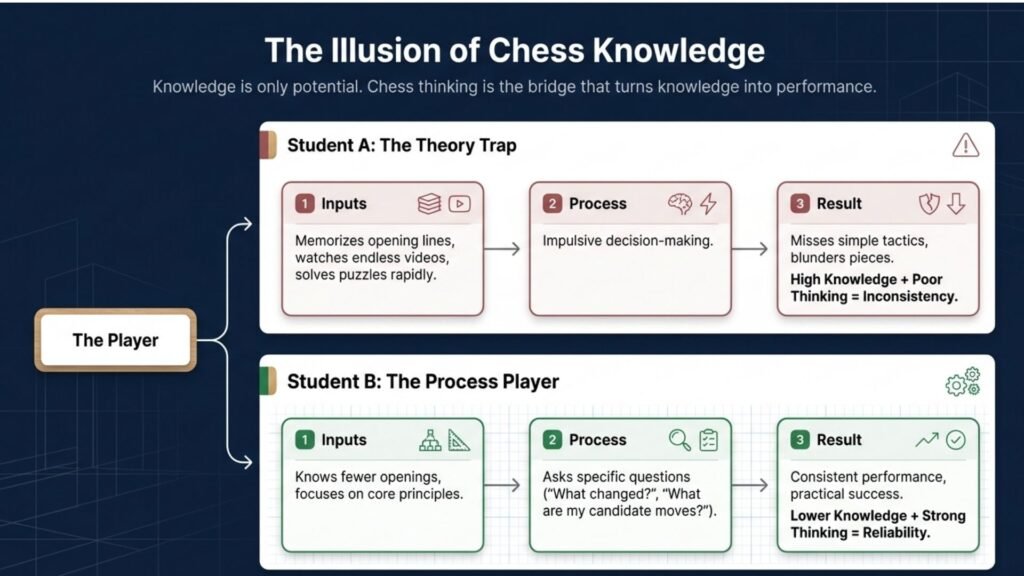
One of the biggest misconceptions in chess improvement is believing that more knowledge automatically leads to better play.
Knowledge is important, but it is only one part of the puzzle.
Consider these two students.
Student A
- Knows many opening variations
- Solves hundreds of puzzles
- Watches instructional videos regularly
Yet during tournament games:
- Misses simple tactics
- Blunders pieces
- Plays too quickly
- Forgets basic principles
Student B
Knows fewer opening lines but consistently asks:
- What changed?
- What is my opponent threatening?
- Which pieces are active?
- What are my candidate moves?
- What happens after each option?
Although Student B possesses less theoretical knowledge, they often achieve better practical results because they make stronger decisions.
The difference is not information.
The difference is thinking.
Coach’s Tip
Many blunders happen because players start calculating before understanding the position. Spend a few seconds observing first—it often saves much more time later.
Why Chess Thinking Matters
Every chess move creates consequences.
A move may:
- Improve a piece
- Lose material
- Create a tactical opportunity
- Prevent an attack
- Strengthen your king
- Weaken your position
- Change the entire direction of the game
Strong thinking helps players understand these consequences before making a move.
Instead of asking,
“What move should I play?”
experienced players ask,
- What is happening?
- What has changed?
- What does my opponent want?
- Which move solves my biggest problem?
- Which move creates the greatest improvement?
These questions transform random play into purposeful decision-making.
The Foundation of Good Chess Thinking
Good chess thinking begins long before calculation.
It begins with observation.
Many mistakes occur because players calculate variations without first understanding the position.
Imagine trying to solve a puzzle before reading the question.
That is exactly what happens when players start calculating immediately.
The strongest habit is learning to pause.
Observe first.
Think second.
Move last.
The UTPAL Thinking Cycle
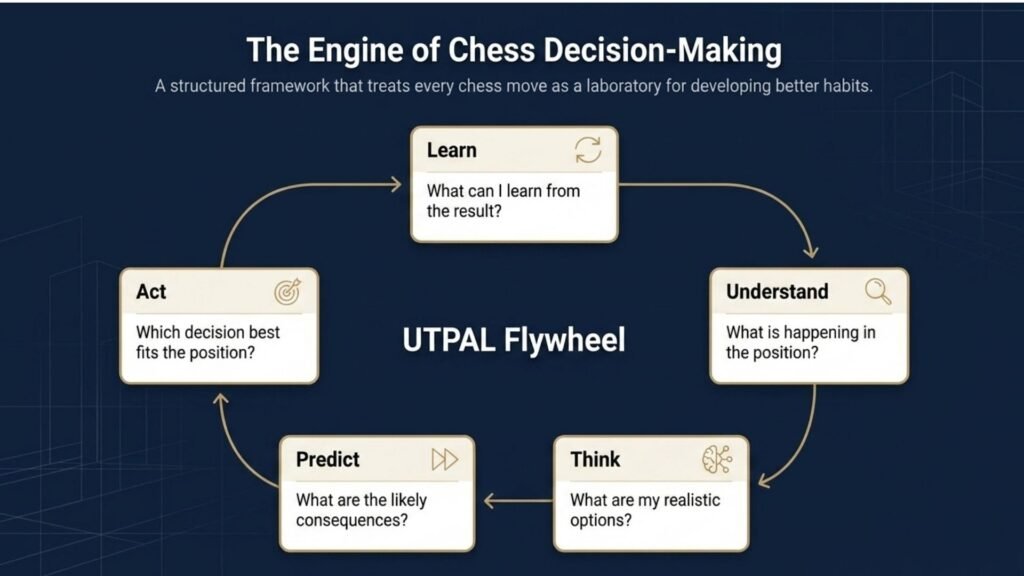
A practical way to organize chess thinking is through the UTPAL Thinking Cycle, a structured decision-making process that treats chess as a laboratory for developing thinking skills rather than simply memorizing moves.
| Stage | Question |
|---|---|
| Understand | What is happening in the position? |
| Think | What are my realistic options? |
| Predict | What are the likely consequences of each option? |
| Act | Which decision best fits the position? |
| Learn | What can I learn from the result? |
This cycle encourages players to slow down, evaluate before acting, and reflect afterward. Over time, these habits become increasingly automatic.
Step 1 — Understand
Every move begins with observation.
Before looking for brilliant ideas, ask simple questions:
- Whose king is less safe?
- Which pieces are active?
- Are any pieces undefended?
- Has my opponent created a new threat?
- Which squares have become weak?
- Has anything important changed since the previous move?
Many blunders happen not because players cannot calculate, but because they fail to notice obvious information.
Observation is the foundation of every strong decision.
Step 2 — Think
Once you understand the position, generate candidate moves.
Avoid stopping after finding the first reasonable move.
Instead, ask:
- Can I improve my worst piece?
- Can I increase pressure?
- Can I defend first?
- Can I simplify?
- Can I create a threat?
- Can I improve king safety?
Strong players compare ideas before choosing one.
Average players often play the first move they notice.
Step 3 — Predict
Every move creates future possibilities.
Before moving, imagine your opponent’s best response.
Ask:
- What will my opponent do?
- What changes after my move?
- Do I lose material?
- Can they create a tactical threat?
- Does my move weaken something important?
Prediction transforms calculation into practical decision making.
Step 4 — Act
Once you’ve evaluated the available options, commit to the best decision.
Avoid second-guessing yourself after making a thoughtful choice.
A well-reasoned move that later proves imperfect is often more valuable than a lucky move played without understanding.
Develop confidence in your process, not just in the outcome.
Step 5 — Learn
Every game provides feedback.
Instead of asking only, “Did I win?” ask:
- Which decisions worked well?
- Where did my thinking break down?
- Did I overlook a threat?
- Did I rush?
- Did I follow my thinking process consistently?
Reflection turns experience into improvement.
Players who regularly review their decisions improve much faster than those who simply play more games.
A Simple Example
Imagine your opponent has just developed a knight and attacked one of your pawns.
An impulsive player immediately defends the pawn.
A thoughtful player pauses:
- Is the pawn worth defending?
- Can I create a stronger threat?
- Is there a tactical opportunity?
- Can I improve development instead?
- What happens if I ignore the attack?
Sometimes the obvious move is correct.
Sometimes it is not.
The difference lies in the thinking process, not in memorized rules.
The Biggest Mistake Most Players Make
Many improving players believe that stronger chess comes from finding brilliant moves.
In practice, most games are decided by avoiding poor decisions rather than discovering extraordinary ones.
Consistently choosing solid, well-reasoned moves usually produces better results than occasionally finding spectacular combinations.
Strong chess is built on disciplined thinking, not constant brilliance.
The Complete Chess Thinking Process
One of the biggest differences between beginners and experienced players is not the number of opening variations they know. It is the quality of the thinking process they follow before making each move.
Many beginners ask only one question:
“What should I play?”
Strong players ask several questions before they commit to a move.
Their thinking follows a repeatable process that helps them reduce mistakes and make better decisions consistently.
The following framework can be applied in almost every position, regardless of your playing strength.
The Chess Thinking Framework
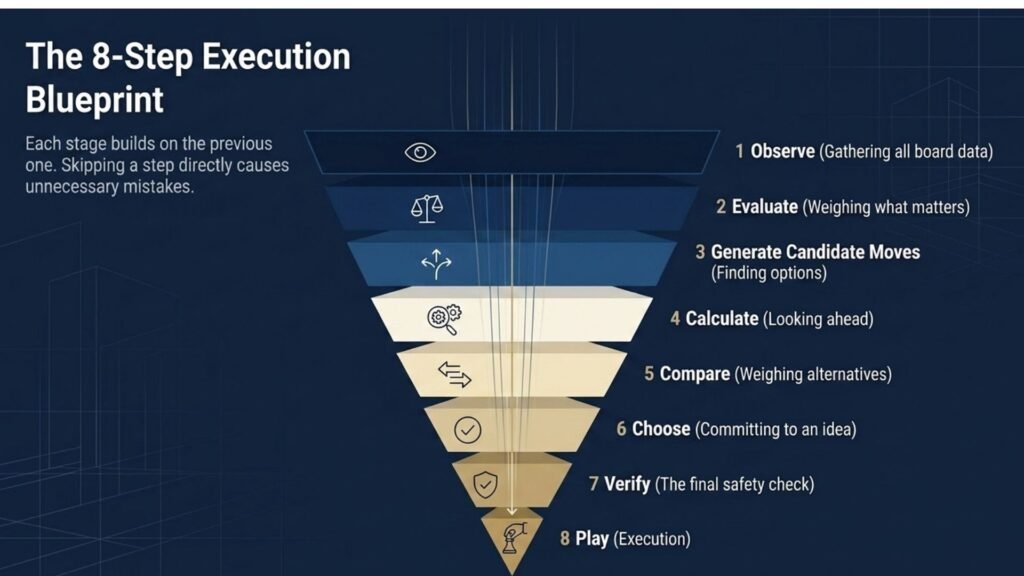
Each stage builds on the previous one.
Skipping a step often leads to unnecessary mistakes.
Step 1 – Observe the Position
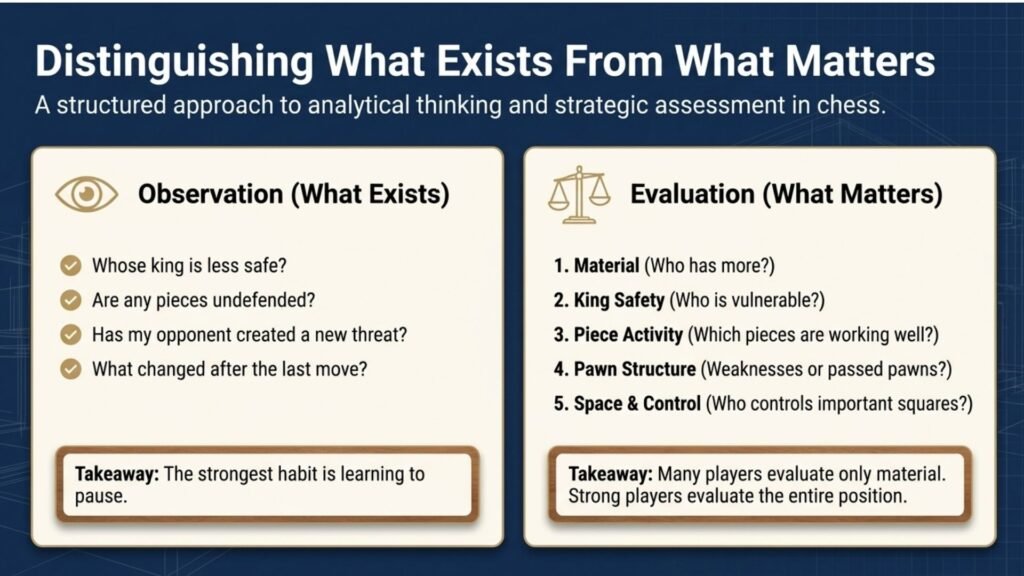
Many players start calculating immediately.
Strong players start by understanding the position.
Before searching for moves, spend a few seconds answering these questions.
Position Checklist
✔ Is my king safe?
✔ Is my opponent’s king safe?
✔ What changed after the last move?
✔ Which pieces are active?
✔ Which pieces are inactive?
✔ Are any pieces hanging?
✔ Which squares became weak?
✔ What is my opponent threatening?
Only after answering these questions should you begin searching for candidate moves.
Step 2 – Evaluate the Position
Observation tells you what exists.
Evaluation tells you what matters.
A useful evaluation can be made by examining five areas.
| Area | Questions |
|---|---|
| Material | Who has more material? |
| King Safety | Which king is more vulnerable? |
| Piece Activity | Which pieces are working well? |
| Pawn Structure | Are there weaknesses or passed pawns? |
| Space & Control | Who controls more important squares? |
Many players evaluate only material.
Strong players evaluate the entire position.
Step 3 – Generate Candidate Moves
One common beginner mistake is choosing the first move that looks reasonable.
Experienced players rarely do this.
Instead, they generate several candidate moves before making a decision.
Usually, three candidate moves are enough.
Example:
Position:
White to move.
Possible ideas might include:
- Developing a bishop
- Castling
- Placing a rook on an open file
Instead of choosing one immediately, compare them.
This simple habit dramatically improves decision quality.
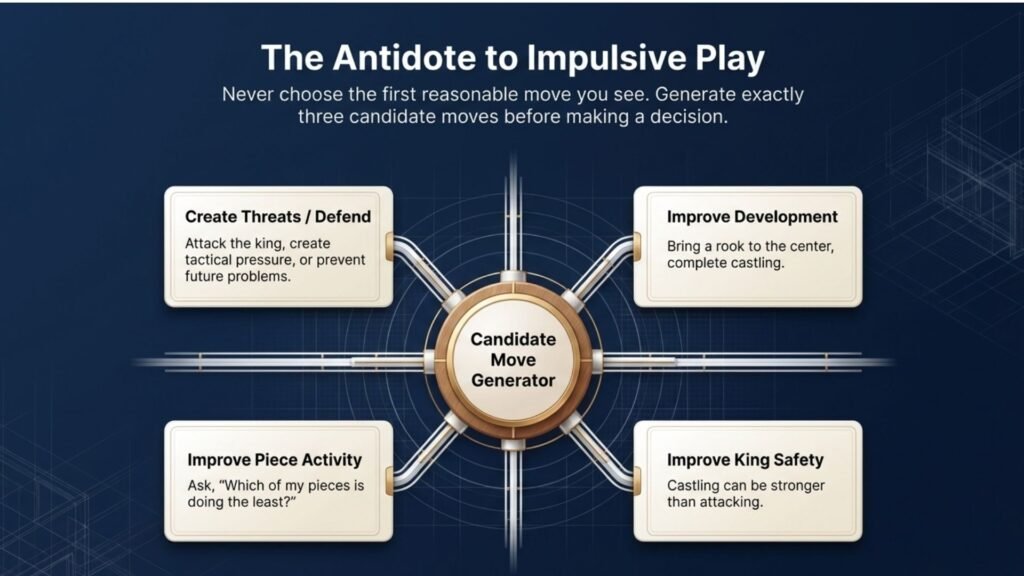
Where Should Candidate Moves Come From?
Most good candidate moves belong to one of these categories.
Improve Development
Ask:
Can I develop another piece?
Examples
- Develop a bishop
- Bring a rook toward the center
- Complete castling
Improve King Safety
Ask:
Can I make my king safer?
Sometimes castling is stronger than attacking.
Improve Piece Activity
Ask:
Which of my pieces is doing the least?
Improving your worst piece often produces better positions than creating new threats.
Create Threats
Threats force your opponent to react.
Examples
- Attack a piece
- Attack the king
- Create tactical pressure
Defend Weaknesses
Sometimes the strongest move is simply preventing future problems.
Good thinking balances attack and defence.
Step 4 – Calculate Variations
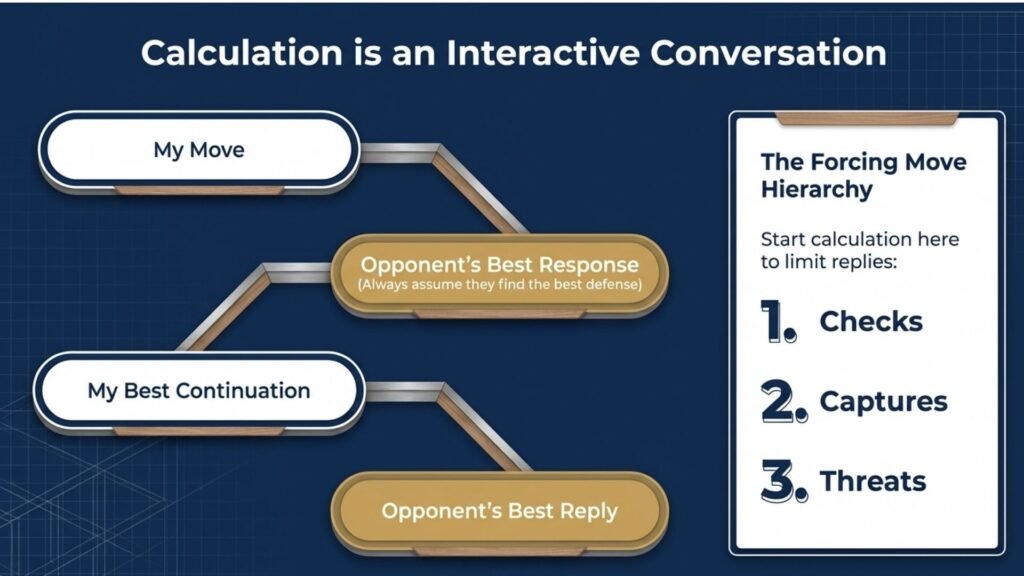
Calculation means looking ahead.
Instead of asking,
“What happens if I move here?”
Ask,
“What happens after my opponent plays their best move?”
Good calculation is always interactive.
Think of it as a conversation.
You make a move.
Your opponent replies.
You respond.
They respond again.
Continue until the position becomes clear.
The Candidate Move Formula
For every move, calculate:
My Move
↓
Opponent’s Best Response
↓
My Best Continuation
↓
Opponent’s Best Reply
Only then compare different options.
Common Calculation Mistakes
Many players calculate only their own ideas.
Strong players calculate both sides.
Avoid these mistakes.
❌ Ignoring opponent threats
❌ Assuming your opponent will cooperate
❌ Stopping calculation too early
❌ Missing forcing moves
The Importance of Forcing Moves
Strong players begin calculation with forcing moves because they limit the opponent’s choices.
The order is simple.
- Checks
- Captures
- Threats
These moves deserve attention before quieter positional ideas.
Sometimes a tactical opportunity exists that completely changes the position.
Visualization
Calculation depends on visualization.
Visualization means seeing future positions without physically moving the pieces.
Fortunately, visualization can be trained.
Simple exercises include:
- Solving puzzles without moving pieces
- Reading notation mentally
- Following master games move by move
- Blindfold training (gradually)
Like any skill, visualization improves through consistent practice.
Step 5 – Compare Candidate Moves
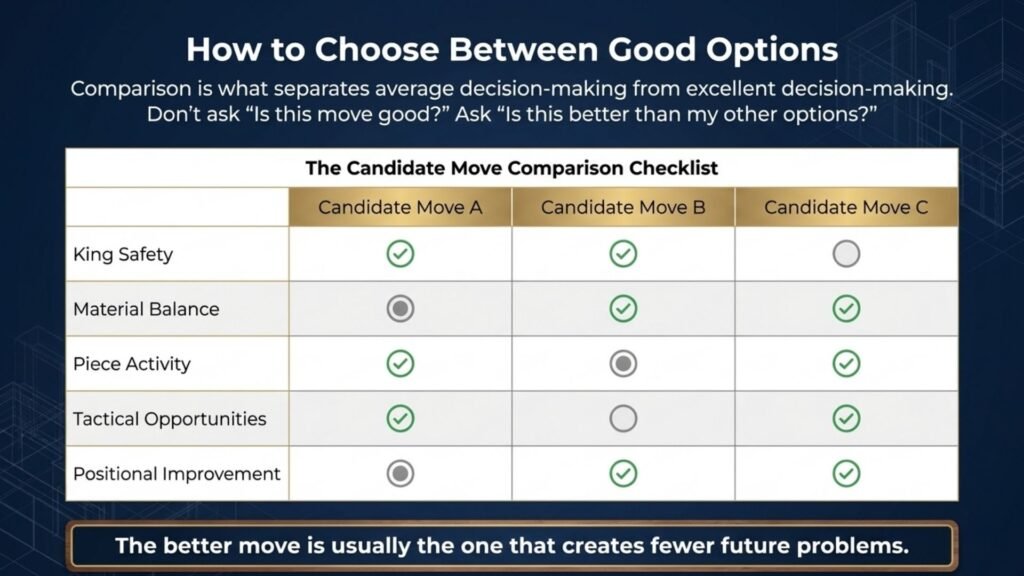
Many moves may be playable.
The challenge is identifying the strongest one.
Instead of asking,
“Is this move good?”
Ask,
“Is this better than my other options?”
Comparison is what separates average decision-making from excellent decision-making.
The Comparison Checklist
For each candidate move, compare:
✓ King safety
✓ Material
✓ Piece activity
✓ Tactical opportunities
✓ Positional improvement
✓ Long-term plans
Often two moves appear equally good.
The better move is usually the one that creates fewer future problems.
Step 6 – Verify Before Playing
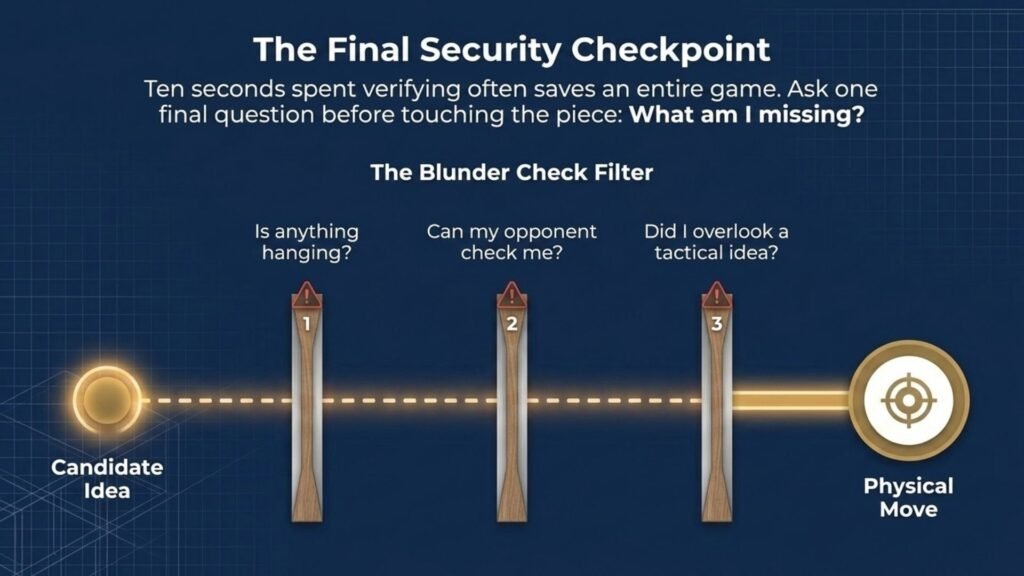
One final check prevents many blunders.
Before touching the piece, ask:
What did I miss?
This simple question catches surprising numbers of mistakes.
The Blunder Check
Before every move:
The Blunder Check Principle
Before every move, ask yourself:
✓ Can I win material?
Has my opponent left a piece, pawn, or tactical opportunity that I can exploit?
✓ Can my opponent win material?
Does my move allow my opponent to win a pawn, piece, or exchange?
✓ Can I check my opponent?
Is there a check that creates immediate threats, starts a tactical sequence, or improves my position?
✓ Can my opponent check me?
Does my move allow my opponent to check my king, create threats, or seize the initiative?
✓ Why did my opponent play their last move?
What is the purpose of their move? Are they creating a threat, setting a trap, improving a piece, or preparing a tactical idea?
Take ten seconds to run through this checklist before every move. It helps you spot tactical opportunities, avoid blunders, and make stronger decisions.
Want a practical checklist you can use before every move? Read How to Stop Blundering in Chess | The Five Rules System to learn the complete five-question verification process.
Tactical Thinking vs Strategic Thinking
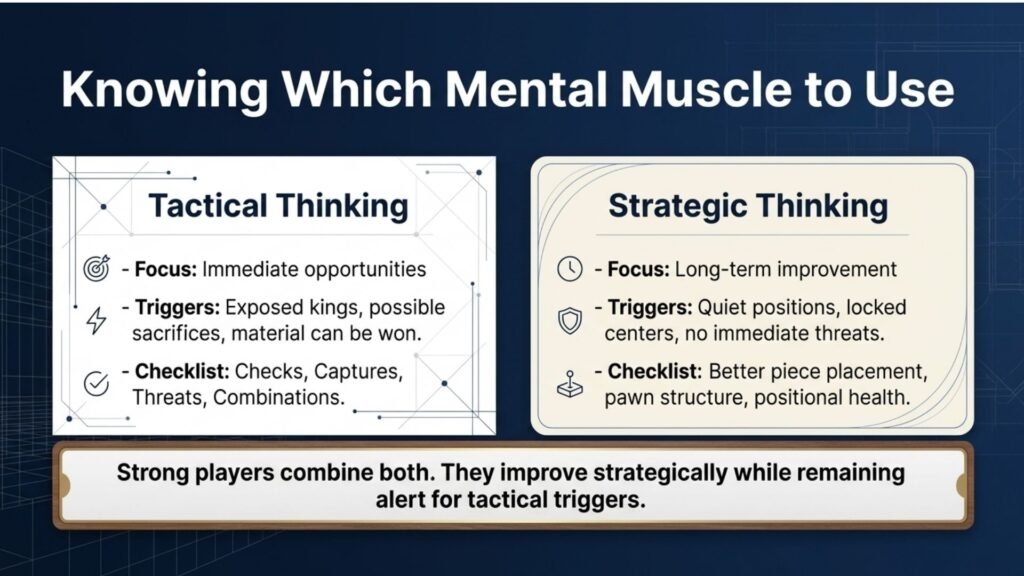
Many players confuse tactics and strategy.
Both are essential.
They simply answer different questions.
| Tactical Thinking | Strategic Thinking |
|---|---|
| Immediate opportunities | Long-term improvement |
| Checks | Better piece placement |
| Captures | Better pawn structure |
| Threats | Stronger plans |
| Combinations | Better positions |
Strong players combine both.
They improve their position strategically while remaining alert for tactical opportunities.
When Should You Calculate?
Not every position requires deep calculation.
Calculate carefully when:
- Material can be won
- Kings are exposed
- Tactical opportunities exist
- Sacrifices are possible
- Promotions are close
- The position is complicated
In quiet positions, planning and evaluation often matter more than lengthy calculation.
Decision Quality Matters More Than Perfect Moves
Many students become frustrated because they cannot always find the engine’s best move.
That is not the goal.
The goal is to make good practical decisions consistently.
If your thinking process is strong, your moves will improve naturally over time.
Coaching Observations
After teaching hundreds of students, several patterns appear repeatedly.
Pattern 1
Students move too quickly.
They see one idea and immediately play it.
Solution:
Pause.
Generate three candidate moves first.
Pattern 2
Students attack without asking what their opponent wants.
Solution:
Always identify your opponent’s threat before creating your own.
Pattern 3
Students calculate only their own ideas.
Solution:
Every variation should include your opponent’s strongest response.
Pattern 4
Students stop calculating as soon as they find one acceptable continuation.
Solution:
Compare alternatives before making your decision.
Pattern 5
Students forget to perform a final blunder check.
Solution:
Make verification the last step before every move.
This habit alone can eliminate many avoidable losses.
Common Thinking Mistakes
Playing Automatically
Many players rely on habit rather than observation.
Every position is different.
Treat each move as a new problem to solve.
Falling in Love with the First Idea
Your first idea may be good.
It may also be your weakest option.
Always compare alternatives.
Ignoring Your Opponent
Chess is a conversation between two players.
Every plan must consider your opponent’s resources.
Calculating Too Much
Sometimes players spend several minutes calculating unnecessary variations in quiet positions.
Good thinking includes knowing when calculation is necessary and when simple strategic improvement is enough.
Playing for Tricks Instead of Good Moves
Beginners often hope their opponent will make a mistake.
Strong players assume their opponent will find the best defence and choose moves that remain strong even if no mistake occurs.
Building Strong Chess Thinking Habits
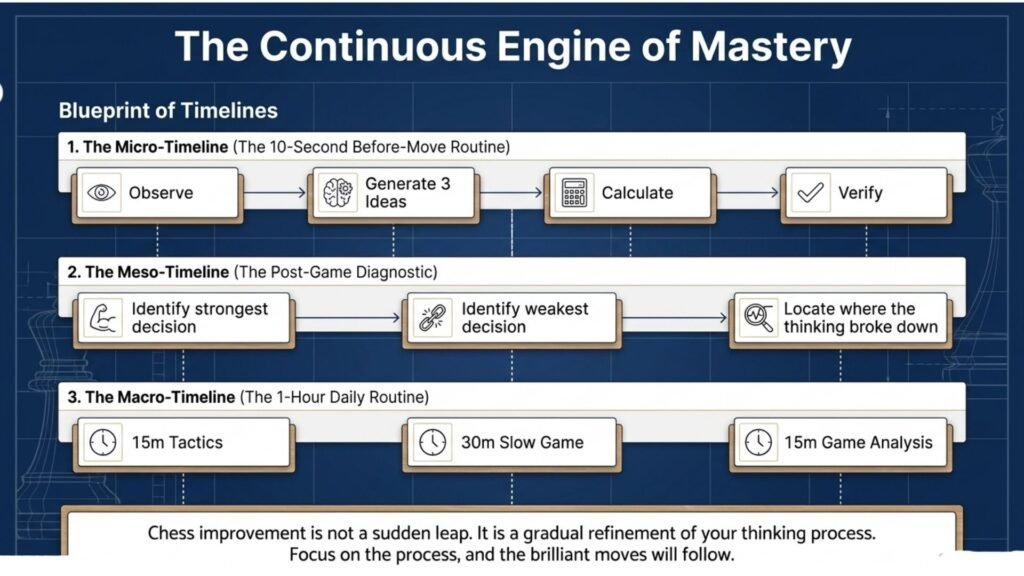
Understanding the thinking process is only the beginning.
The real improvement happens when good thinking becomes automatic.
Strong chess players do not consciously work through every checklist forever. With deliberate practice, observation, evaluation, calculation, and verification become natural habits.
The goal is not to think longer.
The goal is to think better.
A Daily Chess Thinking Routine
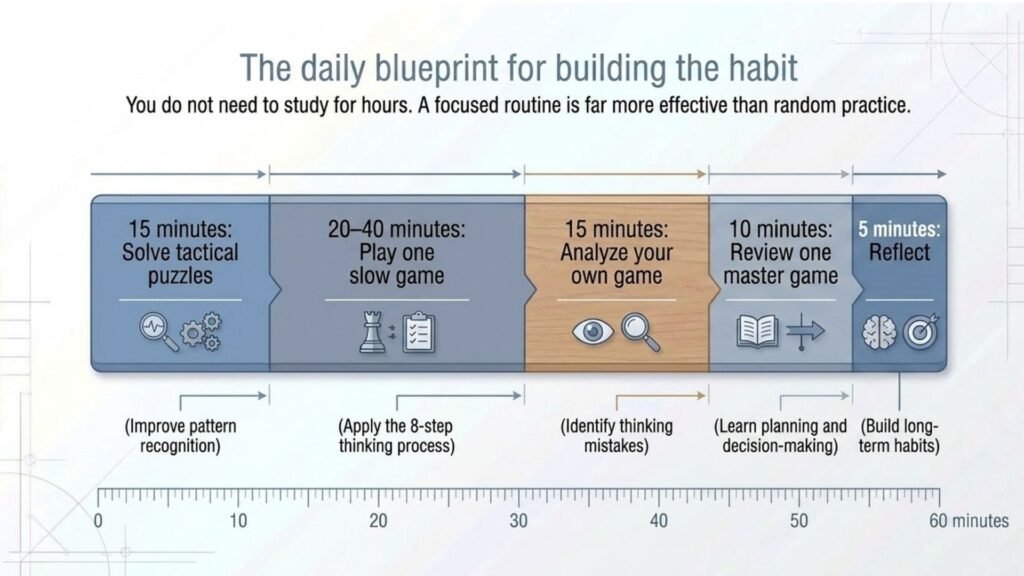
You do not need to study for hours every day to improve your thinking.
A focused routine is far more effective than random practice.
| Activity | Time | Purpose |
|---|---|---|
| Solve tactical puzzles | 15 minutes | Improve pattern recognition |
| Play one slow game | 20–40 minutes | Apply thinking process |
| Analyse your own game | 15 minutes | Identify thinking mistakes |
| Review one master game | 10 minutes | Learn planning and decision-making |
| Reflect on one lesson | 5 minutes | Build long-term thinking habits |
Even 45–60 minutes of purposeful practice can produce steady improvement over time.
A Thinking Routine Before Every Move
Develop the habit of asking yourself these questions before making every move.
Step 1 — Observe
- What changed?
- Is there a threat?
- Which pieces became stronger or weaker?
Step 2 — Evaluate
- Who stands better?
- What is my biggest problem?
- What is my greatest opportunity?
Step 3 — Generate Ideas
Can I:
- Improve a piece?
- Create a threat?
- Increase king safety?
- Simplify?
- Gain space?
Step 4 — Calculate
Look ahead.
Always assume your opponent will find their best move.
Step 5 — Verify
Before playing, ask one final question.
What am I missing?
This single habit prevents countless blunders.
Student Scenarios
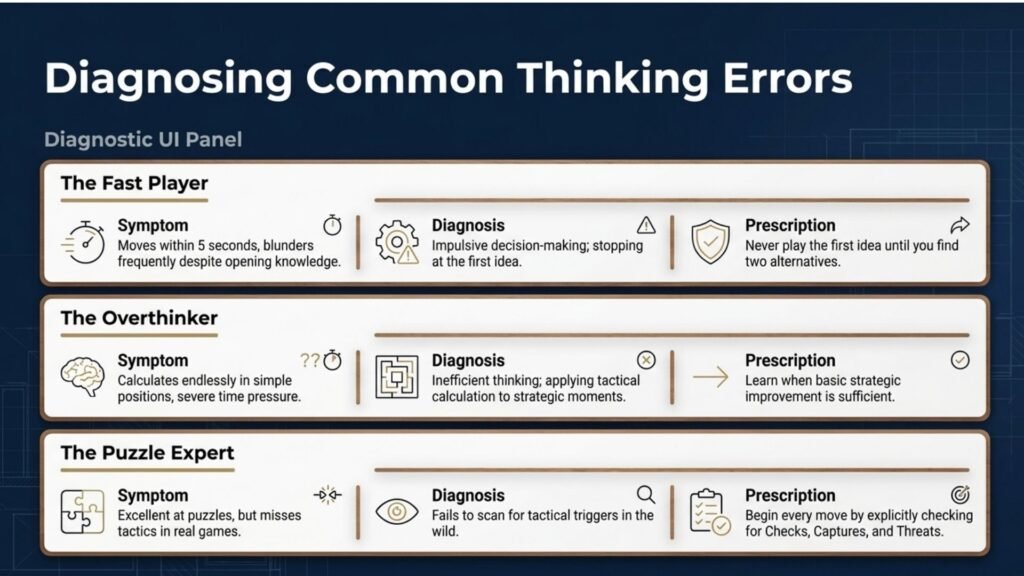
Scenario 1 – The Fast Player
A student completed every move within five seconds.
He knew opening theory reasonably well but frequently blundered pieces.
The issue was not knowledge.
The issue was impulsive decision-making.
Instead of giving him more opening lines, we introduced one simple rule:
Never play your first idea until you have found two alternatives.
Within a few weeks, his blunder rate dropped noticeably.
Scenario 2 – The Overthinker
Another student spent several minutes calculating every move, even in simple positions.
Time pressure became a constant problem.
The solution was not deeper calculation.
The solution was learning when calculation was necessary and when basic strategic improvement was sufficient.
Good thinking is not endless thinking.
It is efficient thinking.
Scenario 3 – The Puzzle Expert
A student solved hundreds of tactical puzzles every week but continued missing tactics in tournament games.
The problem became clear.
He searched for combinations without first asking whether tactical opportunities existed.
Once he learned to begin every move by checking:
- Checks
- Captures
- Threats
his practical tactical awareness improved significantly.
From Good Moves to Good Thinking
Many players judge themselves only by the moves they play.
Instead, judge yourself by the quality of your thinking.
Ask questions such as:
- Did I understand the position?
- Did I consider multiple options?
- Did I calculate carefully?
- Did I verify before moving?
- Did I learn something from this position?
Over time, stronger thinking naturally leads to stronger moves.
Learning Roadmap
Beginner
        ↓
Learn Chess Principles
        ↓
Develop Observation Skills
        ↓
Evaluate Positions
        ↓
Generate Candidate Moves
        ↓
Improve Calculation
        ↓
Build Planning Skills
        ↓
Develop Consistency
        ↓
Think Independently
Improvement is not a sudden leap.
It is a gradual refinement of your thinking process.
Chess Thinking at Different Levels
| Rating Level | Primary Thinking Focus |
|---|---|
| Beginner | Safety, development, basic tactics |
| Improving Player | Candidate moves and calculation |
| Intermediate | Planning and positional understanding |
| Advanced | Deep evaluation and long-term decision-making |
| Expert | Efficient thinking, precision, practical judgement |
Each stage builds on the previous one.
Trying to skip foundations often creates unnecessary confusion.
Strong Thinking vs Weak Thinking
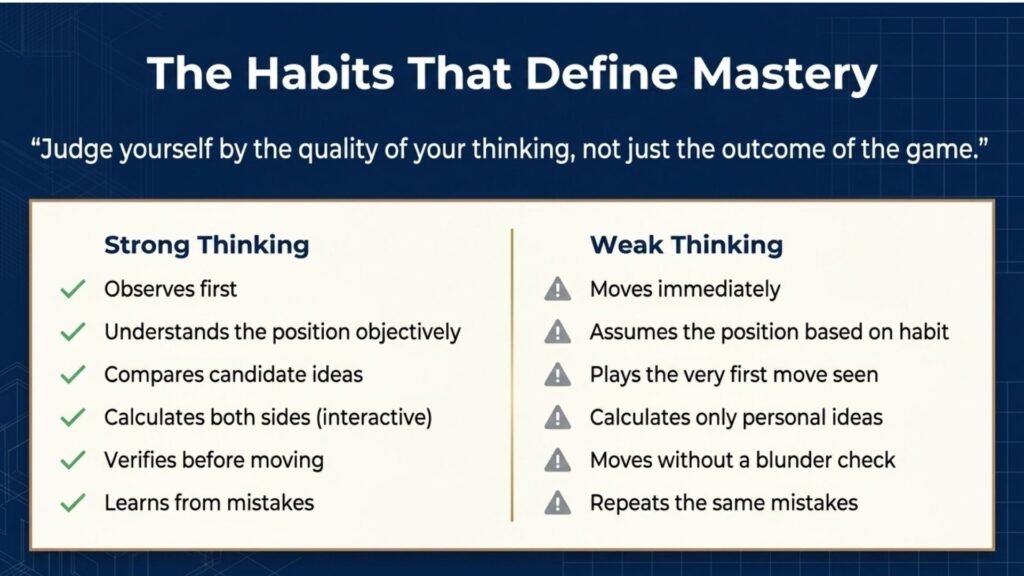
Common Habits of Strong Chess Thinkers
Strong players usually:
- Remain patient
- Stay curious
- Look for improvement rather than perfection
- Consider their opponent’s ideas
- Think in terms of plans instead of isolated moves
- Reflect after every serious game
These habits become more valuable as competition becomes stronger.
Practical Tips You Can Use Today
If you want immediate improvement, begin with these habits.
Before Every Move
✔ Observe
✔ Identify threats
✔ Generate three candidate moves
✔ Calculate carefully
✔ Verify your decision
After Every Game
Instead of asking,
“Why did I lose?”
Ask,
- Which decisions were strongest?
- Which decisions were weakest?
- What thinking mistake happened first?
- What should I do differently next time?
Reflection transforms experience into progress.
Key Takeaways
- Chess thinking is a structured decision-making process.
- Observation comes before calculation.
- Good evaluation leads to better plans.
- Candidate moves improve decision quality.
- Calculation must include your opponent’s best responses.
- Verification prevents unnecessary mistakes.
- Reflection accelerates improvement.
- Strong thinking creates strong results.
Frequently Asked Questions
What is chess thinking?
Chess thinking is the process of observing, evaluating, calculating, planning, deciding, and learning from each move during a game.
Can chess thinking be improved?
Yes.
Like tactical vision or endgame technique, thinking habits improve through deliberate practice and consistent reflection.
Should beginners calculate many moves ahead?
No.
Beginners benefit more from improving observation, avoiding blunders, following basic principles, and recognising simple tactical ideas.
Depth of calculation naturally develops with experience.
How can I stop making simple mistakes?
Slow down before moving.
Perform a final blunder check.
Many mistakes disappear simply by asking,
“What is my opponent threatening?”
before making your move.
Is calculation more important than strategy?
Neither is more important.
Calculation helps you make accurate decisions.
Strategy helps you choose the right long-term direction.
Strong players combine both.
How long does it take to improve chess thinking?
Improvement is gradual.
Players who consistently analyse their games, solve puzzles thoughtfully, and follow a structured thinking process often notice meaningful progress within a few months.
Final Thoughts
Every chess game presents a series of decisions.
Some are simple.
Others are complex.
Your results depend less on memorising thousands of moves and more on developing a reliable process for making those decisions.
When you learn to observe carefully, evaluate objectively, calculate accurately, and reflect honestly, improvement becomes more predictable.
Openings, tactics, strategy, and endgames all become easier because they are supported by stronger thinking.
The strongest players are not those who know the most.
They are often the ones who consistently make better decisions.
Develop your thinking, and your chess will follow.
Continue Your Learning Journey
If you enjoyed this guide, continue building your understanding by exploring:
- Chess Strategy
- Chess Tactics
- Chess Openings
- Chess Endgames
- Chess Improvement
- Game Analysis
- Calculation in Chess
- Visualization in Chess
Together, these topics form a complete system for becoming a stronger, more confident chess player.
Conclusion
Chess is often described as a game of knowledge, but lasting improvement comes from something deeper: the ability to think clearly under changing conditions.
Every position asks new questions. Every move has consequences. By developing a disciplined thinking process—observing, evaluating objectively, calculating accurately, and learning from experience—you build skills that improve not only your chess but also your confidence as a decision-maker.
The objective is not to find brilliant moves in every game. It is to make consistently sound decisions. Over time, that habit becomes your greatest competitive advantage.
Ready to Improve Your Chess Thinking?
The fastest progress comes from combining structured study with thoughtful practice. Use the frameworks in this guide during your games, review your decisions honestly, and focus on improving your thinking process one move at a time.