
Chess Endgames
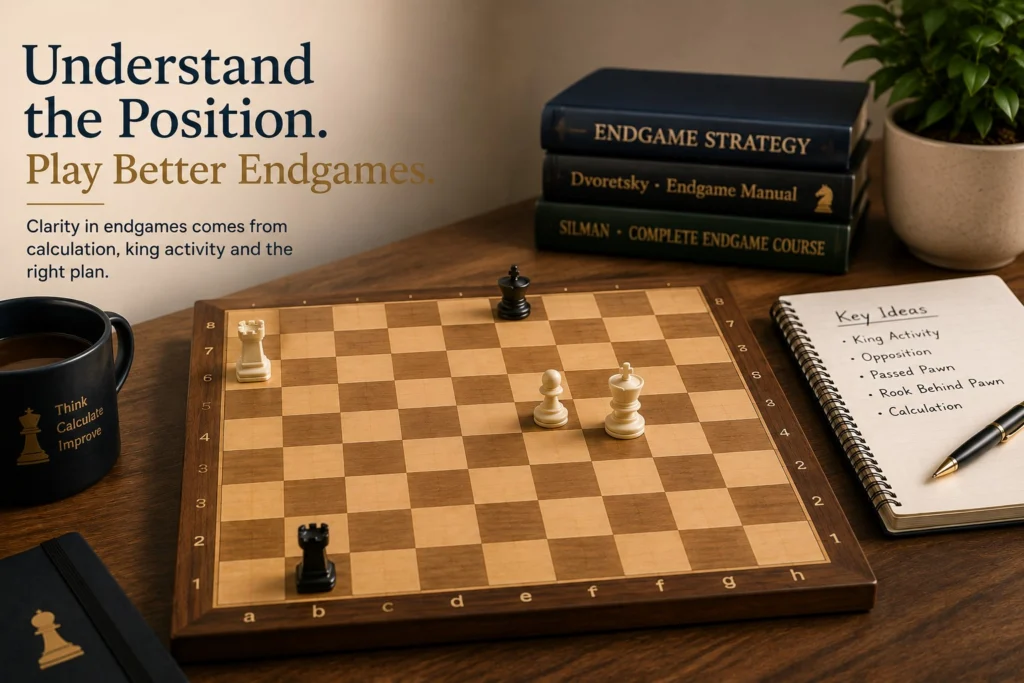
Chess endgames are where small advantages often become decisive.
With fewer pieces on the board, every king move, pawn move, exchange, and calculation can matter more. The position may look simpler than a middlegame, but the decisions are often more concrete: Can the king reach the critical square? Can a pawn promote? Should the pieces be exchanged? Can the defender create counterplay?
The key to improving at endgames is not memorising hundreds of positions. It is learning how to recognise the features that determine whether an ending is winning, drawn, or difficult to defend.
This guide covers the essential principles of chess endgames, including king activity, opposition, key squares, the rule of the square, pawn races, passed pawns, zugzwang, rook endings, minor-piece endings, conversion, defence, and practical training.
If you are still building your overall chess foundation, begin with the Complete Beginner Chess Guide.
Quick Summary
The most important endgame principles are:
- Activate your king.
- Identify the critical squares.
- Calculate pawn races before pushing.
- Understand opposition and the rule of the square.
- Create, support, and stop passed pawns.
- Use zugzwang, triangulation, and spare tempi when relevant.
- Keep your rook active.
- Know the basic Lucena and Philidor positions.
- Judge exchanges by the position they create.
- Convert advantages patiently.
- Defend actively rather than waiting passively.
- Practise important positions from both sides.
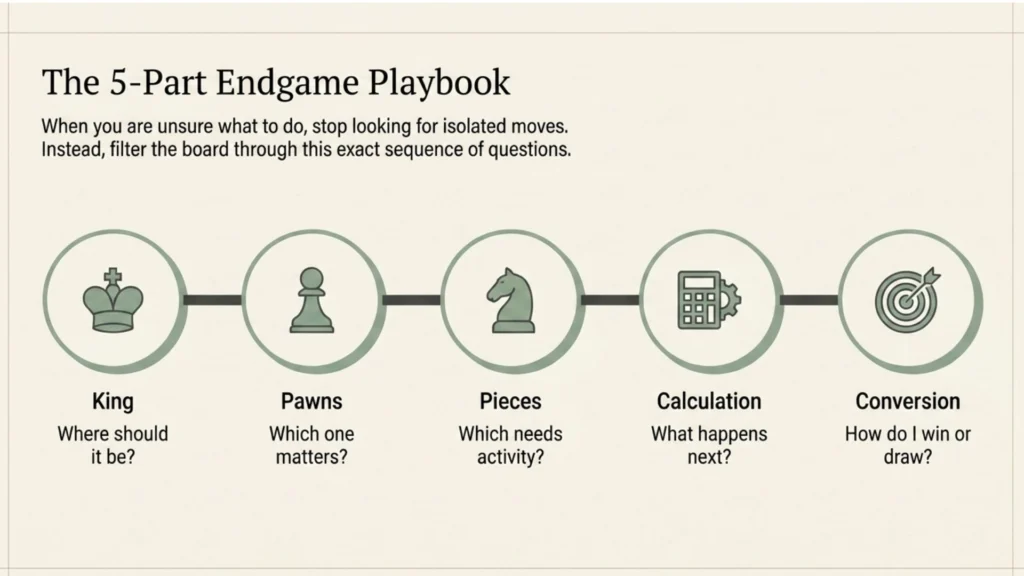
When the correct plan is unclear, use this simple decision sequence:
King → Pawns → Pieces → Calculation → Plan
Ask what each part of the position is telling you before choosing a move.
What Is a Chess Endgame?
A chess endgame is a phase of the game in which king activity, pawn structure, piece activity, promotion, and precise calculation become increasingly important.
There is no fixed number of pieces that automatically defines an endgame. A position with queens still on the board can have endgame characteristics, while a position with several pieces may still require typical middlegame attacking play.
The important change is the character of the position.
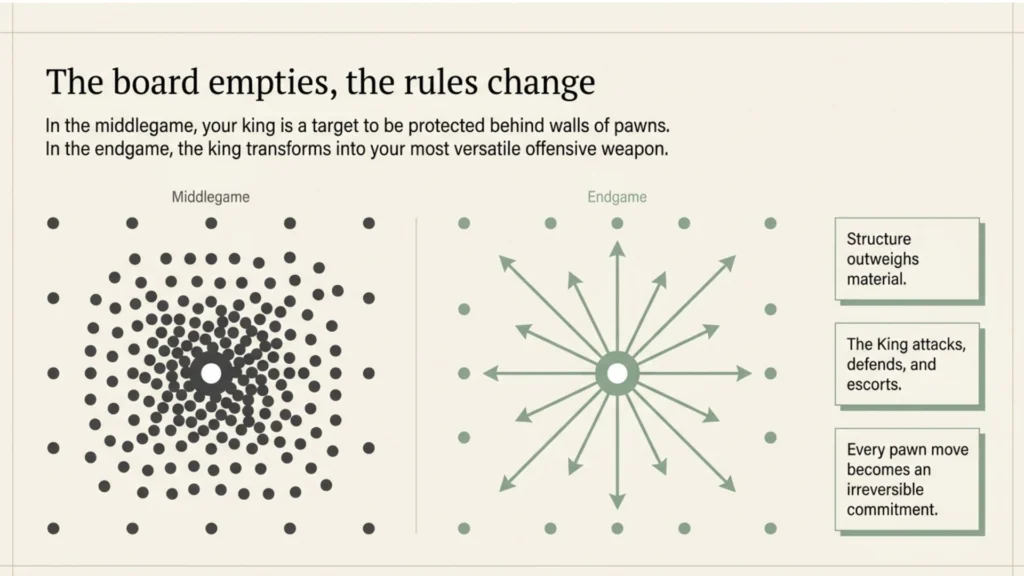
As material decreases:
- kings usually become more active
- passed pawns become more important
- weaknesses become easier to attack
- pawn moves become more consequential
- exchanges become easier to evaluate
- promotion becomes a central objective
- calculation becomes more concrete
The endgame therefore teaches more than what to do after the queens come off. It teaches you to understand the consequences of your decisions.
Why Chess Endgames Matter
An extra pawn does not automatically mean a winning position.
Before assuming that an advantage can be converted, consider:
- Which king is more active?
- Can the defending king reach the critical pawn?
- Can a passed pawn be created?
- Can the defender establish a blockade?
- Is a pawn exchange favourable?
- What position will remain after a piece exchange?
- Can the defender create counterplay?
- Is the position actually winning?
This is one of the reasons endgame study improves general chess understanding.
You learn to look beyond material and consider activity, structure, calculation, and the resulting position.
Endgames also teach an important defensive lesson: being down material does not necessarily mean that the position is lost. A well-placed king, blockade, checking distance, or active passed pawn can provide significant defensive resources.
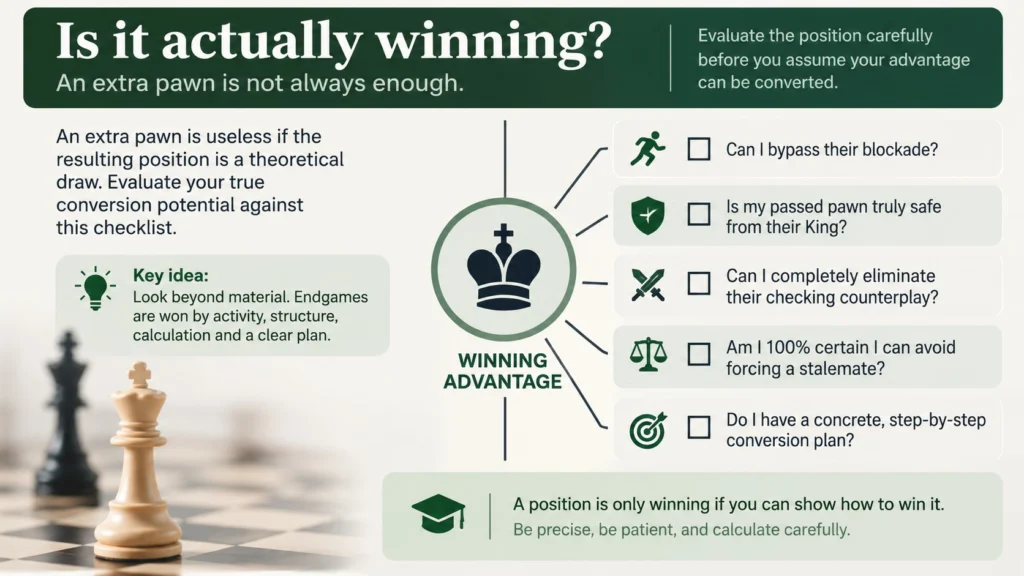
Is Your Advantage Actually Winning?
Having an extra pawn is an advantage, but it is not automatically a winning position.
In practical endgames, the important question is not simply “Am I ahead?” but “Can I convert this advantage into a win?”
A passed pawn may be blockaded. Your king may be poorly placed. Your opponent may have checking opportunities or counterplay. In some positions, trying too hard to win can even allow a stalemate or a perpetual-check resource.
Before beginning the conversion, pause and evaluate the position as a whole.
The conversion checklist
Ask yourself:
- Can I bypass their blockade?
If your opponent has a piece or king stopping your pawn, look for a way to improve your position before pushing it further. - Is my passed pawn genuinely safe?
A passed pawn is only useful if it can survive. Check whether the enemy king can attack it or whether your opponent has a tactical resource. - Can I eliminate their checking counterplay?
Many endgames are difficult to convert because the defending side can give repeated checks. Improve your king and restrict the checking pieces whenever possible. - Can I avoid stalemate?
When the opponent has very little material or mobility, every move matters. Before making a forcing move, check whether you are removing all legal moves. - Do I have a concrete conversion plan?
Do not move pieces simply because you are ahead. Identify the next objective: improve the king, create a passed pawn, win another pawn, restrict the opponent, or simplify into a known winning ending.
The key principle: A position is not truly winning just because you have more material. It is winning when you can explain how the advantage will be converted.
The Main Types of Chess Endgames
Different endgames require different techniques, but they share several underlying principles.
King-and-Pawn Endgames
Only kings and pawns remain.
These endings are the foundation of endgame calculation because king activity, opposition, key squares, pawn races, and promotion are exposed without the complications of other pieces.
Rook Endgames
Rooks and pawns remain, usually with both kings.
Rook endings involve checking distance, king activity, passed pawns, cutting off the opposing king, and active defence. They are among the most practically important endgames to understand.
Bishop Endgames
Bishops and pawns remain.
The colour of the squares, pawn structure, king activity, and whether the bishops operate on the same or opposite colours can strongly influence the result.
Knight Endgames
Knights and pawns remain.
Centralisation, outposts, king activity, blockades, and the ability to stop passed pawns become especially important.
Queen Endgames
Queens and pawns remain.
These endings can remain highly tactical because checks, perpetual check, king safety, promotion threats, and tactical resources continue to matter.
Mixed-Piece Endgames
Many practical endings contain several different pieces.
The exact material may vary, but the core questions remain:
- Which king is better placed?
- Which piece is most active?
- Which piece is restricted?
- Which pawns can become passed?
- Which exchanges improve the position?
King Activity: The Foundation of Endgame Play
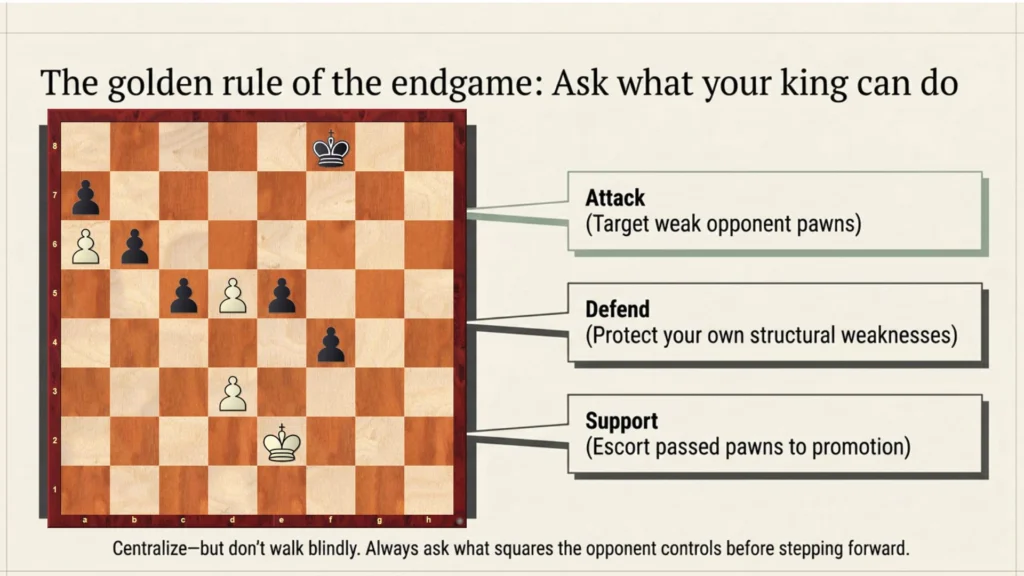
In many endgames, the king changes from a piece that must primarily be protected into an active participant.
An active king can:
- attack weak pawns
- defend its own pawns
- control critical squares
- support a passed pawn
- stop an enemy passed pawn
- restrict the opposing king
- support a breakthrough
Centralise With a Purpose
Moving the king toward the centre is often useful, but centralisation alone is not a plan.
Before moving, ask:
Where does my king need to go?
The best square is often the one that allows the king to perform a specific job: attack a weakness, support a pawn, stop an enemy king, or reach a promotion square.
A king that moves toward the centre without considering the opponent’s plan may simply lose time.
Opposition and Key Squares
Opposition is one of the fundamental ideas in king-and-pawn endings.
It occurs when the kings face one another with an appropriate distance between them, and the player who does not have the move can often use the resulting move order to control the critical squares.
The practical question is not simply:
“Do I have opposition?”
Instead ask:
“What does the opposition allow my king to achieve?”
That distinction matters because opposition is a means to an objective, not an objective by itself.
Key Position: Opposition
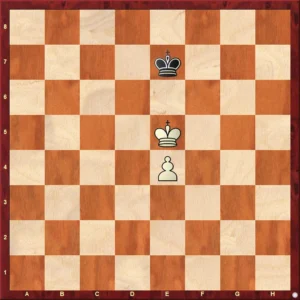
White: King e5, Pawn e4
Black: King e7
White to move.
The important feature is the relationship between the kings. The result depends on whose turn it is and whether either king can give way without surrendering the critical squares.
When studying opposition, always change the side to move and compare the resulting positions.
The Rule of the Square
The rule of the square is a practical method for estimating whether a defending king can catch an advancing pawn.
Imagine a square extending from the pawn toward the promotion area. If the defending king can enter that square in time, it may be able to stop the pawn. If it cannot, the pawn may be able to promote without assistance.
The rule is an estimation tool rather than a replacement for calculation. Special features such as a pawn’s initial two-square move, captures, king support, or another pawn can change the exact result.
Key Position: Rule of the Square
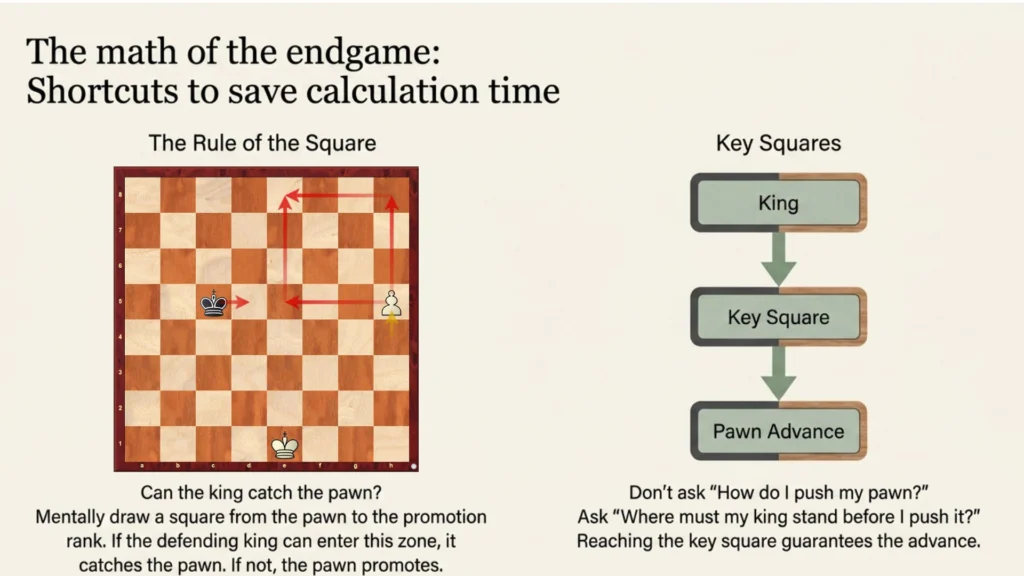
White: Pawn a5
Black: King g7
The useful question is:
Can the black king reach the pawn’s path before the pawn promotes?
This is exactly the type of question the rule of the square helps you answer quickly.
Pawn Races, Passed Pawns, and Breakthroughs
Pawn endings often become races.
Before pushing a pawn, calculate:
- How many moves does my pawn need to promote?
- How many moves does the opponent’s pawn need?
- Whose king can interfere?
- Will either side promote with check?
- Can one king enter the promotion square?
- Can a pawn capture another pawn during the race?
Do not calculate only your own pawn’s journey.
Calculate both sides’ plans.
Passed Pawns
A passed pawn has no opposing pawn on its own file or adjacent files that can stop its advance.
Passed pawns become dangerous because they force the opponent to allocate pieces or king moves to stopping them.
A passed pawn may:
- promote
- distract the defending king
- force a piece into a passive position
- create a second weakness
- allow another pawn to advance
Pawn Breakthroughs
A pawn breakthrough occurs when an exchange or pawn advance creates a passed pawn.
Before exchanging pawns, ask:
What pawn structure will exist after the exchange?
A seemingly harmless exchange can create an outside passed pawn, protected passer, or winning king invasion.
Zugzwang, Triangulation, and Spare Tempi
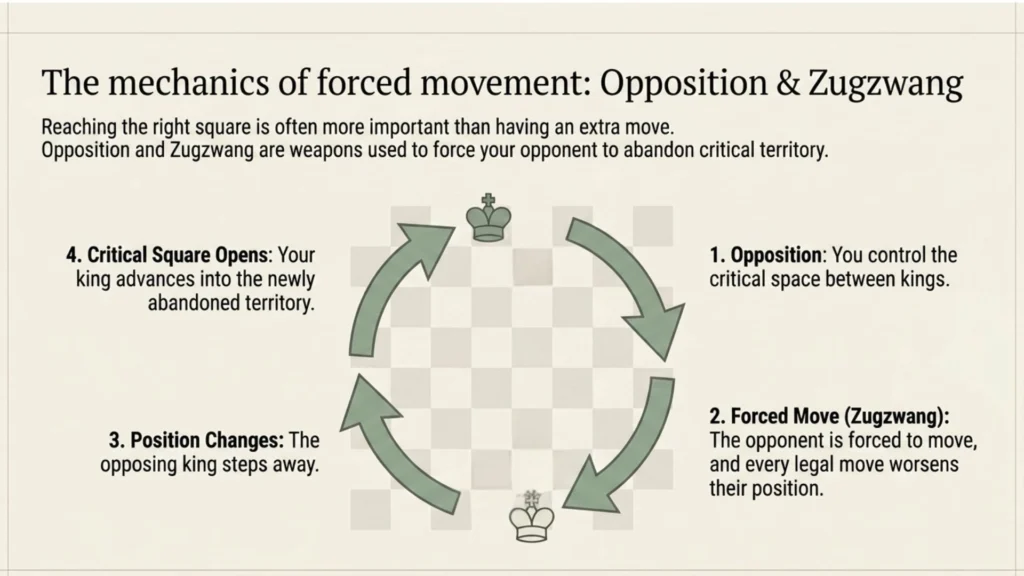
Zugzwang
Zugzwang occurs when having to move makes a player’s position worse.
This is particularly important in endgames because there may be very few useful moves available.
A player may therefore improve the position simply by arranging matters so that the opponent has to move first.
Spare Tempi
A spare tempo is a useful waiting move that changes whose turn it is at a critical moment.
Pawn moves often provide spare tempi.
That is why unnecessary pawn moves can be harmful: once a pawn has moved, that waiting move may no longer be available.
Triangulation
Triangulation is a king manoeuvre used to lose a tempo and change whose turn it is.
It is useful when the same basic position is favourable with the opponent to move but unfavourable with you to move.
The practical question is:
Can I change the move order without damaging my position?
Outflanking
Outflanking means moving the king around the opposing king to reach an important square from another direction.
It becomes useful when direct opposition is not enough.
These ideas all reinforce one principle:
King placement and move order can determine the result of a pawn ending.
Cutting Off the Enemy King
Restricting the opposing king is one of the most useful endgame techniques.
A king can be restricted by:
- your king
- a rook
- a bishop
- a pawn structure
- control of critical squares
The purpose is not necessarily to attack the king.
Often, the objective is simply to prevent it from reaching the square where it could defend.
This becomes particularly important in rook endings, where cutting off the defending king can give a passed pawn time to advance.
Rook Endgames
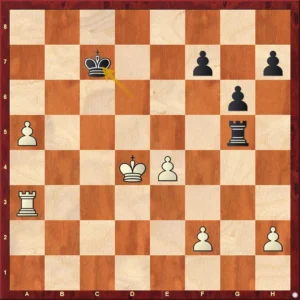
Rook endings combine several important endgame ideas:
- king activity
- rook activity
- passed pawns
- checking
- cutting off the king
- promotion threats
- counterplay
Keep the Rook Active
A rook should generally have a useful job.
It can:
- check the enemy king
- attack pawns
- attack from the side
- support a passed pawn
- cut off the opposing king
- create counterplay
A passive rook can leave the defending side without useful resources.
Rook Behind a Passed Pawn
A rook can often be effective behind a passed pawn because it supports the pawn’s advance while remaining positioned to respond to the opponent’s rook.
But the correct rook placement depends on the position. Do not apply a rule mechanically.
Always ask:
What is the rook trying to achieve?
Lucena and Philidor Positions
Lucena and Philidor are two fundamental rook-and-pawn-versus-rook positions.
They are valuable because they teach two sides of rook-endgame technique:
- Lucena: a basic winning method
- Philidor: a fundamental defensive method
The goal is not to memorise the names alone. Understand the problem each position is solving.
Key Position: Lucena
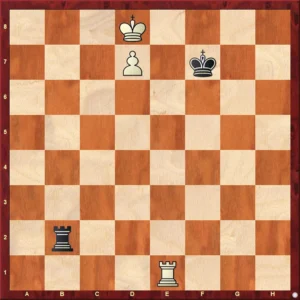
White: King e6, Rook a1, Pawn e7
Black: King e8, Rook h1
The position illustrates the classic bridge-building idea. The winning side needs to protect the king from checks while making progress toward promotion.
The exact technique should be studied as a sequence of moves rather than reduced to the phrase “build a bridge.”
Key Position: Philidor
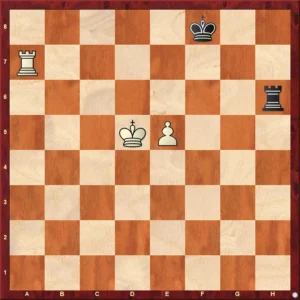
White: King e5, Rook a1, Pawn e6
Black: King e8, Rook h1
This position illustrates an important defensive setup. The defender’s rook uses checking distance to prevent the stronger side from making progress.
The lesson is broader than the exact position:
Active rook defence can hold positions that look materially difficult.
Bishop and Knight Endgames
Bishop Endgames
Bishop endings are strongly influenced by pawn structure and square colour.
Consider:
- Are the bishops on the same or opposite colours?
- Which pawns are fixed?
- Can the king enter?
- Which side has the more active bishop?
- Can a passed pawn be created?
An extra pawn does not automatically win a bishop ending. The placement of the pawns and bishops can determine whether the advantage can actually be converted.
Knight Endgames
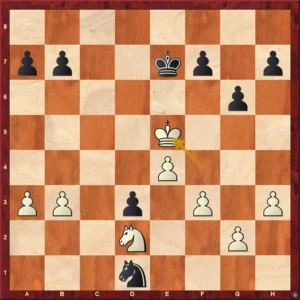
Knight endings often revolve around:
- king activity
- centralisation
- outposts
- blockades
- passed pawns
- promotion-square control
Because knights are short-range pieces, king placement can become especially important.
A knight may be excellent at blocking a pawn but poorly placed for stopping a king-supported passer.
Exchanges and the Resulting Position
One of the most important endgame habits is to evaluate the position after the exchange.
Before trading a piece, ask:
- What pieces remain?
- Which king benefits?
- What pawn structure remains?
- Are there passed pawns?
- Can the opponent activate their king?
- Is the resulting position winning, drawing, or harder to defend?
This prevents the common mistake of exchanging simply because you are ahead in material.
Simplification is useful when it improves the resulting position—not merely because fewer pieces remain.
How to Convert an Advantage
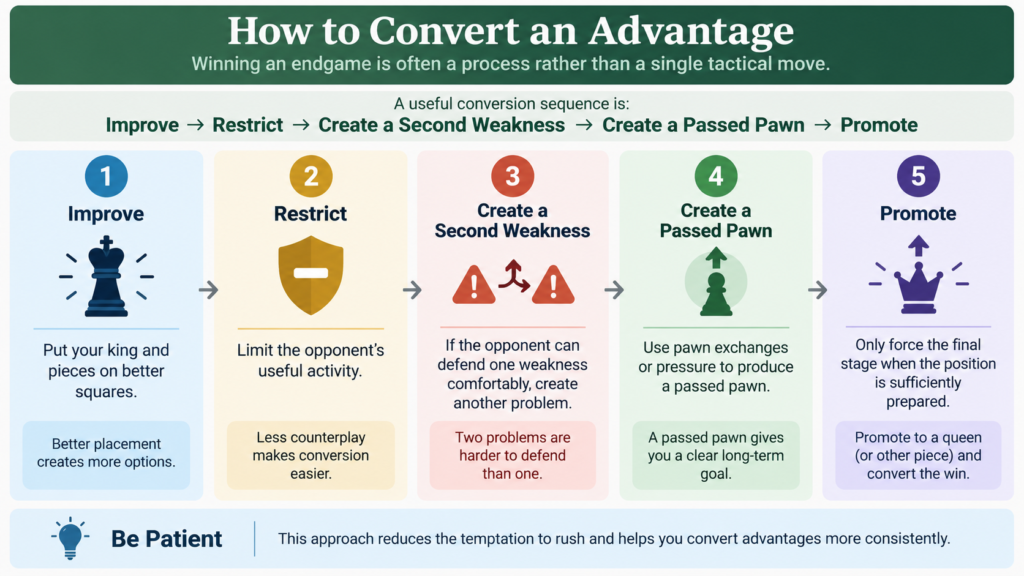
Winning an endgame is often a process rather than a single tactical move.
A useful conversion sequence is:
Improve → Restrict → Create a Second Weakness → Create a Passed Pawn → Promote
1. Improve
Put your king and pieces on better squares.
2. Restrict
Limit the opponent’s useful activity.
3. Create a Second Weakness
If the opponent can defend one weakness comfortably, create another problem.
4. Create a Passed Pawn
Use pawn exchanges or pressure to produce a passed pawn.
5. Promote
Only force the final stage when the position is sufficiently prepared.
This approach reduces the temptation to rush.
How to Defend a Difficult Endgame
Defending does not mean waiting for the opponent to make a mistake.
Look for active resources:
- improve the king
- blockade passed pawns
- attack weak pawns
- use checking distance
- create counterplay elsewhere
- force the stronger side to respond to threats
Ask:
What is my opponent trying to achieve?
Then ask:
What is the most active way I can interfere with that plan?
A defender who creates counterplay can make the stronger side solve new problems instead of completing its own plan freely.
Common Endgame Mistakes
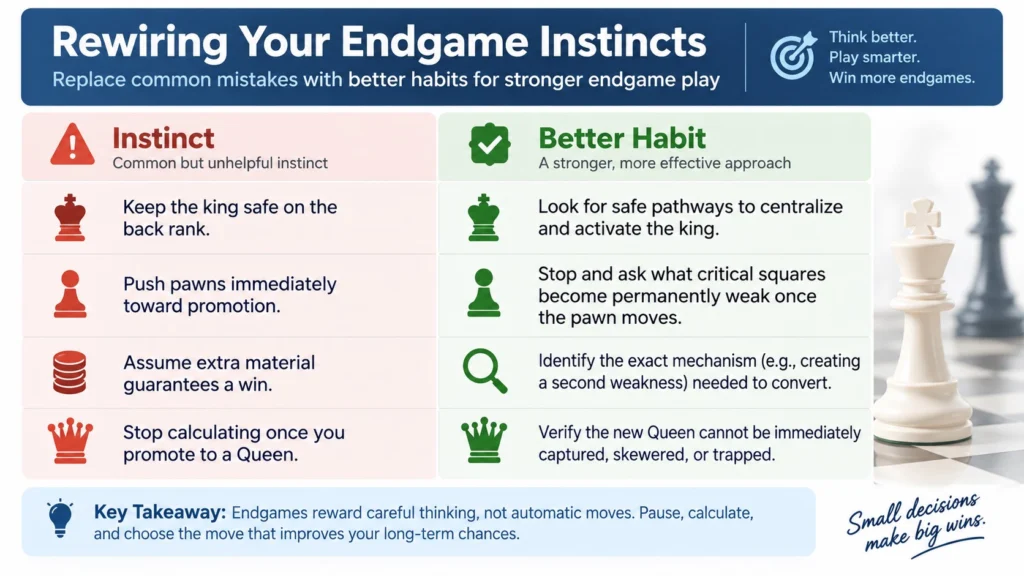
Pushing Pawns Automatically
A pawn push can remove a useful tempo, weaken a square, or change the opposition.
Better approach: calculate what the pawn move changes.
Assuming an Extra Pawn Wins
The defender may have a blockade, active king, or drawing resource.
Better approach: identify exactly how the advantage will be converted.
Exchanging Without Calculating
A favourable-looking exchange can lead to a drawn pawn ending.
Better approach: evaluate the resulting position before exchanging.
Ignoring Counterplay
Your passed pawn may not matter if the opponent creates a more dangerous threat elsewhere.
Better approach: compare both players’ plans.
Rushing a Won Position
Unnecessary pawn pushes and tactical oversights can throw away a winning advantage.
Better approach: improve the position before forcing the result.
Forgetting Stalemate
A completely winning position can become a draw if the defender has no legal move.
Better approach: check the opponent’s available moves before restricting the king completely.
Studying Only Winning Positions
Learning only how to convert advantages leaves an important part of endgame understanding unexplored.
Better approach: practise both winning and defensive positions.
How to Think During an Endgame
When the position becomes an endgame, pause before making an automatic move.
Use five questions:
1. King
Which king is better placed, and where does each king need to go?
2. Pawns
Which pawns are weak, passed, protected, or capable of becoming passed?
3. Pieces
Which piece is passive? Which piece can become more active?
4. Calculation
What happens after the most forcing moves, pawn races, exchanges, and promotions?
5. Plan
What is the simplest useful improvement?
This is not a rigid formula. Its purpose is to make sure you understand the position before acting.
How Beginners Should Study Chess Endgames
Endgame study works best when concepts are learned in a logical progression.
Stage 1: Basic Checkmates and Stalemate
Learn:
- king and queen versus king
- king and rook versus king
- basic mating patterns
- stalemate awareness
Stage 2: King-and-Pawn Endings
Learn:
- king activity
- opposition
- key squares
- rule of the square
- pawn races
- spare tempi
- basic breakthroughs
Stage 3: Passed-Pawn Technique
Study:
- protected passed pawns
- connected passed pawns
- outside passed pawns
- blockades
- creating a second weakness
Stage 4: Basic Rook Endgames
Learn:
- active rook placement
- rook behind passed pawns
- checking from a distance
- cutting off the king
- active defence
- Lucena
- Philidor
Stage 5: Minor-Piece Endgames
Study:
- bishop activity
- opposite-coloured bishops
- knight outposts
- king coordination
- passed pawns
Stage 6: Practical Conversion and Defence
Practise:
- converting an extra pawn
- defending a pawn down
- stopping passed pawns
- choosing useful exchanges
- converting practical rook endings
- analysing your own games
The aim is not to finish this progression quickly. Build each layer until you can use it in real positions.
How to Practise Endgames
Reading about endgames is useful, but playing them is essential.
Start With Small Positions
Set up positions such as:
- king and pawn versus king
- opposition positions
- pawn races
- simple rook endings
- basic checkmates
Play Both Sides
Try to win from the stronger side.
Then switch sides and defend.
This makes you experience the problem from both perspectives.
Vary the Position
Change:
- whose move it is
- king positions
- pawn positions
- the number of pawns
- the side of the board
This prevents pattern recognition from becoming simple memorisation.
Analyse Your Own Games
After an endgame, ask:
- Which king was better?
- What was the critical pawn?
- Did a passed pawn appear?
- Did I calculate the pawn race correctly?
- Was my exchange correct?
- What counterplay did my opponent have?
- Was the position actually winning?
- What was the first important decision?
The last question is particularly valuable.
Do not analyse only the final blunder. Find the first decision that changed the character of the position.
What Endgame Progress Looks Like
Endgame improvement becomes visible when you start making better decisions before the final moves.
Signs of progress include:
- activating the king earlier
- recognising opposition
- identifying critical squares
- calculating pawn races
- recognising passed-pawn possibilities
- evaluating exchanges more accurately
- finding defensive resources
- avoiding unnecessary pawn pushes
- explaining why a position is winning or drawn
- creating plans instead of moving automatically
A useful test is:
Can you explain why the position is winning, drawing, or losing?
If you can explain the reason, you are developing understanding rather than simply memorising moves.
Chess Endgames and the Rest of Your Chess
Endgame study connects naturally with the rest of chess.
Openings
Opening decisions influence the pawn structures and types of middlegames that can eventually lead to endgames.
Middlegame
Exchanges and strategic decisions often determine what kind of endgame you reach.
Strategy
Endgames make concepts such as activity, weaknesses, pawn structure, space, and favourable exchanges especially concrete.
Tactics
Simplified positions still contain checks, captures, forks, promotions, and tactical resources.
Calculation
Endgames often require accurate calculation because king and pawn moves can be difficult or impossible to reverse.
Studying endgames therefore strengthens your ability to evaluate consequences across the whole game.
What Parents Should Know About Endgame Learning
Endgames may appear less exciting to children than openings or tactical combinations, but they can provide valuable practice in:
- patience
- calculation
- decision-making
- consequence awareness
- independent thinking
- practical problem solving
Parents do not need to teach advanced endgame theory themselves.
A more useful question after a game is:
“What was your plan in the endgame?”
Then:
“What made the position winning or drawing?”
This encourages the child to explain the position rather than simply remember the result.
The meaningful sign of progress is not memorising more positions. It is becoming better at understanding why a move works.
Frequently Asked Questions About Chess Endgames
What is a chess endgame?
A chess endgame is a phase in which king activity, pawn structure, promotion, piece activity, and precise calculation become increasingly important.
When does the endgame begin?
There is no universal move number or piece count. It begins when the character of the position changes and endgame factors become more important than typical middlegame attacking play.
What should I learn first?
Start with basic checkmates and stalemate, king activity, king-and-pawn endings, opposition, key squares, the rule of the square, and pawn races.
Why is the king so important?
With fewer attacking pieces on the board, the king can become an active fighting piece. It can attack pawns, defend its own pawns, control important squares, and support promotion.
What is opposition?
Opposition is a king-placement technique in which the relationship between the kings and the side to move can determine access to important squares.
What are key squares?
Key squares are squares that allow the attacking king to make decisive progress with a pawn. Reaching or controlling them can determine whether a pawn ending is won or drawn.
What is the rule of the square?
It is a practical method for estimating whether a defending king can catch an advancing pawn before promotion.
What is a passed pawn?
A passed pawn has no opposing pawn on its own file or adjacent files capable of stopping its advance.
What is zugzwang?
Zugzwang is a position where being required to move makes a player’s position worse. It is particularly important when few useful moves remain.
What is triangulation?
Triangulation is a king manoeuvre used to lose a tempo and change whose turn it is, often creating zugzwang or restoring a favourable move order.
What are Lucena and Philidor positions?
They are fundamental rook-and-pawn-versus-rook positions. Lucena demonstrates a basic winning technique, while Philidor demonstrates an important defensive method.
Should I exchange pieces when I am ahead?
Not automatically. First evaluate the position that remains after the exchange.
How do I defend a difficult endgame?
Look for active counterplay, improve your king, blockade passed pawns, attack weaknesses, and use checking or other active resources where appropriate.
Do beginners need to memorise endgame theory?
Only a limited amount at first. Understanding king activity, pawn structure, opposition, promotion, and piece coordination should come before memorising large quantities of theory.
When should children start studying endgames?
They can begin once they understand the basic rules and checkmate patterns. There is no need to wait until they are advanced players.
Why do I keep drawing winning endgames?
Common causes include rushing, poor king placement, exchanging into a drawn position, missing counterplay, or failing to identify a clear conversion plan.
Get Structured Guidance for Your Chess Improvement
Endgame improvement becomes more useful when you know which skills need attention.
If you are unsure whether your main challenge is endgame technique, calculation, tactics, strategy, or broader chess understanding, a structured assessment can help identify the areas that deserve focused work.
The aim is not simply to memorise more endgame positions. It is to develop the ability to understand positions, calculate accurately, make purposeful decisions, and handle practical advantages with greater clarity.
Related Pages
Continue building your chess understanding through these related resources:
- Complete Beginner Chess Guide — build the broader foundation needed for deeper endgame study.
- Chess Strategy — understand the strategic ideas behind pawn structures, activity, weaknesses, and exchanges.
- Chess Tactics — strengthen the calculation and tactical awareness needed in practical endgames.
- Chess Improvement — develop a structured approach to improving across different areas of chess.
- Chess Training Plan — organise endgame practice within a broader training routine.
- Chess for Kids — understand how endgame learning fits into a child’s broader chess development.