
How to Stop Blundering in Chess | The Five Rules System
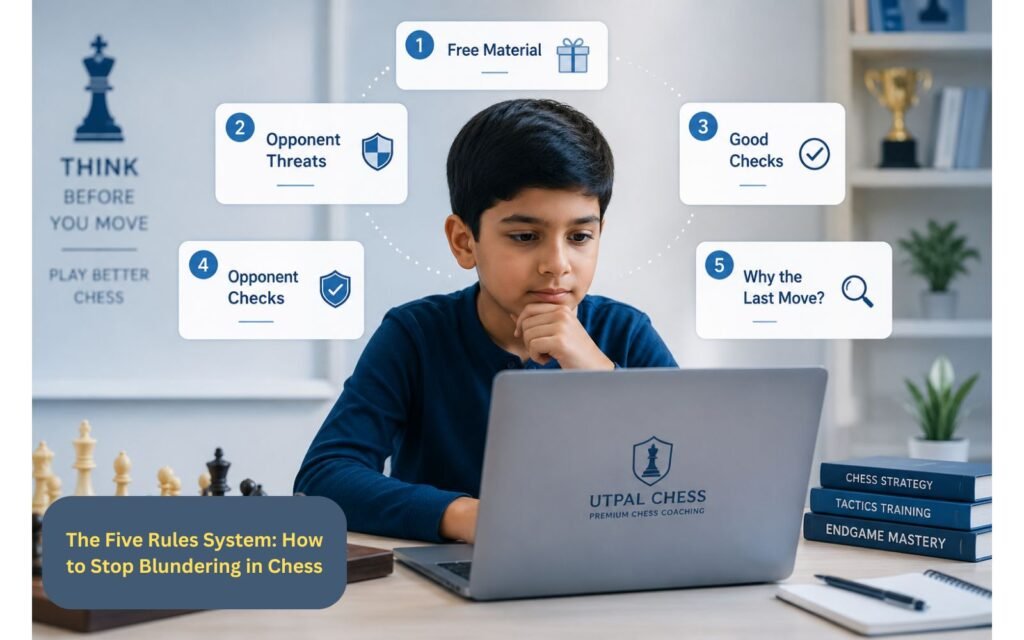
How to Stop Blundering in Chess | The Five Rules System
Most chess players do not lose games because they lack knowledge.
In my experience as a coach, they lose games because they fail to notice something important before making a move.
A missed threat, an undefended piece, or an overlooked tactical opportunity is often enough to change the entire game. These mistakes are rarely caused by a lack of chess theory. More often, they result from moving before fully understanding the position.
This is why the Five Rules System is one of the foundational thinking frameworks of the Utpal Method.
Rather than encouraging students to rely on instinct or guesswork, it provides a simple, repeatable process to follow before every move. By asking five structured questions, students learn to improve their awareness, identify threats and opportunities, and make decisions with greater confidence and consistency.
Over time, this habit transforms the way they approach the game. Instead of reacting impulsively, they begin to observe carefully, think systematically, and reduce many of the avoidable blunders that hold back improvement.
If you are completely new to chess, our Complete Beginner Chess Guide provides a clear step-by-step roadmap that explains exactly what to learn first.
What Is the Five Rules System?
The Five Rules System is a structured chess thinking framework that helps players reduce blunders by following five essential questions before making every move.
Instead of searching immediately for the “best move,” students first learn to understand the position. This shift from guessing to structured thinking develops stronger decision-making, greater board awareness, and more consistent play.
The framework is simple enough for beginners to apply from their first games, yet robust enough to remain valuable as players progress to higher levels of chess.
The Five Rules System is one part of the complete Chess Thinking process. While this guide focuses on preventing blunders, the full Chess Thinking framework also covers observation, evaluation, planning, calculation, comparison, and reflection.
Quick Summary
The Five Rules System helps students:
- Spot free tactical opportunities before looking for complicated ideas.
- Recognize opponent threats before they become serious problems.
- Reduce unnecessary blunders through structured observation.
- Develop the habit of considering both their own plans and their opponent’s intentions.
- Build disciplined thinking that leads to more consistent decision-making.
Within the Utpal Method, the Five Rules System is more than a checklist. It is a practical thinking habit that teaches students to pause, observe, evaluate, and then move with purpose instead of impulse.
What Is the Five Rules System?
The Five Rules System is a practical thinking checklist used before making a move. Rather than relying on instinct or guesswork, students ask five questions that improve awareness and decision quality. :contentReference[oaicite:0]{index=0}
The Five Rules:
- Can I get something free?
- Can my opponent get something free?
- Can I give a good check?
- Can my opponent give a good check?
- Why did my opponent play the last move?
These questions help students slow down, observe, and avoid many of the mistakes that occur when moves are played too quickly.
This thinking process is closely related to the Chess Thinking Process.
Why Does the Five Rules System Exist?
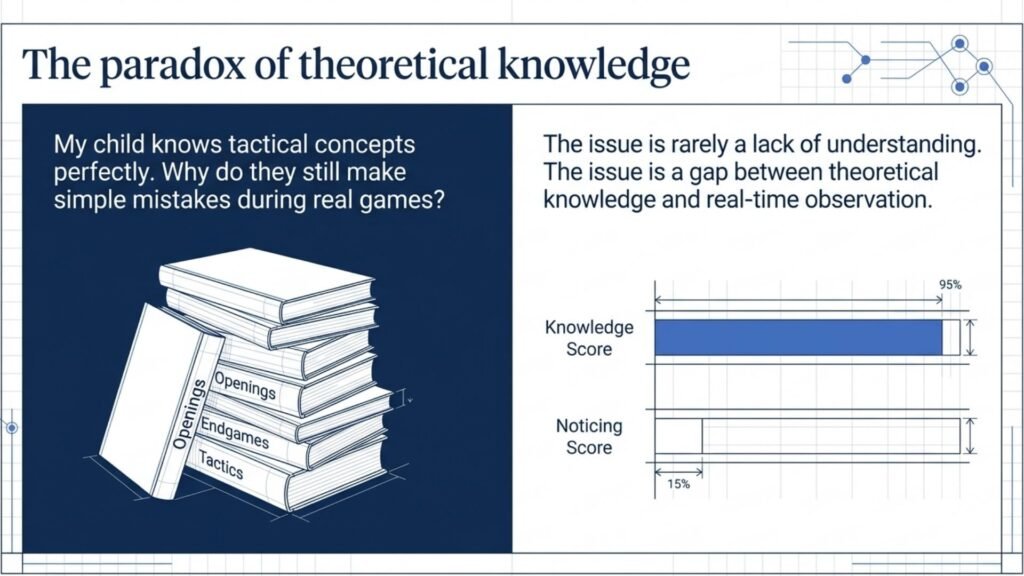
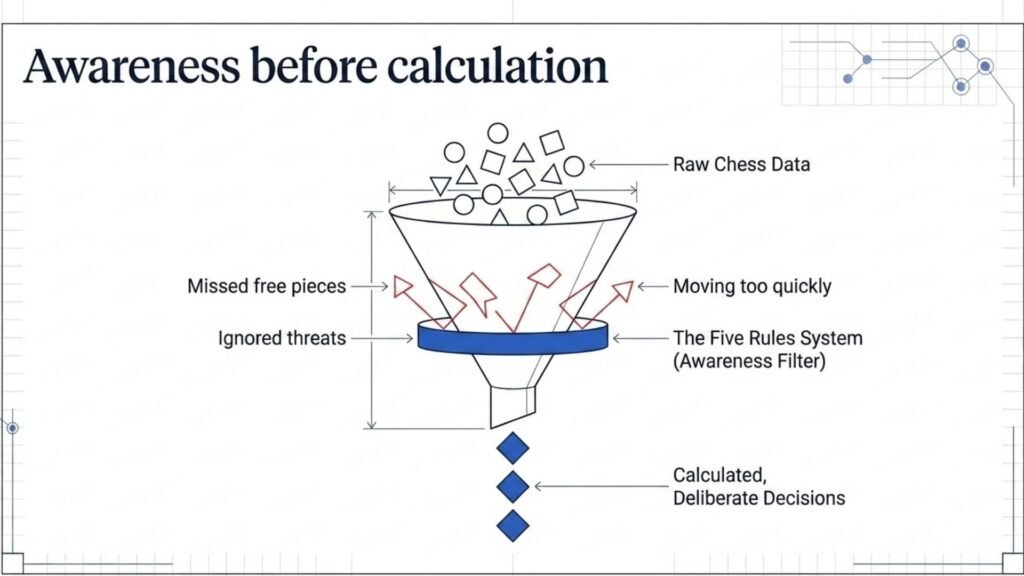
One of the most important discoveries from years of coaching is that many students lose games not because they lack knowledge, but because they fail to notice important information.
Students often:
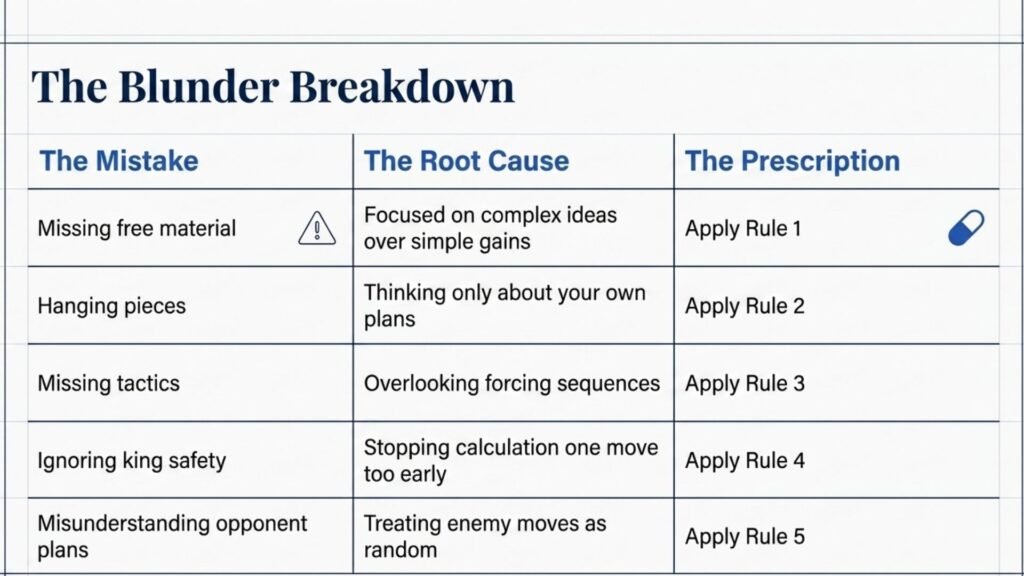
- Miss free pieces
- Ignore threats
- Overlook checks
- Focus only on their own plans
- Move too quickly
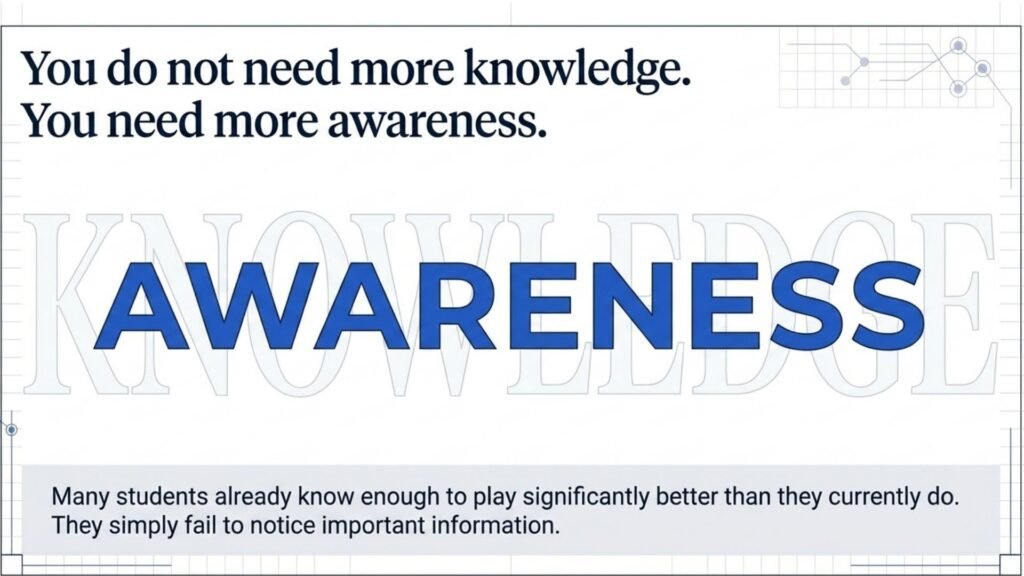
The Five Rules System was created to improve awareness before calculation. It teaches students to observe first and act second.
The Five Rules Explained
Rule 1: Can I Get Something Free?
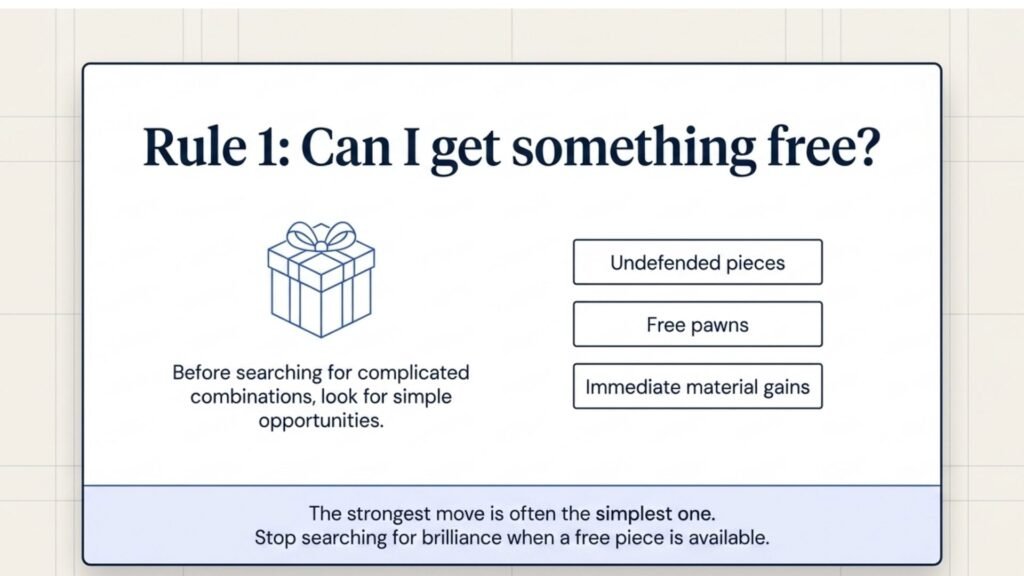
Before searching for complicated combinations, students first look for simple opportunities.
Examples:
- Undefended pieces
- Free pawns
- Loose tactical opportunities
- Immediate material gains
A common coaching pattern is students searching for brilliant moves while completely missing a free piece. The strongest move is often the simplest one.
Rule 2: Can My Opponent Get Something Free?
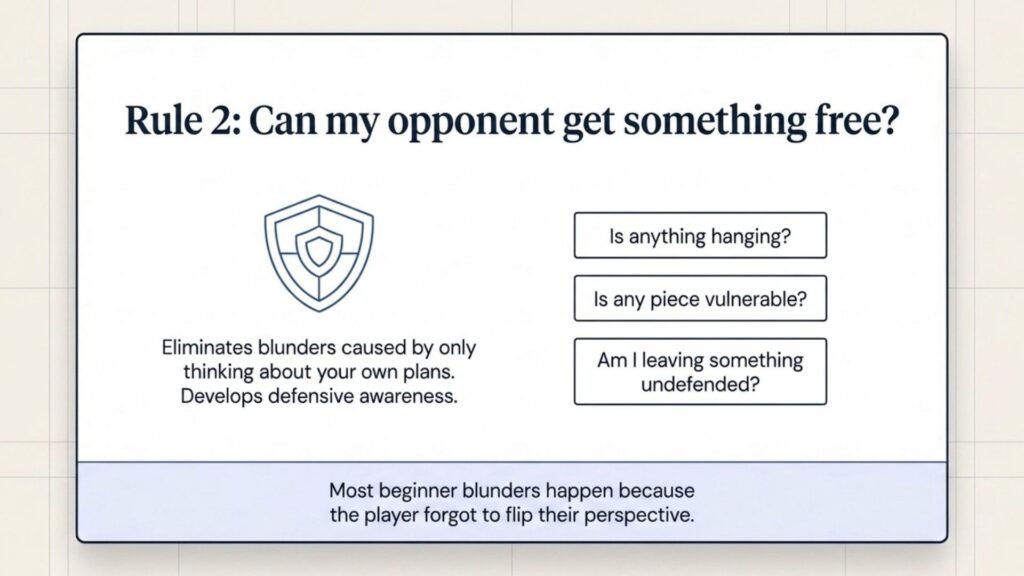
Many mistakes occur because students think only about what they want to do.
This rule develops defensive awareness.
Students learn to ask:
- Is anything hanging?
- Is any piece vulnerable?
- Am I leaving something undefended?
This single habit can eliminate many beginner blunders.
Rule 3: Can I Give a Good Check?
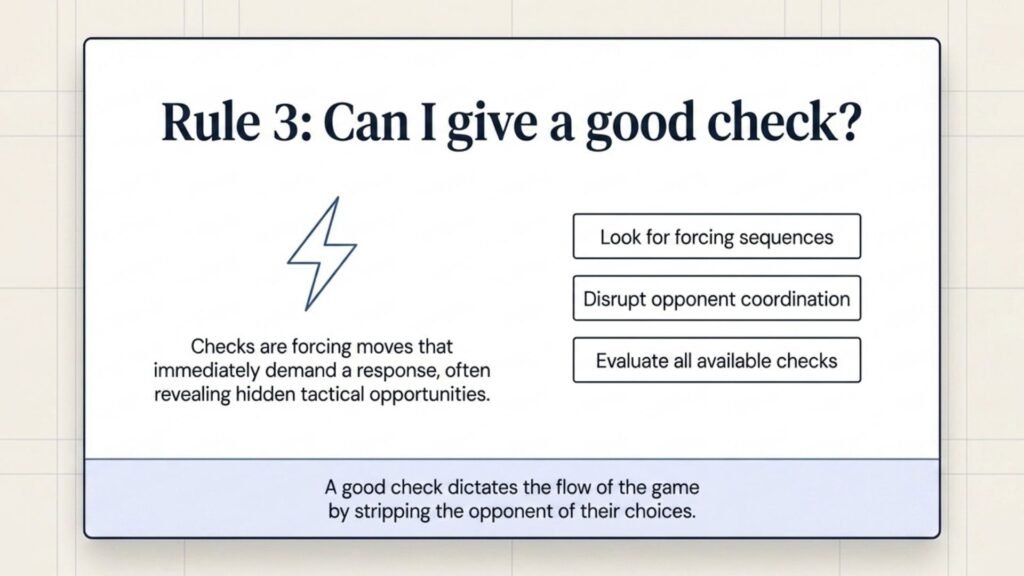
Checks are forcing moves.
Whenever a good check exists, it deserves attention because it immediately demands a response from the opponent.
Students learn that forcing moves often reveal tactical opportunities that might otherwise be missed. This is why understanding chess tactics is an essential part of improving calculation and finding stronger moves.
Rule 4: Can My Opponent Give a Good Check?
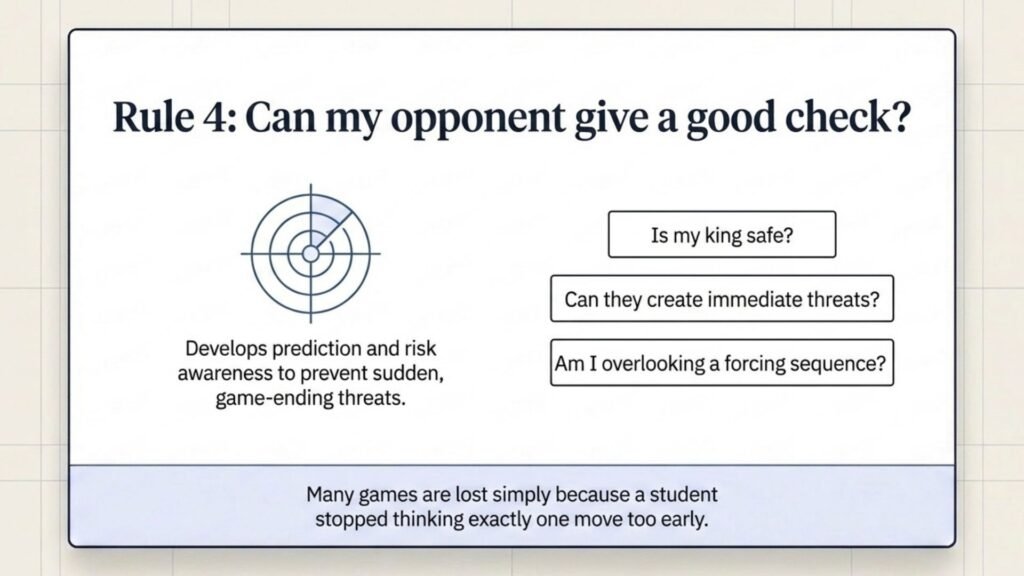
This rule develops prediction and risk awareness.
Before moving, students consider:
- Is my king safe?
- Can my opponent create immediate threats?
- Am I overlooking a forcing sequence?
Many games are lost because students stop thinking one move too early. This rule helps prevent that habit.
Rule 5: Why Did My Opponent Play the Last Move?
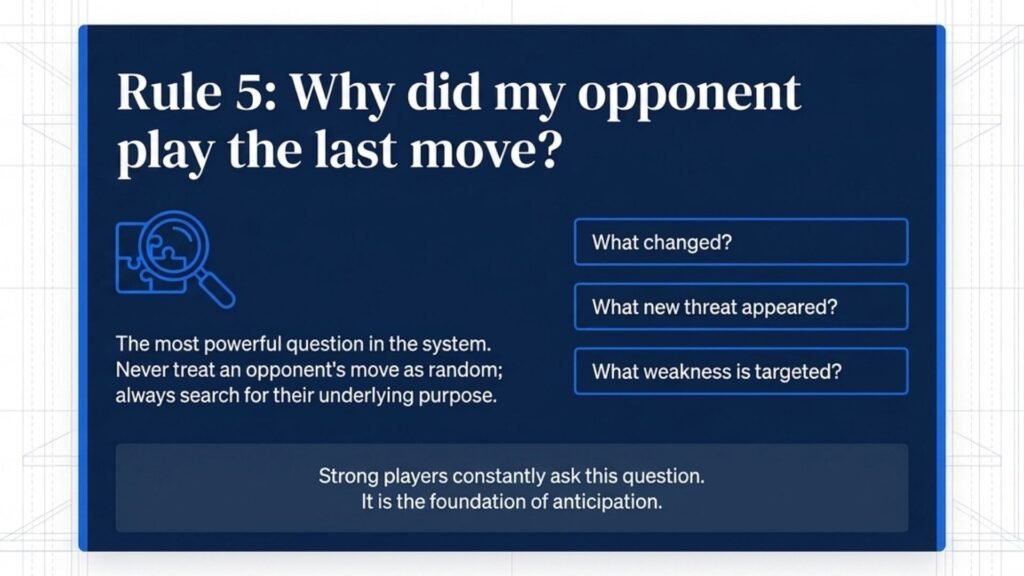
This may be the most powerful question in the entire system.
Instead of treating the opponent’s move as random, students learn to search for purpose.
Questions include:
- What changed?
- What new threat appeared?
- What idea is being prepared?
- What weakness is being targeted?
Strong chess players constantly ask this question. It develops awareness, anticipation, and a deeper understanding of positions.
How the Five Rules Reduce Blunders
How the Five Rules Fit Into the Utpal Method
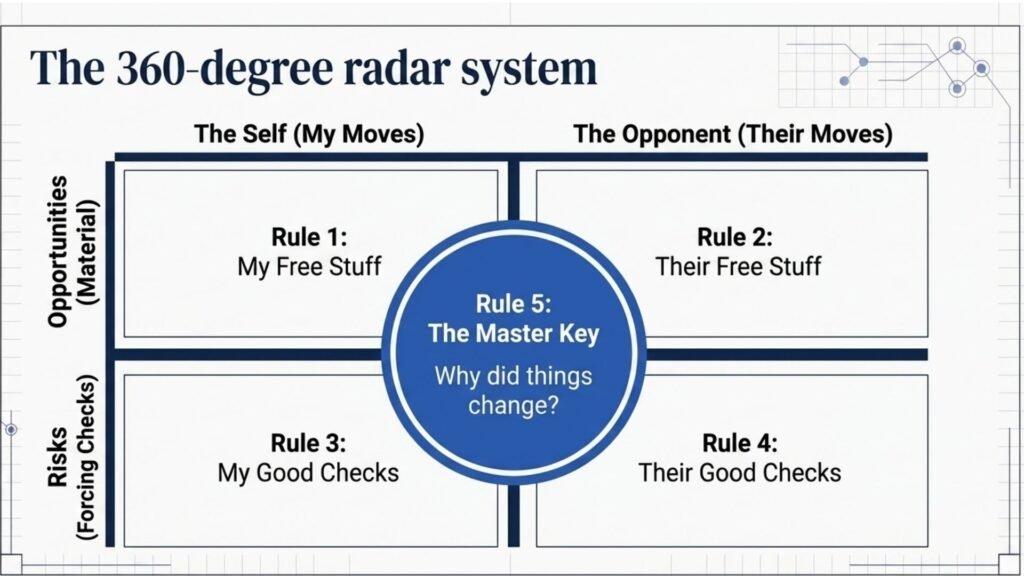
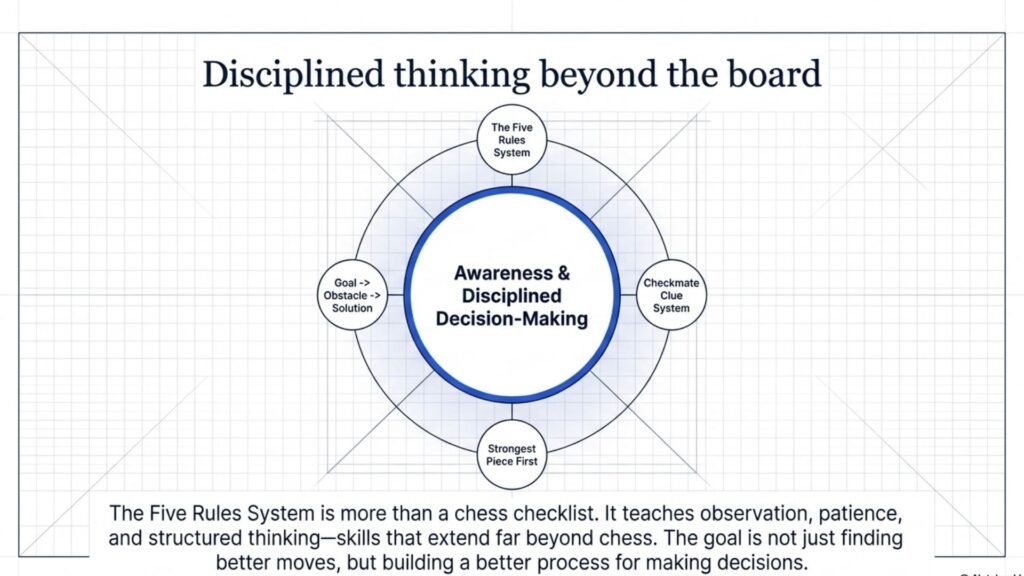
The Five Rules System is one of the foundational thinking systems within the Utpal Method. Its purpose is not simply to improve chess performance.
Its deeper purpose is to teach:
- Awareness
- Observation
- Decision-making
- Patience
- Structured thinking
The system helps students move from guessing toward deliberate decision-making. Over time, these questions become habits rather than checklists.
Parent Perspective
Parents often wonder why a child can explain chess concepts correctly but still make simple mistakes during games.
In many cases, the issue is not understanding. It is awareness.
The Five Rules System provides a repeatable thinking process that helps children slow down and notice more of what is happening around them. This supports focus, discipline, and decision quality—skills that extend beyond chess.
Parents often see a gap between what their child knows and how they perform during games. Building awareness takes consistent practice and the right learning process. To learn more about how chess supports long-term development, explore our guide on the benefits of chess for kids. If you’re wondering how improvement happens over time, read how children improve at chess.
Common Student Mistakes
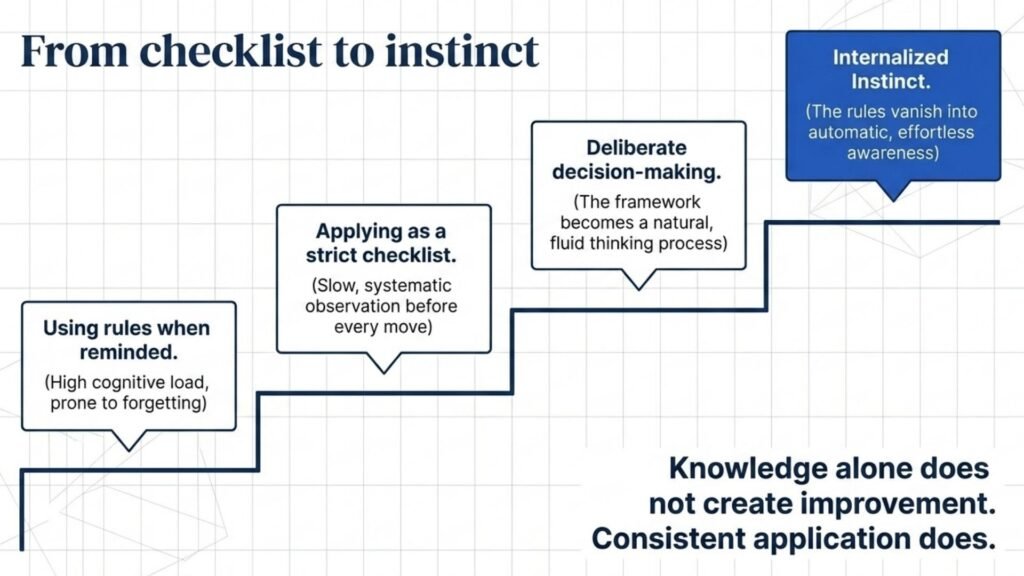
- Using the rules only when reminded
- Applying the rules too quickly
- Ignoring Rule 5 completely
- Focusing only on attacking ideas
- Stopping after finding the first reasonable move
A major goal of coaching is to help students transform the framework into a habit. Knowledge alone does not create improvement. Consistent application does.
Key Takeaways
- The Five Rules System is an awareness framework.
- It helps students reduce avoidable mistakes.
- The framework improves observation before calculation.
- Students learn to consider both opportunities and risks.
- The long-term objective is disciplined thinking rather than guesswork.
Frequently Asked Questions
Is the Five Rules System only for beginners?
No. Beginners use it as a checklist, while stronger players gradually internalize the questions and apply them automatically.
Which rule is most important?
All five work together, but I consider Rule 5—understanding the opponent’s last move—to be especially powerful because it improves awareness and prediction.
Can the Five Rules System reduce blunders?
Yes. Many common blunders occur because students miss threats, checks, or free pieces. The framework directly addresses these problems.
How often should students use the Five Rules?
Ideally, before every move, until the process becomes natural.
Conclusion
The Five Rules System is much more than a chess checklist.
It is a thinking framework that teaches students how to observe, evaluate, and make decisions more carefully. By improving awareness, students often discover that they already know enough to play better chess—they simply need a better process for applying what they know.
Next Step
Learning the Five Rules System is only the beginning. The real improvement happens when these questions become a natural part of your thinking rather than something you have to remember.
Many players understand the rules during a lesson but forget to apply them during a game. Building consistent thinking habits takes deliberate practice, reflection, and repetition.
As you continue your chess improvement journey, challenge yourself to pause before every move and work through the Five Rules. Over time, this simple habit can help you notice more opportunities, avoid unnecessary mistakes, and make better decisions with greater confidence.
If you’re interested in developing a more structured thinking process, you may also enjoy exploring related topics such as the Checkmate Clue System, Strongest Piece First, Goal → Obstacle → Solution, and Decision Mastery, which build on the same principles of awareness and disciplined decision-making.