
Chess for Kids: A Complete Parent Guide to Learning, Thinking, and Development
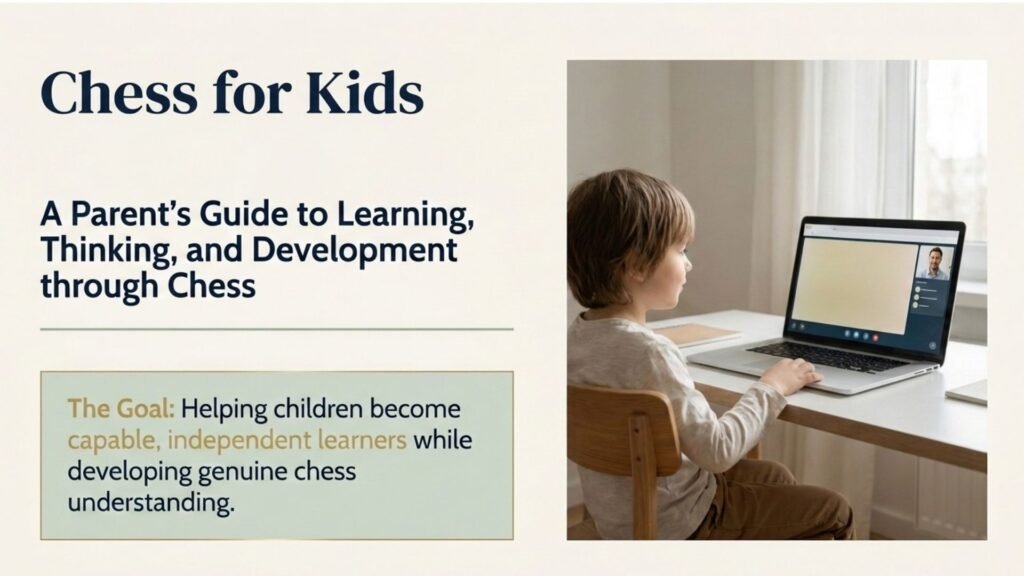
Chess for kids is best understood as a structured way for children to learn, think, make decisions, and reflect on their choices. A child does not simply learn how the pieces move. They gradually learn to observe a position, consider possibilities, anticipate consequences, make a decision, and learn from the result.
For parents, the important question is therefore not only whether a child can learn chess, but how chess should be taught so that learning remains enjoyable, age-appropriate, structured, and meaningful.
This guide explains what chess for kids involves, what children can learn through chess, how the learning process develops, what parents should look for in a chess programme, and how to support steady improvement without putting unnecessary pressure on results.
If your child is completely new to chess, a beginner chess guide can provide the step-by-step fundamentals before moving into more structured improvement.
Quick Summary
- What is chess for kids? A structured learning environment where children develop chess knowledge alongside observation, planning, decision-making, and reflection.
- Who can learn? Children can begin at different ages. Readiness, interest, attention, and the way chess is introduced matter more than a rigid age rule.
- What can children develop? Chess can provide repeated practice in concentration, problem-solving, planning, decision-making, patience, and independent thinking.
- What should parents focus on? Look for understanding, consistent learning, confidence, and healthy habits rather than judging progress only through wins, losses, or ratings.
- What makes learning effective? Clear instruction, practical examples, regular practice, appropriate challenge, and a progression that matches the child’s current level.
- What comes next? Once the fundamentals are established, children can progress towards tactics, strategy, game analysis, structured practice, and independent thinking.
What Is Chess for Kids?
Chess for kids is the teaching of chess concepts and thinking skills in a way that matches a child’s stage of development.
Children need more than information. They need opportunities to understand ideas, apply them, make mistakes, and try again.
A useful chess lesson therefore moves beyond questions such as:
- How does this piece move?
- What is a check?
- How do you castle?
It also introduces questions such as:
- What do you notice?
- What is your opponent threatening?
- What choices do you have?
- Which move makes the most sense?
- What could happen after you move?
- How can you check your decision before playing it?
This distinction matters because stronger chess development comes from learning how to use knowledge, not simply collecting more chess facts.
One principle of the UTPAL Method is to treat chess as a thinking environment. The board gives children repeated opportunities to practise observation, prediction, decision-making, and reflection.
The objective is not to make every child highly competitive.
The objective is to help each child become a more capable and independent learner while developing genuine chess understanding.
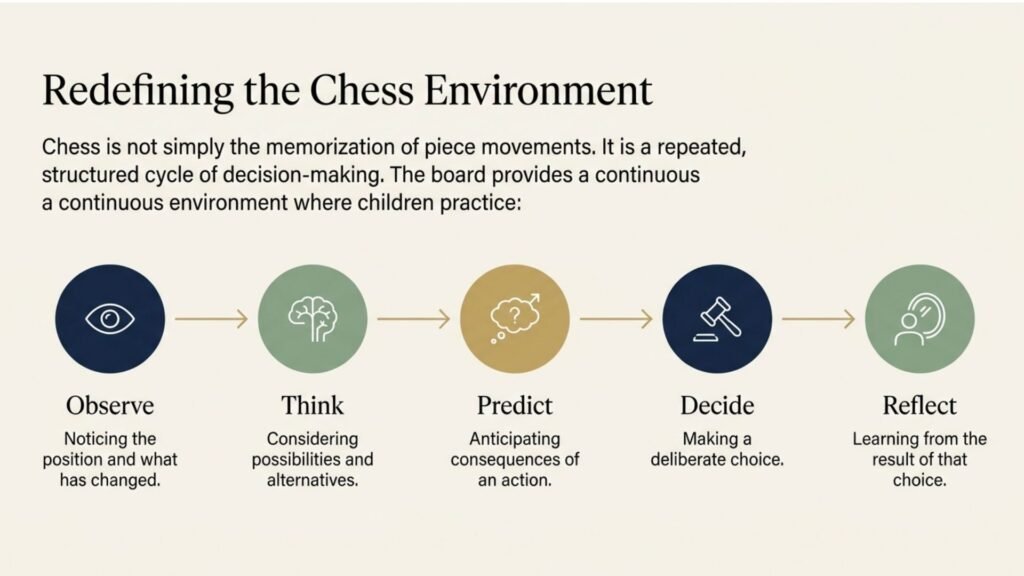
Why Do Parents Choose Chess for Their Children?
Parents often introduce chess because they are looking for an activity that combines learning with active participation.
A chess game requires a child to pay attention to the position, remember relevant information, compare alternatives, and accept the consequences of a decision. That makes chess particularly useful as a structured environment for practising thinking habits.
The value is not that every game produces an obvious improvement in another area of life. Rather, children repeatedly encounter situations where they must slow down, examine a problem, make a choice, and learn from what happens.
For many families, that makes chess a useful complement to other educational and extracurricular activities.
What Skills Can Children Practise Through Chess?
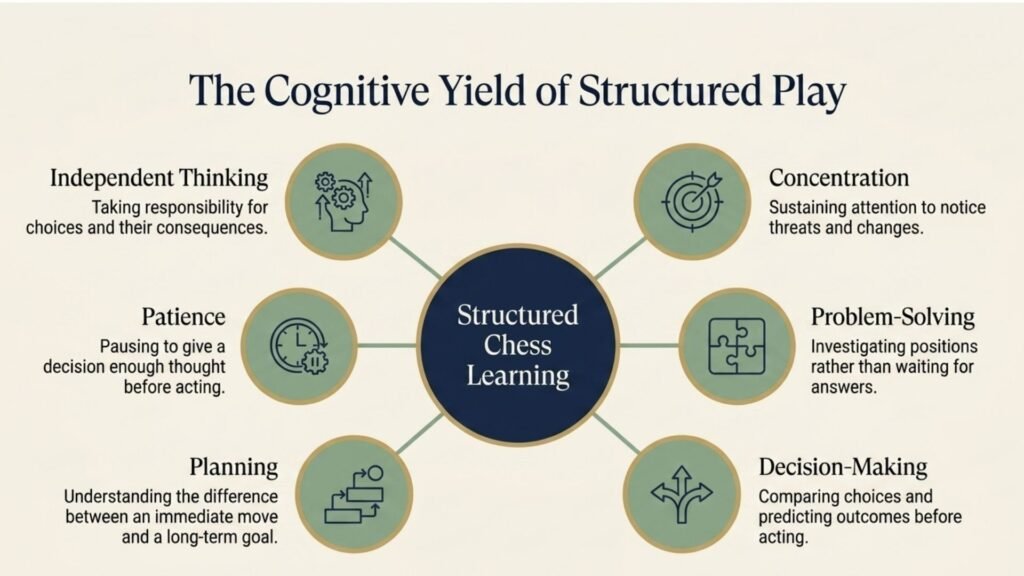
Concentration
A child must pay attention to the board to understand what is happening.
During a game, concentration can involve noticing:
- attacked pieces
- threats
- possible captures
- changes in the position
- opportunities
- the opponent’s ideas
This creates repeated opportunities to practise sustained attention.
The goal should not be to expect a young child to remain perfectly focused for long periods. Effective instruction adjusts the length and complexity of activities to the child’s ability.
Problem-Solving
Chess presents problems continuously.
A child may need to find a safe move, respond to a threat, win material, defend the king, or work out how to achieve a particular objective.
The important part is the process.
Instead of immediately giving the answer, a good learning environment encourages the child to investigate the position and explain their reasoning.
Decision-Making
Every move creates a decision.
Children gradually learn that a move should not be played simply because it looks attractive. They need to consider what the move does and what the opponent may do next.
A simple decision-making routine can be:
- Understand the position.
- Find possible moves.
- Compare the choices.
- Predict the consequences.
- Make the decision.
- Review the result.
This process can become increasingly natural with practice.
Planning
Chess introduces children to the difference between an immediate move and a longer-term objective.
A child may learn to ask:
- What am I trying to achieve?
- Which piece needs improvement?
- What is my opponent trying to do?
- What needs to happen before I can reach my goal?
Planning develops gradually. Young children should not be overloaded with complicated strategic terminology before they are ready to use it.
Patience
Chess rewards careful observation.
Children sometimes want to move quickly because they see an appealing idea. Learning to pause and check whether the move actually works is an important part of chess development.
Patience in chess is therefore not simply waiting. It is learning to give a decision enough thought before acting.
Independent Thinking
One of the most valuable parts of chess is that the child must eventually make decisions for themselves.
A parent or coach can guide the learning process, but the child needs opportunities to:
- analyse positions
- suggest moves
- explain ideas
- make decisions
- experience consequences
- correct mistakes
Too much assistance can unintentionally prevent this independence from developing.
The UTPAL Thinking Cycle
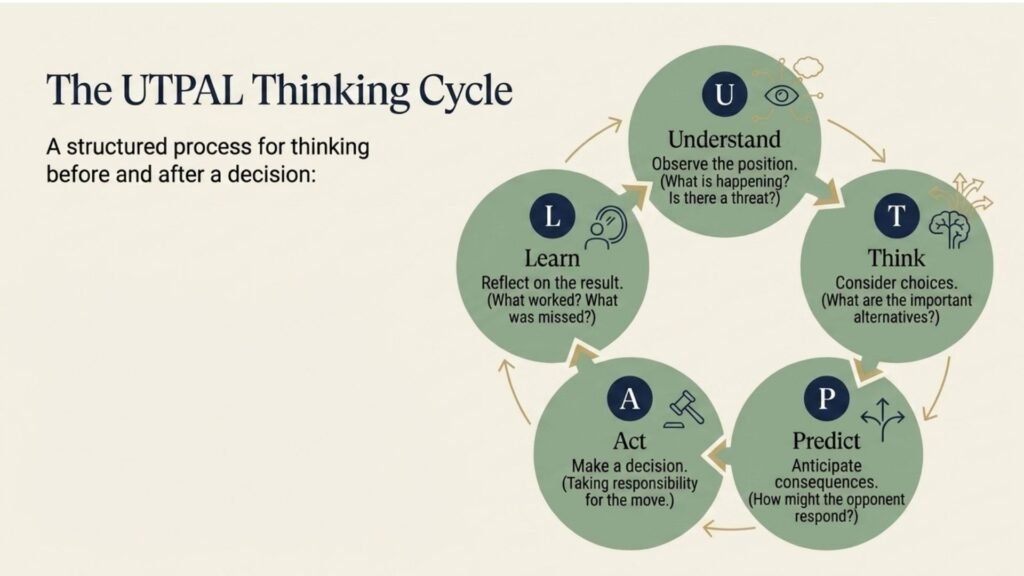
A useful way to structure children’s chess thinking is through five stages:
1. Understand
First, the child observes the position.
Ask:
- What is happening?
- What has changed?
- Is anything under attack?
- Is there an immediate threat?
2. Think
The child considers possible choices.
Ask:
- What moves can I play?
- What are the important alternatives?
- Which ideas deserve attention?
3. Predict
The child looks beyond the first move.
Ask:
- What could happen next?
- How might my opponent respond?
- What problems could my move create?
4. Act
The child makes a decision and plays the move.
This develops responsibility. The child is not simply following an answer supplied by someone else.
5. Learn
After the result, the child reflects.
Ask:
- What worked?
- What did I miss?
- Why did the position change?
- What should I notice next time?
This final stage is essential. Improvement comes not merely from playing more games but from learning from the games that have already been played.
How Children Progress in Chess
Chess improvement usually develops through stages rather than through one large jump in ability.
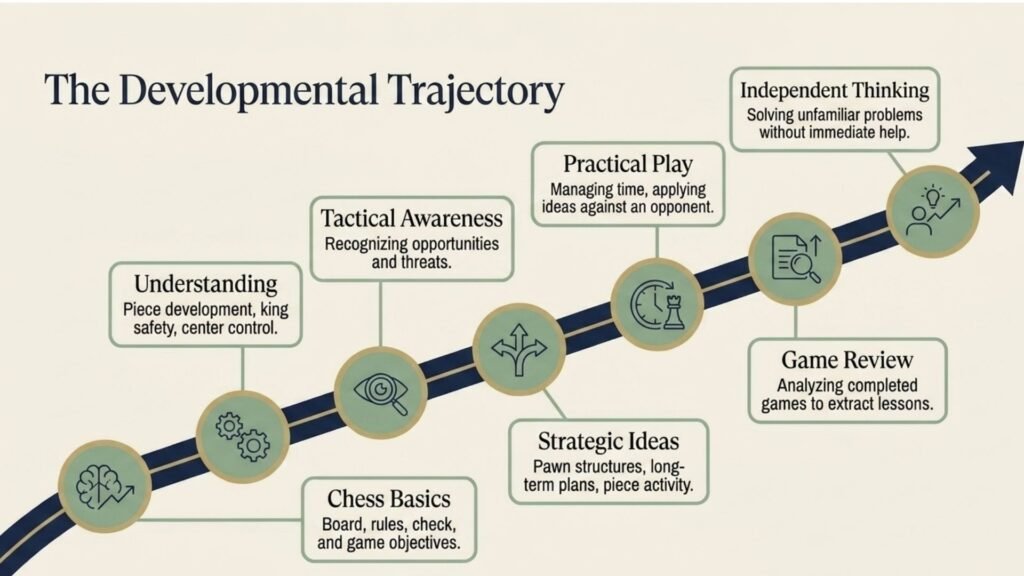
A simple learning roadmap is:
Chess Basics → Understanding → Tactical Awareness → Strategic Ideas → Practical Play → Game Review → Independent Thinking
At the beginning, children need to understand the board, pieces, rules, check, checkmate, and basic game objectives.
As their understanding grows, they begin recognising tactical opportunities and threats.
Later, they learn to think about development, king safety, piece activity, pawn structures, plans, and longer-term decisions.
The exact progression depends on the child. Two children of the same age can have very different levels of chess understanding, attention, confidence, and experience.
That is why structured learning should respond to the student rather than forcing every child through exactly the same sequence.
What Should Children Learn First?
For a beginner, the priority should be a strong foundation.
A sensible progression includes:
- The chessboard and coordinates
- How each piece moves
- Capturing and basic piece values
- Check and checkmate
- Basic game rules
- Simple tactical patterns
- Basic opening principles
- King safety
- Simple planning
- Game review and reflection
Children do not need to memorise large amounts of opening theory at the beginning.
They benefit more from understanding why moves are played.
For example, instead of memorising a sequence of opening moves, a child can learn to recognise the importance of developing pieces, protecting the king, and paying attention to the centre.
Learning Chess at Different Ages
There is no single age at which every child should begin chess.
Readiness depends on factors such as:
- interest in games and puzzles
- ability to follow simple instructions
- willingness to sit with a problem
- attention span
- ability to understand basic relationships
- enjoyment of the activity
Younger children may learn best through short activities, visual examples, simple positions, and games.
Older beginners may be able to handle more explanation, calculation, structured practice, and self-review.
The important question is not simply, “Is my child old enough?”
A better question is:
“Can chess be introduced at a level that is appropriate and enjoyable for my child?”
For a detailed discussion of starting ages, age-specific learning, and the concern that a child may have started “too late,” see the dedicated guide on the best age to learn chess.
How Should Chess Be Taught to Children?
Good chess education is progressive.
A child should encounter concepts in an order that allows one idea to support the next.
A practical learning process looks like this:
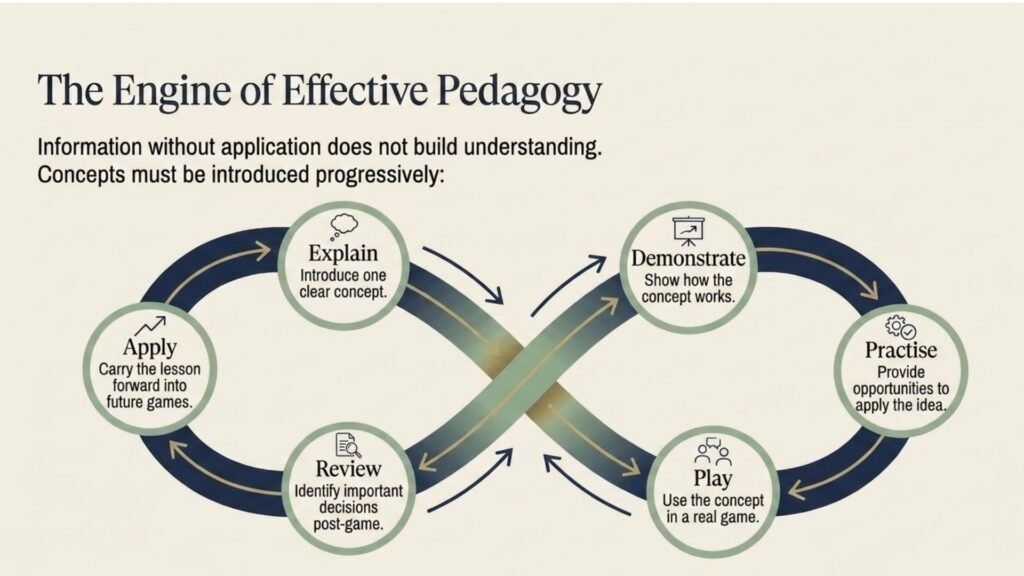
Explain → Demonstrate → Practise → Play → Review → Apply
Explain
Introduce one clear concept.
Demonstrate
Show how the concept works using a position or example.
Practise
Give the child opportunities to apply the idea.
Play
Let the child use the concept in a real game.
Review
Look at what happened and identify important decisions.
Apply
Use the lesson from the review in future games.
This approach is more useful than filling lessons with information that the child has no opportunity to use.
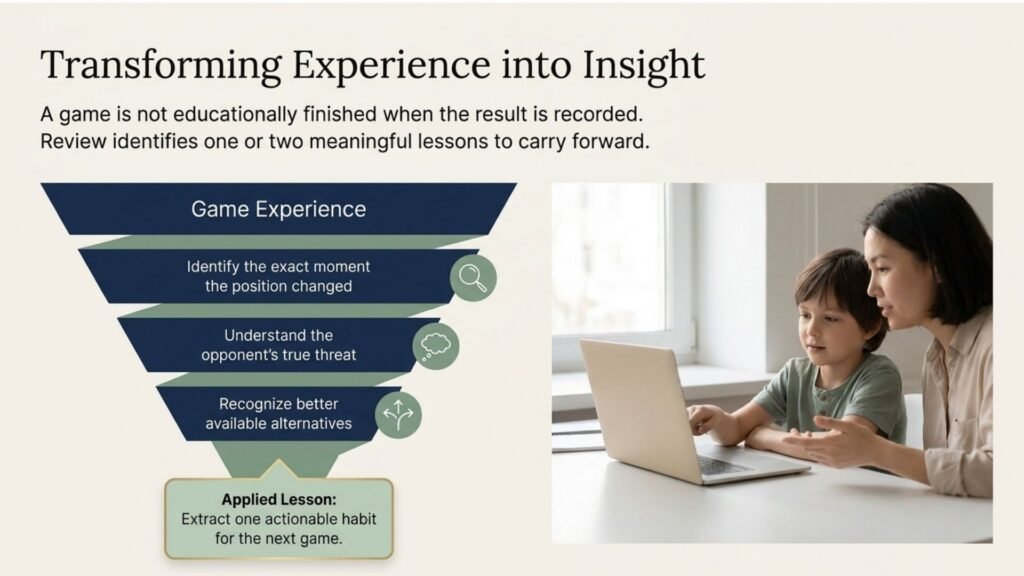
Why Game Review Matters
A game is not finished educationally when the result is recorded.
The review is where many useful learning opportunities appear.
A child can learn to ask:
- Where did the position change?
- What was I thinking at that moment?
- What did I overlook?
- Was there a better option?
- Did I understand my opponent’s threat?
- What can I recognise next time?
The purpose of review is not to find fault with every move.
It is to identify one or two meaningful lessons that the child can carry into future games.
This helps turn experience into improvement.
Common Mistakes Children Make While Learning Chess
Mistakes are a normal part of learning. The goal is to understand them rather than create fear around them.
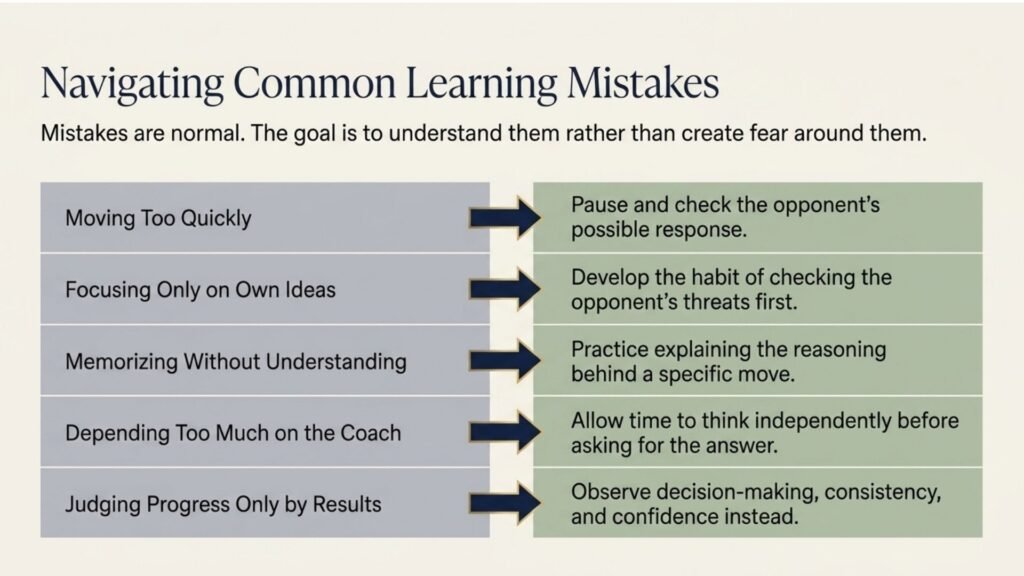
Moving Too Quickly
Children often see a move they like and play it immediately.
Better habit: pause and check the opponent’s possible response.
Focusing Only on Their Own Ideas
A child may become so focused on attacking that they forget to ask what the opponent is doing.
Better habit: develop the habit of checking the opponent’s threats before deciding.
Memorising Without Understanding
Opening sequences or tactical patterns can be memorised temporarily without being understood.
Better habit: explain the reason behind the move or pattern.
Depending Too Much on the Coach
If a child constantly waits for the correct answer, independent thinking can remain underdeveloped.
Better habit: give the child time to think before assisting.
Judging Progress Only by Results
Winning and losing are visible, but they do not tell the whole learning story.
A child may be improving their thinking process even while results remain inconsistent.
Better habit: also observe decision-making, understanding, confidence, consistency, and the ability to learn from mistakes.
How Parents Can Support Chess Learning
Parents do not need to become chess experts to support their child’s development.
The most useful support is usually calm and consistent.
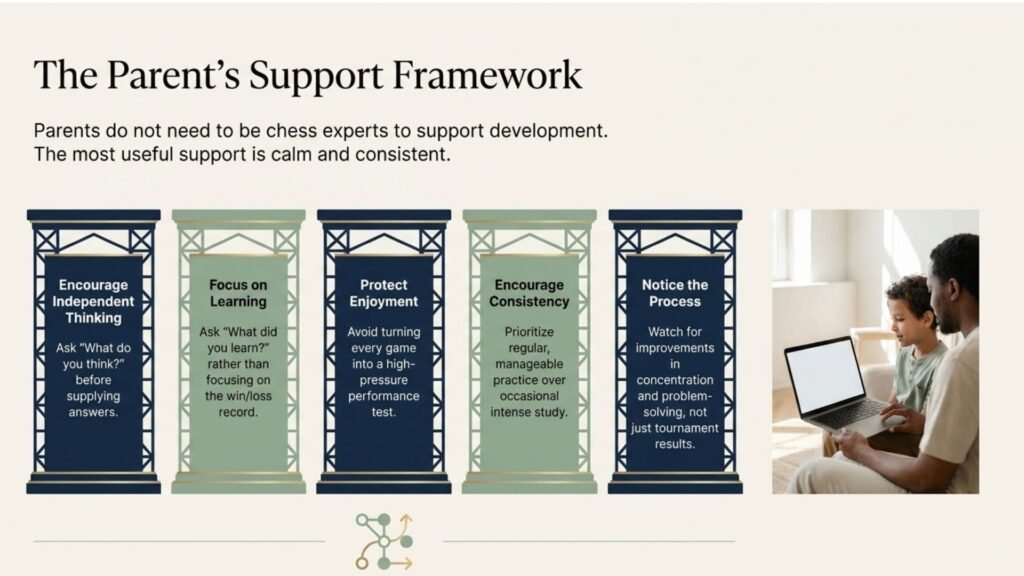
Encourage Thinking Before Giving Answers
When your child asks, “What should I play?”, try asking:
“What do you think?”
This gives the child an opportunity to practise independent decision-making.
Focus on Learning Rather Than Winning
A game can be valuable even when the result is disappointing.
Ask:
- What did you learn?
- What was your best decision?
- What would you try differently next time?
These questions shift attention from judgement to improvement.
Protect Enjoyment
Children learn more effectively when they remain interested.
Avoid turning every game into a test of performance.
Chess should provide challenge, but the challenge should remain appropriate for the child.
Encourage Consistency
Regular, manageable practice is generally more useful than occasional periods of intense study.
A child who plays, practises, and reviews consistently has more opportunities to build understanding.
Notice the Process
Parents can observe whether their child is gradually becoming better at:
- concentrating
- explaining ideas
- recognising mistakes
- thinking before moving
- solving unfamiliar positions
- reviewing games
- working independently
These changes can be more meaningful than a single tournament result.
What Should Parents Look for in a Chess Programme?
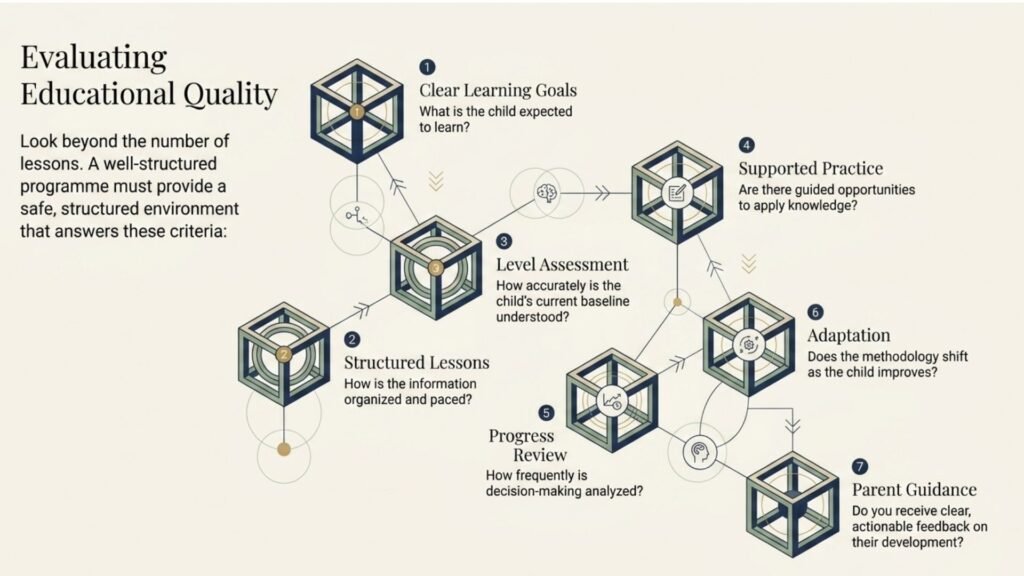
When evaluating chess classes or coaching for a child, look beyond the number of lessons offered.
A well-structured programme should make it reasonably clear:
- what the child is expected to learn
- how lessons are organised
- how the child’s level is understood
- how practice is supported
- how progress is reviewed
- how the programme adapts as the child improves
- how parents receive useful guidance
Parents are often trying to answer a deeper question:
“Will my child be learning in a safe, structured environment with appropriate guidance?”
The quality of the learning process matters more than impressive-sounding promises.
Chess Classes, Self-Learning, or Coaching?
Different learning approaches can work for different children.
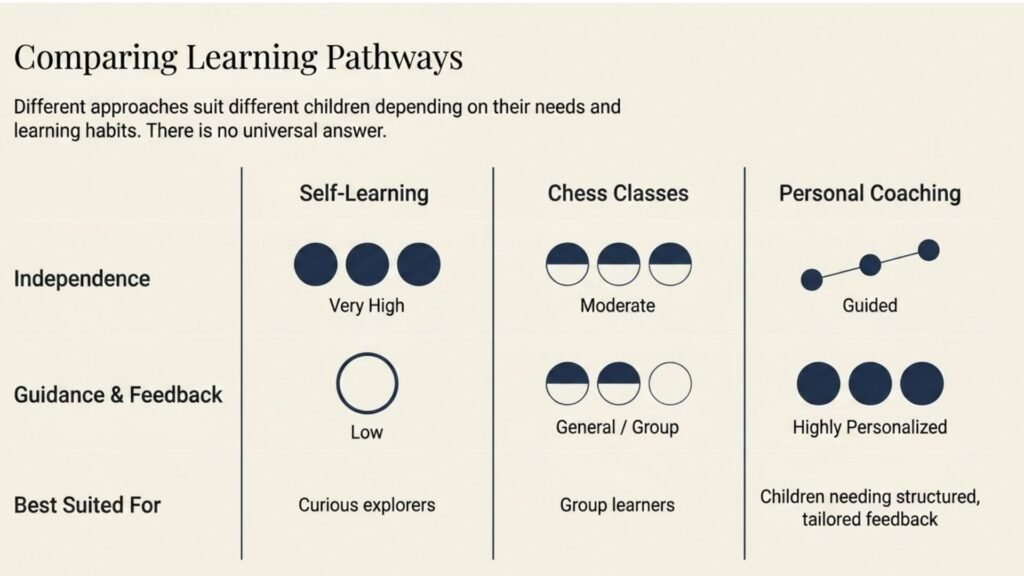
| Approach | Useful For | Main Limitation |
|---|---|---|
| Self-learning | Curious children who enjoy exploring independently | Progress can become unstructured |
| Chess classes | Children who benefit from regular instruction and group learning | Individual needs may receive less attention |
| Personal coaching | Children who benefit from personalised guidance and feedback | Requires a stronger commitment to structured learning |
There is no universal answer.
The right choice depends on the child’s current level, goals, personality, learning habits, and need for guidance.
For families considering coaching, an assessment can help establish where the child currently stands before deciding on an appropriate learning path.
When Should a Child Move Beyond the Basics?
A child is ready for more advanced material when they can use the fundamentals reliably rather than simply recognise them in a lesson.
Signs can include:
- understanding basic tactics
- recognising common threats
- developing pieces with purpose
- considering the opponent’s ideas
- explaining why a move was played
- reviewing games with some independence
- solving unfamiliar positions without immediate help
The next stage should add complexity gradually.
More information is not automatically better. The child needs concepts that they can understand and apply.
What Does Progress in Chess Look Like?
Progress can appear in several forms.
A child may:
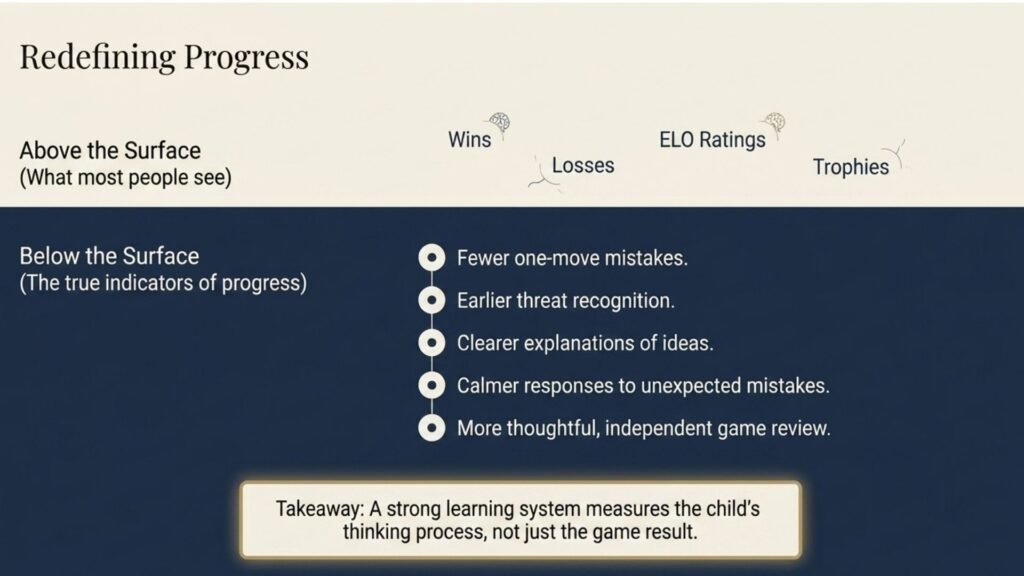
- make fewer one-move mistakes
- notice threats earlier
- think for longer before important decisions
- explain their ideas more clearly
- recognise familiar tactical patterns
- recover more calmly after mistakes
- review games more thoughtfully
- become more independent during play
Rating improvement can be useful, but it should be treated as one indicator rather than the entire definition of progress.
A strong learning system looks at the child’s thinking process as well as the game result.
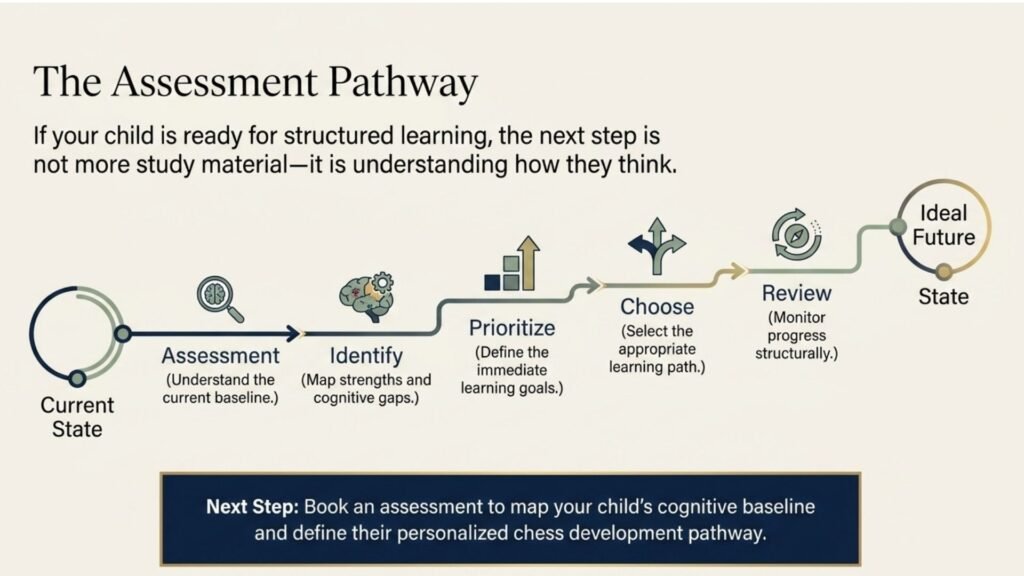
When Should Parents Consider an Assessment?
An assessment can be useful when parents are unsure about:
- the child’s current chess level
- what the child should learn next
- why progress has slowed
- whether the child is ready for more structured coaching
- which areas need the most attention
A meaningful assessment should do more than assign a level.
It should help identify patterns in the child’s thinking, strengths, gaps, and next learning priorities.
That gives parents a clearer basis for deciding what kind of support is appropriate.
Key Takeaways
- Chess for kids should develop understanding as well as chess knowledge.
- Children learn best when concepts are introduced progressively and practised regularly.
- Concentration, problem-solving, planning, decision-making, patience, and independent thinking can all be practised through chess.
- The child’s age matters less than readiness, interest, and an appropriate teaching approach.
- Game review turns playing experience into learning.
- Parents should focus on learning habits and development rather than only wins, losses, or ratings.
- Good coaching provides structure while gradually helping children think independently.
- An assessment can help identify a child’s current level and the most useful next steps.
Frequently Asked Questions
What is the best age to start chess?
There is no universal starting age. Children can begin at different stages, provided the teaching approach matches their development, attention, and interest.
For a detailed age-by-age discussion, see the guide to the best age to learn chess.
Is chess good for children?
Chess can provide a structured environment in which children practise observation, problem-solving, planning, decision-making, concentration, patience, and independent thinking. Its value depends significantly on how it is taught and experienced.
Can a young child learn chess?
Yes. Younger children can learn chess when concepts are presented simply, and activities remain appropriate for their attention span and developmental stage.
Does chess improve concentration?
Chess gives children repeated opportunities to practise focused attention, particularly when they must observe a position, identify threats, and consider alternatives. It should be viewed as a practice environment for concentration rather than a guaranteed solution to attention difficulties.
Should children memorise chess openings?
Beginners generally benefit more from understanding basic opening principles than from memorising long sequences. Opening knowledge becomes more useful as the child’s understanding develops.
How often should children practise chess?
The appropriate amount depends on the child’s age, level, goals, and interest. Consistent, manageable practice is generally more sustainable than occasional intensive study.
Should parents help during a chess game?
Parents can encourage their child, but too much assistance can interfere with independent thinking. When possible, give the child space to make decisions and learn from the consequences.
Is winning important for children learning chess?
Results are part of chess, but they should not be the only measure of progress. Understanding, decision-making, confidence, consistency, and the ability to learn from mistakes are also important.
Can a child learn chess without coaching?
Yes. Books, videos, puzzles, online resources, and playing games can all support learning. The main challenge with self-learning is maintaining a clear progression and identifying misunderstandings. Some children benefit from structured guidance and personalised feedback.
How can I know what my child should learn next?
Look at the child’s actual games and thinking process. An assessment can also help identify strengths, recurring mistakes, and the most appropriate next learning priorities.
Explore Structured Chess Learning for Your Child
If your child enjoys chess and you want a clearer understanding of their current level, the next useful step is not necessarily more lessons or more study material.
It is understanding what the child already knows, how they think during a game, and where the next meaningful improvement can come from.
A structured assessment can provide that starting point and help identify an appropriate learning pathway.
Book an assessment to understand your child’s current level and the next step in their chess development.
Related Pages
Helping Children Learn Chess
Building Chess Habits
Choosing the Right Chess Coach