Benefits of Chess for Kids: 9 Lifelong Skills Every Child Can Develop
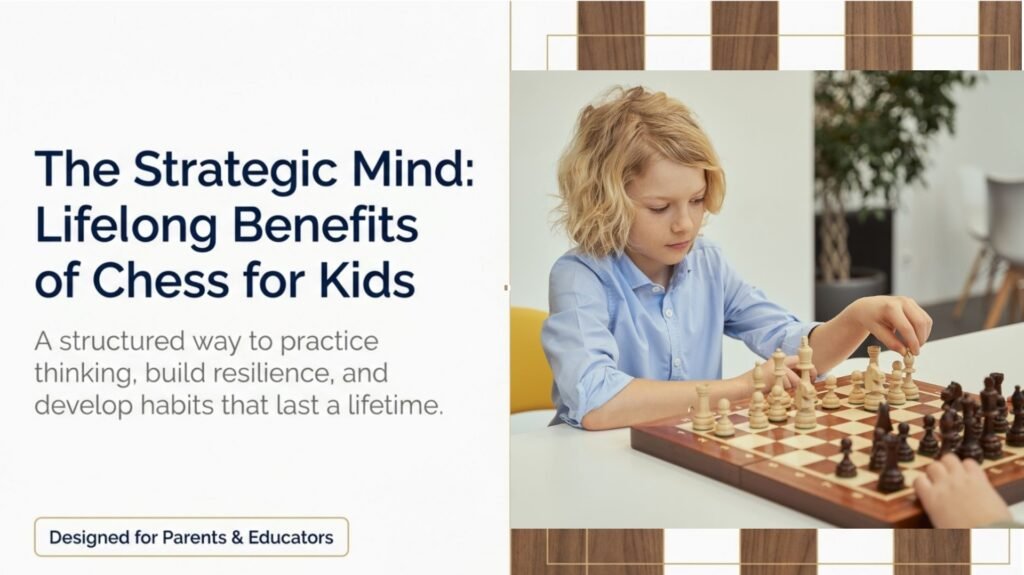
Many parents introduce chess as an enjoyable activity or a way to help their child develop important thinking skills. What often surprises them is how much children learn beyond the chessboard.
The benefits of chess for kids extend far beyond simply learning how the pieces move. Children first begin by understanding the basic chess rules, but over time they develop much broader thinking skills. Every game encourages children to observe, think logically, solve problems, and make thoughtful decisions. Over time, these habits can support learning in school, improve confidence, and help children become more independent thinkers.
Unlike activities that rely mainly on speed or memorization, chess rewards patience, planning, and careful analysis. Children gradually learn that good decisions come from understanding a situation rather than rushing to react—one of the foundations of strong chess strategy.
Whether your child is learning chess for fun, school competitions, structured online chess classes, or long-term improvement, the thinking habits developed through regular practice can become valuable skills throughout life.
Quick Summary
Children who learn chess regularly often develop the following:
- Better concentration and attention span
- Stronger problem-solving skills
- Improved logical and critical thinking
- Better memory and pattern recognition
- Patience and self-discipline
- Emotional resilience after setbacks
- Greater confidence through achievement
- Strategic planning and decision-making
- Lifelong learning habits
These benefits develop gradually through consistent practice and thoughtful guidance rather than simply playing more games.
Table of Contents
Why Chess Is Good for Kids
Chess is often described as a game of strategy, but for children it becomes something even more valuable—a structured way to practise thinking.
Every move asks a child to answer questions such as the following:
- What is happening on the board?
- What choices do I have?
- What might happen if I choose this move?
- Is there a better solution?
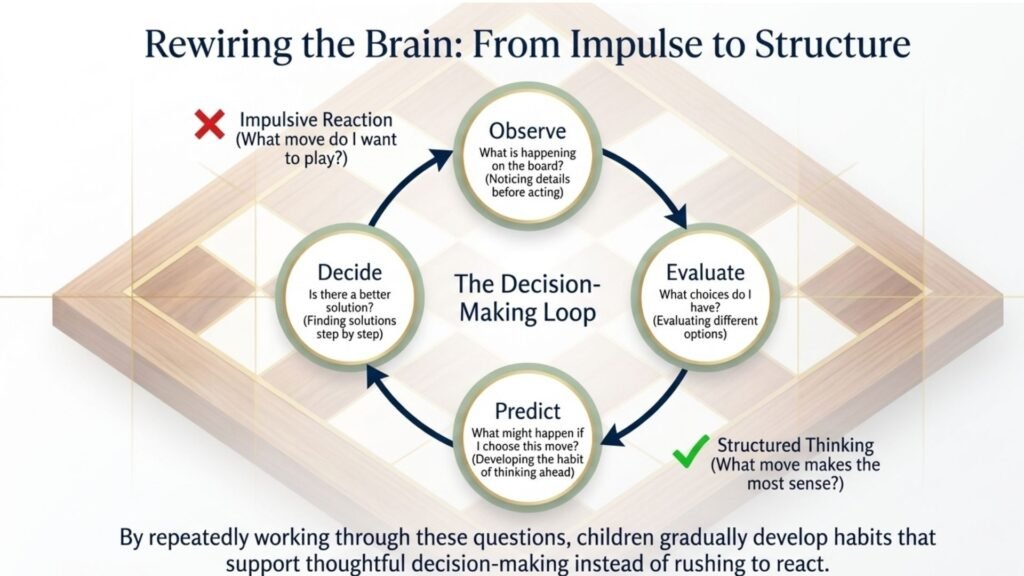
By repeatedly working through these questions, children gradually develop habits that support thoughtful decision-making instead of impulsive reactions.
One reason chess is so effective is that it provides immediate feedback. Good decisions are often rewarded, while mistakes create opportunities to learn. Instead of seeing failure as something to avoid, children begin to understand that mistakes are part of the learning process.
As they gain experience, they become more comfortable analysing situations, adjusting their plans, and trying again with greater confidence.
Parent Insight
Many parents initially hope chess will improve their child’s concentration or academic performance.
While these improvements often occur, one of the greatest long-term benefits is something less visible: children gradually learn how to think before they act. This habit supports learning not only in chess but also in school, problem-solving, and everyday decision-making.
What Makes Chess Different From Other Activities?
Many children’s activities develop important skills, but chess is unique because every game combines multiple thinking processes at the same time.
| Chess Skill | How It Helps Children |
| Observation | Encourages children to notice details before acting |
| Problem Solving | Helps children find solutions step by step |
| Planning | Develops the habit of thinking ahead |
| Decision Making | Teaches children to evaluate different options |
| Patience | Rewards careful thinking instead of rushing |
| Reflection | Encourages learning from mistakes and improving over time |
These skills are practised naturally every time a child sits down to play.
Rather than memorising information alone, children learn to apply ideas, evaluate situations, and adjust their thinking as the game develops.
Why Parents Around the World Encourage Chess
Parents choose chess for different reasons.
Some want their child to develop better concentration through regular chess practice. You can also read our guide on how chess improves concentration.
Others hope to encourage logical thinking or provide an enjoyable educational activity outside school.
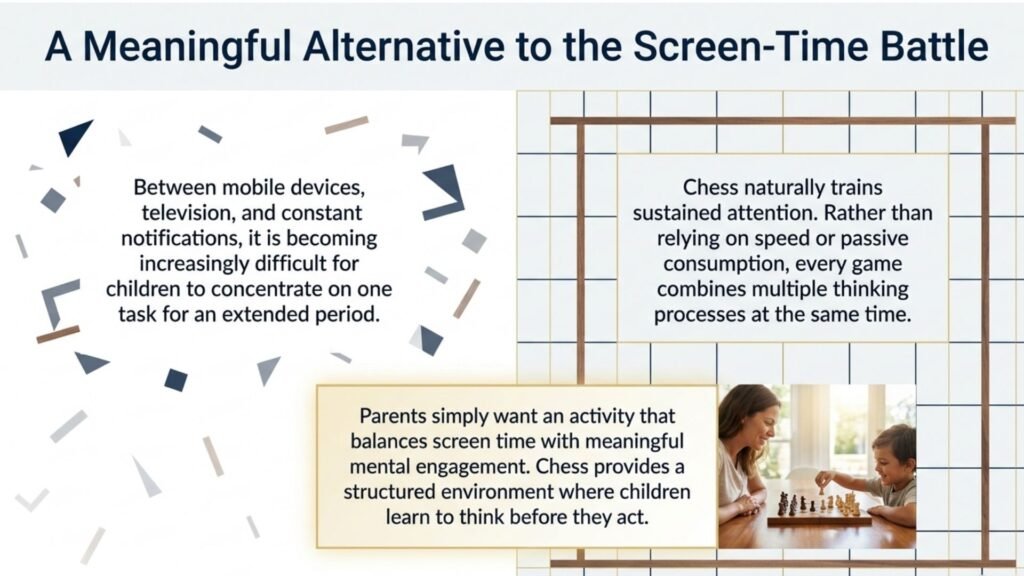
Many simply want an activity that balances screen time with meaningful mental engagement.
Whatever the motivation, chess provides a structured environment where children can learn through experience, develop confidence gradually, and enjoy steady improvement at their own pace.
Most importantly, chess teaches children that success comes from consistent effort, thoughtful decisions, and a willingness to keep learning.
The 9 Benefits of Chess for Kids
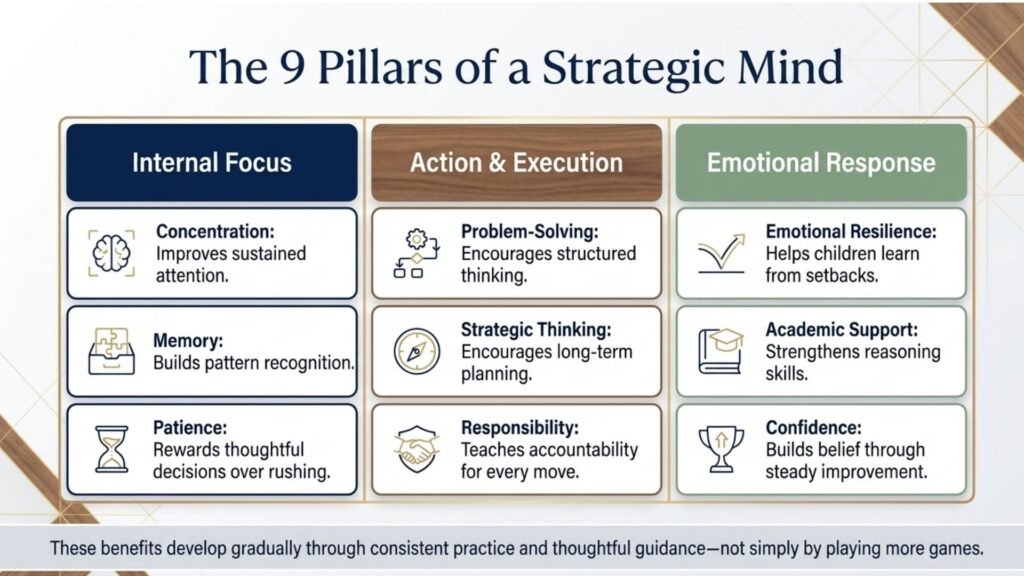
Every child learns differently, but chess develops a combination of thinking skills that are useful both inside and outside the classroom. Rather than focusing on one ability alone, chess encourages children to observe, analyse, plan, and make decisions repeatedly through every game.
Here are nine of the most valuable benefits children can develop through regular chess practice.
1. Chess Improves Concentration
One of the biggest challenges children face today is maintaining focus. Between mobile devices, television, games, and constant notifications, it is becoming increasingly difficult for children to concentrate on one task for an extended period.
Chess naturally trains sustained attention.
During every move, children must carefully observe the board before making a decision. They begin asking themselves questions like:
- What is my opponent threatening?
- Is one of my pieces under attack?
- What is the safest move?
- What should I do next?
Unlike games that reward quick reactions, chess rewards careful observation and thoughtful decisions.
As children play regularly, many parents notice improvements in their ability to focus during homework, reading, and classroom activities.
Parent Observation
If your child starts spending a little longer thinking before making decisions—not only in chess but also while solving schoolwork—it is often a positive sign that their concentration is improving.
2. Chess Develops Problem-Solving Skills
Every chess position presents a new problem.
Sometimes the challenge is defending the king.
Sometimes it is finding the best attack.
Sometimes it is recovering from a mistake.
Children gradually learn that every problem has multiple possible solutions. Instead of guessing, they begin comparing different options before choosing one.
This develops structured problem-solving rather than trial-and-error thinking.
Example
Imagine a child discovers their queen is under attack.
Instead of reacting immediately, they might consider:
- Can I move the queen safely?
- Can I defend it?
- Can I create a stronger threat instead?
This habit of evaluating alternatives becomes useful in many situations beyond chess.
3. Chess Strengthens Memory
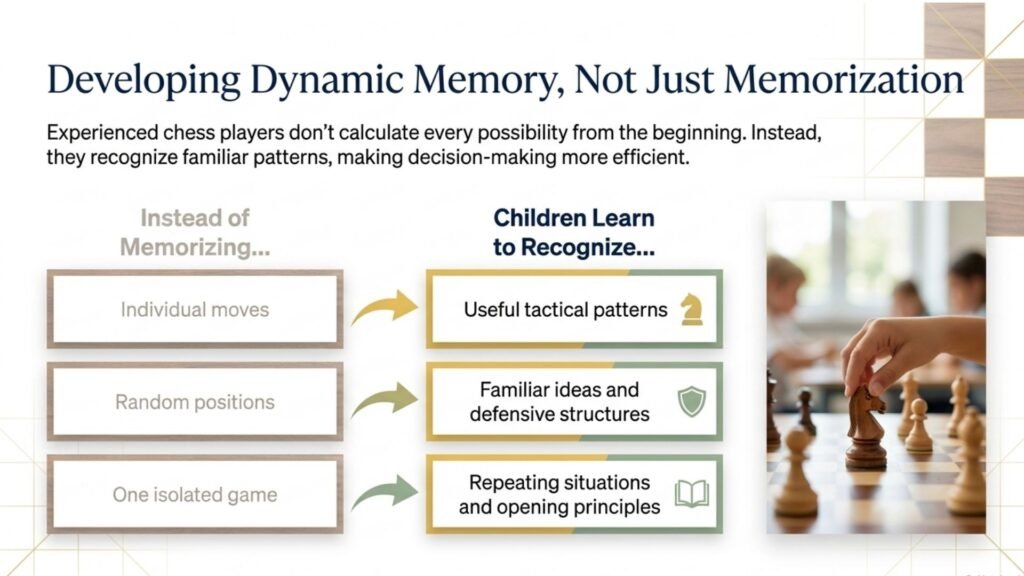
Chess is built around recognising familiar patterns through chess tactics.
As children gain experience, they begin remembering:
- basic chess openings and opening principles
- tactical ideas
- checkmate patterns
- common chess endgames and practical endgame positions.
- mistakes they have made before
Instead of memorising isolated moves, they gradually build a library of useful ideas that can be applied in different situations.
Pattern recognition becomes faster with practice, making decision-making more efficient.
| Instead of Memorising… | Children Learn to Recognise… |
| Individual moves | Useful patterns |
| Random positions | Familiar ideas |
| One game | Repeating situations |
4. Chess Teaches Patience
Many beginners lose games because they rush.
They move too quickly without checking whether their move is safe.
After experiencing these mistakes, children begin to understand an important lesson:
Good decisions usually require time.
Chess encourages children to:
- slow down
- observe carefully
- think before acting
- check their ideas
This patient approach often carries over into schoolwork and everyday decision-making.
Coaching Insight
In my experience, many mistakes made by young players are not caused by a lack of knowledge. They happen because children move before fully thinking through the position. Developing the habit of pausing before acting often leads to noticeable improvement.
5. Chess Builds Responsibility
In team sports, responsibility is shared.
In chess, every move belongs to the player.
If a child overlooks a threat or loses an important piece, they quickly realise that every decision has consequences.
Rather than blaming others, children gradually learn to:
- accept mistakes
- analyse what happened
- improve for next time
This encourages personal responsibility and independent thinking.
6. Chess Improves Emotional Resilience
Winning feels exciting.
Losing can be disappointing.
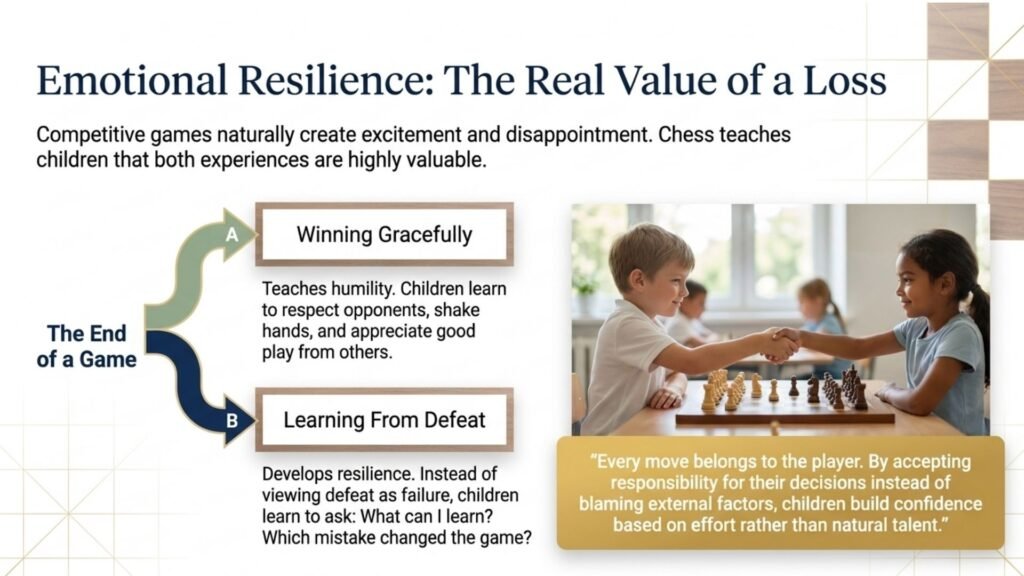
Chess teaches children that both experiences are valuable.
After a difficult game, they begin asking:
- What mistake did I make?
- What can I learn?
- How can I avoid it next time?
Instead of viewing mistakes as failures, children gradually learn to see them as opportunities for improvement.
This mindset supports resilience both in chess and in everyday life.
7. Chess Supports Academic Learning
Chess does not replace school education, but it develops several thinking habits that support learning across different subjects.
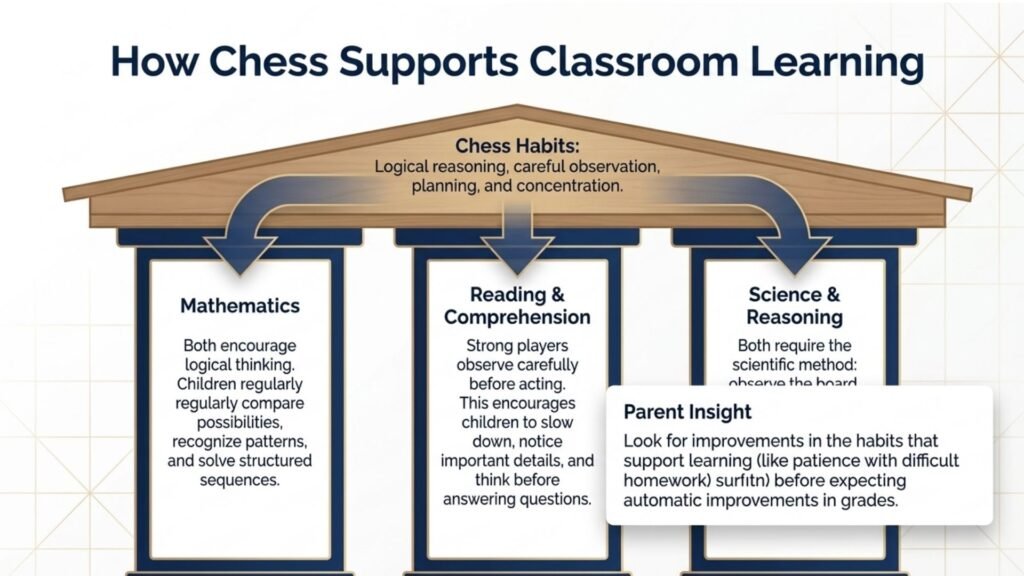
Regular chess practice encourages:
- logical reasoning
- careful observation
- planning
- concentration
- memory
- structured thinking
These skills are useful in subjects such as mathematics, science, and problem-solving activities where children need to analyse information before reaching conclusions.
8. Chess Develops Strategic Thinking
As beginners improve, they stop thinking only about the next move.
Instead, they begin planning several moves ahead.
They start asking questions like:
- Which pieces should I improve first?
- What is my long-term plan?
- Where should I place my king safely?
- Which weaknesses can I create?
Learning to think several moves ahead develops strategic thinking—a skill that becomes increasingly valuable both in education and later in life.
9. Chess Builds Confidence Through Progress
One of the most rewarding aspects of chess is seeing gradual improvement.
Children gain confidence when they:
- solve puzzles independently
- avoid previous mistakes
- understand new ideas
- play stronger games than before
This confidence is based on effort and learning rather than luck.
Children begin to understand an important life lesson:
Consistent practice leads to meaningful progress.
Quick Comparison
| Benefit | How Chess Helps |
| Concentration | Improves sustained attention |
| Problem Solving | Encourages structured thinking |
| Memory | Builds pattern recognition |
| Patience | Rewards thoughtful decisions |
| Responsibility | Teaches accountability |
| Emotional Resilience | Helps children learn from setbacks |
| Academic Support | Strengthens reasoning skills |
| Strategic Thinking | Encourages long-term planning |
| Confidence | Builds belief through steady improvement |
How Chess Supports a Child’s Overall Development
The nine benefits we’ve discussed don’t develop in isolation. They work together to help children become more thoughtful learners, better problem solvers, and more confident decision-makers.
Parents often ask whether chess improves intelligence or guarantees better academic performance. While no activity can promise specific results for every child, regular chess practice encourages many of the thinking habits that support learning and personal development.
Let’s look at these areas in more detail.
Cognitive Benefits of Chess
Cognitive skills are the mental abilities children use to understand information, solve problems, and make decisions.
Chess provides continuous opportunities to practise these skills.
Improved Attention
Every move requires children to stay focused on the board and notice small details that could change the game.
Over time, they learn to maintain attention for longer periods without becoming distracted.
Better Logical Thinking
Chess encourages children to think logically rather than emotionally.
Instead of asking,
“What move do I want to play?”
they gradually begin asking,
“What move makes the most sense?”
This shift from impulse to reasoning is one of the game’s greatest educational strengths.
Pattern Recognition
Experienced chess players don’t calculate every possibility from the beginning.
Instead, they recognise familiar patterns.
Children gradually learn to identify:
- common tactical ideas
- checkmate patterns
- defensive structures
- basic chess openings and opening principles
- recurring mistakes
Pattern recognition helps children make better decisions more efficiently.
Better Decision-Making
Every move in chess is a decision.
Children learn to:
- gather information
- compare alternatives
- predict possible outcomes
- choose the best available option
Repeated practice gradually improves decision quality.
Academic Benefits of Chess
Many parents wonder whether chess can help children perform better at school.
Chess is not a replacement for classroom learning, but it develops habits that can support academic success.
Mathematics
Chess and mathematics both encourage logical thinking.
Children regularly:
- compare possibilities
- recognise patterns
- analyse sequences
- solve structured problems
These thinking habits are useful when approaching mathematical questions.
Reading and Comprehension
Strong chess players learn to observe before acting.
This same habit can support reading comprehension by encouraging children to slow down, notice important details, and think before answering questions.
Science and Reasoning
Science often requires children to:
- observe
- form hypotheses
- test ideas
- evaluate results
Chess follows a similar thinking process through repeated experimentation and reflection.
Parent Insight
Rather than expecting chess to automatically improve school grades, look for improvements in the habits that support learning.
For example:
- better concentration during homework
- greater patience when solving difficult questions
- willingness to think independently
- improved confidence when facing new challenges
These changes often become noticeable before academic results improve.
Social and Emotional Benefits
Although chess is often played quietly, it teaches important social and emotional skills.
Learning to Win Gracefully
Success in chess teaches humility.
Children learn to respect opponents, shake hands after games, and appreciate good play from others.
Learning From Defeat
Every chess player loses games.
Instead of viewing defeat as failure, children gradually learn to ask:
- What can I learn?
- Which mistake changed the game?
- What should I improve next time?
This develops resilience and a healthier attitude toward challenges.
Managing Emotions
Competitive games naturally create excitement and disappointment.
Chess helps children practise emotional control by encouraging calm thinking even in difficult positions.
Learning to stay composed under pressure becomes a valuable life skill.
Building Self-Confidence
Confidence grows through progress.
Each puzzle solved, each new idea understood, and each improvement in play helps children believe in their own ability to learn.
This creates confidence built on effort rather than natural talent.
Life Skills Chess Helps Develop
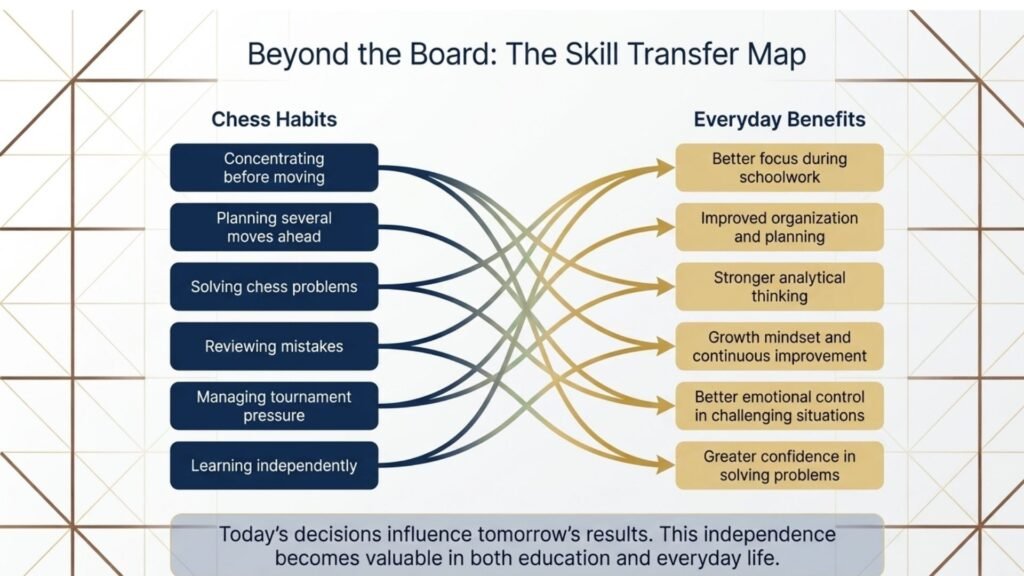
The lessons children learn through chess often extend beyond tournaments and competitions.
Planning Ahead
Children begin thinking beyond the immediate situation.
They learn that today’s decisions influence tomorrow’s results.
Responsibility
Every move has consequences.
Children gradually accept responsibility for their decisions instead of blaming external factors.
Patience
Success rarely comes from rushing.
Chess teaches children that careful thinking usually produces better outcomes.
Independent Thinking
Rather than depending on constant guidance, children gradually learn to evaluate situations for themselves.
This independence becomes valuable in both education and everyday life.
How Chess Skills Transfer Beyond the Board
| Chess Habit | Everyday Benefit |
| Concentrating before moving | Better focus during schoolwork |
| Planning several moves ahead | Improved organisation and planning |
| Solving chess problems | Stronger analytical thinking |
| Reviewing mistakes | Growth mindset and continuous improvement |
| Managing tournament pressure | Better emotional control in challenging situations |
| Learning independently | Greater confidence in solving problems |
Although chess cannot solve every educational challenge, it creates repeated opportunities for children to practise valuable thinking habits in an enjoyable and structured environment where children gradually learn chess step by step.
Common Misconceptions About Chess
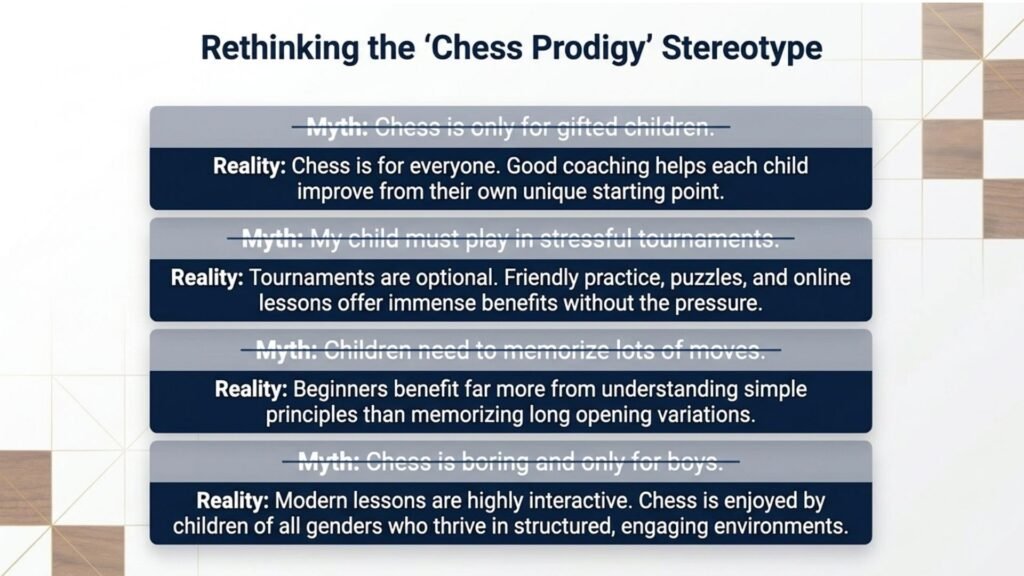
Many parents have understandable questions before introducing chess to their child.
“Chess is only for gifted children.”
Not at all.
Chess can be enjoyed by children with a wide range of abilities. Good coaching focuses on helping each child improve from their own starting point.
“My child must become a tournament player.”
Competitive chess is only one path.
Many children simply enjoy learning, solving puzzles, and playing friendly games while developing useful thinking skills.
“Children need to memorise lots of moves.”
Beginners benefit far more from understanding simple principles than memorising long opening variations.
Learning why a move works is much more valuable than simply remembering it.
“Chess is boring.”
Modern chess lessons often include interactive puzzles, mini-games, challenges, and engaging activities that make learning enjoyable for children.
The key is finding age-appropriate instruction that matches the child’s level.
Chess is only for boys
Chess is enjoyed by children of all genders, and many girls thrive in structured chess environments.
What Does Research Say About Chess for Kids?
Parents often ask whether the benefits of chess are supported by research or based only on personal experiences.
Over the years, researchers have explored how chess may influence children’s cognitive development, academic performance, and thinking skills. While the results vary between studies, many suggest that structured chess instruction can positively support skills such as concentration, logical reasoning, memory, and problem-solving.
It is important, however, to have realistic expectations.
Chess is not a magic solution that automatically improves intelligence or guarantees higher grades. Like learning a musical instrument or playing a sport, the benefits come through regular practice, thoughtful guidance, and consistent effort.
What Research Commonly Suggests
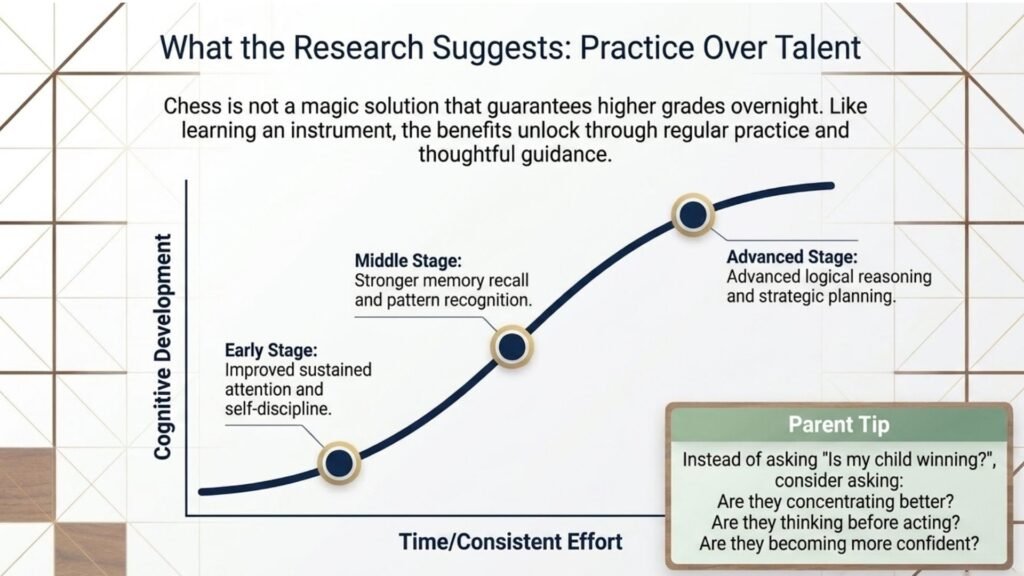
Research has found that children who regularly engage in chess often show improvement in areas such as the following:
- Concentration and sustained attention
- Logical reasoning
- Planning and decision-making
- Pattern recognition
- Problem-solving ability
- Memory and recall
- Self-discipline
Many educators value chess because it provides an enjoyable environment where children repeatedly practise these mental skills.
Why Regular Practice Matters More Than Talent
Some parents worry that their child is “not naturally good at chess”.
Fortunately, chess improvement depends far more on consistent practice than natural talent.
Children who:
- play regularly,
- solve puzzles,
- review their games,
- and receive proper guidance,
usually improve steadily over time.
Like reading, swimming, or learning a language, chess rewards consistent effort.
Parent Tip
Instead of asking,
“Is my child winning?”
consider asking,
- Is my child concentrating better?
- Are they thinking before acting?
- Do they enjoy solving problems?
- Are they becoming more confident?
These are often stronger indicators of meaningful progress than tournament results alone.
Frequently Asked Questions About Chess for Kids
Is chess good for children’s brain development?
Chess regularly challenges children to concentrate, solve problems, recognise patterns, and make thoughtful decisions. These mental activities help strengthen important cognitive skills over time.
While chess is not a shortcut to becoming more intelligent, it provides an enjoyable environment where children repeatedly practise valuable thinking habits.
Can chess improve school performance?
Chess develops skills such as concentration, logical reasoning, planning, and problem-solving that support classroom learning.
Although chess alone cannot guarantee higher grades, many parents notice improvements in learning habits that benefit children across different school subjects.
Is chess suitable for every child?
Yes.
Chess can be enjoyed by children with different interests, personalities, and learning styles.
Some children enjoy competition, while others simply enjoy solving puzzles and learning new ideas.
The goal should always be steady improvement and enjoyment rather than comparing children with others.
Does my child need to play tournaments?
No.
Tournament chess is only one way to enjoy the game.
Many children benefit greatly from learning chess through:
- friendly practice games
- puzzles
- online lessons
- classroom activities
- family games
A child can develop valuable thinking skills without competing regularly.
Can chess help reduce screen time?
For many families, yes.
Chess provides a meaningful alternative to passive screen entertainment.
Whether played over a physical board or through supervised online learning, chess encourages active thinking rather than passive consumption.
Final Thoughts
The benefits of chess for kids extend far beyond learning how to play a board game.
Through every game, children practise concentration, patience, planning, logical reasoning, and problem-solving. They learn to make decisions, accept responsibility for mistakes, and improve through consistent effort.
Perhaps the greatest lesson chess teaches is that meaningful progress rarely happens overnight. It comes from thinking carefully, practising regularly, and learning from experience.
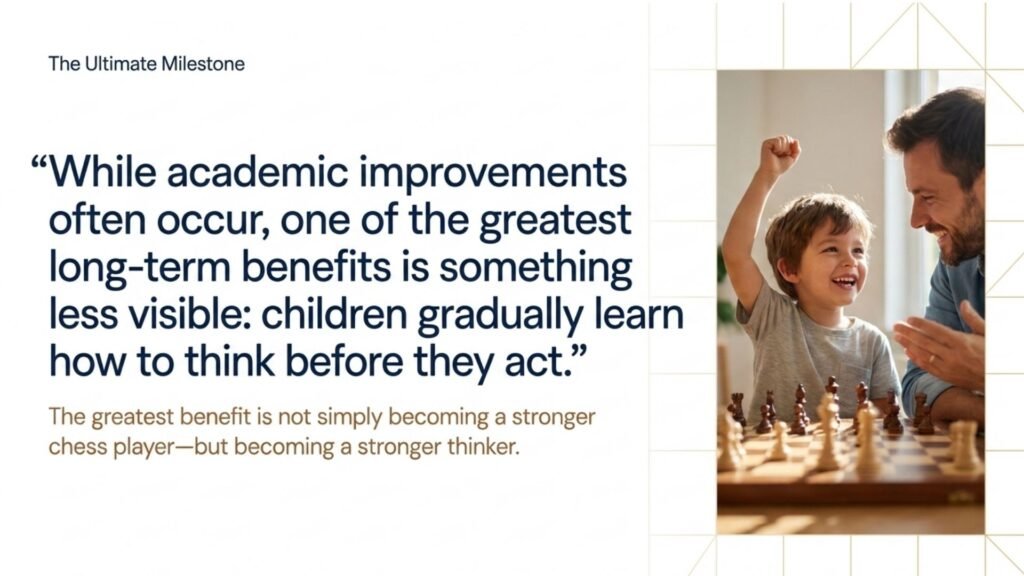
These habits can support children not only in chess but also in school, future careers, and everyday life.
Whether your child dreams of competing in tournaments or simply wants to enjoy learning something new, chess provides a structured and enjoyable environment for lifelong learning.
Ready to Help Your Child Learn Chess?
Every child learns differently.
A structured learning approach begins with an online chess assessment that can help children build strong foundations, enjoy the game, and develop confidence step by step.
Our online chess coaching programme is designed to help children:
- Learn through structured lessons
- Build strong thinking habits
- Improve with guided online chess coaching
- Enjoy a supportive learning environment
- Develop confidence at their own pace
Whether your child is just beginning or already has some experience, personalised guidance from an experienced online chess coach can make learning more enjoyable and effective.
Key Takeaways
✔ Chess helps children develop concentration and focus.
✔ It strengthens logical thinking and problem-solving.
✔ Regular practice encourages patience and thoughtful decision-making.
✔ Children learn resilience by analysing mistakes and improving over time.
✔ Chess supports valuable learning habits that extend beyond the classroom.
✔ The greatest benefit is not simply becoming a stronger chess player—but becoming a stronger thinker.
Thank You for Reading
We hope this guide has helped you understand why chess has become one of the world’s most valued educational activities for children.
If you’re looking for a structured, supportive way for your child to learn chess, we’d be delighted to help you begin that journey.