
Chess Rules: A Complete Beginner’s Guide
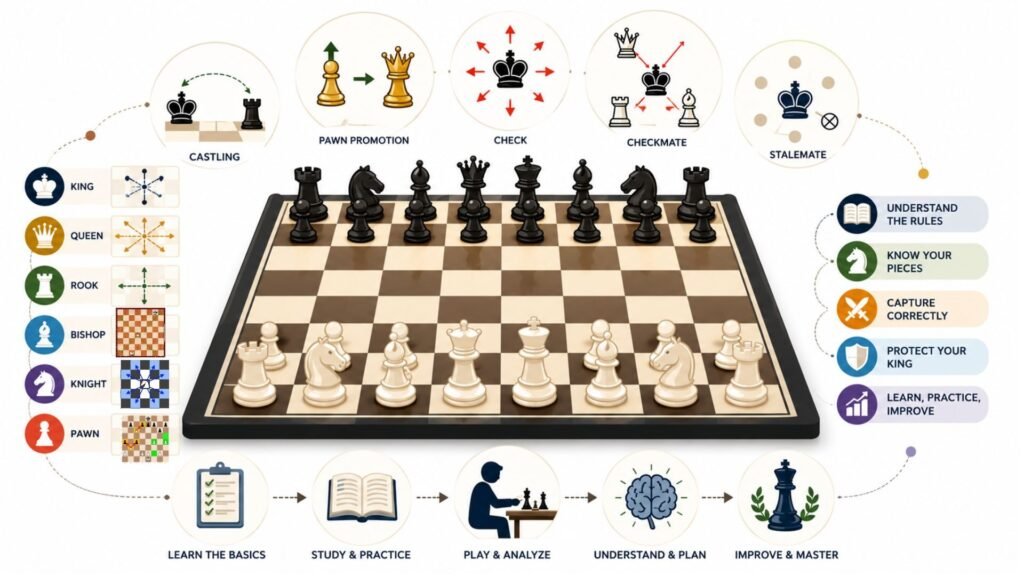
Learning the rules of chess is the first step toward becoming a confident player. While chess has only a few fundamental rules, understanding them clearly makes every future lesson easier.
Many beginners try to memorize moves without understanding the purpose behind them. A better approach is to first Once you understand the rules, the next step is learning the basic chess principles that help you make better decisions during a game.
If you’re just beginning your chess journey, our Complete Beginner Chess Guide provides the complete learning roadmap before you study the rules in detail.
Quick Summary
- Learn how the chessboard is arranged.
- Understand how every chess piece moves.
- Know the objective of the game.
- Master special rules like castling, promotion, and en passant.
- Understand check, checkmate, and stalemate.
- Learn the common ways a chess game can end.
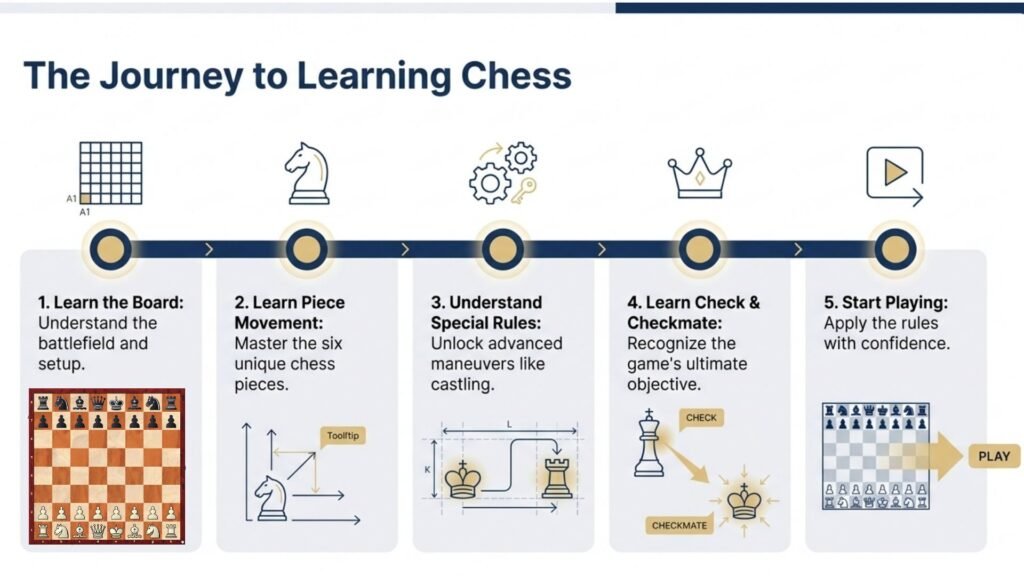
What Is the Goal of Chess?
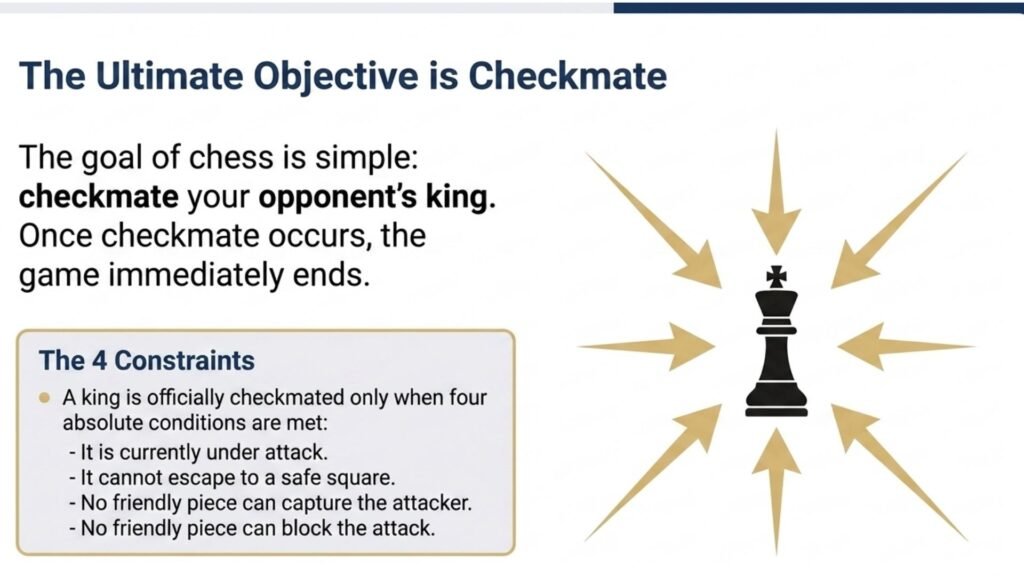
The objective of chess is simple:
Checkmate your opponent’s king.
A king is checkmated when:
- It is under attack.
- It cannot escape.
- No piece can capture the attacking piece.
- No piece can block the attack.
Once checkmate occurs, the game immediately ends.
Chessboard Setup
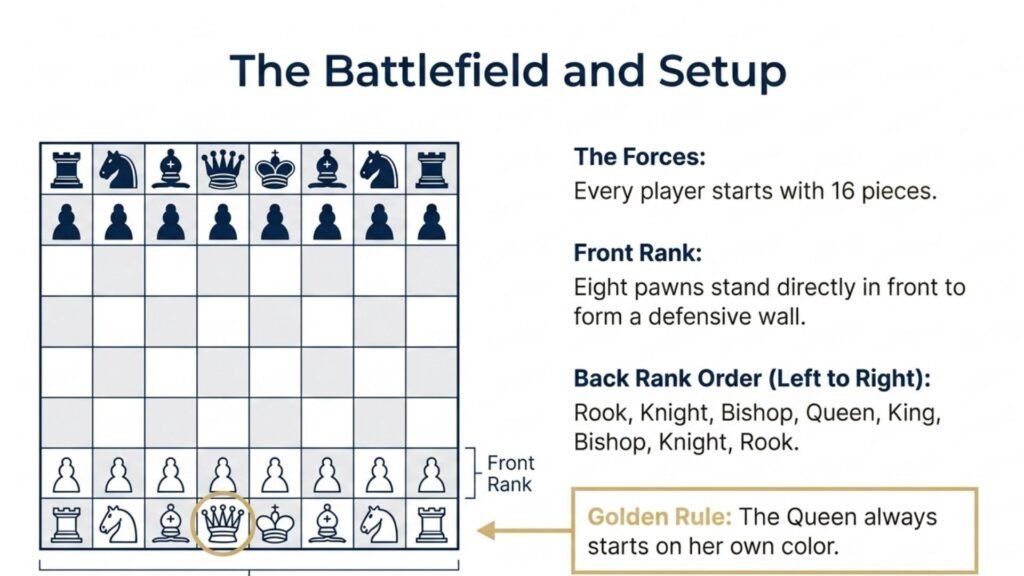
Every player starts with sixteen pieces.
Back Rank
From left to right:
- Rook
- Knight
- Bishop
- Queen
- King
- Bishop
- Knight
- Rook
Front Rank
Eight pawns stand directly in front of the major pieces.
Remember:
The queen always starts on her own color.
- White Queen on a White Square
- Black Queen on a Black Square
How Every Chess Piece Moves
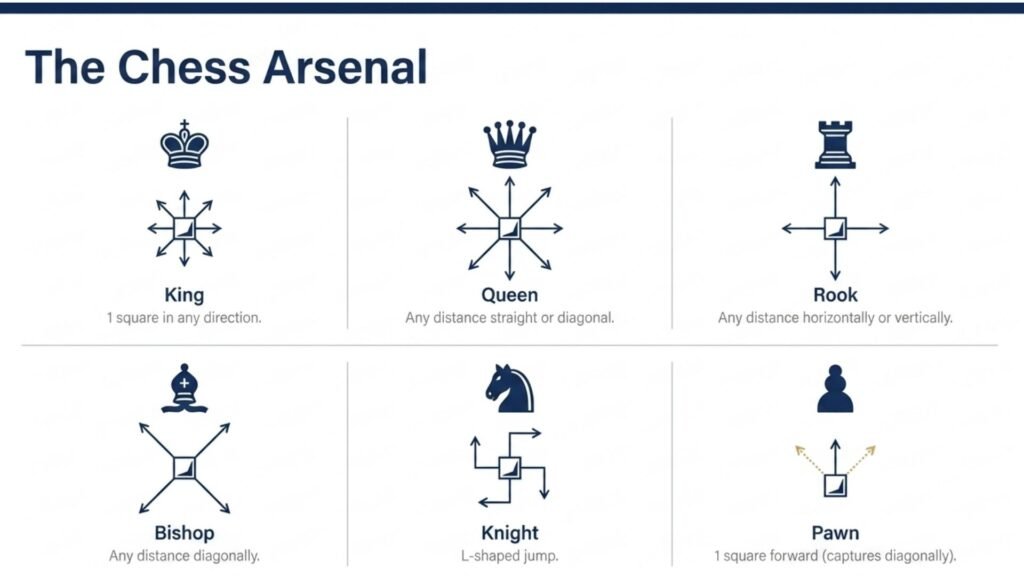
Each chess piece has its own movement pattern. Understanding these movements is essential because every decision in chess depends on knowing which pieces can attack, defend, or control important squares.
| Piece | How It Moves | Special Notes |
|---|---|---|
| King | One square in any direction | Cannot move into check. |
| Queen | Any number of squares horizontally, vertically, or diagonally | Most powerful piece. |
| Rook | Horizontally or vertically | Excellent in open files. |
| Bishop | Diagonally | Always stays on the same colour. |
| Knight | L-shaped move (2 squares + 1 square) | Can jump over other pieces. |
| Pawn | Moves forward one square (two on its first move) | Captures diagonally. |
The King
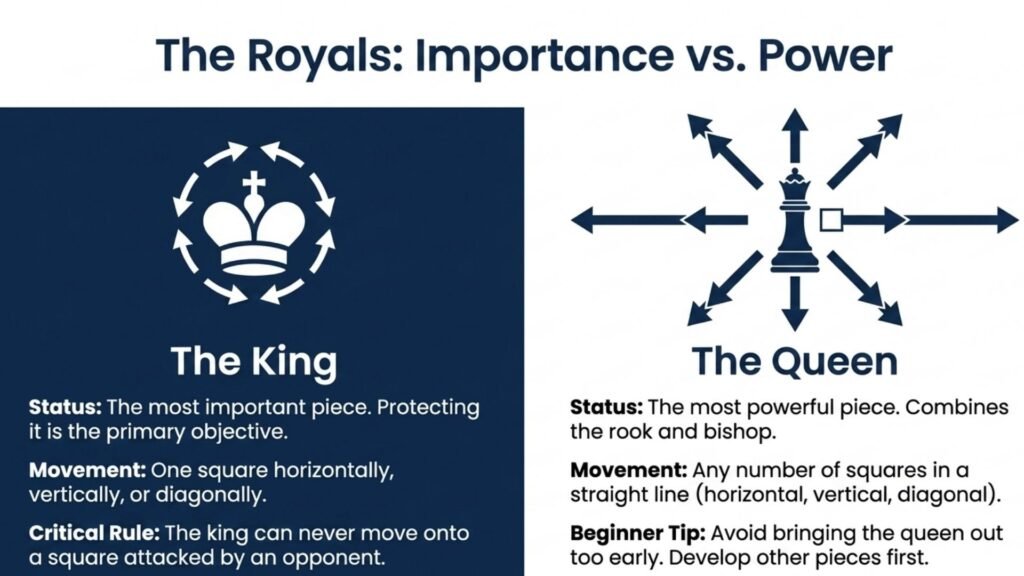
The king is the most important piece on the chessboard. Although it is not the strongest attacker, protecting the king is the primary objective of the game.
How the King Moves
- One square horizontally.
- One square vertically.
- One square diagonally.
Important Rule: The king can never move onto a square that is under attack by an opponent’s piece.
The Queen
The queen combines the movement of both the rook and the bishop, making it the most powerful piece in chess.
The Queen Can Move
- Horizontally
- Vertically
- Diagonally
- Any number of squares in a straight line
Because of its power, beginners should avoid bringing the queen out too early. Developing other pieces first usually leads to stronger positions. This idea is one of the first opening principles every beginner should learn.
The Rook
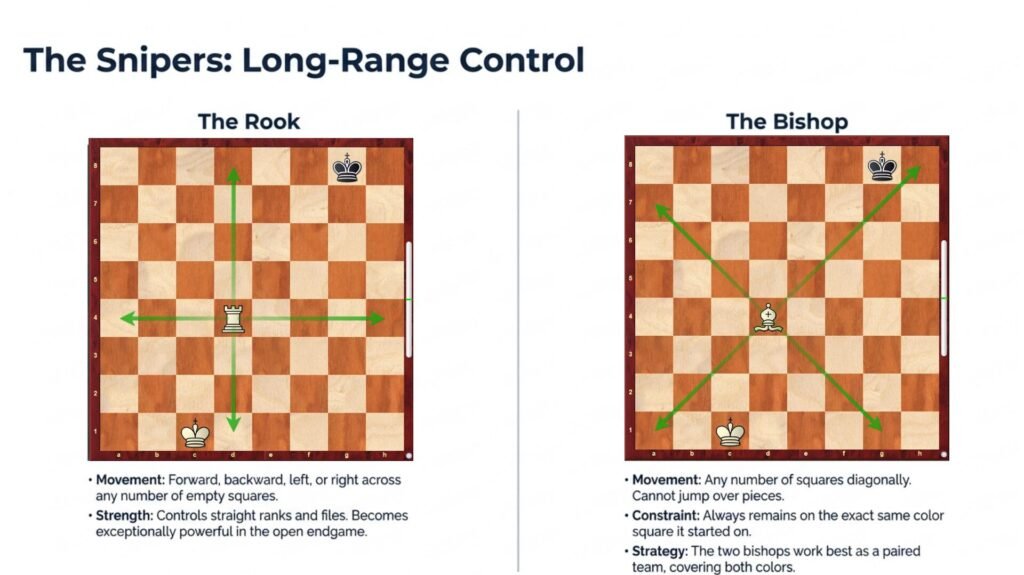
The rook is a long-range piece that controls ranks and files.
The Rook Moves
- Forward
- Backward
- Left
- Right
- Any number of empty squares
Rooks become especially powerful after castling and during the endgame when the board is more open.
The Bishop
Bishops move diagonally across the board.
Key Characteristics
- Moves any number of squares diagonally.
- Cannot jump over pieces.
- Always remains on the same-coloured squares throughout the game.
Since each bishop controls only one color, the two bishops work best together.
The Knight
The knight has the most unique movement in chess.
The Knight Moves
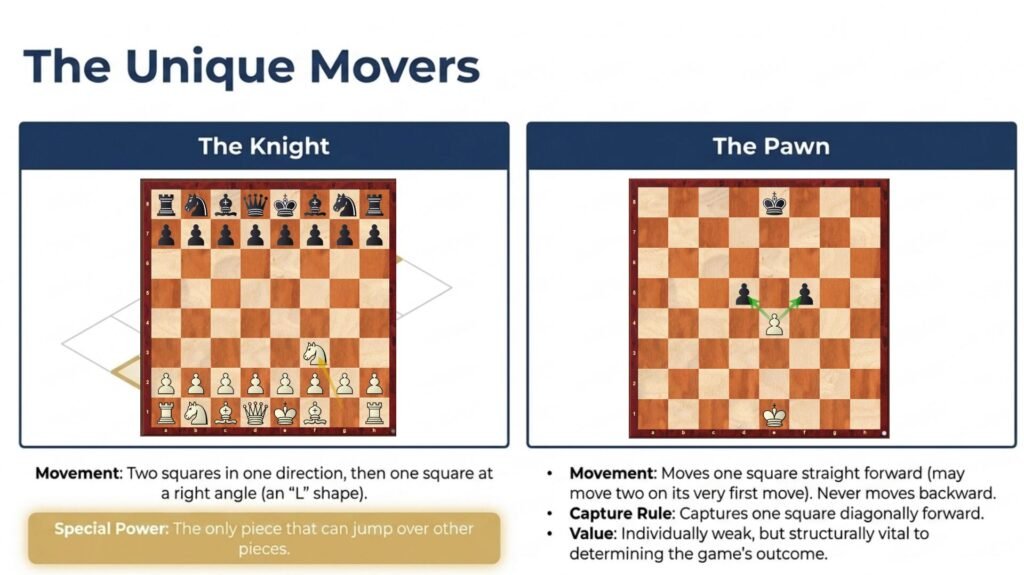
- Two squares in one direction.
- One square at a right angle.
This movement forms the familiar “L” shape.
Special Rule: The knight is the only chess piece that can jump over other pieces.
The Pawn
Pawns may look simple, but they have the most unique movement rules of any chess piece.
How Pawns Move
- Move one square straight forward.
- May move two squares on their very first move.
- Capture one square diagonally forward.
- Never move backwards.
Although pawns are the least valuable pieces individually, they often determine the outcome of a game through promotion and strong pawn structures. Understanding how pawns work is one of the biggest steps toward improving your overall chess strategy.
How to Capture Chess Pieces
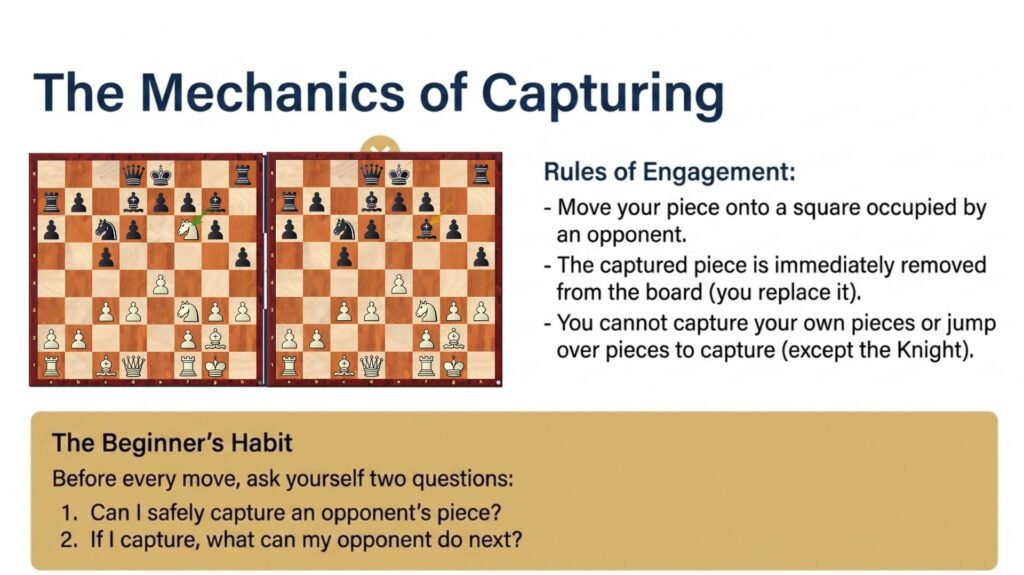
Capturing is one of the fundamental actions in chess. Every piece captures according to its normal movement pattern, except for the pawn, which has a unique way of capturing.
General Capturing Rules
- A piece captures by moving onto a square occupied by an opponent’s piece.
- The captured piece is immediately removed from the board.
- You cannot capture your own pieces.
- Most pieces cannot jump over other pieces while capturing. The knight is the only exception.
Beginner Tip: Before making any move, always ask yourself:
- Can I safely capture an opponent’s piece?
- If I capture, what can my opponent do next?
Thinking one move ahead helps avoid many beginner mistakes. Developing this habit is also the foundation of recognising tactical opportunities.
Understanding Check
A king is in check when it is being attacked by one or more of the opponent’s pieces.
Whenever your king is in check, you must respond immediately. Ignoring a check is an illegal move.
There Are Only Three Ways to Escape a Check
- Move the king to a safe square.
- Capture the attacking piece.
- Block the attack (only possible against sliding pieces such as queens, rooks, and bishops).
Important: If none of these three options is available, the position is checkmate.
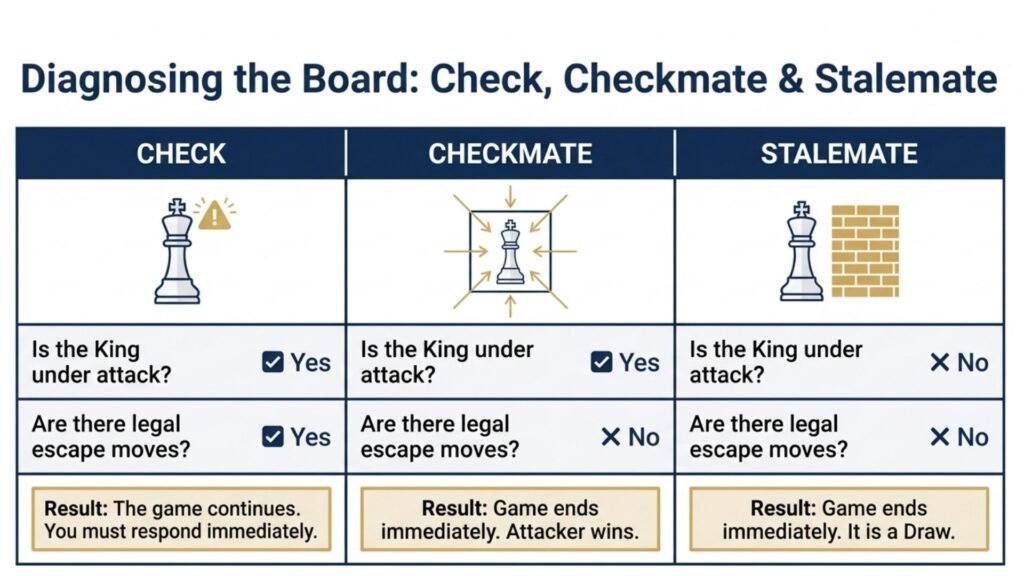
What Is Checkmate?
Checkmate is the ultimate goal of chess.
A king is checkmated when:
- It is under attack.
- It has no safe square to move to.
- The attacking piece cannot be captured.
- The attack cannot be blocked.
Once checkmate occurs, the game immediately ends, and the player delivering checkmate wins.
Quick Comparison
| Check | Checkmate |
|---|---|
| The king is under attack. | The king is under attack and cannot escape. |
| The game continues. | The game ends immediately. |
What Is Stalemate?
Not every game ends with a winner.
A stalemate occurs when:
- The player whose turn it is has no legal move.
- The king is not in check.
When this happens, the game is declared a draw.
Checkmate vs Stalemate
| Checkmate | Stalemate |
|---|---|
| King is in check. | King is not in check. |
| No legal escape. | No legal move. |
| Win for the attacking player. | Draw. |
Illegal Moves in Chess
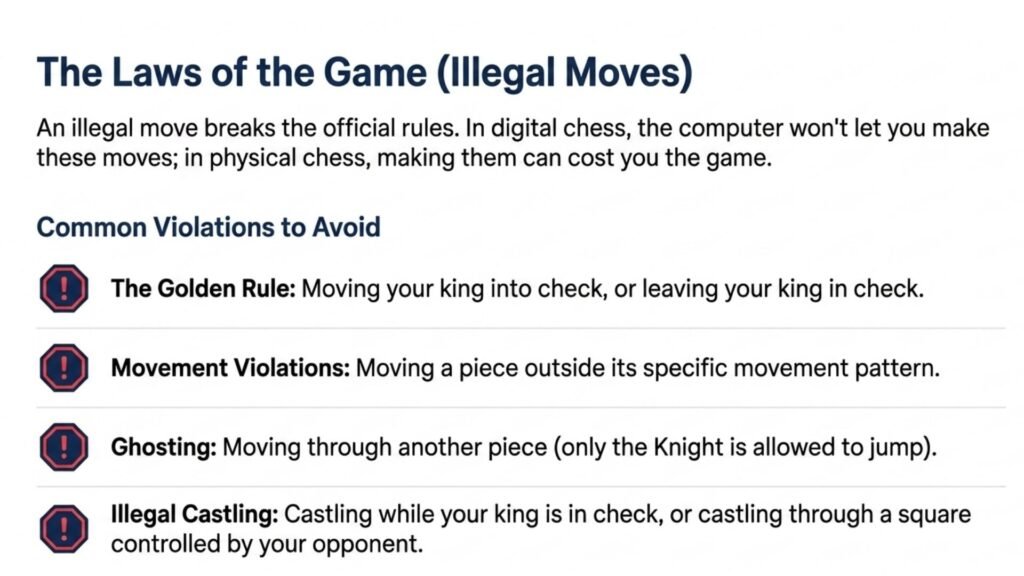
An illegal move is any move that breaks the official rules of chess.
Common Illegal Moves
- Moving your king into check.
- Leaving your king in check.
- Moving a piece in a way that it is not allowed to move.
- Moving through another piece (except with a knight).
- Castling while the king is in check.
- Castling through a square that is under attack.
- Making an illegal pawn move.
Beginner Thinking Habit
Before every move, ask yourself these three questions:
- Is my king safe?
- Is my opponent threatening something?
- Is my move legal?
Developing this simple habit prevents many avoidable mistakes and helps build confidence during games.
Special Rules in Chess
Once you understand how the pieces move, the next step is learning the special rules of chess. These rules don’t occur in every game, but knowing them is essential for playing correctly and confidently.
Castling
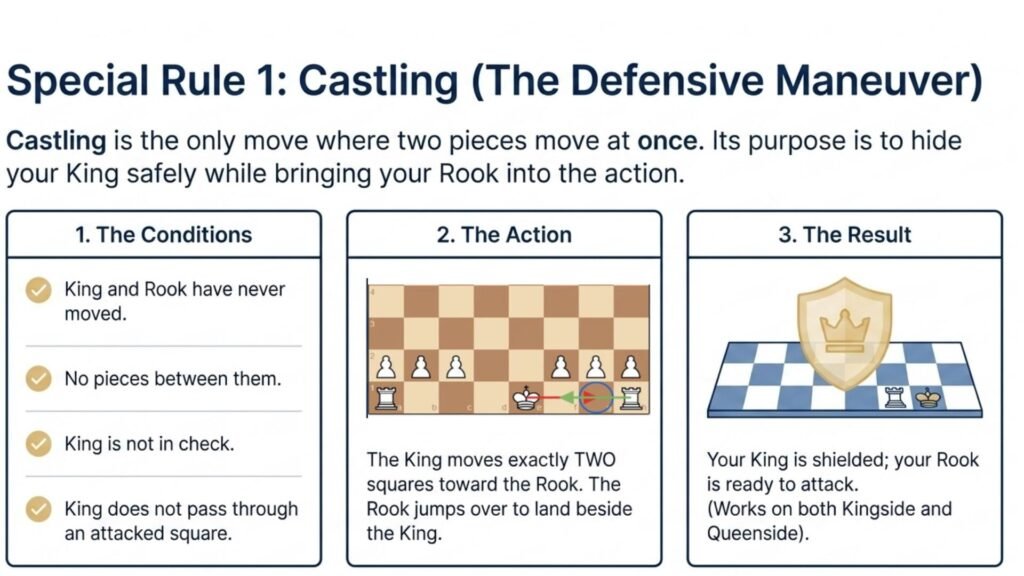
Castling is the only move in chess where two pieces move at the same time. It involves the king and one rook.
The primary purpose of castling is to improve the safety of your king while bringing the rook into a more active position.
How to Castle
- The king moves two squares toward the rook.
- The rook jumps over the king and lands on the square immediately beside it.
There Are Two Types of Castling
| Type | Also Called | Description |
|---|---|---|
| Kingside Castling | Short Castling | King moves two squares toward the kingside rook. |
| Queenside Castling | Long Castling | King moves two squares toward the queenside rook. |
Conditions for Castling
You may castle only if all of the following conditions are satisfied:
- The king has never moved.
- The rook involved has never moved.
- There are no pieces between the king and rook.
- The king is not currently in check.
- The king does not pass through a square that is under attack.
- The king does not finish on a square that is under attack.
Beginner Tip: In most games, castling early is a good habit because it protects your king and connects your rooks.
Pawn Promotion
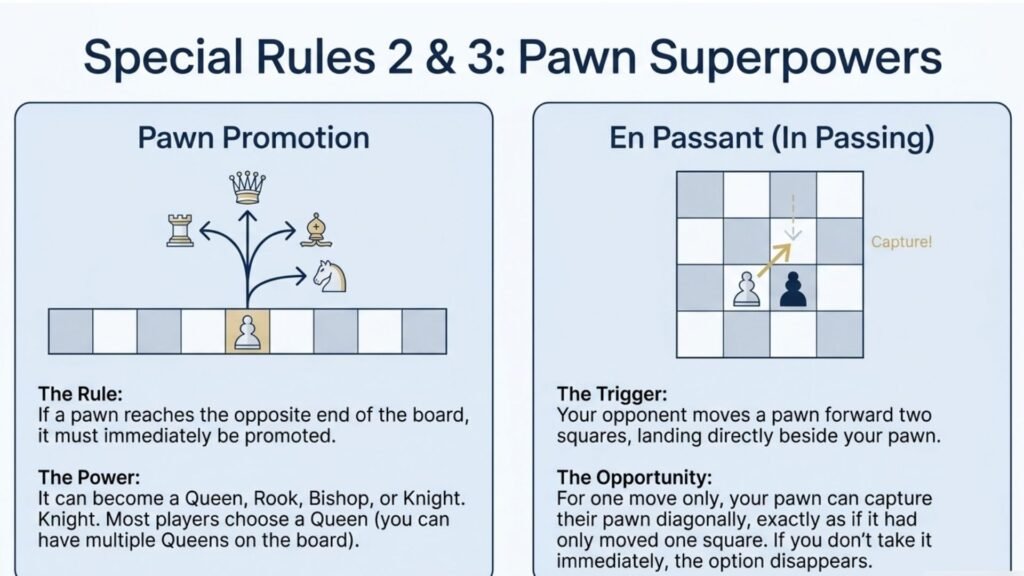
Pawns may be the least valuable pieces at the beginning of the game, but they have the unique ability to become much stronger.
When a pawn reaches the last rank on the opposite side of the board, it must be promoted immediately.
A Pawn Can Be Promoted To
- Queen
- Rook
- Bishop
- Knight
In most situations, players choose to promote to a queen because it is the most powerful piece. This is known as queen promotion. Choosing the right promotion piece becomes easier once you understand basic endgame ideas.
Did You Know?
A player can have more than one queen on the board through pawn promotion.
En Passant
En Passant is one of the most misunderstood rules in chess because it only applies in a very specific situation.
When Is En Passant Allowed?
- An opponent’s pawn moves forward two squares from its starting position.
- Your pawn is on an adjacent file.
- Your pawn could have captured the opponent’s pawn if it had moved only one square.
- You capture immediately on your very next move.
If you choose not to capture immediately, the opportunity disappears.
Remember: En Passant is optional. You are never required to play it.
How Can a Chess Game End?
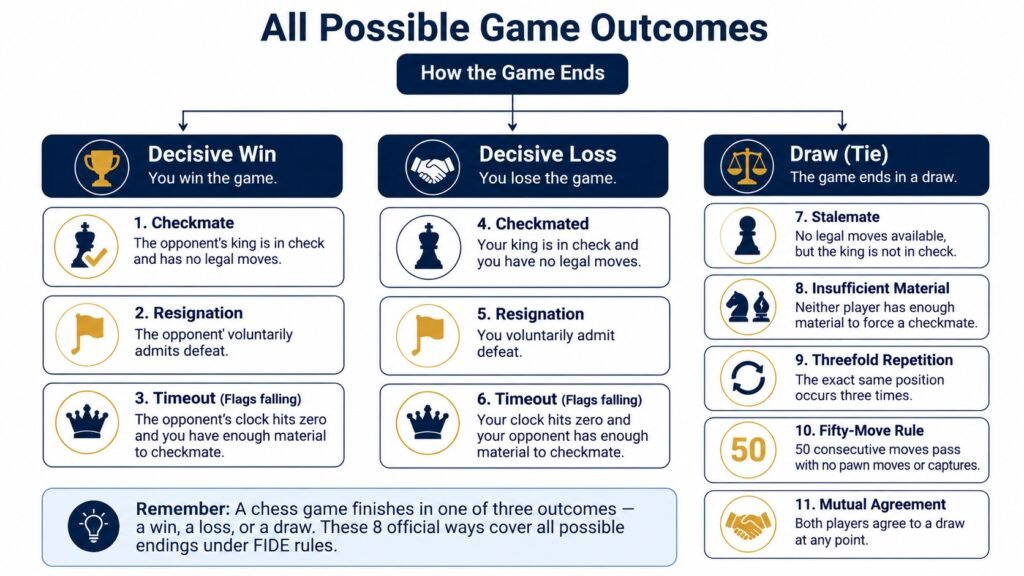
Not every chess game ends with checkmate. There are several official ways a game may conclude.
| Game Result | Meaning |
|---|---|
| Checkmate | One player wins by trapping the opponent’s king. |
| Resignation | A player voluntarily admits defeat. |
| Stalemate | No legal moves, but the king is not in check. |
| Draw by Agreement | Both players agree to end the game. |
| Threefold Repetition | The same position appears three times. |
| Fifty-Move Rule | Fifty consecutive moves occur without a pawn move or capture. |
| Insufficient Material | Neither player has enough pieces to force checkmate. |
Rules Every Beginner Should Remember
Even after learning the rules of chess, beginners often forget important details during a game. Reviewing these key rules before you play can help you avoid common mistakes and build confidence at the board.
Quick Rules Checklist
- Always respond to a check. If your king is in check, you must move out of check immediately.
- Never move your king into check. A king may not move to a square that is under attack.
- Knights can jump over pieces. They are the only pieces that can move over other pieces.
- Pawns move and capture differently. Pawns move straight ahead but capture one square diagonally forward.
- Castle only when it is legal. Neither the king nor the rook must have moved; there must be no pieces between them, and the king cannot castle through or into check.
- En passant is a one-move opportunity. If you do not capture immediately after an eligible two-square pawn advance, the opportunity is lost.
- Promotion is mandatory. A pawn reaching the last rank must be promoted to a queen, rook, bishop, or knight.
- Stalemate is a draw. If a player has no legal moves and their king is not in check, the game ends in a draw, regardless of the material advantage.
If you’re ever unsure during a game, return to these eight rules. These rules become much easier to remember through regular practice of chess online. They cover many of the situations that confuse new players and will help you play more accurately and confidently.
Key Takeaways
- Castling is the safest way to protect your king early in the game.
- Pawns become extremely powerful because they can be promoted.
- En Passant is a special pawn capture that is available only immediately after a qualifying two-square pawn move.
- Chess games can end by checkmate, resignation, stalemate, or several official draw rules.
- Learning these special rules helps you avoid illegal moves and play with confidence.
Frequently Asked Questions
How long does it take to learn chess rules?
Most beginners can learn the basic rules within a few hours. Becoming a stronger player comes through regular practice and understanding chess principles.
Which chess piece is the strongest?
The queen is the most powerful piece because it can move horizontally, vertically, and diagonally.
Can a king capture another king?
No. Kings may never move onto adjacent squares because neither king is allowed to move into check.
Is castling compulsory?
No. Castling is optional, although it is usually one of the best ways to protect your king.
Can a pawn become another queen?
Yes. When a pawn reaches the last rank, it can be promoted to a queen, rook, bishop, or knight.
What happens if I forget that my king is in check?
Leaving your king in check is an illegal move. You must always respond to a check immediately.
What is the best way to improve after learning the rules?
Play regularly, solve simple chess puzzles, review your games, and gradually learn opening principles, tactics, and endgames. Following a structured learning plan helps beginners improve faster than random practice.
Final Thoughts
Learning the rules of chess is the beginning of an exciting journey. The rules provide the foundation, but real improvement comes from understanding ideas, practicing consistently, and learning from every game you play.
Don’t worry about memorizing everything at once. Build your knowledge step by step, play regularly, review your mistakes, and enjoy the learning process.
If you’d like a structured roadmap instead of figuring everything out on your own, explore our beginner learning resources before booking an assessment.
Ready to Take the Next Step?
Whether you’re a beginner or a parent looking for structured chess learning, the right guidance can make improvement faster, more enjoyable, and more consistent.