
Online Chess Classes
Choosing online chess classes is not simply about finding a convenient way to learn chess from home.
The more important question is whether the learning experience helps a student understand chess, think carefully, practise purposefully and improve over time.
A good online chess class should provide more than access to a digital chessboard. It should give the learner appropriate instruction, active participation, meaningful feedback and a clear connection between what is taught and what the student should practise next.
For a beginner, that may mean learning the board, checkmate, basic tactics and sound opening principles. For an improving player, it may involve calculation, candidate moves, positional understanding, game analysis and increasingly independent decision-making.
Parents often have another important question:
How can I tell whether an online chess programme is genuinely educational?
The answer is not simply the number of classes, the length of the syllabus or the number of topics listed.
A better evaluation looks at the quality of the learning process: how the student participates, how feedback is given, whether the level is appropriate, how mistakes are analysed, whether practice has a purpose and whether there is a sensible path for continued development.
This guide explains what online chess classes should provide, how learning progresses, how different formats compare, what parents should look for and when an assessment can help identify the right next step.
Quick Summary
- Good online chess classes provide structured learning, not simply online playing time.
- Students should actively solve positions, make decisions, explain ideas and receive feedback.
- Beginners need strong foundations before taking on excessive opening theory or advanced concepts.
- Improving players gradually need more calculation, candidate-move thinking, positional understanding and game analysis.
- Lessons should connect naturally with practice, games and review.
- Game analysis should help students understand why mistakes happened, not simply reveal the engine’s best move.
- Group classes, small-group learning, individual coaching and self-study each have different strengths.
- Parents should evaluate teaching, curriculum, feedback, practice, progress and level placement.
- Improvement should be considered more broadly than rating alone.
- An assessment can help identify the learner’s current understanding and the most appropriate next challenge.
What Are Online Chess Classes?
Online chess classes are structured chess lessons delivered through an online learning environment.
Depending on the programme, they may include:
- live instruction,
- an interactive chessboard,
- guided positions,
- tactical exercises,
- questions and discussion,
- practical games,
- game analysis,
- homework,
- independent practice,
- and feedback.
The important word is structured.
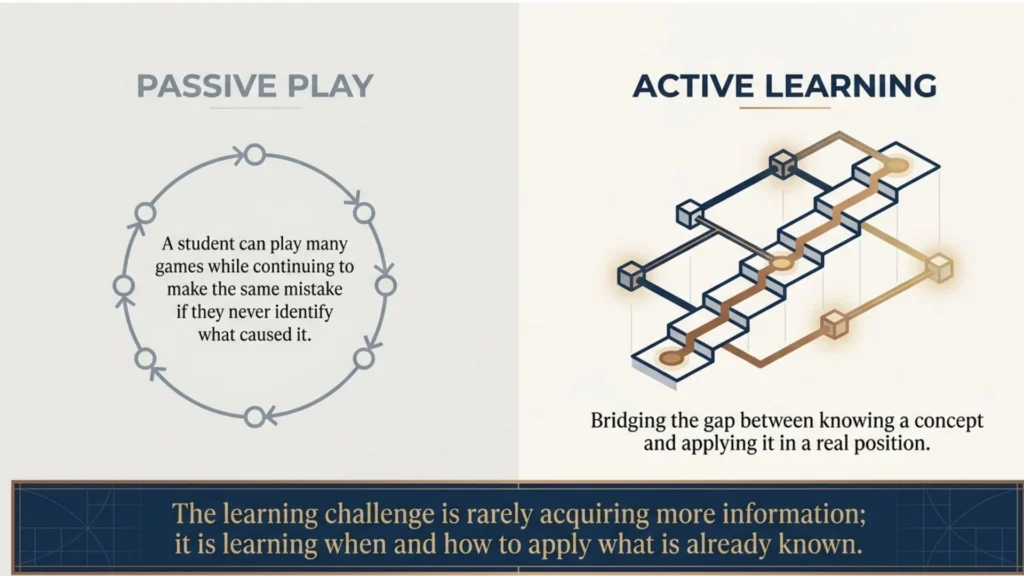
Playing chess online can provide valuable practical experience, but playing alone does not necessarily create a learning progression. A student can play many games while continuing to make the same mistake if they never identify what caused it or how to correct it. For children, explore Online Chess Classes for Kids to understand how learning can be adapted to their age, experience and current level.
A stronger learning cycle looks like this:
Understand → Think → Try → Receive Feedback → Practise → Apply Again
The balance changes as the student develops.
A beginner may spend more time learning board awareness, checkmate patterns and basic tactical ideas.
An improving player may spend more time comparing candidate moves, calculating variations, analysing games and understanding plans.
How Are Chess Classes Different From Simply Playing Chess Online?
Playing is an important part of chess development, but it is only one part of the learning process.
During a useful class, a student should have opportunities to:
- Understand a concept.
- Work with a real position.
- Make a decision.
- Explain the reasoning.
- Receive feedback.
- Try again.
- Connect the lesson with future practice.
This creates a bridge between knowing a chess concept and using it in a real position.
A student may know what a fork is but fail to notice one during a game.
They may understand that pieces should be developed but repeatedly move the same piece because an immediate idea looks attractive.
The learning challenge is therefore not always acquiring more information.
Often, it is learning when and how to apply what is already known.
Looking for Online Chess Classes Near Me?
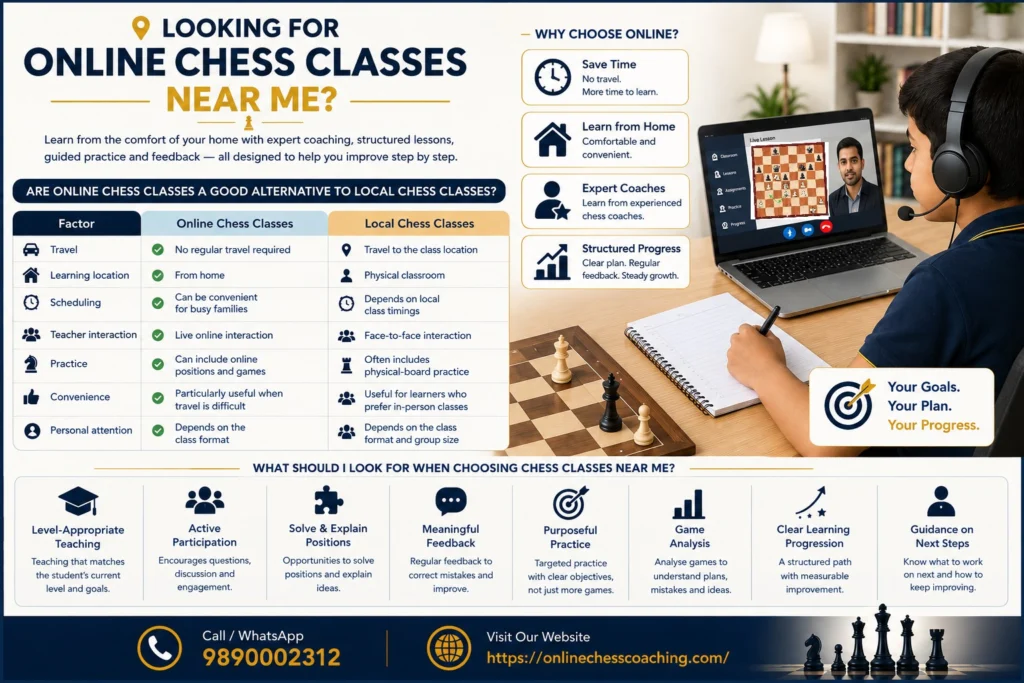
If you are searching for chess classes near me, you may primarily be looking for a chess learning option that is convenient, accessible and suitable for your schedule.
Online chess classes remove the need to travel to a physical chess academy. Students can learn from home while still receiving structured instruction, guided practice, feedback and opportunities to apply what they learn.
For parents, this can make chess learning easier to fit around school, homework, family routines and other activities. For adult learners, online classes can provide a practical way to learn consistently without adding travel time to the schedule.
The important question, however, is not simply whether a class is nearby.
It is whether the learning environment provides the right level of teaching, interaction, feedback and progression for the student.
Are Online Chess Classes a Good Alternative to Local Chess Classes?
A local chess academy may be the right choice for some learners, particularly those who enjoy learning in a physical classroom and benefit from face-to-face interaction.
Online classes offer a different form of convenience. The student can learn from home while working with a coach through an interactive online environment.
| Factor | Online Chess Classes | Local Chess Classes |
|---|---|---|
| Travel | No regular travel required | Travel to the class location |
| Learning location | From home | Physical classroom |
| Scheduling | Can be convenient for busy families | Depends on local class timings |
| Teacher interaction | Live online interaction | Face-to-face interaction |
| Practice | Can include online positions and games | Often includes physical-board practice |
| Convenience | Particularly useful when travel is difficult | Useful for learners who prefer in-person classes |
| Personal attention | Depends on the class format | Depends on the class format and group size |
Neither format is automatically better for every student.
The better choice depends on the learner’s age, level, goals, preferred learning environment and need for individual attention.
What Should I Look For When Choosing Chess Classes Near Me?
Whether you choose online or local chess classes, look beyond convenience alone.
A useful programme should provide:
- teaching appropriate to the student’s current level,
- active participation rather than passive listening,
- opportunities to solve positions and explain ideas,
- meaningful feedback,
- purposeful practice,
- game analysis,
- a clear learning progression,
- and guidance about what the student should work on next.
If you are considering online chess classes near me, the same principles apply. The absence of a physical classroom should not mean the absence of structure, interaction or feedback.
The goal is to find a learning environment in which the student can understand chess, practise purposefully and gradually become more independent.
Why Does Structure Matter in Chess Learning?
A good programme should feel like a learning system rather than a collection of unrelated lessons.
A useful sequence is:
Learning Objective
↓
Explanation
↓
Student Thinking
↓
Feedback
↓
Practice
↓
Game Application
↓
Review
↓
Next Learning Priority
This matters because chess improvement is cumulative.
If a student learns a concept but never applies it, the concept may remain theoretical.
If they practise without feedback, they may reinforce an inefficient habit.
If they receive feedback without understanding the reason behind it, they may remember the answer without improving the underlying decision-making process.
The strongest learning connects these stages.
What Should Happen During a Useful Lesson?
A structured lesson can include several stages.
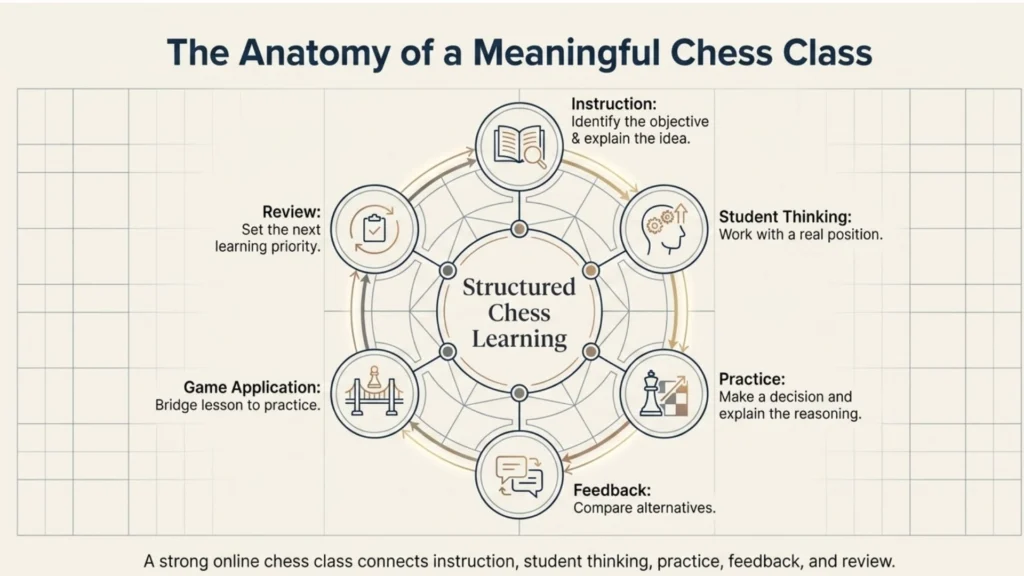
1. Identify the Learning Objective
The lesson begins with something the student needs to understand or improve.
This might be:
- a new concept,
- a recurring mistake,
- a tactical weakness,
- a calculation problem,
- or a decision-making habit.
2. Explain the Idea
The teacher introduces the concept at an appropriate level.
A beginner may need a simple visual explanation.
An improving player may need to compare several candidate moves and their consequences.
3. Give the Student a Position
The student should work with a real position rather than simply listen to an explanation.
4. Ask the Student to Explain
The reasoning behind a move matters.
A wrong answer can reveal how the student is thinking and allow the teacher to address the actual misunderstanding.
5. Compare Alternatives
Students should understand why one choice is stronger than another.
6. Practise
The student applies the idea through positions, puzzles or games.
7. Review and Continue
The lesson should lead naturally into the next stage of learning.
A useful cycle is:
Lesson → Practice → Game → Review → Next Learning Priority
That continuity is what turns individual classes into a structured learning journey.
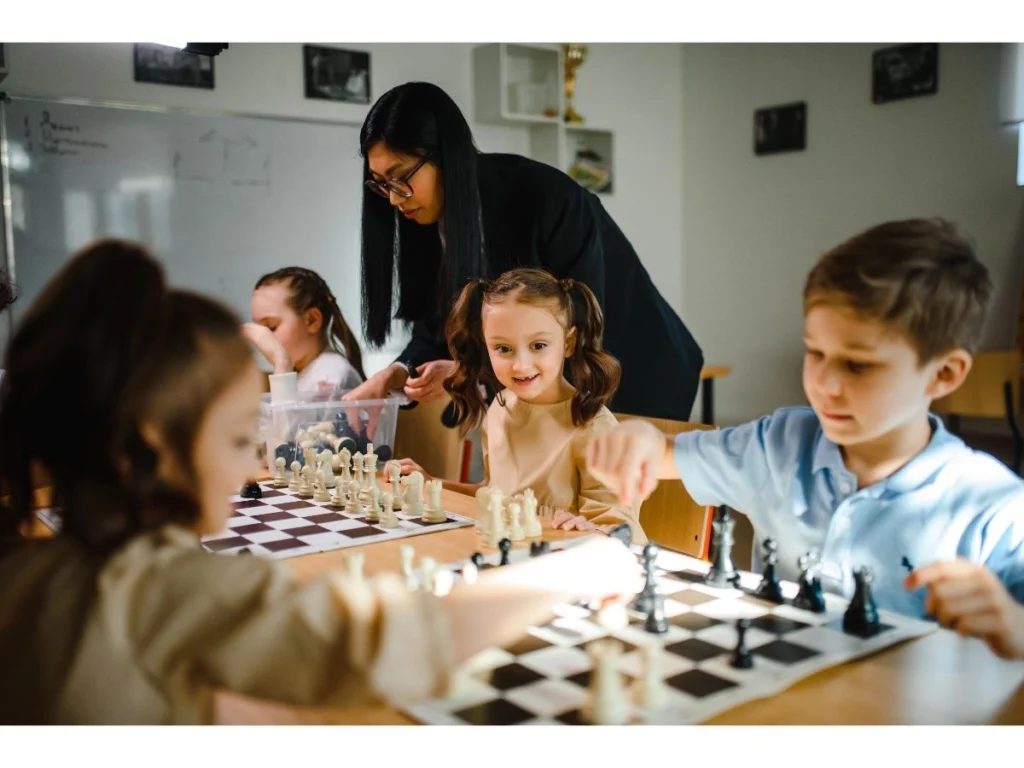
Looking for Online Chess Classes Near Me?
If you are searching for chess classes near me, you may primarily be looking for a chess learning option that is convenient, accessible and suitable for your schedule.
Online chess classes remove the need to travel to a physical chess academy. Students can learn from home while still receiving structured instruction, guided practice, feedback and opportunities to apply what they learn.
For parents, this can make chess learning easier to fit around school, homework, family routines and other activities. For adult learners, online classes can provide a practical way to learn consistently without adding travel time to the schedule.
The important question, however, is not simply whether a class is nearby.
It is whether the learning environment provides the right level of teaching, interaction, feedback and progression for the student.
Are Online Chess Classes a Good Alternative to Local Chess Classes?
A local chess academy may be the right choice for some learners, particularly those who enjoy learning in a physical classroom and benefit from face-to-face interaction.
Online classes offer a different form of convenience. The student can learn from home while working with a coach through an interactive online environment.
| Factor | Online Chess Classes | Local Chess Classes |
|---|---|---|
| Travel | No regular travel required | Travel to the class location |
| Learning location | From home | Physical classroom |
| Scheduling | Can be convenient for busy families | Depends on local class timings |
| Teacher interaction | Live online interaction | Face-to-face interaction |
| Practice | Can include online positions and games | Often includes physical-board practice |
| Convenience | Particularly useful when travel is difficult | Useful for learners who prefer in-person classes |
| Personal attention | Depends on the class format | Depends on the class format and group size |
Neither format is automatically better for every student.
The better choice depends on the learner’s age, level, goals, preferred learning environment and need for individual attention.
What Should I Look For When Choosing Chess Classes Near Me?
Whether you choose online or local chess classes, look beyond convenience alone.
A useful programme should provide:
- teaching appropriate to the student’s current level,
- active participation rather than passive listening,
- opportunities to solve positions and explain ideas,
- meaningful feedback,
- purposeful practice,
- game analysis,
- a clear learning progression,
- and guidance about what the student should work on next.
If you are considering online chess classes near me, the same principles apply. The absence of a physical classroom should not mean the absence of structure, interaction or feedback.
The goal is to find a learning environment in which the student can understand chess, practise purposefully and gradually become more independent.
What Should Students Learn in Online Chess Classes?
The exact curriculum should depend on the student’s current level, goals and learning needs.
A sensible programme can cover several broad areas.
Chess Foundations
Beginners need a reliable understanding of:
- the board and coordinates,
- how the pieces move,
- captures,
- check,
- checkmate,
- castling,
- promotion,
- basic opening principles,
- and simple endgame ideas.
The objective is not simply to memorise rules.
Students need enough confidence with the board that they can begin focusing on decisions rather than constantly thinking about how pieces move.
For deeper foundational learning, explore Chess Basics.
Tactical Awareness
As students become comfortable with the basics, they can begin recognising tactical patterns such as:
- forks,
- pins,
- skewers,
- double attacks,
- discovered attacks,
- deflections,
- removing defenders,
- mating patterns,
- and simple combinations.
The deeper objective is not memorising the names of tactics.
It is developing pattern recognition: noticing when something important is happening on the board.
For deeper tactical learning, explore Chess Tactics rather than making this page responsible for teaching every tactical concept.
Calculation
Calculation means considering what may happen after a move.
For a beginner, it may start with:
If I play this move, what can my opponent do?
As the student improves, the process becomes more structured:
- What are my candidate moves?
- What is my opponent’s strongest response?
- What position results from each option?
The aim is not to calculate every possible variation.
It is to calculate the important consequences of the moves that genuinely deserve consideration.
Opening Understanding
Students generally benefit more from understanding opening principles than from memorising long variations without knowing why those moves are played.
Important foundations include:
- developing pieces efficiently,
- influencing the centre,
- preparing king safety,
- avoiding unnecessary queen moves,
- avoiding repeated movement of the same piece without a clear reason,
- and coordinating the pieces.
The question should gradually change from:
What move comes next?
to:
What is this move trying to achieve?
That change marks an important step towards independent chess understanding.
Endgame Understanding
Students also need to learn that chess does not end when the opening finishes.
Depending on their level, useful endgame work may include:
- basic checkmates,
- king and pawn principles,
- opposition,
- simple king-and-pawn endings,
- piece coordination,
- converting material advantages,
- and practical decision-making in simplified positions.
The goal is to introduce endgame ideas when they can be understood and applied, not simply to complete a checklist of topics.
Game Analysis
Game analysis turns practical experience into learning.
Instead of asking only:
Where did I lose?
students can learn to ask:
- What was I trying to achieve?
- What was my opponent threatening?
- What did I overlook?
- Did I move too quickly?
- Which candidate moves did I have?
- Was the problem tactical, positional or decision-making related?
- Have I made this type of mistake before?
The purpose is not simply to find the engine’s preferred move.
It is to understand why the student chose the move they played and what can be learned from it.
How Does Learning Progress From Beginner to Improving Player?
A useful programme should develop the student’s ability progressively.
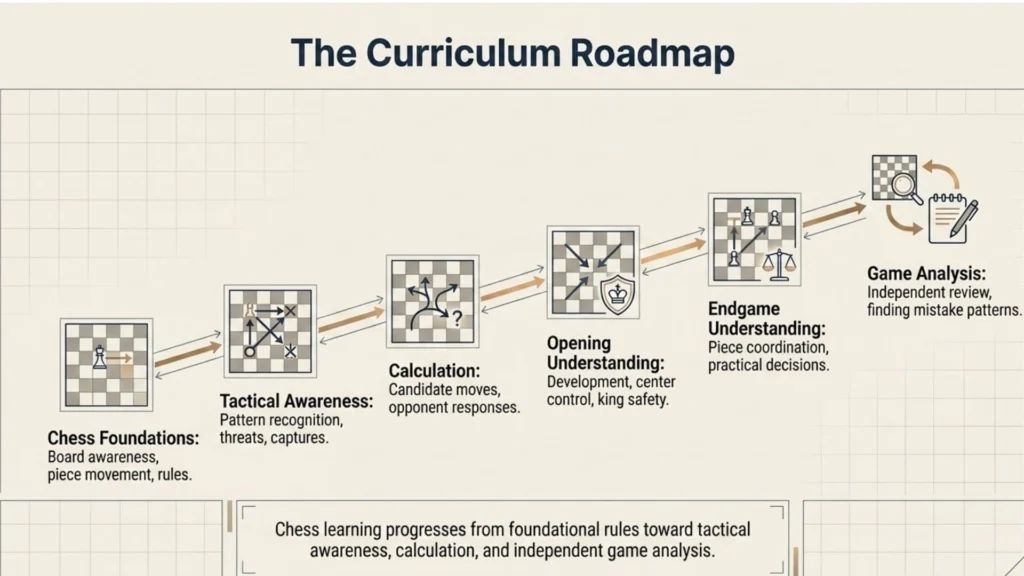
A broad learning roadmap may look like this:
Foundation
Board → Pieces → Rules → Check → Checkmate
↓
Tactical Awareness
Checks → Captures → Threats → Basic Patterns
↓
Decision-Making
Threats → Candidate Moves → Verification
↓
Opening Understanding
Development → Centre → King Safety → Piece Coordination
↓
Practical Chess
Games → Calculation → Exchanges → Endgames
↓
Game Understanding
Analysis → Mistake Patterns → Positional Ideas → Strategic Plans
↓
Independent Improvement
Self-Analysis → Deliberate Practice → Tournament Preparation → Personal Training Plan
This is a learning framework, not a rigid timetable.
Students progress at different rates.
The right next step depends on what the learner already understands, where the gaps are and what level of challenge is appropriate.
When Is a Student Ready for a More Advanced Level?
Progression should not depend simply on completing a certain number of lessons.
A student may be ready for greater complexity when they can increasingly:
- apply previously learned concepts,
- solve positions with less prompting,
- explain their reasoning,
- recognise common tactical patterns,
- analyse their mistakes,
- compare different options,
- and handle more complex positions without becoming lost.
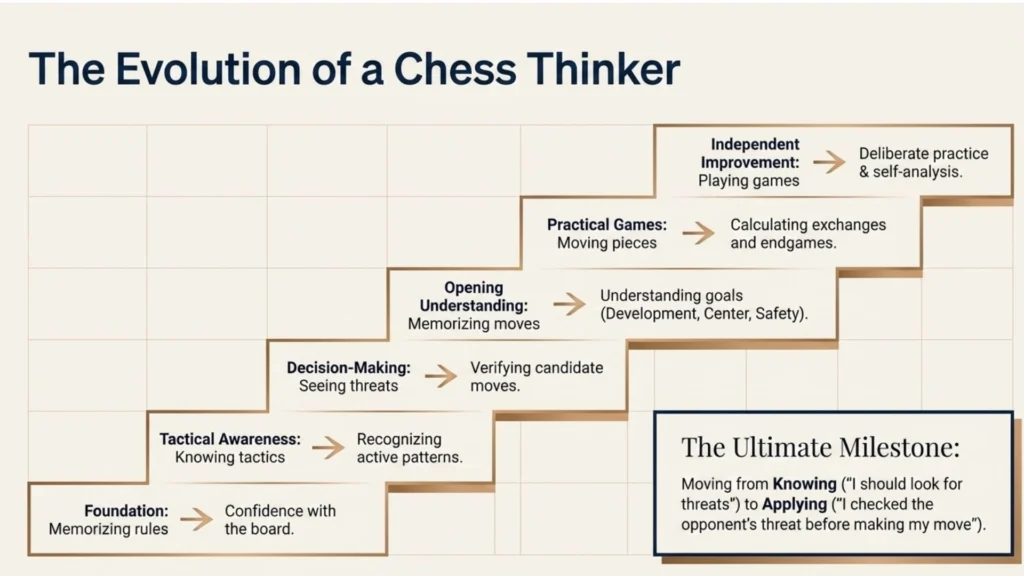
A particularly useful distinction is:
Knowing:
“I should look for threats.”
Applying:
“I actually checked the opponent’s threat before making my move.”
This matters because chess improvement is not simply about accumulating more knowledge.
A student may already know a principle but still fail to apply it during a real game.
The goal is not to move through levels as quickly as possible.
The goal is to make sure the student is ready for the next layer of thinking.
What Does Good Progress Look Like?
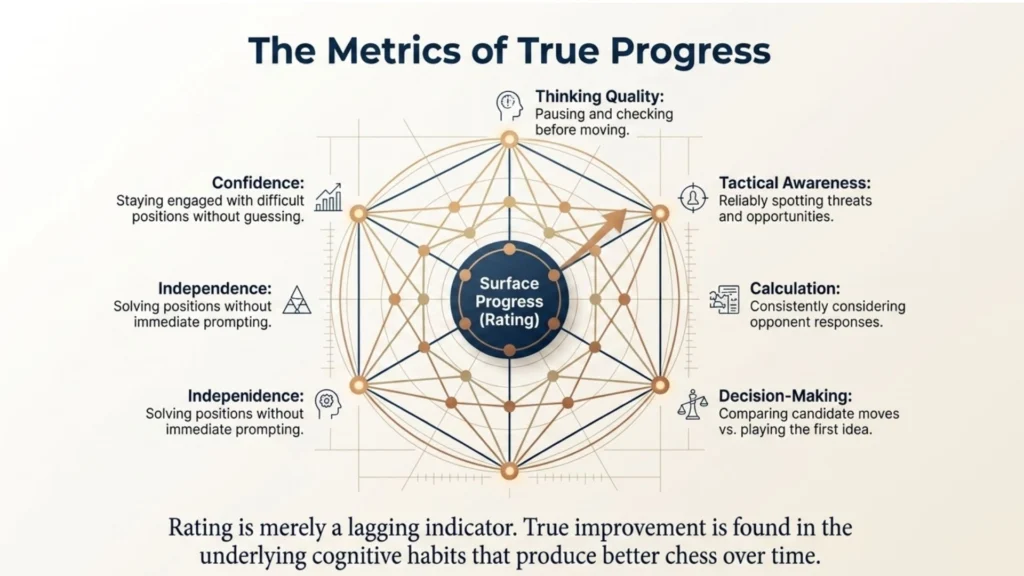
Rating can be useful, but it is not the whole picture.
A student may develop important skills before those changes are clearly reflected in a rating.
Parents can also look for changes in:
Thinking Quality
Does the student pause and check before moving?
Tactical Awareness
Are they spotting threats and opportunities more reliably?
Calculation
Can they consider what may happen after a move?
Decision-Making
Are they comparing candidate moves rather than choosing the first idea?
Understanding
Can they explain why a move or plan makes sense?
Game Quality
Are recurring mistakes becoming less frequent?
Independence
Can they solve positions without immediately needing the answer?
Confidence
Can they stay engaged with difficult positions rather than guessing?
These indicators provide a broader picture of development than rating alone.
Online Chess Classes for Kids
Children need instruction that matches their development rather than a one-size-fits-all curriculum.
A young child discovering chess for the first time should not necessarily be taught in the same way as an older student preparing for serious competition.
For detailed child-specific guidance, explore Online Chess Classes for Kids.
Younger Learners
Early lessons may focus on:
- recognising the pieces,
- understanding movement,
- basic board awareness,
- simple checkmate,
- short tactical exercises,
- and interactive activities.
Developing Young Players
As the student becomes more comfortable, learning can progress into:
- tactical patterns,
- calculation,
- opening principles,
- practical games,
- game analysis,
- notation,
- and independent practice.
Older Children and Teenagers
More advanced students can gradually take greater responsibility for:
- analysing their own games,
- identifying recurring mistakes,
- following a study routine,
- calculating variations,
- understanding positional plans,
- and preparing for competition where appropriate.
The teaching should evolve as the student’s needs change.
Online Chess Classes for Tournament Preparation
Tournament preparation is different from learning the basic rules of chess.
A student preparing for competition may need additional work on:
- calculation,
- tactical accuracy,
- practical game management,
- opening understanding,
- endgames,
- notation,
- time management,
- game analysis,
- and handling unfamiliar positions.
The right emphasis depends on the student’s current level.
For a beginner preparing for a first tournament, confidence with the rules, practical decision-making and basic tactical awareness may matter more than an elaborate opening repertoire.
For a more experienced player, preparation may involve deeper calculation, opening decisions, endgame technique and analysis of previous games.
The objective should be appropriate preparation, not simply more information.
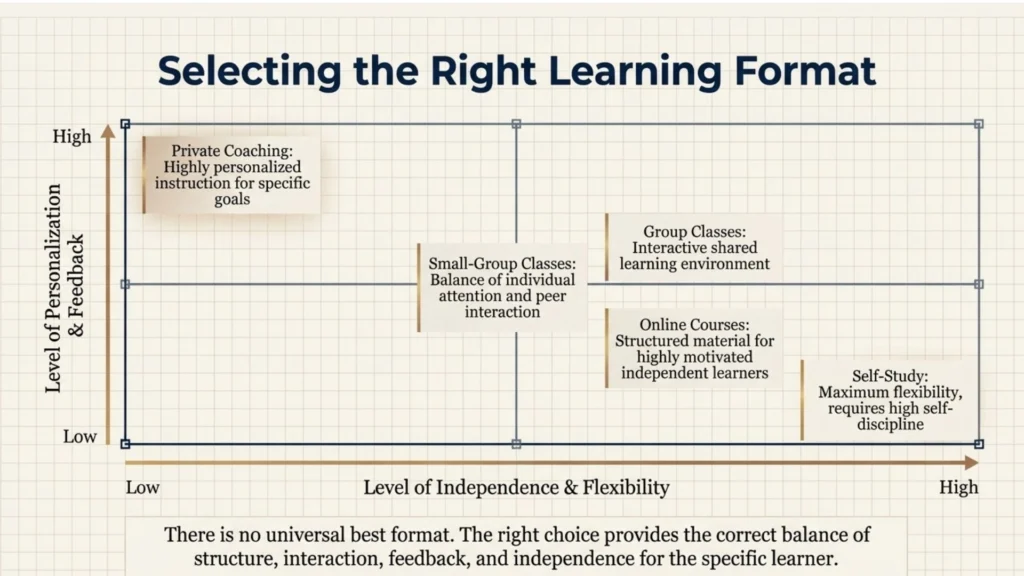
Which Online Chess Learning Format Is Best?
There is no single format that is best for every learner.
| Format | Main Strength | Possible Limitation | Often Suitable For |
|---|---|---|---|
| Self-study | Flexibility and independence | Less personalised feedback | Motivated learners who can structure their own study |
| Group classes | Interaction and shared learning | Less individual attention | Students who benefit from learning with others |
| Small-group classes | Balance between interaction and attention | Still less individualised than private coaching | Learners who want structure and peer interaction |
| Private coaching | Personalised instruction and feedback | Requires greater investment | Students with specific learning needs or goals |
| Online courses | Structured material and flexibility | Limited real-time adaptation | Independent learners who can manage their own practice |
The important question is not:
Which format is universally best?
It is:
Which format gives this learner the right combination of structure, interaction, feedback and independence?
For course-based learning, explore Online Chess Courses.
For the broader coaching relationship, explore Online Chess Coaching.
How Much Practice Should Students Do?
There is no universal number of minutes that guarantees improvement.
Practice should reflect:
- age,
- current level,
- goals,
- attention span,
- school commitments,
- interest,
- and the student’s ability to practise independently.
A simple practice cycle can be:
Tactical Practice
↓
Thoughtful Games
↓
Review Important Positions
↓
Identify One Learning Point
↓
Practise the Weak Area
The quality of practice matters.
Ten focused minutes spent carefully solving positions may be more useful than a much longer period of random games if the longer session involves little reflection.
The right routine should also be sustainable.
A manageable routine that a student can follow consistently is usually more useful than an ambitious schedule that quickly becomes a burden.
For deeper practice planning, explore Chess Training.
Why Game Review Matters
A student can repeat the same mistake many times without recognising the pattern.
For example:
Game 1: Misses an opponent’s threat.
↓
Game 2: Misses another similar threat.
↓
Game 3: Makes the same type of decision again.
Simply playing more games has not necessarily solved the problem.
Review creates a different cycle:
Game → Identify Mistake → Understand Cause → Practise → Apply Again
The important question is not always:
What was the engine’s best move?
A more useful educational question can be:
Why did the student choose the move they played?
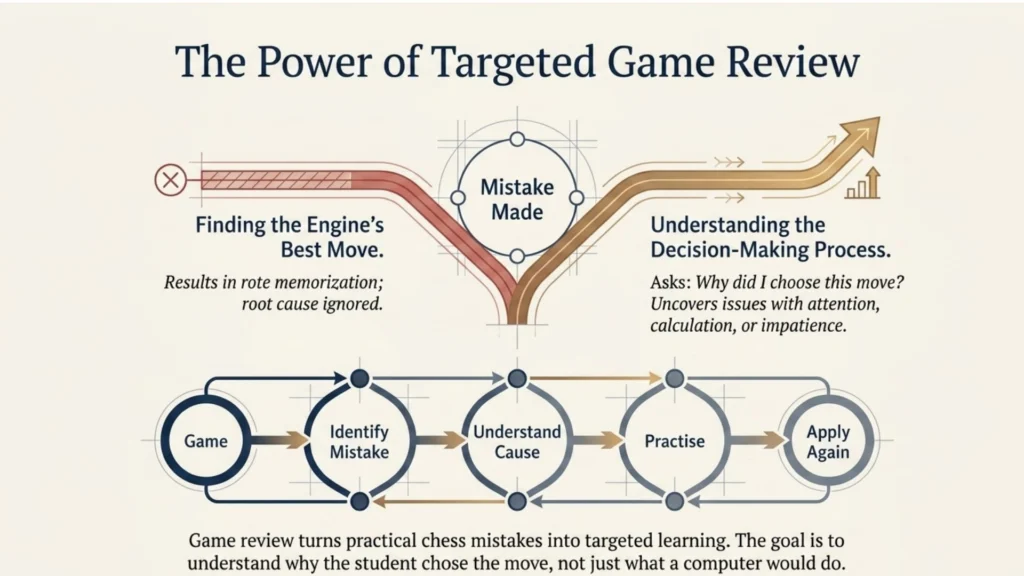
That answer may reveal whether the underlying issue was:
- calculation,
- attention,
- threat recognition,
- impatience,
- evaluation,
- or a missing concept.
This is where game analysis becomes part of learning rather than simply post-game checking.
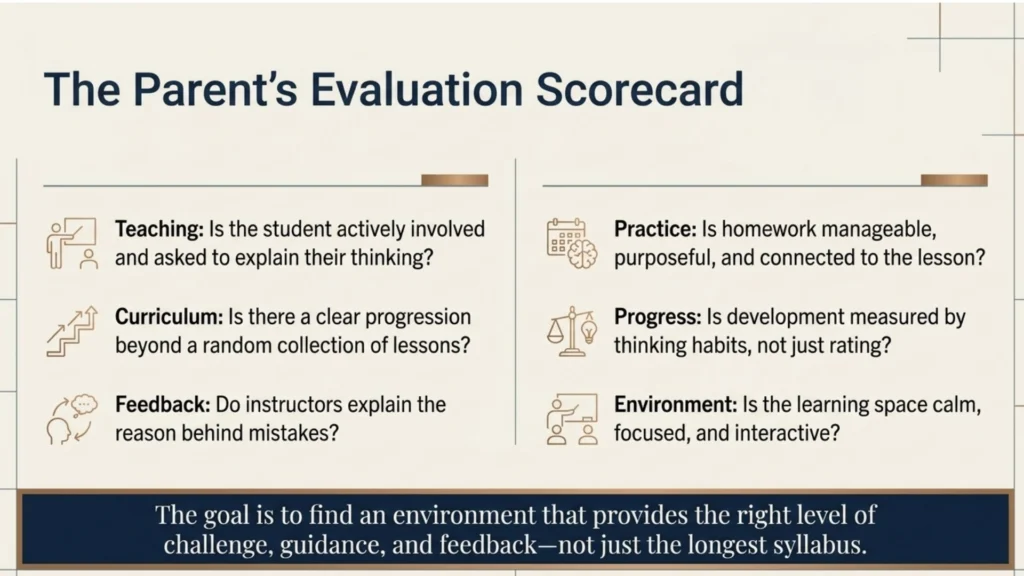
What Should Parents Look For in an Online Chess Programme?
Parents do not need to be experienced chess players to evaluate whether a programme is thoughtfully designed.
Teaching
Ask:
- Is the student actively involved?
- Are they asked to solve positions and explain their thinking?
- Does the teacher adapt explanations to the learner?
Curriculum
Look for:
- a clear learning progression,
- appropriate level placement,
- practical games,
- game analysis,
- and a sensible connection between lessons and practice.
Feedback
Ask:
- Are mistakes discussed constructively?
- Does the student receive useful feedback?
- Does feedback explain the reason behind a mistake rather than simply provide the correct move?
Progress
Consider:
- How are learning gaps identified?
- Is progress measured beyond rating?
- Are recurring mistakes and thinking habits considered?
- Does the student gradually become more independent?
Practice
Find out:
- Is there guidance between classes?
- Does practice have a clear purpose?
- Is the workload manageable?
- Does the routine fit the student’s age and schedule?
Learning Environment
Consider:
- Is the class interactive?
- Is the student given enough time to think?
- Is the environment calm and focused?
- Can the student ask questions comfortably?
A good programme should make these questions reasonably easy to answer.
A Simple Parent Decision Checklist
Before choosing an online chess programme, ask:
- Will my child actively participate rather than simply watch?
- Is the teaching appropriate for their current level?
- Is there a clear progression rather than a collection of unrelated lessons?
- Will they receive meaningful feedback on their thinking and mistakes?
- Does practice connect with what they are learning?
- Will the programme help me understand how my child is progressing?
- Does the class format suit my child’s learning needs?
- Is there a clear way to determine what they should learn next?
The goal is not to find the programme with the most lessons, the most advanced topics or the biggest promises.
It is to find a learning environment that provides the right level of challenge, guidance, practice and feedback for the individual student.
How Can Parents Support Chess Learning at Home?
Parents do not need to analyse every game.
One of the most useful things they can do is create the conditions for consistent learning.
Before the Lesson
- Reduce unnecessary distractions.
- Help the child arrive prepared.
- Keep the learning space comfortable.
- Make sure the required equipment is ready.
During Practice
- Give the child time to think.
- Avoid immediately supplying the answer.
- Encourage them to explain their move.
- Let mistakes become part of the learning process.
After the Lesson
Instead of asking only:
Did you win?
try:
What did you learn today?
or:
Which position did you find interesting?
This shifts attention from the result of one game towards the development of understanding.
What Should an Assessment Tell You?
An assessment should provide more information than whether a student enjoyed a session.
It can help identify:
- current chess understanding,
- tactical strengths and weaknesses,
- thinking and decision-making habits,
- recurring learning gaps,
- practical playing ability,
- and the appropriate next stage.
A useful assessment should answer questions such as:
- What does the student already understand?
- How do they approach a new position?
- Do they guess or think systematically?
- How well do they respond to questions?
- Are there obvious tactical or foundational gaps?
- Is the lesson difficulty appropriate?
- What should the student work on next?
The purpose is guidance.
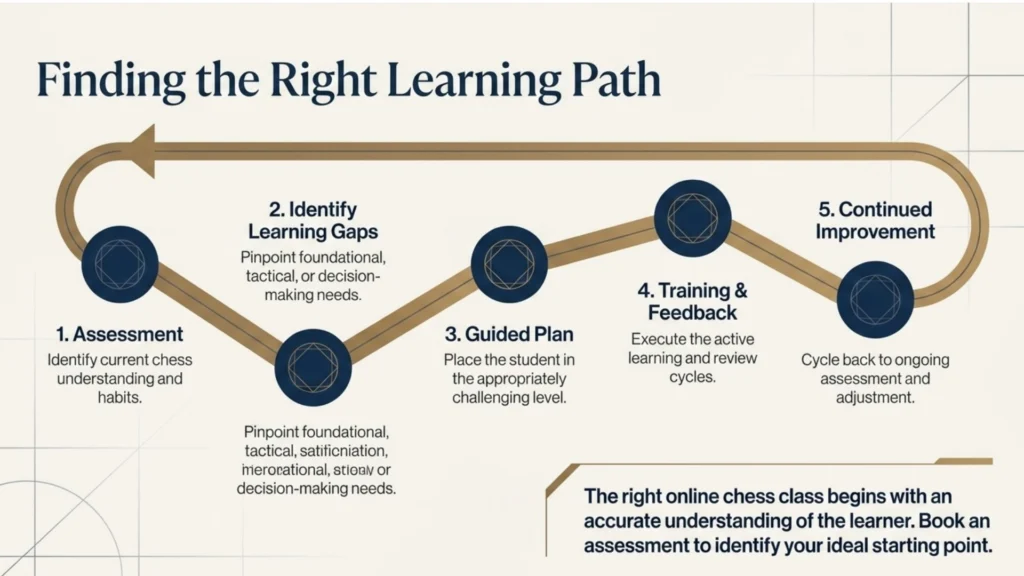
An assessment is most useful when it helps understand the learner before recommending the next stage, rather than functioning simply as a sales demonstration.
Common Mistakes When Choosing Online Chess Classes
Choosing by Lesson Quantity Alone
A large number of lessons does not automatically mean a better learning experience.
Better question: Is there a clear progression, and does each stage have a purpose?
Expecting Advanced Theory Too Early
Beginners can become overloaded when opening variations or complex concepts are introduced before basic decision-making is secure.
Better approach: Build foundations first, then increase complexity as the learner becomes ready.
Treating the Class as Passive Screen Time
A student can attend a lesson without doing much thinking.
Better approach: Look for opportunities to solve positions, answer questions, explain moves and compare alternatives.
Measuring Everything Through Rating
Rating can provide useful information, but it does not capture every part of development.
Better approach: Also look at thinking quality, tactical awareness, independence, confidence and recurring mistakes.
Playing Without Reviewing
More games do not automatically solve recurring problems.
Better approach: Review important positions and identify the thinking pattern behind mistakes.
Moving Through Levels Too Quickly
Completing a certain number of lessons does not necessarily mean a student is ready for greater complexity.
Better approach: Look for evidence that the student can apply concepts with increasing independence.
Choosing the Most Advanced Programme
More advanced material is not automatically better.
A student usually benefits more from material that is appropriately challenging and can be understood and applied.
Frequently Asked Questions
Are online chess classes good for beginners?
They can be very useful when the programme teaches progressively and gives beginners opportunities to practise, ask questions and receive feedback. Beginners should build strong foundations before taking on advanced theory.
Are there online chess classes near me?
Yes. Online chess classes can be attended from home, so the student does not need to travel to a local chess academy. This can be particularly convenient for families who want structured chess learning while fitting classes around school, work and other commitments. When choosing an online programme, look beyond convenience and consider the teaching quality, student interaction, feedback, curriculum and learning progression.
Are online chess classes suitable for children?
Yes, when the teaching approach matches the child’s age, experience, attention span and current level. Younger learners generally need more interactive and manageable instruction, while older students can gradually handle deeper calculation, analysis and independent practice.
What age can a child start online chess classes?
There is no single age that works for every child. Readiness depends on factors such as interest, attention, ability to follow simple instructions and willingness to engage with the chessboard.
What do students learn in online chess classes?
Depending on their level, students may learn chess foundations, tactics, calculation, opening principles, endgames, notation, game analysis, positional understanding and decision-making.
Are online chess classes better than self-study?
They serve different purposes. Self-study provides flexibility, while structured classes provide direction, feedback and progression. Combining guided learning with independent practice can be useful for many learners.
Should a student take group or private chess classes?
It depends on the learner. Group classes can provide interaction and shared learning, while private coaching allows more individualised attention. The appropriate format depends on level, goals, personality and learning needs.
How much practice should a student do between classes?
There is no universal amount. Practice should reflect the student’s age, level, goals, attention span and available time. Focused, sustainable practice is generally more useful than simply maximising playing time.
How can parents tell whether their child is improving?
Look beyond rating. Useful signs include better decision-making, stronger tactical awareness, more patience, fewer recurring mistakes, greater independence and an increasing ability to explain why a move works.
Do online chess classes include game analysis?
A structured programme can connect practical games with learning through review and analysis. Game analysis helps identify recurring mistakes and shows students how concepts apply in real positions.
Can online chess classes help with tournament preparation?
Yes, when the learning programme matches the student’s competitive level. Tournament preparation may include practical games, calculation, tactics, opening understanding, endgames, time management and analysis.
What equipment is needed for online chess classes?
Usually a reliable computer or tablet, stable internet access, an online chessboard and a suitable learning environment are sufficient. A physical chessboard can also be useful for additional practice.
How do I know which level is right for my child?
An assessment can help determine what the student already understands, where the learning gaps are and what level of challenge is appropriate.
What should parents ask before choosing an online chess programme?
Ask about the curriculum, student participation, level placement, feedback, game analysis, practice, progress communication, class format and how the programme determines the appropriate next step.
Key Takeaways
Good online chess classes are built around structured learning, not simply online game time.
Students should actively think, solve, explain and apply ideas.
Beginners need strong foundations before advanced theory.
Improving players gradually needs more sophisticated calculation, candidate-move thinking, positional understanding and game analysis.
Lessons should connect naturally with practice and game review.
Game analysis is most useful when it identifies the reason behind a mistake.
Opening instruction should emphasise understanding rather than excessive memorisation.
Children should receive instruction appropriate to their age and current level.
Parents should look for curriculum, interaction, feedback, appropriate challenge, meaningful practice and realistic expectations.
Group and individual learning can both be effective when matched to the learner.
Most importantly, the right learning path depends on the individual student.
Book an Assessment
The right online chess class is not necessarily the one with the longest syllabus or the most impressive promises.
It is the one that begins with an accurate understanding of the learner and provides an appropriate next challenge.
An assessment can help identify the student’s current understanding, learning gaps, thinking habits and most suitable next stage.
If you are considering online chess classes for yourself or your child, book an assessment to understand the current level and identify the most suitable learning path.
Related Pages
Book Assessment — Identify the most suitable next step for the learner.
Online Chess Coaching — Explore the broader, structured coaching and mentorship approach.
Online Chess Courses — Compare course-based learning with live instruction.
Online Chess Classes for Kids — Explore learning considerations specific to children.
Chess Basics — Build strong foundations before moving into more advanced concepts.
Chess Tactics — Develop tactical awareness and pattern recognition.
Chess Strategy — Learn how stronger players evaluate positions and create plans.
Chess Thinking — Develop a more reliable decision-making process.
Chess Improvement — Build a structured approach to long-term development.
Chess Training — Explore purposeful practice and improvement systems.