
Chess for Beginners
Learning chess is much easier when you know what to learn first.
If you are starting from the beginning, you do not need to memorise a large opening repertoire or understand advanced strategy. First learn how the board and pieces work, understand the rules, develop a few reliable thinking habits, and practise those ideas through real games.
This Chess for Beginners guide takes you through that progression step by step. You will learn the essential rules, how to make sensible moves, which tactical patterns to recognise, how to practise effectively, and what to study next as your understanding develops.
Quick Summary
- Learn the board, pieces and rules before studying advanced chess.
- Understand check, checkmate, king safety and piece safety.
- Develop your pieces and give your moves a clear purpose.
- Before moving, ask what your opponent is threatening.
- Learn basic tactics such as forks, pins and skewers.
- Understand opening principles before memorising detailed variations.
- Study simple endgames as well as openings.
- Improve through a cycle of learning, playing, reviewing and correcting.
- Build your chess knowledge progressively rather than trying to learn everything at once.
What Is Chess?
Chess is a two-player strategy game played on a board of 64 squares. Each player begins with 16 pieces, and the pieces have different ways of moving and capturing.
The objective is to checkmate the opponent’s king.
That sounds simple, but chess becomes increasingly interesting because every move changes the position. A move can create an attack, remove a defender, open a line, protect a piece or create a threat.
For beginners, the most important transition is from knowing what moves are legal to understanding why one move is better than another.
That is the foundation of chess improvement.
Chess for Beginners: What Should You Learn First?
A beginner’s learning journey is easier to manage when it follows a sensible sequence:
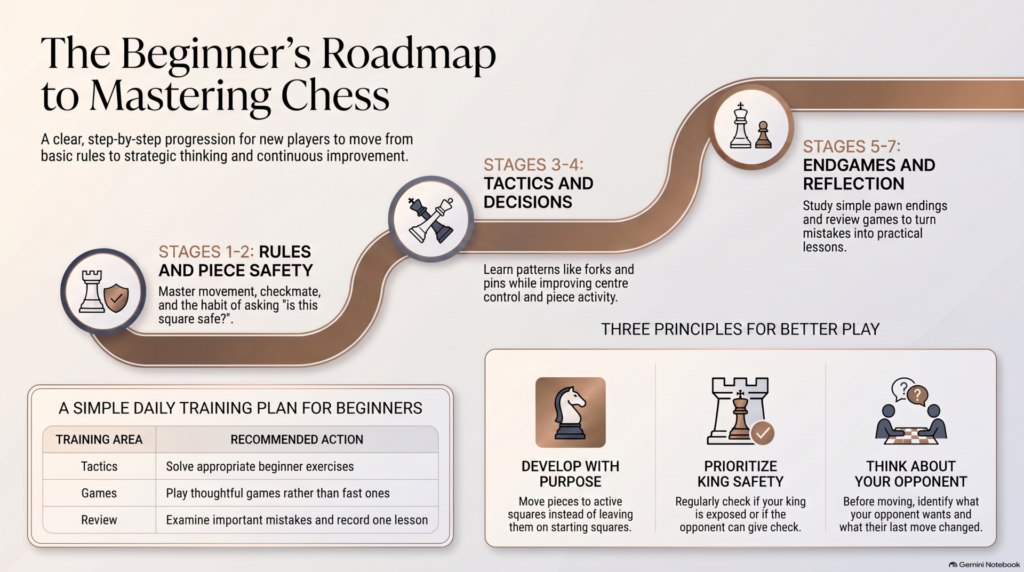
Rules → Piece Safety → Thinking Habits → Tactics → Opening Principles → Endgames → Practice → Improvement
This is not a rigid curriculum. You will naturally revisit earlier ideas as your understanding develops.
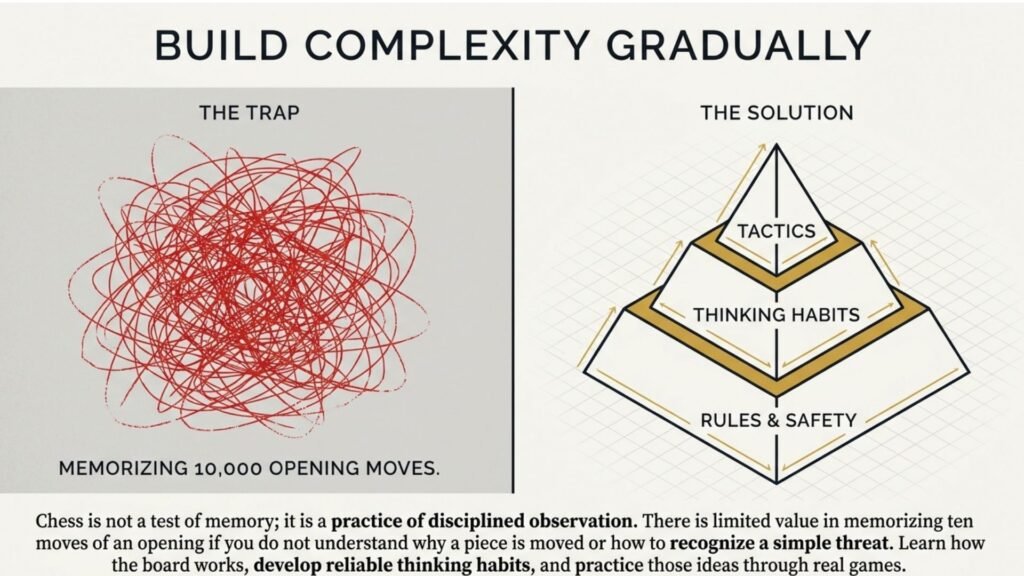
The important point is to build complexity gradually.
For example, there is limited value in memorising ten moves of an opening if you do not yet understand why pieces are developed or how to recognise a simple threat.
A good beginner learns the foundations first and then builds on them.
Chess Basics Every Beginner Should Know
The Chessboard
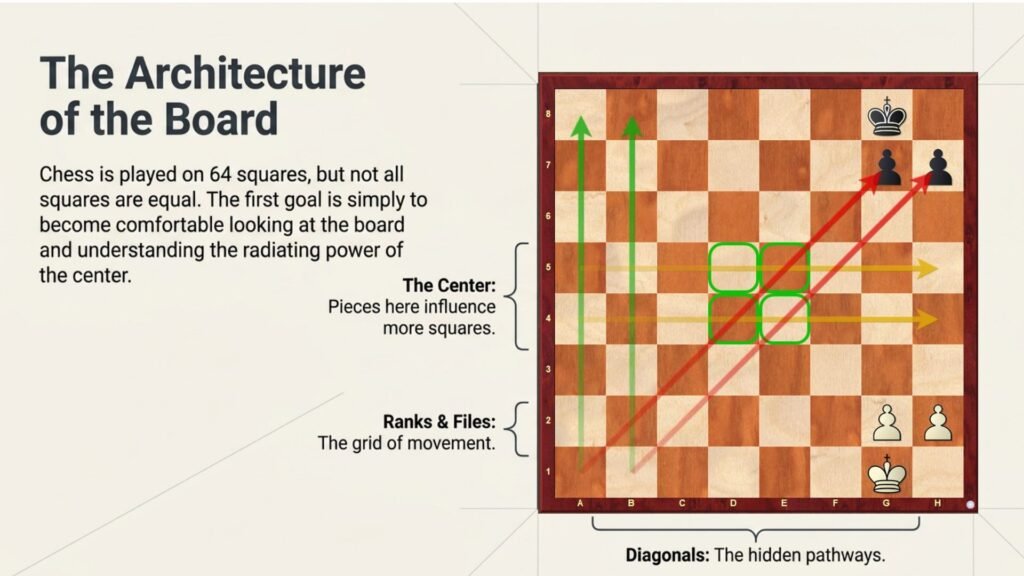
A chessboard contains 64 squares arranged across eight ranks and eight files.
You should become comfortable with:
- ranks
- files
- diagonals
- the centre of the board
- the starting position
- identifying individual squares
You do not need to memorise complicated notation immediately.
The first goal is simply to become comfortable looking at the board and understanding where your pieces and your opponent’s pieces are positioned.
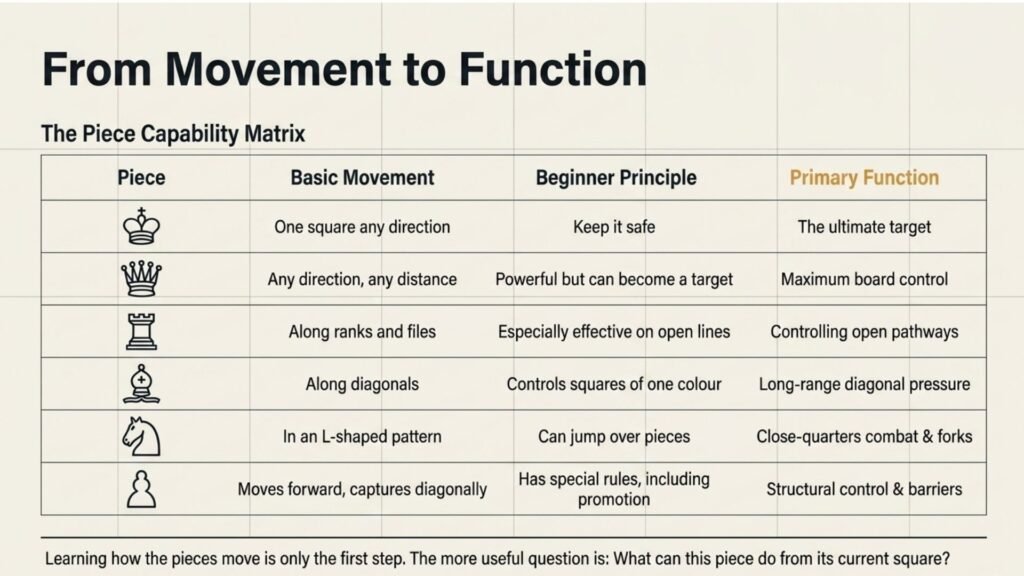
The Chess Pieces
Each piece has its own movement pattern.
| Piece | Basic Movement | Beginner Principle |
|---|---|---|
| King | One square in any direction | Keep it safe |
| Queen | Any number of squares along ranks, files or diagonals | Powerful but can become a target |
| Rook | Along ranks and files | Especially effective on open lines |
| Bishop | Along diagonals | Controls squares of one colour |
| Knight | In an L-shaped pattern | Can jump over pieces |
| Pawn | Moves forward and captures diagonally | Has special rules, including promotion |
Learning how the pieces move is only the first step.
The more useful question becomes:
What can this piece do from its current square?
That question moves you from learning rules toward learning chess.
Check, Checkmate and Stalemate
‘Check’ means that a king is currently under attack.
‘Checkmate’ means the king is in check and there is no legal move that can remove the threat.
‘Stalemate‘ is different. The player whose turn it is has no legal move, but their king is not in check. The game is then drawn.
Beginners should learn to recognise these situations because they affect how the game ends.
You should also understand:
- legal moves
- captures
- protecting pieces
- castling
- pawn promotion
- en passant
These rules are the foundation for playing complete games correctly.
Why Piece Safety Matters
One of the earliest lessons in chess is that a piece can be valuable in one position and vulnerable in another.
A beginner may see that a queen, rook or knight can move to a particular square without noticing that the opponent can capture it immediately.
Before moving a piece, ask:
Is the square safe?
After your opponent moves, ask:
Which pieces are now attacked?
And:
Is anything undefended?
This simple habit prevents many beginner mistakes.
Five Principles That Help Beginners Play Better
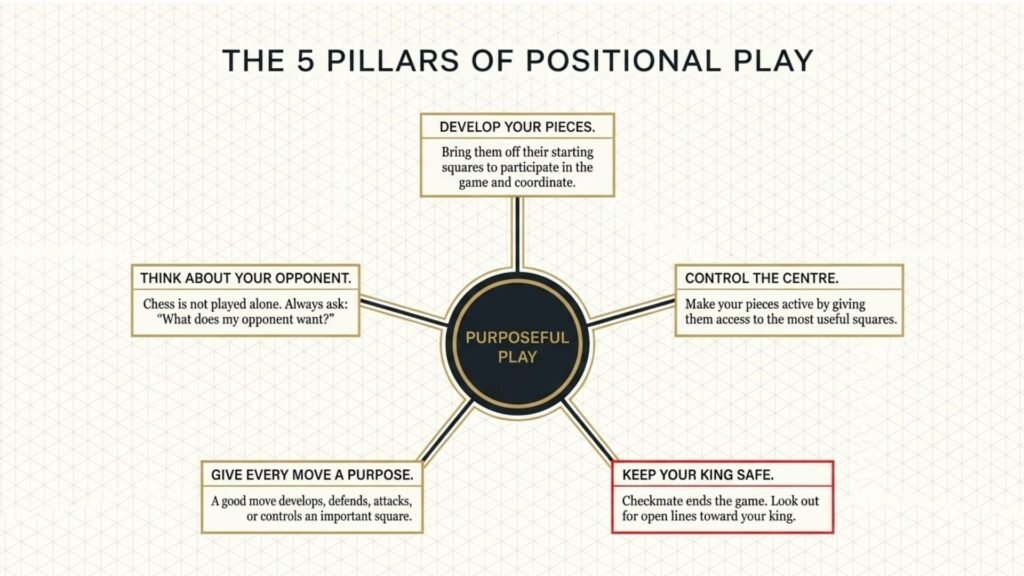
1. Develop Your Pieces
At the beginning of the game, most of your pieces are still on their starting squares.
Development means bringing them into useful positions so they can participate in the game.
Good development helps you:
- control important squares
- prepare for king safety
- coordinate your pieces
- respond to threats
- build a more active position
You do not need to memorise one perfect sequence.
Learn the principle first.
2. Control the Centre
The central part of the board is important because pieces placed near the centre can often influence more squares.
Controlling the centre does not always mean placing every piece directly in the middle.
The deeper idea is to make your pieces active and give them access to useful squares.
3. Keep Your King Safe
The king is the most important piece because checkmate ends the game.
Beginners sometimes focus so heavily on winning material that they forget about their own king.
Regularly ask:
- Is my king safe?
- Can my opponent give me a check?
- Are there open lines toward my king?
- Have I moved too many pieces away from its protection?
King safety matters throughout the game, not just during the opening.
4. Give Every Move a Purpose
Before moving a piece, ask:
What does this move accomplish?
A useful move might:
- develop a piece
- defend a piece
- attack something
- improve a poorly placed piece
- control an important square
- create a threat
- prevent an opponent’s idea
You do not need a complicated explanation.
Even a simple reason is better than moving automatically.
5. Think About Your Opponent
Chess is not a sequence of moves that you make alone.
Every move changes what your opponent can do.
Before making your move, ask:
What does my opponent want?
Then:
What can I do about it?
This habit is one of the biggest steps from playing chess casually toward thinking like a chess player.
How to Think Before Making a Move
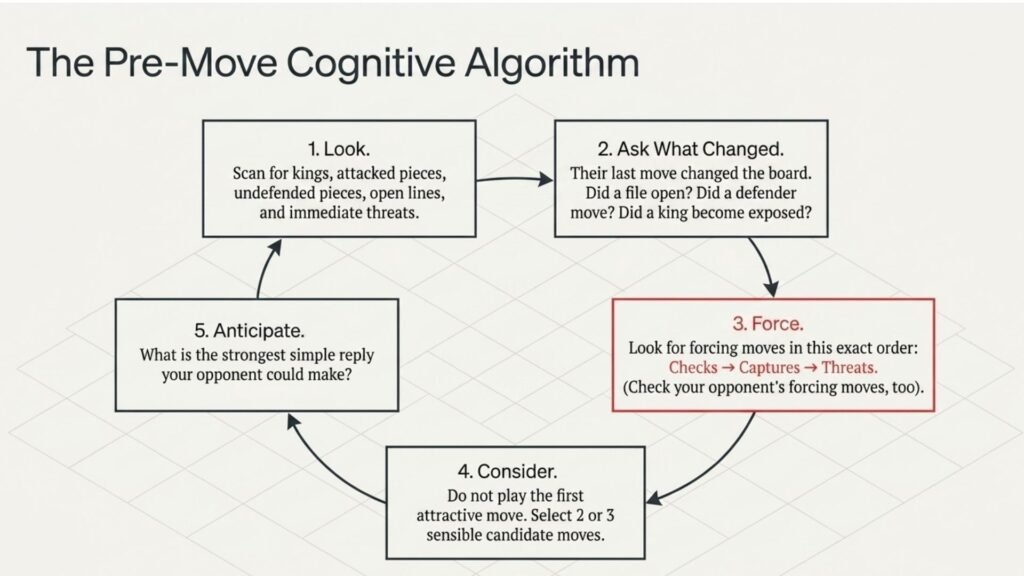
A beginner does not need to calculate ten moves ahead.
What matters more is developing a reliable process.
Try these five steps.
Step 1: Look at the Position
Before searching for your move, look at:
- both kings
- attacked pieces
- undefended pieces
- checks
- open lines
- immediate threats
Step 2: Ask What Changed
Your opponent’s last move changed the position.
Perhaps:
- a piece became attacked
- a defender moved
- a file opened
- a diagonal opened
- a king became exposed
- a tactical opportunity appeared
Identify the change before deciding what to do.
Step 3: Look for Forcing Moves
A useful beginner checklist is:
Checks → Captures → Threats
Ask:
- Do I have a useful check?
- Is there a safe capture?
- Can I create a meaningful threat?
Then ask the same questions about your opponent.
Step 4: Consider Candidate Moves
Do not automatically play the first move that looks attractive.
Consider two or three sensible possibilities.
Step 5: Check the Reply
Before making your move, ask:
What is the strongest simple response my opponent could make?
This catches many one-move blunders.
Then make your move.
The aim is not to calculate everything. It is to make your current decision carefully.
Beginner Chess Tactics
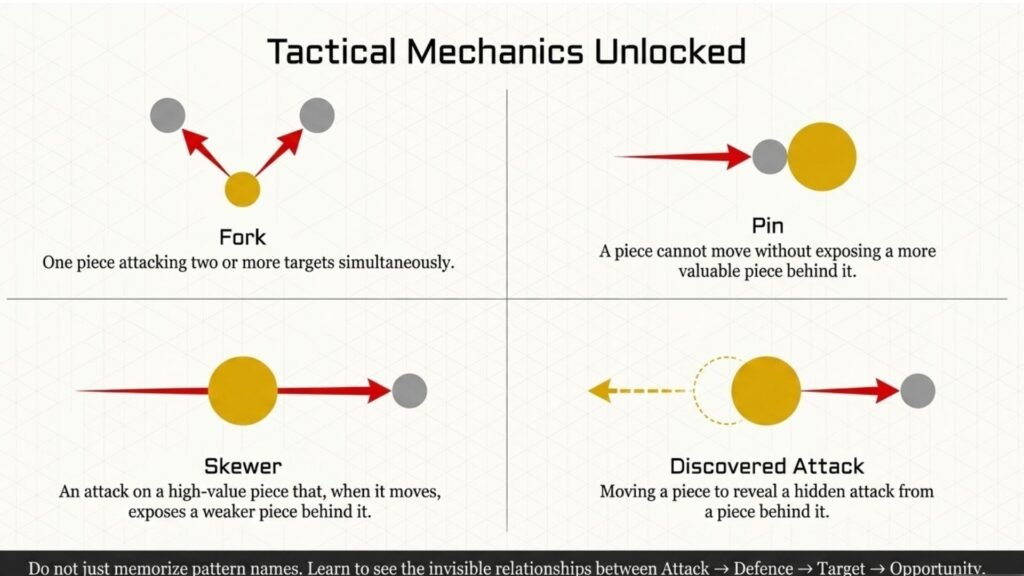
Tactics are concrete opportunities that usually involve a short sequence of moves.
You do not need to memorise hundreds of tactical patterns at the beginning. Learn a small number well and practise recognising them.
Forks
A fork occurs when one piece attacks two or more targets at the same time.
Knights are especially well known for creating forks because of their unusual movement.
The practical lesson is:
Look for positions where one piece can attack multiple valuable targets.
Pins
A pin occurs when a piece cannot move freely because moving it would expose a more valuable piece behind it.
A common example is a piece that cannot move because doing so would expose the king.
Skewers
A skewer is related to a pin, but the more valuable piece is attacked first. When it moves, the less valuable piece behind it may become vulnerable.
Discovered Attacks
A discovered attack occurs when one piece moves away and reveals an attack from another piece behind it.
Basic Checkmate Patterns
Beginners should also learn to recognise simple mating patterns.
The important lesson is not simply remembering a pattern’s name.
Instead, learn to see the relationship between:
Attack → Defence → Target → Opportunity
That way, tactical knowledge becomes something you can apply rather than something you only memorise.
Opening Principles for Beginners
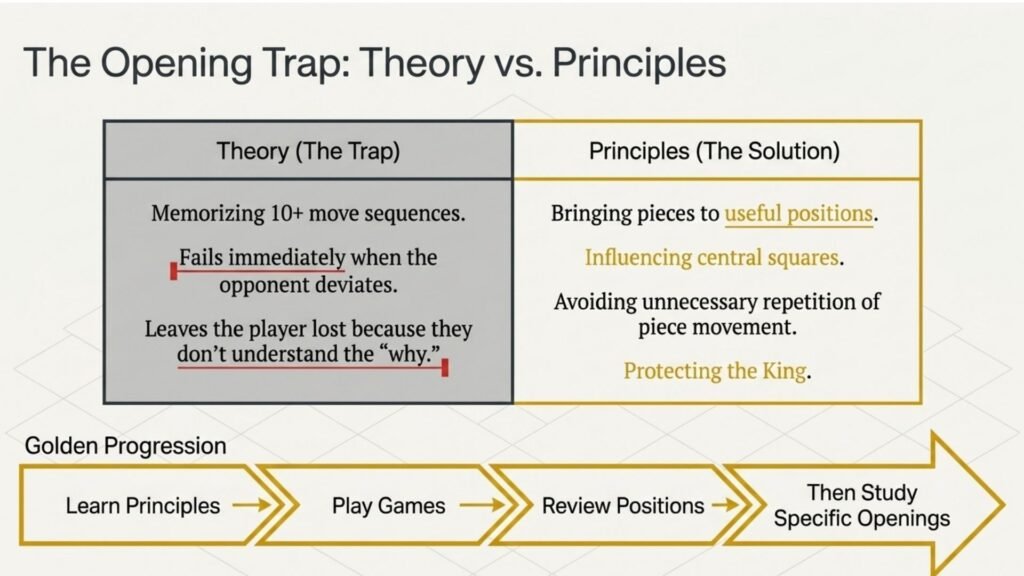
You do not need a large opening repertoire when you are starting.
Focus on understanding a few principles.
Develop Your Pieces
Bring your pieces into useful positions instead of leaving them inactive.
Control the Centre
Use your pieces and pawns to influence important central squares.
Avoid Unnecessary Repetition
Moving the same piece several times without a clear reason can leave your other pieces undeveloped.
Protect Your King
Make king safety part of your early-game planning.
Connect Your Pieces
As your development progresses, your pieces should begin working together.
The purpose of opening principles is to help you understand why good moves work.
How Much Opening Theory Should a Beginner Learn?
Opening study can be useful, but memorisation should not become the centre of beginner training.
Suppose you memorise several moves of an opening but do not understand:
- why the pieces are being developed
- which squares matter
- what your opponent is threatening
- how to respond when the position changes
The memorised sequence may stop helping as soon as the game leaves familiar territory.
A better progression is:
Learn principles → Play games → Review positions → Study relevant openings
This gives opening knowledge a practical foundation.
Basic Endgames Beginners Should Learn
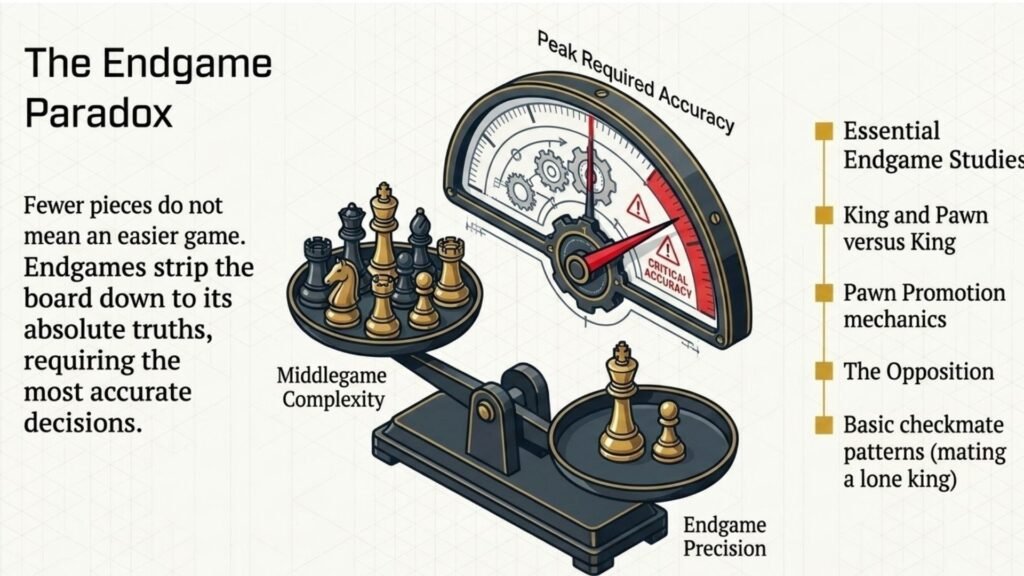
Endgames deserve attention because they teach you how pieces and pawns work when the position becomes simpler.
Useful beginner endgame topics include:
- king and pawn versus king
- pawn promotion
- opposition
- basic checkmate patterns
- active king play
- simple rook endgame ideas
You do not need to study advanced endgame theory immediately.
Start with positions where you can clearly understand the goal and practise the correct technique.
Endgame study also teaches an important chess lesson:
Fewer pieces do not necessarily mean an easier game. They often require more accurate decisions.
How Should a Beginner Practise Chess?
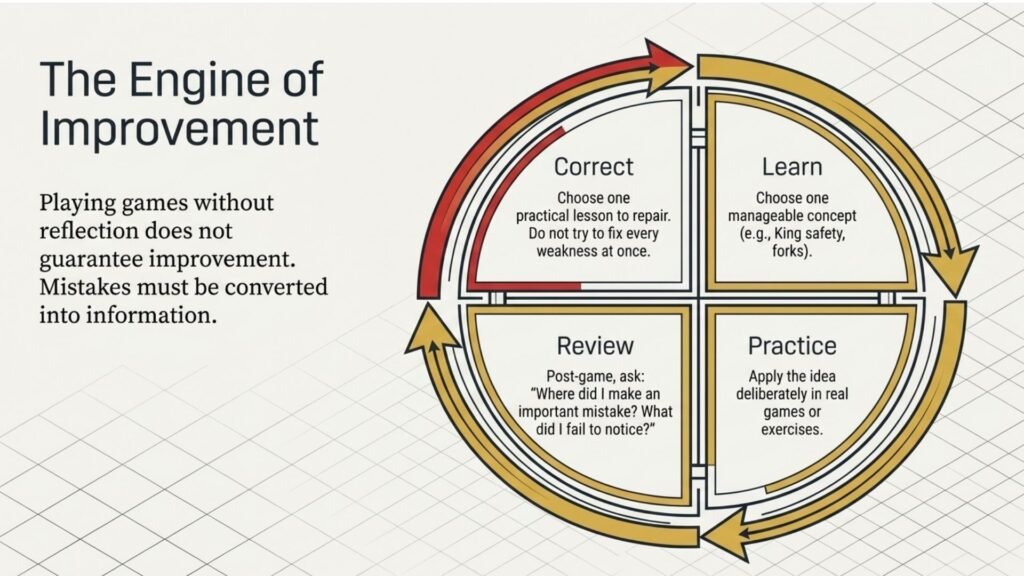
Playing games is important, but playing a large number of games without reflection does not guarantee improvement.
A stronger learning cycle is:
Learn → Practise → Review → Correct → Practise Again
Learn
Choose one manageable concept.
For example:
- king safety
- piece development
- forks
- checkmate patterns
Practise
Use games, exercises or positions where you can apply the idea.
Review
After the game, ask:
- Where did I make a serious mistake?
- What did I fail to notice?
- Which decision was difficult?
- Did I understand my opponent’s threat?
- What would I do differently next time?
Correct
Choose one practical lesson.
Do not try to repair every weakness at once.
Practise Again
Apply the lesson in another game or exercise.
This turns mistakes into information rather than simply treating them as losses.
A Simple Beginner Chess Training Plan
A balanced beginner routine can include several types of practice.
| Training Area | What to Do |
|---|---|
| Chess knowledge | Learn one concept |
| Tactics | Solve appropriate beginner exercises |
| Games | Play thoughtful games |
| Review | Examine important mistakes |
| Endgames | Study a basic position |
| Reflection | Record one useful lesson |
The exact amount of time depends on the learner’s age, experience and schedule.
Consistency matters more than creating a demanding routine that is difficult to maintain.
If you want a more structured practice routine, explore the daily chess training plan.
Common Beginner Mistakes
Trying to Win Material Immediately
A beginner may see a pawn or piece that can be captured and take it without checking the consequences.
Better habit: Before capturing, ask what your opponent can do next.
Moving Too Quickly
Fast moves often happen before the player has noticed an opponent’s threat.
Better habit: Pause after every opponent move and identify what changed.
Moving the Same Piece Repeatedly
A familiar piece can become the focus of too many moves.
Better habit: Look for ways to develop and coordinate your other pieces.
Ignoring the Opponent’s Plan
Beginners sometimes think only about their own attack.
Better habit: Before making your move, identify your opponent’s most important threat.
Memorising Too Many Openings
Opening memorisation can feel productive while important thinking skills remain underdeveloped.
Better habit: Learn principles first and study specific openings gradually.
Playing Without Reviewing
Moving from game to game without reflection makes recurring mistakes difficult to identify.
Better habit: After important games, find one or two decisions worth learning from.
Trying to Improve Everything at Once
A beginner may try to study openings, tactics, strategy, endgames and puzzles all at the same time.
Better habit: Choose one or two priorities and build from them.
A Beginner Chess Learning Roadmap
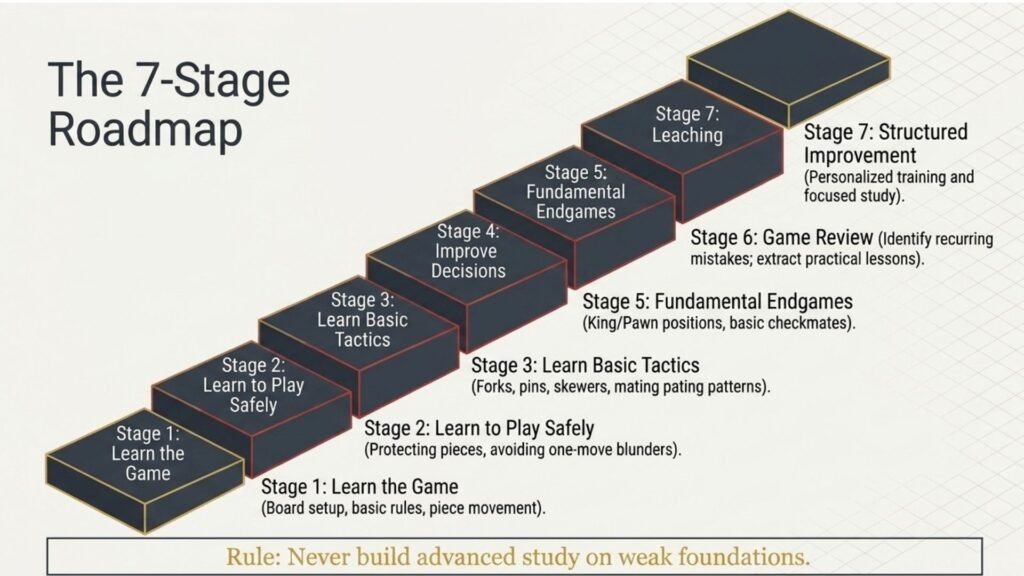
A sensible progression looks like this:
Stage 1: Learn the Game
Understand:
- board setup
- piece movement
- captures
- check
- checkmate
- castling
- promotion
- basic rules
Stage 2: Learn to Play Safely
Focus on:
- protecting pieces
- recognising attacks
- king safety
- basic development
- avoiding simple blunders
Stage 3: Learn Basic Tactics
Study:
- forks
- pins
- skewers
- discovered attacks
- basic mating patterns
Stage 4: Improve Your Decisions
Begin developing an understanding of:
- centre control
- piece activity
- open lines
- improving poorly placed pieces
- basic planning
Stage 5: Learn Fundamental Endgames
Study simple king-and-pawn positions, basic checkmates and other essential endings.
Stage 6: Review Your Games
Play, review, identify recurring mistakes and turn those mistakes into practical lessons.
Stage 7: Build Structured Improvement
Once the foundations are secure, move toward a more personalised training approach.
You do not have to “finish” one stage before touching the next. Chess learning overlaps naturally. The important thing is to avoid building advanced study on weak foundations.
Parent Guidance: Helping a Child Learn Chess
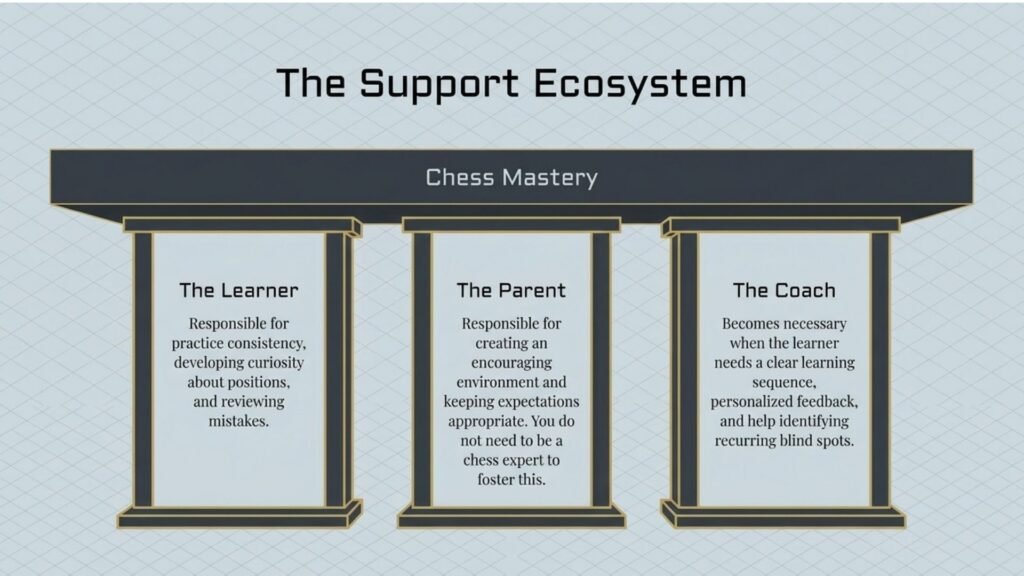
Parents do not need to become chess experts to support a child who is learning.
A more useful role is to create a consistent and encouraging learning environment.
For a child, early progress can involve much more than winning games.
Useful signs include:
- recognising when pieces are attacked
- explaining why a move was made
- noticing simple threats
- thinking before moving
- becoming more comfortable reviewing mistakes
- developing curiosity about positions
- practising consistently
Parents can also help by keeping expectations appropriate.
A child may understand a concept one day and forget it during a game the next. That is a normal part of learning.
The goal is to build understanding and confidence over time, not to turn every game into a test.
For more child-specific guidance, explore chess for kids.
When Is Structured Coaching Useful?
A beginner can learn the rules, practise positions and play games independently.
Structured coaching becomes particularly useful when a learner needs:
- a clear learning sequence
- personalised feedback
- help identifying recurring mistakes
- appropriate exercises
- guidance about what to study next
- consistent accountability
The question is not simply:
Does every beginner need a coach?
A better question is:
What kind of support will help this learner make the next meaningful step?
Independent learning and coaching do not have to be opposites. A learner can study independently while using structured instruction to understand mistakes and organise the next stage of development.
If you are specifically looking for structured online instruction, explore online chess classes for beginners.
A Simple Beginner Thinking Framework
When you are unsure what to do in a position, use this checklist:
1. Safety
Is my king safe?
2. Threats
What is my opponent threatening?
3. Opportunities
Do I have a useful check, capture or threat?
4. Piece Safety
Is any piece attacked or undefended?
5. Decision
Which move improves my position while dealing with my opponent’s ideas?
This framework is deliberately simple.
As your chess improves, you will calculate deeper variations and evaluate positions more accurately. But the basic habit of checking threats and consequences remains useful at every level.
How Long Does It Take to Learn Chess?
There is no single timeline that applies to every learner.
The basic rules can be learned relatively quickly. Developing reliable decision-making takes longer because it depends on practice, experience, feedback and the ability to recognise patterns.
Progress can be influenced by:
- age
- previous experience
- practice consistency
- quality of feedback
- amount of play
- ability to reflect on mistakes
- learning environment
It is more useful to think of chess as a series of learning stages than as something you simply “finish.”
You learn the rules.
Then you learn to play safely.
Then you recognise patterns.
Then you make stronger decisions.
Then you continue refining those decisions.
What Should You Do After Learning the Basics?
Once you are comfortable with the rules and can play complete games, the next step is not to study everything.
Instead, identify what is currently holding you back.
For example:
- If you regularly lose pieces, work on piece safety.
- If you miss tactical opportunities, practise tactics.
- If your games go badly in the opening, study opening principles.
- If you reach winning positions but cannot convert them, study basic endgames.
- If you make good moves but lack a clear plan, study piece activity and simple positional ideas.
- If you cannot identify your weaknesses, review your games or seek structured feedback.
This is a more effective way to progress than simply collecting more chess information.
Key Takeaways
- Learn the rules and piece movement before studying advanced ideas.
- Understand check, checkmate, king safety and piece safety.
- Develop your pieces and give your moves a clear purpose.
- Think about your opponent’s threats before making your move.
- Use checks, captures and threats to identify tactical possibilities.
- Learn opening principles before memorising detailed variations.
- Give endgames a place in your beginner training.
- Review your games instead of simply playing one game after another.
- Focus on one or two improvement priorities at a time.
- Parents can support consistency and confidence without needing to become chess experts.
- Build your chess understanding progressively.
Frequently Asked Questions
Is chess difficult for beginners?
The basic rules are straightforward to learn. The more challenging part is learning how to make good decisions, and that develops gradually through practice, games and review.
What should I learn first in chess?
Start with the board, pieces, basic rules, check and checkmate. Then learn piece safety, development, king safety and simple tactical ideas.
How can I learn chess as a complete beginner?
Learn the rules, practise basic positions, play games, review your mistakes and gradually study tactics, opening principles and endgames.
Should beginners memorise chess openings?
Not extensively. Beginners generally benefit more from understanding development, centre control and king safety before memorising detailed opening variations.
What chess tactics should beginners learn first?
Forks, pins, skewers, discovered attacks and basic checkmate patterns are useful starting points.
How often should a beginner practise chess?
The ideal routine depends on the learner’s age, schedule and experience. Regular, manageable practice is generally more useful than an ambitious routine that is difficult to maintain.
How should a child start learning chess?
A child should begin with the rules and simple practical positions, then gradually develop tactical awareness, thinking habits and confidence through games and appropriate practice.
Can I learn chess without a coach?
Yes. You can learn the rules, solve exercises, play games and study independently. Coaching can become useful when you need personalised feedback or a clearer learning path.
Is online chess suitable for beginners?
Online chess can provide convenient access to games, exercises and learning resources. The quality of improvement depends on how deliberately the learner practises and reviews their games.
What should I do after learning the basics?
Play thoughtful games, review your decisions, identify recurring mistakes and establish a regular practice routine. Then focus your study on the areas that need the most improvement.
Start Your Beginner Chess Journey
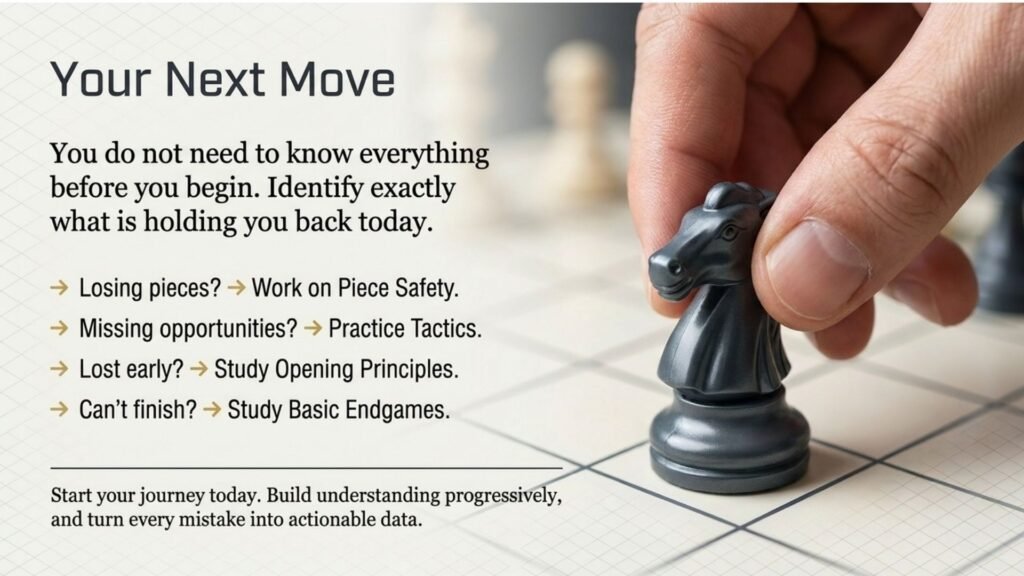
You do not need to know everything before you begin.
Start with the fundamentals, learn one concept at a time, play games, review your decisions and gradually develop stronger thinking habits.
If you want structured guidance alongside your own practice, explore online chess classes for beginners and see how guided learning can fit into your development.
Related Pages
- Online Chess Classes for Beginners — Structured online instruction for new chess learners.
- Beginner Chess Course — A structured pathway for learning the fundamentals.
- Chess Improvement Guide — Guidance for progressing beyond the beginner stage.
- Daily Chess Training Plan — A practical way to organise regular chess practice.
- Chess for Kids — Guidance for children learning chess.